Understanding
Table of Contents
- What Is Zakat? Understanding the Third Pillar of Islam
- How to Calculate Zakat on Modern Assets
- The Al Quran Companion Nisab Reality Check: Gold vs Silver
- Calculating Zakat on Stocks, ISAs, and Pensions
- Who Is Eligible for Zakat? The 8 Quranic Categories Explained
- What Is Zakat al-Fitr and When Must You Pay It?
- Zakat al-Fitr vs Annual Zakat: What Is the Difference?
- How Do You Pay Zakat Accurately in the West?
- Why Learning the Quran Helps You Understand Islamic Finance
- Frequently Asked Questions
Key Takeaways
- Zakat is an annual mandatory wealth tax of 2.5 percent levied on qualifying assets held for a full lunar year.
- Surah At-Tawbah 9:60 strictly limits the distribution of Zakat to eight specific categories of eligible recipients.
- Zakat al-Fitr is a separate, per-person obligation due before the Eid prayer to purify the fasting person.
- Modern assets such as stocks, ISAs, and pension funds are subject to Zakat based on consensus across the four Madhabs.
- Calculating the Nisab threshold requires checking the current market value of either 87.48 grams of gold or 612.36 grams of silver.
What Is Zakat? Understanding the Third Pillar of Islam
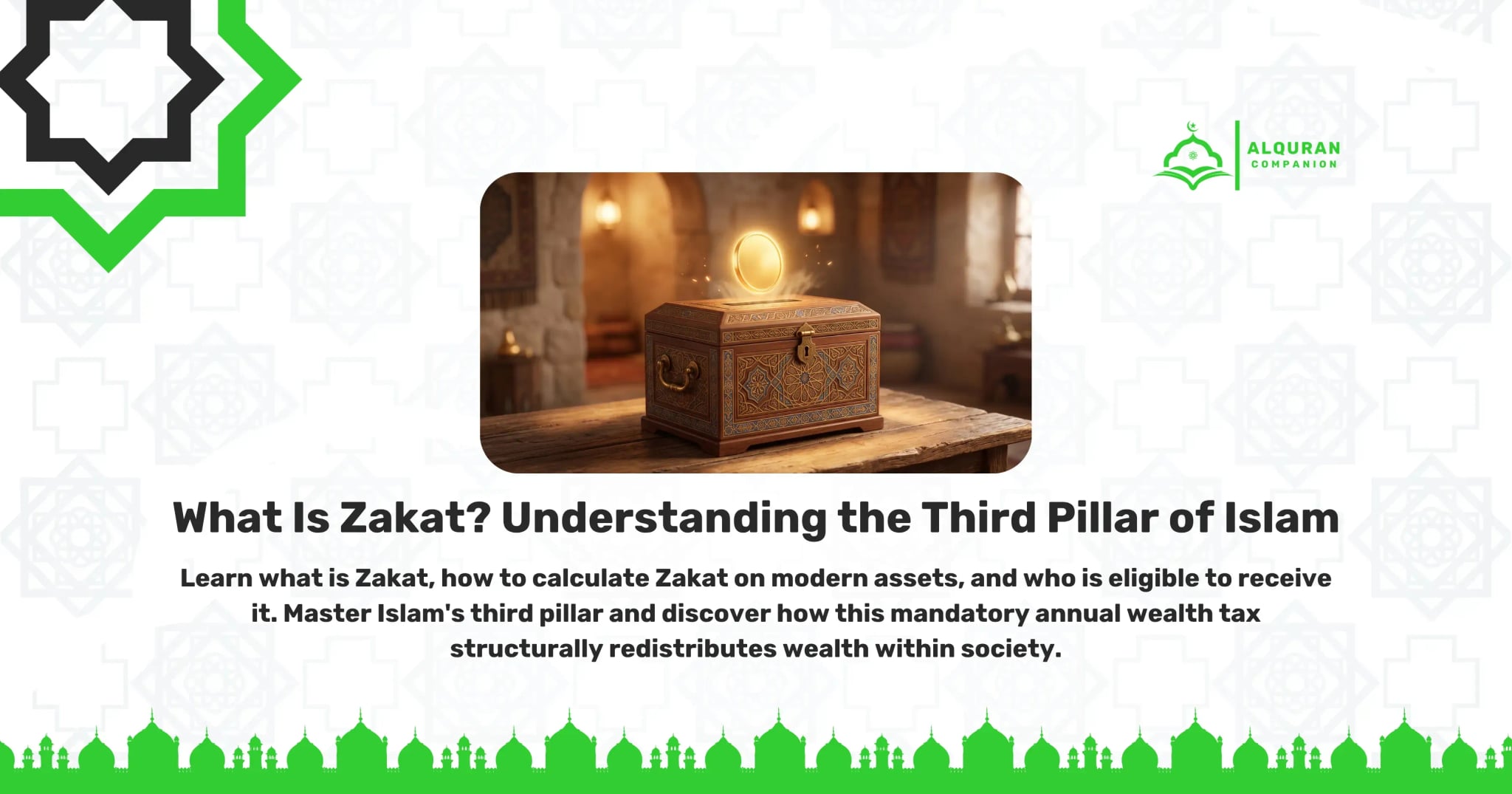
Zakat is a compulsory annual wealth tax in Islam, mandating eligible Muslims to donate 2.5 percent of their qualifying accumulated wealth to specific charitable categories. This obligation purifies personal assets, structurally redistributes wealth within society, and serves as a fundamental pillar of Islamic practice alongside
Linguistically, the Arabic word Zakat translates to 'that which purifies' and 'that which grows'. The theological premise is that wealth inherently belongs to Allah, and humanity merely holds it in trust. By extracting the mandated portion for the poor, a Muslim purifies the remainder of their wealth from greed and spiritual corruption. Furthermore, Islamic economics asserts that hoarding money damages society. Zakat forces capital to circulate, stimulating the economy and protecting the most vulnerable populations from extreme destitution.
According to the consensus across the four established schools of Islamic jurisprudence (Hanafi, Maliki, Shafi'i, and Hanbali), denying the obligation of Zakat takes a person out of the fold of Islam, while neglecting to pay it out of laziness is a major sin. The Prophet Muhammad ﷺ systematically established the collection and distribution of Zakat during his residence in Madinah Munawwarah, cementing it as a state-level institution.
"Islam is built upon five: testifying that there is no true god except Allah and that Muhammad is the Messenger of Allah, performing Salah, paying Zakat, making the Hajj to the House, and fasting in Ramadan."
How to Calculate Zakat on Modern Assets
To correctly understand
The Al Quran Companion Nisab Reality Check: Gold vs Silver
The term Nisab refers to the minimum threshold of wealth a Muslim must possess before Zakat becomes obligatory. Historically, the Prophet Muhammad ﷺ set this threshold at 20 Dinars of gold or 200 Dirhams of silver. In modern metric terms, this equates to 87.48 grams of gold or 612.36 grams of silver.
Here is the critical distinction for modern Muslims: During the time of the Prophet ﷺ, the value of 87.48 grams of gold and 612.36 grams of silver were roughly equal. Today, the silver standard is vastly lower in monetary value than the gold standard. The Hanafi school of jurisprudence strongly advocates using the silver Nisab standard to evaluate cash and business assets. Why? Because using the lower silver threshold means more people qualify to pay Zakat, generating significantly more support for the poor. When utilizing the silver standard, many professionals in the United States, United Kingdom, and Australia will find they easily meet the threshold.
Calculating Zakat on Stocks, ISAs, and Pensions
Modern financial instruments generate widespread confusion. The general scholarly consensus dictates that you must pay 2.5 percent on the total value of your cash savings, gold, and silver. But what about investments?
Consider this: If you buy stocks purely for long-term dividend yield, you only owe Zakat on the dividend income and the cash equivalent of the company's zakatable assets. However, if you purchase stocks with the explicit intention of capital gains (buying low to sell high), the entire market value of the stock portfolio is subject to the 2.5 percent Zakat calculation. For Muslims in the UK holding Cash ISAs or Stocks and Shares ISAs, the entire accessible balance is Zakatable. For Muslims in the US holding 401(k) retirement accounts, Zakat is generally calculated only on the accessible portion (the amount you would receive after early withdrawal penalties and taxes), though some scholars advise paying on the entire amount if you have alternative funds available.
Who Is Eligible for Zakat? The 8 Quranic Categories Explained
Surah At-Tawbah 9:60 explicitly restricts Zakat distribution to eight precise categories. These eligible recipients are Al-Fuqara (the extremely poor), Al-Masakin (the needy), Zakat administrators, those whose hearts are to be reconciled, captives seeking freedom, those burdened by inescapable debt, those striving in the path of Allah, and stranded travelers.
اِنَّمَا الصَّدَقٰتُ لِلۡفُقَرَآءِ وَالۡمَسٰكِيۡنِ وَالۡعٰمِلِيۡنَ عَلَيۡهَا وَالۡمُؤَلَّـفَةِ قُلُوۡبُهُمۡ وَفِى الرِّقَابِ وَالۡغٰرِمِيۡنَ وَفِىۡ سَبِيۡلِ اللّٰهِ وَابۡنِ السَّبِيۡلِؕ فَرِيۡضَةً مِّنَ اللّٰهِؕ وَاللّٰهُ عَلِيۡمٌ حَكِيۡمٌ ﴿٦٠﴾
Zakāh expenditures are only for the poor and for the needy and for those employed for it and for bringing hearts together [for Islām] and for freeing captives [or slaves] and for those in debt and for the cause of Allāh and for the [stranded] traveler - an obligation [imposed] by Allāh. And Allāh is Knowing and Wise.
Understanding exactly
- Al-Fuqara (The Poor):
- Al-Masakin (The Needy):
- Al-Aamileen (The Administrators):
- Mu'allafatul Quloob (Reconciling Hearts):
- Ar-Riqaab (Freeing Captives):
- Al-Gharimeen (Those in Debt):
- Fi Sabeelillah (In the Path of Allah):
- Ibn As-Sabeel (The Stranded Traveler):
What Is Zakat al-Fitr and When Must You Pay It?
Zakat al-Fitr is a mandatory charitable food contribution required from every Muslim before the Eid al-Fitr prayer. This obligation purifies the fasting person from idle talk during Ramadan and provides immediate sustenance to the poor so they can celebrate the festival of Eid alongside the community.
Allah's Messenger (ﷺ) enjoined the payment of one Sa' of dates or one Sa' of barley as Zakat-ul-Fitr on every Muslim slave or free, male or female, young or old, and he ordered that it be paid before the people went out to offer the `Id prayer. (One Sa' = 3 Kilograms approx)
When discussing
Today, scholars from the Hanafi school allow the payment of
Zakat al-Fitr vs Annual Zakat: What Is the Difference?
Zakat al-Maal is an annual wealth tax based on accumulated assets exceeding the Nisab threshold over a lunar year. Conversely, Zakat al-Fitr is a per-person levy due at the end of Ramadan regardless of wealth, specifically intended to purify the fast and feed the needy for Eid.
Understanding the distinction between
Annual Zakat (Al-Maal) vs Zakat al-Fitr
Pros
- Based on accumulated wealth (Gold, Silver, Cash).
- Requires meeting the Nisab threshold.
- Must be held for one full lunar year (Hawl).
- Calculated at exactly 2.5% of total eligible assets.
Cons
- Based on head count, paid per person.
- Mandatory for anyone with enough food for one day and night.
- Due specifically during the month of Ramadan.
- A fixed amount of food (or equivalent cash value) per person.
How Do You Pay Zakat Accurately in the West?
Paying Zakat in Western countries requires Muslims to calculate their Nisab using local currencies and assess modern financial instruments. Families in the United Kingdom, United States, and Australia often utilize local charitable organizations or international relief funds to distribute their wealth strictly to the eight Quranic categories.
Consider the logistics for diaspora families. If you live in Sydney, Toronto, or London, finding individuals who legally classify as Al-Fuqara in your immediate neighborhood can be challenging due to government welfare systems. Therefore, scholars permit transferring Zakat funds to poorer countries where the need is critical. Reputable Islamic charities guarantee a '100% Zakat Policy', meaning they do not deduct administrative fees from your 2.5 percent, fulfilling the obligation perfectly on your behalf.
For parents managing busy schedules, teaching children about Islamic obligations requires structured support. Connecting your charitable actions to your family's educational goals creates lasting impact. For instance, explaining the difference between Sadaqah and Zakat to a child becomes much easier when they already have a strong foundation in Islamic studies.
Why Learning the Quran Helps You Understand Islamic Finance
Studying the Quran comprehensively allows Muslims to understand the divine wisdom behind financial obligations like Zakat and Sadaqah. Authentic Quranic education provides the foundational literacy required to navigate complex financial rulings, ensuring that families maintain Halal income and fulfill their charitable duties according to the Shariah.
At Al Quran Companion, our certified Ijazah-holding instructors guide students through the exact verses and Ahadith that govern Islamic life. When you understand the Arabic roots of the Quran, the profound justice behind Islamic wealth redistribution becomes clear. We understand the specific challenges facing Muslims in the West. That is why we provide flexible, live 1-on-1 video classes tailored to your timezone, whether you are managing an EST schedule in New York or balancing school runs in the UK.
Safety and institutional trust are our highest priorities. At Al Quran Companion, we always conduct comprehensive Background Checks and detailed multi-stage reviews of every single teacher before they are certified to teach our students. We offer highly qualified female Quran tutors for daughters, young children, and adult sisters seeking a comfortable learning environment. For adult learners and reverts, our academy guarantees a 100% private, patient, and zero-judgment environment.
To deepen your understanding of Islamic obligations, consider enrolling in our
Frequently Asked Questions

Al Quran Companion Team
Verified AuthorThe official academic and editorial team at Al Quran Companion, a leading Online Quran Academy dedicated to simplifying Tajweed, Hifz, and Islamic studies for students worldwide.
Read more about author