
What Was Arabia Like Before Prophet Muhammad (ﷺ)?
Before the birth of Prophet Muhammad (ﷺ) in 570 CE, the Arabian Peninsula was trapped in a period of moral collapse, tribal warfare, and spiritual emptiness that Islamic historians call Jahiliyyah — the Age of Ignorance. Arabia had no unified moral code, no concept of universal justice, and no central authority beyond shifting tribal alliances.
The 6th century was brutal. Daughters were sometimes buried alive at birth out of shame or fear of poverty. Women had virtually no legal rights — inherited like property, divorced at whim, and denied any share in family wealth. The poor were crushed under the weight of usury, called Riba in Arabic, where interest rates on loans spiraled until entire families were enslaved to repay debts they could never settle.
And yet, Makkah was a city that attracted thousands. The Kaaba — the cube-shaped structure originally built by Prophet Ibrahim (AS) and his son Ismail (AS) for the worship of the One God — had been corrupted beyond recognition. By the year 570 CE, it housed 360 idols. Pilgrims from across the peninsula flocked to Makkah each year, and the Quraysh tribe, as custodians of the Kaaba, profited enormously from this traffic. The spiritual had become commercial. The sacred had become transactional.
It was into this world — fractured, violent, and spiritually starving — that the last messenger of God was born.
When Was Prophet Muhammad (ﷺ) Born and What Was His Early Life Like?
Prophet Muhammad (ﷺ) was born in Makkah in the year 570 CE, a year called the Year of the Elephant (Am al-Fil) after the failed military campaign by Abraha, the Abyssinian ruler, to destroy the Kaaba. He belonged to the Banu Hashim clan of the Quraysh, the most respected tribe in Arabia, and his lineage traces directly to Prophet Ibrahim (AS) through his son Ismail (AS).
Loss defined his earliest years. His father, Abdullah ibn Abdul Muttalib, died before Muhammad (ﷺ) was even born — some historians say during a trading journey to Syria, others say shortly after. The infant never saw his father's face.
Following the custom of the Quraysh elite, baby Muhammad was given to a Bedouin wet nurse named Halimah as-Sa'diyyah to be raised in the clean desert air and to learn the purest dialect of Arabic. He spent roughly four years with Halimah's family among the Banu Sa'd tribe. According to Ar-Raheeq Al-Makhtum (The Sealed Nectar) by Safi-ur-Rahman Mubarakpuri, Halimah's household experienced unusual blessings during this period — her barren land yielded, and her animals produced abundant milk.
He returned to his mother Aminah at around age five. But their reunion was short-lived. During a journey to Madinah to visit relatives, Aminah fell ill and died in a place called Abwa. He was six years old. An orphan twice over.
His grandfather, Abdul Muttalib — the chief of Makkah and custodian of the Zamzam well — took him in. But Abdul Muttalib was elderly, and he too passed away just two years later, when Muhammad (ﷺ) was eight. The Quran acknowledges this sorrow directly: "Did He not find you an orphan and give [you] refuge?" (Quran, Surah Ad-Duha, 93:6).
Finally, his paternal uncle Abu Talib became his guardian. Though Abu Talib was never wealthy — he had many children of his own to feed — he loved his nephew deeply and would remain his fiercest protector for decades. That bond between an orphaned boy and a kind uncle would prove critical when the entire city turned against Muhammad (ﷺ) years later.
Why Was Prophet Muhammad (ﷺ) Called Al-Amin (The Trustworthy)?
Long before receiving any revelation, the young Muhammad (ﷺ) earned two extraordinary titles from the people of Makkah: Al-Amin (The Trustworthy) and Al-Sadiq (The Truthful). These were not honorary awards. They were earned through decades of consistent, unblemished character in a society that valued tribal honor above everything else.
As a boy, he worked as a shepherd — tending flocks in the rocky outskirts of Makkah. It was humble work, but it taught patience, watchfulness, and solitude. According to Sahih Al-Bukhari, the Prophet (ﷺ) later said: "Allah did not send any Prophet who did not herd sheep." There is something about the loneliness of shepherding that seems to prepare a soul for prophethood.
In his teenage years, he accompanied Abu Talib on a trading caravan to Syria. It was during this journey, as documented by Ibn Hisham in Al-Seerah Al-Nabawiyyah, that a Christian monk named Bahira recognized signs of prophethood in the young boy and warned Abu Talib to protect him carefully.
What set Muhammad (ﷺ) apart in Makkah's rough commercial culture was simple: he never cheated. He never lied about the quality of his goods. He returned deposits entrusted to him — every single dirham. Even the Quraysh elite who would later try to assassinate him acknowledged this. When the Kaaba was being rebuilt after a flood and the tribes nearly went to war over who would have the honor of placing the Black Stone back in its corner, they chose Muhammad (ﷺ) as the arbiter — specifically because he was Al-Amin.
He also joined the Hilf al-Fudul (The League of the Virtuous), a pact formed by young Makkans to defend the weak, the oppressed, and travelers from injustice. Years after becoming Prophet, he still spoke of this alliance with pride. Consider the character of a man so honest that the very people who persecuted him still trusted him with their valuables.
Who Was Khadijah (RA) and How Did She Marry Prophet Muhammad (ﷺ)?
Khadijah bint Khuwaylid (RA) was a wealthy, noble, and highly respected businesswoman in Makkah — one of the most prominent merchants in the entire city. She hired the 25-year-old Muhammad (ﷺ) to lead a trade caravan to Syria, and after witnessing his extraordinary honesty and the unprecedented profits he returned, she proposed marriage to him through an intermediary.
She was approximately 40 years old at the time. A widow. Already the mother of children from previous marriages. But the age difference meant nothing. What followed was one of the most profound partnerships in recorded history.
Khadijah (RA) was not simply his wife — she was his anchor. When the first terrifying revelation came and he rushed home trembling, she did not doubt him for a second. She wrapped him in a cloak and spoke words that still echo across centuries: "By Allah, He will never humiliate you. You keep good relations with your relatives, you bear the burden of the weak, you help the poor, you entertain guests generously, and you assist those who are stricken by calamity." (Sahih Al-Bukhari, Hadith 3)
She became the first person on Earth to accept Islam. The first believer. Before Abu Bakr. Before Ali. Before anyone. She invested her entire wealth into supporting the early Muslim community during the years of persecution. Together they had several children, including their daughters Zaynab, Ruqayyah, Umm Kulthum, and Fatimah (RA).
He remained monogamously married to Khadijah (RA) for 25 years until her death. Even decades later, he would remember her with such intense love that his younger wife Aisha (RA) admitted to feeling jealous of a woman she had never met. At Al Quran Companion, our Quranic Tafsir course explores the revelation context of Surah Ad-Duha — which was sent to comfort the Prophet (ﷺ) during a period of deep personal loss, including the death of Khadijah (RA).
How Did Prophet Muhammad (ﷺ) Receive the First Revelation?
During the month of Ramadan in 610 CE, the Angel Jibril (Gabriel) appeared to Prophet Muhammad (ﷺ) in the Cave of Hira outside Makkah and commanded him to read, revealing the first five verses of Surah Al-Alaq (96:1-5). This moment marked the beginning of 23 years of Quranic revelation and changed the course of human history.
As he approached 40, something shifted inside him. The idolatry of Makkah weighed on him. The injustice — the buried daughters, the crushed poor, the hollow rituals at the corrupted Kaaba — all of it pressed against his conscience like a stone against the chest. He began retreating to the Cave of Hira, a small grotto high on Jabal an-Nour (The Mountain of Light), to meditate in solitude. Sometimes for days at a time. Khadijah would send food up with servants.
Then came the night that split time itself. The Angel Jibril appeared in a form so overwhelming that Muhammad (ﷺ) could barely breathe. The angel seized him in a crushing embrace and commanded: "Iqra!"(Read!). Muhammad (ﷺ), who had never been taught to read or write, replied in terror: "I cannot read." Jibril squeezed him again. And again. On the third time, the first words of divine revelation poured forth:
"Read in the name of your Lord who created — Created man from a clinging substance. Read, and your Lord is the most Generous — Who taught by the pen — Taught man that which he knew not." (Quran, Surah Al-Alaq, 96:1-5)
This moment — the first revelation in the Cave of Hira — is arguably the single most consequential event in human history for over a quarter of the world's population. It was not gentle. It was not serene. It was violent and terrifying. The Prophet (ﷺ) fled down the mountain, his heart hammering, his limbs shaking, crying out to Khadijah: "Cover me! Cover me!"
She calmed him. She reassured him. And then she took him to her elderly cousin, Waraqah bin Nawfal, a Christian scholar who had studied the Hebrew scriptures. When he heard what had happened, Waraqah recognized the angel immediately: "This is the same Namus (Angel of Revelation) whom Allah had sent to Moses."He told the Prophet (ﷺ): "I wish I could be alive when your people drive you out." Muhammad (ﷺ), stunned, asked: "Will they really drive me out?" Waraqah replied: "Anyone who came with something similar to what you have brought was treated with hostility."
Students at Al Quran Companion study the revelation order of each Surah through our Quran Recitation course, connecting the historical context of each revelation to its meaning — exactly as the early companions experienced it.
How Did the Early Muslims Spread Islam in Makkah?
For the first three years after receiving revelation, Prophet Muhammad (ﷺ) spread the message of Islam secretly and privately, inviting only his closest family and trusted friends to accept Tawhid — the oneness of God. The earliest converts gathered in secret at the house of Al-Arqam ibn Abi al-Arqam (Dar al-Arqam) to pray and learn the newly revealed Quran.
The first believers tell you everything about what kind of message this was. It was not a movement of the powerful. It was a movement of the honest, the vulnerable, and the overlooked.
His wife Khadijah (RA) believed first. Then his young cousin Ali ibn Abi Talib (RA), who was perhaps ten years old at the time. Then his freed slave Zayd ibn Harithah (RA) — a man who loved the Prophet (ﷺ) so much that when given the choice to return to his biological father, he chose to stay. And then Abu Bakr as-Siddiq (RA), his closest friend, a wealthy merchant whose immediate and unwavering faith earned him the title "The Truthful."
Abu Bakr (RA) did not just believe himself — he became the first active missionary. He brought some of the most significant figures into Islam during those early secret years: Uthman ibn Affan (RA), Az-Zubayr ibn Al-Awwam (RA), Abdur-Rahman ibn Awf (RA), and Sa'd ibn Abi Waqqas (RA). These men would later become pillars of the Islamic state.
Then, in approximately 613 CE, after three years of private preaching, Allah commanded the Prophet (ﷺ) to go public. He climbed Mount Safa — a small hill near the Kaaba that the Quraysh used for announcements — and called out to the clans of Quraysh by name. He asked them: "If I told you that an army was behind this hill, about to attack, would you believe me?" They said: "Yes, we have never known you to lie."
And there it was — Al-Amin, The Trustworthy, telling his people the truth. But the truth he brought was intolerable to the Quraysh. Tawhid — the absolute oneness of God — meant that the 360 idols in the Kaaba were worthless. It meant the entire pilgrimage economy that enriched the Quraysh was built on a lie. And the egalitarian message that a slave and a chieftain are equal before God? That was a direct assault on the social order.
His own uncle Abu Lahab screamed at him from the crowd: "May you perish!" The Quran immortalized this rejection in Surah Al-Masad (111:1-5). The battle lines were drawn.
What Persecution Did the Early Muslims Face in Makkah?
After the public declaration of Islam, the Quraysh launched a systematic campaign of persecution against the early Muslims in Makkah, targeting the most vulnerable — slaves, women, and the poor — with torture, economic boycotts, and social isolation that lasted over a decade. The Prophet Muhammad (ﷺ) himself was protected by his uncle Abu Talib's tribal status, but his followers suffered immensely.
The Quraysh understood something: they could not simply kill Muhammad (ﷺ) without triggering a blood feud with the entire Banu Hashim clan. So they directed their fury at those who had no tribal protection.
Bilal ibn Rabah (RA), an Abyssinian slave owned by Umayyah ibn Khalaf, was dragged into the scorching desert at midday. A massive boulder was placed on his bare chest while his tormentor demanded that he renounce his faith. Bilal, crushed and burning under the Arabian sun, whispered one word over and over: "Ahad, Ahad" — "One, One," affirming the oneness of God. Abu Bakr (RA) eventually purchased and freed him.
Sumayyah bint Khayyat (RA) and her husband Yasir (RA)were tortured publicly as a warning to others. Sumayyah (RA) was killed by Abu Jahl with a spear — making her the first martyr in the history of Islam. Her son, Ammar ibn Yasir (RA), was also tortured relentlessly. The Prophet (ﷺ) passed by the family during their suffering and could only say: "Patience, family of Yasir, for your promised place is Paradise."
How does a community endure this? What holds a group of believers together when their leaders are being murdered in broad daylight?
When physical torture failed to break them, the Quraysh escalated. They initiated a total economic and social boycott against the entire Banu Hashim clan — not just the Muslims, but anyone who sheltered them. For three agonizing years, the Muslims and their supporters were confined to a barren valley called Shi'b Abi Talib. According to the Seerah, they were reduced to eating leaves and boiled leather to survive starvation. Children cried from hunger. No one was allowed to trade with them, marry into their families, or even speak to them.
The boycott finally ended when several Quraysh leaders, disturbed by the cruelty of the pact, tore up the written agreement. But the damage was done. The physical and emotional toll on the Prophet (ﷺ) and his community was devastating — and the worst loss was still to come.
What Was the Year of Sorrow and What Is Al-Isra wal-Mi'raj?
The Year of Sorrow (Am al-Huzn) refers to approximately 619 CE, when Prophet Muhammad (ﷺ) lost both his beloved wife Khadijah (RA) and his protective uncle Abu Talib within months of each other. This double loss left him grief-stricken and without tribal protection in Makkah. Shortly afterward, Allah granted him the miraculous Night Journey — Al-Isra wal-Mi'raj — as consolation.
Khadijah died first. The woman who had believed in him before anyone else. Who had invested everything she owned into the survival of Islam. Who had wrapped him in a cloak when the first revelation left him trembling. She was around 65 years old.
Abu Talib followed weeks later. Though he never formally accepted Islam — a fact that caused the Prophet (ﷺ) deep sorrow — he had shielded his nephew from assassination for over a decade. Without Abu Talib's tribal protection, the physical attacks on the Prophet (ﷺ) intensified immediately. People threw garbage on him as he prayed. They placed thorns on his path. They were no longer afraid.
Desperate for a new sanctuary, the Prophet (ﷺ) walked to the nearby city of Ta'if — approximately 100 kilometers from Makkah — hoping to find allies. Instead, the leaders of Ta'if mocked him, rejected his message, and ordered the children and slaves of the city to chase him through the streets, pelting him with stones until his sandals filled with blood and he collapsed outside the city walls.
According to Sahih Al-Bukhari and Sahih Muslim, the Angel of the Mountains then appeared and offered to crush Ta'if between two mountains. Think about it: a bloodied, exhausted man, rejected by two cities, given the power to annihilate his tormentors. And he refused. He prayed instead: "O Allah, guide them, for they do not know." He hoped that their children — or their grandchildren — might one day worship Allah.
This act of mercy still moves scholars to tears 1,400 years later.
Then came the gift. In a single miraculous night, Al-Isra wal-Mi'raj occurred. The Prophet (ﷺ) was transported from Makkah to Jerusalem (Al-Isra), where he led all previous Prophets — Ibrahim, Musa, Isa, and others (peace be upon them all) — in prayer at Al-Masjid al-Aqsa. He then ascended through the seven heavens (Al-Mi'raj), meeting each Prophet at a different level, witnessing Paradise and Hellfire, and speaking directly with Allah. It was during this ascension that the five daily prayers (Salah) were ordained — originally fifty, reduced to five through the Prophet Musa's (AS) advice.
Why Did Prophet Muhammad (ﷺ) Migrate from Makkah to Madinah?
Prophet Muhammad (ﷺ) migrated from Makkah to Madinah in 622 CE because the Quraysh escalated from persecution to a coordinated assassination plot — agreeing to murder him in his bed using one representative from each tribe so that no single clan could be blamed. The Hijrah to Madinah gave the Muslims a safe homeland, and this migration marks Year 1 of the Islamic Hijri calendar.
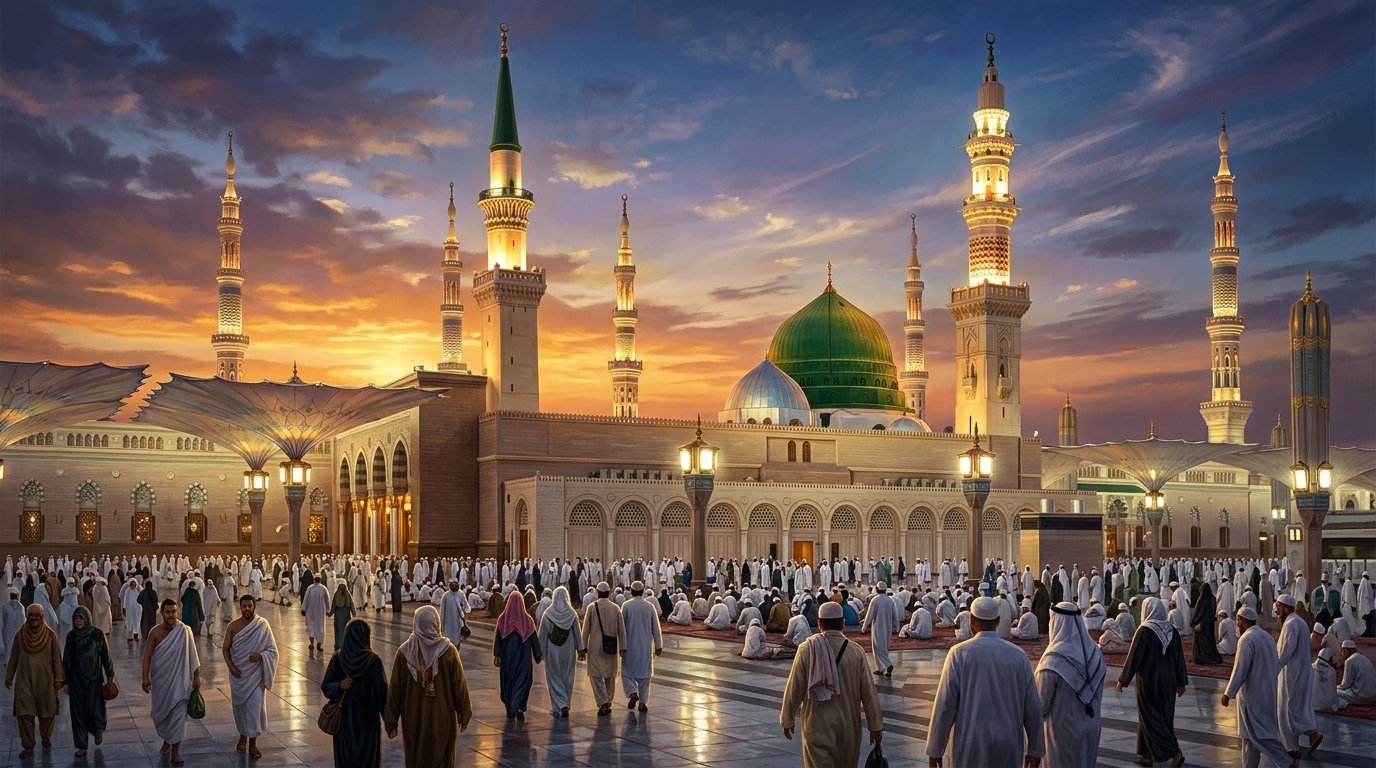
The sands of Makkah had become suffocating. A city 450 kilometers to the north would change everything.
During the annual pilgrimage season, a group of men from Yathrib (later renamed Madinah) had secretly met the Prophet (ﷺ) and embraced Islam. They pledged to protect him if he relocated there. These were the Pledges of Aqabah — first a group of twelve, then seventy-three men and two women. Yathrib was a city torn by decades of tribal warfare between the Aws and Khazraj tribes, and they saw in Muhammad (ﷺ) a peacemaker who could unite them.
The Quraysh learned of these contacts and decided that Muhammad (ﷺ) could not be allowed to leave Makkah alive. They convened an emergency meeting at Dar an-Nadwa and agreed on an assassination plan: one young warrior from each Quraysh clan would strike simultaneously, spreading the blood-guilt so thinly that the Banu Hashim could never avenge it.
But Allah informed the Prophet (ﷺ) of the plot through revelation. On the appointed night, the Prophet (ﷺ) asked his cousin Ali ibn Abi Talib (RA) to sleep in his bed as a decoy. Ali (RA), then a young man of perhaps twenty, agreed without hesitation — knowing that assassins would surround the house. The Prophet (ﷺ) walked out past the sleeping attackers, reciting Surah Ya-Sin, and they did not see him.
He met Abu Bakr (RA) at a pre-arranged spot, and together they fled south — not north toward Madinah — to throw off pursuers. They hid in the Cave of Thawr for three days while Quraysh search parties scoured the desert. According to the Seerah, a spider had spun a web across the cave entrance and a bird had nested there, convincing the trackers that no one could have recently entered. Abu Bakr (RA), terrified that they would be discovered, whispered: "If they look down, they will see us." The Prophet (ﷺ) replied calmly: "What do you think of two when Allah is their third?" (Quran, Surah At-Tawbah, 9:40).
After three days, they hired a Bedouin guide and made the arduous journey north. When they finally arrived at the outskirts of Madinah, the people of the city poured out to greet them — singing, rejoicing, and chanting: "The full moon has risen upon us."
Study the Seerah in Deep Detail
Connect each historical event to specific Quranic verses with our certified scholars in live 1-on-1 sessions.
How Did Prophet Muhammad (ﷺ) Build the First Islamic State in Madinah?
Upon arriving in Madinah in 622 CE, Prophet Muhammad (ﷺ) transformed from a persecuted preacher into a head of state. He built Al-Masjid an-Nabawi (the Prophet's Mosque), established a revolutionary bond of brotherhood called Mu'akhah between the Makkan emigrants (Muhajirun) and the Madinan helpers (Ansar), and drafted the Constitution of Madinah — a pluralistic treaty guaranteeing freedom of religion for all citizens including the Jewish tribes.
His first act was to build a mosque. Not a palace. Not a fortress. A mosque — a place of prayer, education, and community gathering. He laid the foundation stones of Al-Masjid an-Nabawi with his own hands, alongside his companions. It was simple: palm tree trunks for pillars, packed earth for the floor, and a canopy of palm leaves for shade. Yet this modest structure became the administrative capital of an emerging civilization.
Then came a social innovation that had no precedent in Arabian history. The Mu'akhah(Bond of Brotherhood) paired each Makkan emigrant — who had arrived in Madinah penniless, having left everything behind — with a Madinan host family. The Ansar did not just offer a spare room. They offered to split their wealth, their property, even their businesses in half. Abdur-Rahman ibn Awf (RA), a wealthy Makkan merchant who arrived in Madinah with nothing, was paired with Sa'd ibn ar-Rabi (RA), who offered to divide his wealth and even suggested divorcing one of his wives so Abdur-Rahman could marry her. Abdur-Rahman politely declined, asking only to be shown the way to the marketplace, where he quickly rebuilt his fortune.
The Constitution of Madinah (Sahifat al-Madinah) was remarkable for its time. It declared Muslims and Jews of Madinah as one political community (Ummah), with each group retaining its own religious law. It guaranteed mutual defense against external aggression, banned giving shelter to enemies, and established that disputes would be brought to Muhammad (ﷺ) for arbitration.
But the Quraysh in Makkah were not content to let the Muslims build their new state in peace. They confiscated the homes and wealth of the emigrants, and launched military campaigns to crush the young community.
- The Battle of Badr (624 CE): Three hundred and thirteen poorly equipped Muslims faced a heavily armed Makkan force of approximately 1,000. Against every worldly calculation, the Muslims won. The Quran describes it: "And already had Allah given you victory at Badr while you were few in number" (Quran, Surah Aal-Imran, 3:123). This was the first military engagement, and it sent shockwaves across Arabia.
- The Battle of Uhud (625 CE): The Quraysh returned with 3,000 men. The Muslims were winning until a group of archers abandoned their position on a hill, disobeying the Prophet's explicit orders. The tide turned. Hamza ibn Abdul Muttalib (RA), the Prophet's beloved uncle, was killed and his body mutilated. The Prophet (ﷺ) himself was wounded — struck in the face, his helmet rings driven into his cheek, a front tooth broken. Uhud was a painful lesson about discipline and obedience.
- The Battle of the Trench (Khandaq, 627 CE): A confederation of 10,000 pagans — Quraysh, Ghatafan, and allied tribes — marched on Madinah to destroy the Muslims once and for all. On the suggestion of Salman al-Farsi (RA), a Persian companion, the Muslims dug a massive trench around the exposed northern side of the city. The strategy was unprecedented in Arabian warfare. The confederates, unable to cross the trench, laid siege for nearly a month before harsh winds and internal dissent forced their withdrawal. The Quran records: "O you who have believed, remember the favor of Allah upon you when armies came to you and We sent upon them a wind and armies you did not see" (Quran, Surah Al-Ahzab, 33:9).
What Was the Treaty of Hudaybiyyah and Why Was It Important?
The Treaty of Hudaybiyyah was a 10-year peace agreement negotiated in 628 CE between Prophet Muhammad (ﷺ) and the Quraysh of Makkah. Though its terms initially seemed humiliating to the Muslims — including not being allowed to perform Umrah that year — the Quran declared it a "Manifest Victory" (Fath al-Mubin) because the resulting peace allowed Islam to spread rapidly across Arabia through peaceful preaching.
In 628 CE, the Prophet (ﷺ) and approximately 1,400 companions marched toward Makkah unarmed, wearing pilgrimage garments, intending only to perform the minor pilgrimage (Umrah). They brought sacrificial animals with them — a clear signal that this was a religious journey, not an invasion.
The Quraysh blocked them at a place called Hudaybiyyah, on the outskirts of Makkah. Negotiations began. The Prophet (ﷺ) sent Uthman ibn Affan (RA) as an envoy into Makkah. When a rumor spread that Uthman had been killed, the companions gathered under a tree and pledged to fight to the death — this is the famous Pledge of Ridwan, mentioned in the Quran: "Allah was pleased with the believers when they pledged allegiance to you under the tree" (Quran, Surah Al-Fath, 48:18).
Uthman was alive, and a treaty was eventually reached. Its terms were harsh on paper: the Muslims would return home without performing Umrah that year, any Quraysh member who fled to Madinah without permission would be returned, but any Muslim who fled to Makkah would not be returned. Umar ibn al-Khattab (RA), frustrated, asked the Prophet (ﷺ) why they should accept such terms.
But the Prophet (ﷺ) saw what others could not. Peace was the real victory. During the two years of the truce, more people entered Islam than in all the previous years combined. The Prophet (ﷺ) used this period to send diplomatic letters to the rulers of the Byzantine Empire (Heraclius), the Persian Empire (Chosroes), the Negus of Abyssinia, and others — inviting them to Islam.
How Did Prophet Muhammad (ﷺ) Conquer Makkah Peacefully?
In 630 CE, Prophet Muhammad (ﷺ) marched on Makkah with an army of 10,000 men after the Quraysh broke the Treaty of Hudaybiyyah by supporting an attack on a Muslim-allied tribe. The Quraysh, realizing they were completely outmatched, surrendered without resistance. The Prophet (ﷺ) entered the city, declared a general amnesty, and destroyed the 360 idols inside the Kaaba.
The treaty was supposed to last ten years. It lasted barely two. When the Banu Bakr — a Quraysh-allied tribe — attacked the Banu Khuza'ah, who were allied with the Muslims, and the Quraysh provided weapons and fighters, the treaty was shattered.
The Prophet (ﷺ) marched. Ten thousand companions — the largest Muslim force ever assembled — moved toward Makkah. The Quraysh leader Abu Sufyan, sent out to spy on the approaching army, witnessed the vast encampment of campfires stretching across the desert floor and realized resistance was futile.
Makkah fell without a single battle. And then came a moment that separates Prophet Muhammad (ﷺ) from virtually every conqueror in human history.
He stood at the door of the Kaaba and addressed the people who had tortured his followers, killed his family, starved his community for three years, and driven him from his home. He asked them: "What do you think I will do with you?" They replied: "You are a noble brother, son of a noble brother." He declared: "Go, for you are all free."
No executions. No revenge. No mass confiscations. He then entered the Kaaba and destroyed the 360 idols with his own hands, reciting: "Truth has come, and falsehood has departed. Indeed is falsehood, [by nature], ever bound to depart" (Quran, Surah Al-Isra, 17:81). The Kaaba was restored to its original purpose: the worship of the One God.
What Did Prophet Muhammad (ﷺ) Say in His Farewell Sermon?
In the 10th year of Hijrah (632 CE), Prophet Muhammad (ﷺ) performed his first and only Hajj, known as the Farewell Pilgrimage. Standing on Mount Arafat before over 100,000 Muslims, he delivered the Farewell Sermon — a universal charter of human rights that abolished blood feuds, prohibited usury (Riba), commanded kindness toward women, and declared racial equality.
Think about it: a 63-year-old man who started with zero followers had united an entire peninsula. And on this day, standing on Mount Arafat with the Arabian sun beating down, he knew he was speaking to his community for the last time.
He abolished all outstanding blood feuds. He cancelled all interest-based debts. He commanded men to treat women with kindness and respect, declaring: "Fear Allah regarding women, for you have taken them under the trust of Allah."
And then he delivered what may be the most powerful single sentence ever spoken about racial equality, fourteen centuries before the modern civil rights movement:
"An Arab has no superiority over a non-Arab, nor a non-Arab has any superiority over an Arab; also a white has no superiority over black, nor a black has any superiority over white — except by piety and good action."
He asked the crowd: "Have I conveyed the message?" They roared: "Yes!" He raised his finger toward the sky and said: "O Allah, bear witness."
And then, at that exact moment, the final verse of the Quran regarding legislation descended upon him:
"This day I have perfected for you your religion and completed My favor upon you and have approved for you Islam as religion." (Quran, Surah Al-Ma'idah, 5:3)
When Abu Bakr (RA) heard this verse, he wept. He understood what it meant. If the religion was now "perfected," then the one who brought it would soon depart.
When Did Prophet Muhammad (ﷺ) Pass Away?
Prophet Muhammad (ﷺ) passed away on the 12th of Rabi al-Awwal, 11 AH (June 8, 632 CE), at the age of 63, in the city of Madinah. He spent his final days in the room of his wife Aisha (RA), and his last words were "O Allah, [with] the highest companions." He was buried in the same room where he passed away, beneath what is now part of Al-Masjid an-Nabawi.
A few months after returning from the Farewell Pilgrimage, the Prophet (ﷺ) fell severely ill with a high fever. He spent his final days in the room of his beloved wife, Aisha (RA). Though too weak to lead the prayers, he lifted the curtain separating her room from the mosque, saw the congregation praying behind Abu Bakr, and smiled.
On the morning of his death, the Prophet (ﷺ) dipped his hand in a vessel of water and wiped his face, whispering: "There is no god but Allah. Death indeed has its agonies." He then looked upward and said: "O Allah, with the highest companions." His hand fell. He was gone.
The news shattered the Muslim community. Umar ibn al-Khattab (RA), in a state of shock and denial, drew his sword and threatened anyone who said the Prophet was dead. It was Abu Bakr (RA) who steadied the Ummah. He entered the room, kissed the Prophet's forehead, and then walked out to the crowd. His words that day remain among the most powerful declarations of Islamic theology:
"Whoever worshipped Muhammad, then Muhammad is dead. But whoever worships Allah, then Allah is alive and will never die."
He then recited: "Muhammad is not but a messenger. [Other] messengers have passed on before him. So if he was to die or be killed, would you turn back on your heels?" (Quran, Surah Aal-Imran, 3:144). The crowd fell silent. Reality settled. The mission continued.
What Was the Character and Daily Life of Prophet Muhammad (ﷺ)?
Prophet Muhammad (ﷺ) was described by his companions as a man of extraordinary humility, gentleness, and mercy. He milked his own sheep, mended his own shoes, swept his home, and sat with the poorest members of society. His wife Aisha (RA) summarized his entire character in one sentence: "His character was the Quran." His way of life — the Sunnah — remains the daily guide for over 2 billion Muslims worldwide.
His companions — who saw him every day for years — have left us detailed descriptions known as the Shamail. He had a radiant face, a medium build, and carried himself with a quiet authority that did not need to raise its voice. He walked with purpose, leaning slightly forward. His smile was frequent and warm.
But what astounded people was the gap between his authority and his lifestyle. He was the leader of an entire civilization, yet he lived in a small room attached to his mosque. His bed was a leather mat stuffed with palm fibers. He would go weeks eating nothing but dates and water. Umar ibn al-Khattab (RA) once entered his room and wept when he saw the marks of the rough mat on his back, saying: "The Persian and Roman emperors live in luxury, yet you, the Messenger of Allah, live like this?" The Prophet (ﷺ) calmly replied: "Are you not satisfied that for them is the world, and for us is the Hereafter?" (Sahih Al-Bukhari)
He never hit a servant, a child, or a woman. He stood when his daughter Fatimah (RA) entered the room. He raced his wife Aisha (RA) on foot in the desert — she won the first race, and he won a later one, joking: "This one is for that one." He loved children and would lengthen his prostration in prayer because his grandson Hasan (RA) had climbed onto his back.
Over thousands of student assessments across the UK, USA, and Australia, the academic faculty at Al Quran Companion has found that students who study the Seerah of the Prophet (ﷺ) alongside their Quran Memorization develop a deeper emotional connection to the verses they memorize — because they understand the living context in which each Surah was revealed.
Today, over 2 billion Muslims structure their daily lives around his Sunnah. From prayer to fasting, from business ethics to family life, his example remains the living interpretation of the Holy Quran. As Allah declared: "And We have not sent you, [O Muhammad], except as a mercy to the worlds" (Quran, Surah Al-Anbiya, 21:107).