
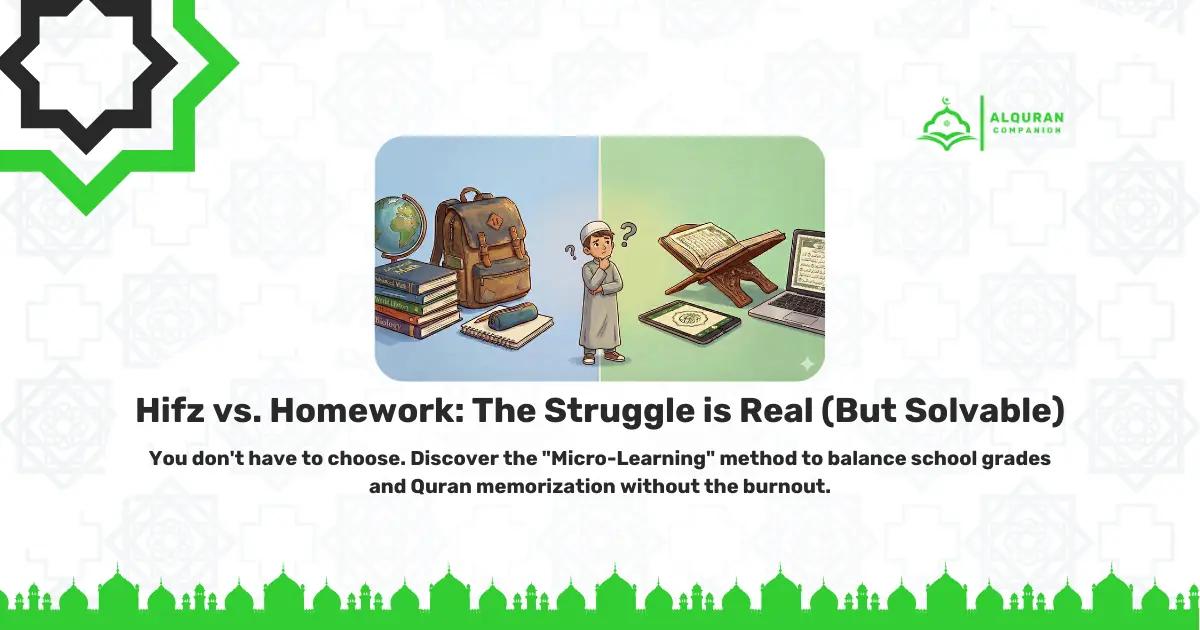
Balancing Hifz & Homework: How to Help Your Child Memorize Quran Without Burnout
Is it possible to raise a Hafiz who also excels in their GCSEs or SATs? Yes. But it requires abandoning the "2-hour marathon" approach and embracing "Micro-Learning"—short, consistent bursts that fit into a modern student's busy life.
"Sheikh, he is just too tired."
I hear this often from parents in London, New York, and Sydney. Their children leave for school at 7:30 AM and return at 4:00 PM. They have soccer practice, math tutors, and piles of homework. Adding a rigorous Hifz for school students program on top feels like asking them to climb Mount Everest without oxygen.
We fear that if we push them too hard, they will burn out. If we don't push them, they will lose their connection to the Quran.
The good news? You do not have to choose between Harvard and Heaven. You just need a smarter schedule.
The Myth: "More Hours = More Hifz"
In many traditional cultures, we equate "struggle" with "success." We think that unless a child sits on a mat for 2 hours straight, they aren't learning.
Science—and experience—tells us otherwise. A tired brain is a leaky bucket. If your child is sitting in a 2-hour class after a long school day, staring blankly at the page, they are not memorizing; they are enduring.
The Solution: Micro-Learning (The 30-Minute Power Session)
At Al Quran Companion, we have restructured the Hifz journey for the Western student. We utilize a method called Micro-Learning.
Instead of a grueling marathon, we focus on 30-minute High-Intensity Sessions.
- Why it works: 30 minutes is short enough to maintain 100% focus but long enough to complete a "Hifz Cycle" (New Lesson + Review).
- The Psychological Win: A child coming home from school dreads a "class." But if they know it is only 30 minutes, it feels manageable. It is a "break" rather than a burden.
The "Neuro-Link": Why Hifz Actually Helps With Homework
Parents often view Quran and School as competitors fighting for the child’s brain space. In reality, they are partners.
Research shows that memorization strengthens the hippocampus—the part of the brain responsible for memory and learning.
- Discipline: The habit of sitting daily for Quran translates to better study habits for math and science.
- Memory Capacity: Hifz students often find memorizing biology terms or history dates easier because their "memory muscle" is already trained.
So, when you are balancing Quran and school, remember: you are not taking time away from their studies; you are sharpening the tool (their brain) they use for their studies.
A Realistic Schedule for the UK/USA Student
How does this look in practice? Here is a sample schedule for a 12-year-old student that prioritizes mental health and online Quran classes for busy kids.
| Time | Activity | The Strategy |
|---|---|---|
| 4:00 PM | Home & Decompress | No screens. Just food, water, and rest. The brain needs to reset. |
| 4:30 PM | The "Micro" Hifz Session | 30 Minutes with Al Quran Companion. Quick, focused, done. |
| 5:00 PM | Homework Block 1 | The brain is now "warmed up" from Hifz. Transition to Math/English. |
| 6:30 PM | Dinner & Family | Social time is crucial for preventing burnout. |
| 7:30 PM | Light Review (Optional) | 10 minutes of listening to tomorrow's lesson (Audio only) while relaxing. |
4:00 PM
4:30 PM
5:00 PM
6:30 PM
7:30 PM
4 Tips to Prevent Hifz Burnout
- Use "Gap Time" for Revision: Don't make them sit at a desk to revise old Juz. Play the audio in the car on the way to school. This is "passive revision" that costs zero mental energy.
- Flexible Weekends: Don't cram 5 hours of Hifz on Saturday to "make up" for the week. That kills the weekend joy. Instead, keep the 30-minute rhythm or give them Friday off completely.
- The "Quality Over Quantity" Rule: If it is exam week, tell the teacher. At Al Quran Companion, our teachers are trained to pivot. During finals week, we might stop new memorization entirely and switch to only revision. This keeps the habit alive without adding pressure.
- Celebrate Small Wins: Did they finish Surah Yasin? Celebrate it like they got an 'A' in Math. Show them that this achievement matters just as much to you.
Why Online is Better for Busy Families
The travel time to a local mosque (30 mins there, 30 mins back) is one hour of wasted time. For a busy family, that hour is gold. Online Quran classes reclaim that time. Your child logs in, learns, and logs out. That saved hour can be used for homework, sleep, or play—all of which reduce burnout.
Conclusion: It’s About Consistency, Not Speed
My dear parents, do not panic if your child is memorizing slowly. The tortoise beat the hare for a reason.
By using Al Quran Companion’s flexible, 30-minute sessions, you allow your child to carry the Quran in their heart without feeling the weight of the world on their shoulders.
Give your child the gift of balance. Book a flexible, 30-minute Free Trial with Al Quran Companion today.
FAQs

Sheikh Abdullah Al-Hanif
Verified AuthorSheikh Abdullah Al-Hanif is the Head of Education at Al Quran Companion. With over 15 years of experience in Tajweed and Hifz, he specializes in bridging the gap between classical Islamic tradition and modern digital pedagogy. He is passionate about making the Quran accessible to everyone—from energetic toddlers to busy professionals.
Read more about author