What is the Best Age to Start Noorani Qaida? (It’s Earlier Than You Think)
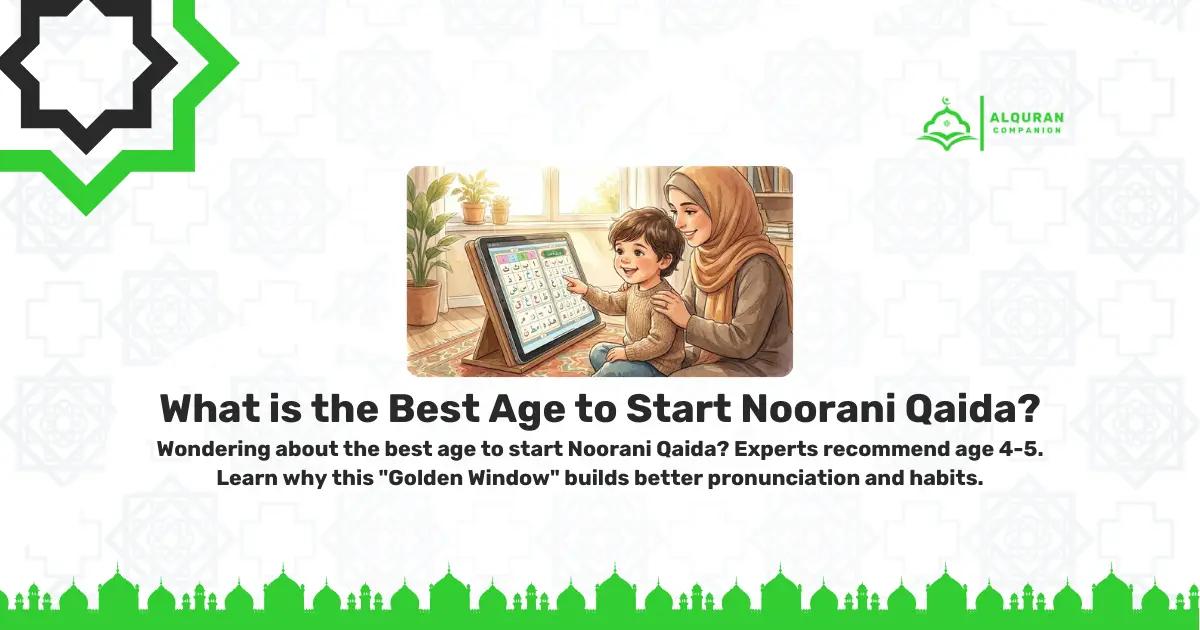
The best age to start Noorani Qaida is between 4 and 5 years old. At this stage, a child’s linguistic faculties are rapidly developing, making it the "Golden Window" for acquiring correct Arabic phonetics (Makharij). Starting early builds a spiritual connection and ingrained pronunciation habits before other languages dominate their palate.
The Blessed Foundation: Why Early is Better
In the Name of Allah, the Most Gracious, the Most Merciful.
As parents, we often gaze at our children—these small, trusting emanah (trusts) from Allah (SWT)—and wonder when to plant the seeds of faith. We worry: Is he too young? Will she get bored? Is it too much pressure?
Let me assure you, my dear brothers and sisters, the heart of a child is like fertile soil; whatever you plant in it will grow.
The great Imam Al-Shafi’i (may Allah have mercy on him) memorized the entire Qur’an by the age of seven. While we do not expect every child to be an Imam Shafi’i, his story teaches us that the capacity of a young mind is vast—far vaster than we often give credit for.
The Noorani Qaida is not just a book of letters; it is the key that unlocks the door to the Words of Allah.
5 Scientific & Spiritual Reasons to Start at Age 4
Why do we specifically recommend the ages of 4 to 5? It is not an arbitrary number. It is the intersection of developmental readiness and spiritual purity.
1. The Linguistic "Sponge" Phase
Science tells us that children are "universal listeners" until about the age of 10 months, but their ability to mimic new sounds remains at its peak until age 6 or 7.
- The Reality: The Arabic letters ’Ayn (ع), Haa (ح), and Daad (ض) utilize throat and tongue muscles that English does not use.
- The Benefit: If a child starts Noorani Qaida at 4, these sounds become second nature. If they wait until 10, it requires significant remedial effort to fix the accent.
2. Building Discipline without Drudgery
At 4 years old, children thrive on routine. Introducing a 20-minute Noorani Qaida session establishes a lifelong habit. It teaches them that the Qur’an is a daily priority, not an afterthought.
3. Pure Hearts, Sharp Memories
The Prophet Muhammad (ﷺ) said:
"Every child is born on the Fitrah (natural disposition)..." (Sahih al-Bukhari) A child at this age has a heart unclouded by the distractions of the world—social media, peer pressure, or complex anxieties. This purity allows the Light of the Qur’an to enter easily.
Signs Your Child is Ready for Noorani Qaida
Every child is unique. While 4 is the recommended age, look for these signs in your toddler:
- Attention Span: Can they sit and focus on a toy or activity for 10–15 minutes?
- Verbal Skills: Are they speaking in sentences in their native language?
- Curiosity: Do they mimic you when you pray or recite?
- Recognition: Can they identify shapes or colors? (If they can distinguish a square from a circle, they can distinguish Ba from Ta).
If you see these signs, do not wait.
The Modern Challenge: "Will My Child Get Bored?"
This is the most common question I receive from parents. "Sheikh, my son can’t sit still!"
In the past, learning the Qaida meant sitting on a floor mat, rocking back and forth, reciting in a monotone voice while a teacher held a stick. Alhamdulillah, those days are behind us.
To teach a 4-year-old effectively, we must speak their language: Engagement.
The Solution: Interactive Screens & Gamified Learning
At Al Quran Companion, we understand that a 21st-century child learns differently. We have replaced the "fear" of the old days with the "fun" of today.
- Visual Engagement: Our specialized tutors use Interactive Screens where letters light up, colors change, and children can "touch" and draw on the screen.
- Joyful Reinforcement: We celebrate small wins. When a child correctly pronounces Jeem, it is a victory.
- Short, Focused Sessions: We do not force a toddler to sit for an hour. Our sessions are optimized for young attention spans, ensuring they leave the class wanting more, not feeling exhausted.
Safety First: The Digital Guardian
I know that inviting a stranger into your home—even virtually—is a heavy decision. You worry about who is speaking to your child.
This is why Al Quran Companion introduced the Digital Guardian. Unlike other platforms where a teacher and student are alone in a private room, we employ a dedicated Quality Assurance Officer. This "Guardian" monitors attendance, chat behavior, and lesson progress.
- You are never leaving your child alone with a stranger.
- There is accountability in every minute of the lesson.
- We ensure the environment remains respectful, Islamic, and safe.
A Roadmap for the First Year: Your Child’s Milestones
If you enroll your 4-year-old today, here is a step-by-step look at their potential progress over the next 12 months:
- Months 1–2: Alphabet Recognition
- Goal: Your child will learn to identify and name all singular letters, from Alif to Yaa, building visual familiarity.
- Months 3–4: Makhaarij (Points of Articulation)
- Goal: We focus on the "mechanics" of the mouth, teaching them to correctly pronounce and distinguish between heavy and light letters.
- Months 5–6: Connecting Letters
- Goal: The letters come together. Your child will learn how shapes change when joined, reading combinations like Ba-Ta-Tha.
- Months 7–9: Vowels (Harakat)
- Goal: Introduction to the "accents" of Arabic—Fatha, Kasra, and Damma—which allows them to produce distinct sounds.
- Months 10–12: Reading Words
- Goal: Putting it all together. By the end of the year, your child will be reading simple words directly from the Qur'an fluently.
Conclusion: The Best Gift You Can Give
The Prophet (ﷺ) said:
The best among you (Muslims) are those who learn the Qur'an and teach it.
Narrated by: Uthman
By starting your child on Noorani Qaida at age 4 or 5, you are not just teaching them to read; you are giving them the tools to speak to their Creator. You are arming them with a light that will guide them through the darkness of this life.
Do not let the fear of "too young" stop you. The capacity is there. The technology is here. The support is ready.
Ready to try this method? Book your Free Trial with Al Quran Companion today.
FAQs

Sheikh Abdullah Al-Hanif
Verified AuthorSheikh Abdullah Al-Hanif is the Head of Education at Al Quran Companion. With over 15 years of experience in Tajweed and Hifz, he specializes in bridging the gap between classical Islamic tradition and modern digital pedagogy. He is passionate about making the Quran accessible to everyone—from energetic toddlers to busy professionals.
Read more about author