Online Quran Classes vs Local Madrasah: The 2026 Parent Verdict
Online Quran classes vs local madrasah is a safety and attention comparison for UK parents. Online classes provide verified 1-on-1 tutors, recorded lessons, and no winter commute. Local madrasahs offer community and routine, yet often teach 20+ children per class. UK parents should weigh commute, DBS checks, ratio, oversight, and Tajweed feedback.
What You Will Learn
- Online Quran Classes vs Local Madrasah: The 2026 Parent Verdict
- The 5-Factor Madrasah vs. Online Safety and Quality Matrix
- Why British Muslim Parents Are Moving Away from Evening Madrasahs
- Verse 6: Protect Your Families from the Fire (66:6)
- Book Your Child's Free 1-on-1 Safety Diagnostic Class
- How to Transition Your Child from a Mosque Madrasah to Online Learning
- What Should UK Parents Look for in a Safe Online Quran Academy?
- How Do Online Quran Classes Fit Around British School Terms and Winter?
- Final Verdict: Safety and Progress for Your Child
- Frequently Asked Questions About UK Quran Classes
Key Takeaways
- Online Quran classes give children private 1-on-1 attention, unlike crowded UK madrasah classes.
- Enhanced DBS checks and recorded lessons help UK parents verify safety.
- Dark winter commutes in London, Birmingham, and Bradford add stress to evening madrasah runs.
- Female Quran teachers are available online for daughters and adult sisters.
- A free diagnostic trial lets parents test safety and teaching quality before paying.
This guide is for British Muslim parents in London, Birmingham, Manchester, and Bradford who balance work, school pickup, and Quran education. The school year brings early dark evenings, packed homework schedules, and tired children. Many families still search for quran classes near me, then discover long waiting lists or classes that end after 7 PM. The decision is not about rejecting the mosque. It is about finding the safest daily learning setup for your child. For a deeper look at child-focused options, read our online Quran classes for kids UK evaluation.
The 5-Factor Madrasah vs. Online Safety and Quality Matrix
The 5-Factor Madrasah vs. Online Safety and Quality Matrix evaluates commute and weather impact, tutor verification and DBS standards, student-to-teacher ratio, parental oversight, and personalized Tajweed correction. UK parents can use this matrix to compare a local mosque madrasah with a structured online Quran academy before enrolling a child.
The 5-Factor Madrasah vs. Online Safety and Quality Matrix
| Criterion | Local UK Madrasah | Al Quran Companion Online |
|---|---|---|
| Commute and Weather | Dark 4 PM winter drive | No commute from home |
| Tutor Verification | Varies by mosque | Enhanced DBS checks |
| Student-to-Teacher Ratio | Often 20+ children | Private 1-on-1 lesson |
| Parental Oversight | Limited visibility | Recorded live sessions |
| Tajweed Correction | Few minutes per child | Personal feedback each class |
Commute and Weather
Tutor Verification
Student-to-Teacher Ratio
Parental Oversight
Tajweed Correction
The matrix helps parents move past brand names and check real safety factors. A local madrasah may sit five minutes from your home, but the class may still hold 20 children with one imam. Your child might receive two minutes of recitation correction in a 60-minute session. Online, a private lesson gives the tutor time to listen to every letter, correct Makharij, and repeat a rule until your child gets it. At Al Quran Companion, we always conduct comprehensive Background Checks and detailed multi-stage reviews of every single teacher before they are certified to teach our students.
Local UK Madrasah: Pros and Cons
Pros
- Community bonds with local children
- Fixed weekly routine
- Some are within walking distance
- Group recitation practice
Cons
- Large classes limit attention
- Winter commute adds stress
- Female tutors may be unavailable
- Tajweed correction can be brief
Online Quran Classes: Pros and Cons
Pros
- Private 1-on-1 attention
- DBS-checked tutor options
- Recorded lessons for parents
- Flexible around UK school terms
Cons
- Needs a quiet home space
- Screen time must be balanced
- Parent must protect the routine
Why British Muslim Parents Are Moving Away from Evening Madrasahs
British Muslim parents are moving away from evening madrasahs because dark 4 PM winter commutes, crowded classrooms of 20 or more children, limited female tutors for daughters, and outdated discipline methods create stress. Families in London, Birmingham, Manchester, and Bradford now seek structured online Quran classes for kids that fit British school terms and home safety.
- Winter commute pain: school ends near 3:30 PM, traffic builds, and by 4 PM cities like London and Bradford are dark and wet. A mosque run can take 40 minutes each way.
- Overcrowded classes: many madrasahs group 15 to 25 children per teacher. Individual Tajweed correction can shrink to a few minutes, especially in mixed-age classes.
- Female tutor shortage: parents of daughters often ask for a female teacher. Local mosques may not have enough qualified women on staff, while online academies can offer vetted female Quran teachers.
- Old discipline habits: some children face shouting, comparing, or harsh correction. This can damage a child's love for Quran. A calm 1-on-1 online teacher can correct with patience and clear rewards.
For London families stuck in traffic, see this practical comparison on online Quran classes in London. The same logic applies in Birmingham, Manchester, and Bradford where mosque parking and rain add friction. Before you choose any teacher, use our 5 questions to ask an online Quran teacher checklist.
Verse 6: Protect Your Families from the Fire (66:6)
يٰۤاَيُّهَا الَّذِيۡنَ اٰمَنُوۡا قُوۡۤا اَنۡفُسَكُمۡ وَاَهۡلِيۡكُمۡ نَارًا وَّقُوۡدُهَا النَّاسُ وَالۡحِجَارَةُ عَلَيۡهَا مَلٰٓٮِٕكَةٌ غِلَاظٌ شِدَادٌ لَّا يَعۡصُوۡنَ اللّٰهَ مَاۤ اَمَرَهُمۡ وَيَفۡعَلُوۡنَ مَا يُؤۡمَرُوۡنَ﴿٦﴾
yāayyuhā alladhīna āmanū qū anfusakum wa-ahlīkum nāran waqūduhā l-nāsu wal-ḥijāratu ʿalayhā malāikatun ghilāẓun shidādun lā yaʿṣūna l-laha mā amarahum wayafʿalūna mā yu'marūna
O you who have believed, protect yourselves and your families from a Fire whose fuel is people and stones, over which are [appointed] angels, harsh and severe; they do not disobey Allāh in what He commands them but do what they are commanded.
Surah At-Tahrim 66:6 reminds parents that protection includes spiritual education. The verse orders believers to guard themselves and their families from the Fire. Classical Tafsir by Ibn Kathir explains this as teaching prayer, good manners, and Quran. The command is serious, but the method matters. A safe learning space, patient correction, and consistent routine help a child accept Quran with love. Fear-based teaching can push a child away, while gentle 1-on-1 instruction builds confidence.
Book Your Child's Free 1-on-1 Safety Diagnostic Class
How to Transition Your Child from a Mosque Madrasah to Online Learning
Transitioning from a mosque madrasah to online learning works best through four steps: assess baseline recitation, create a quiet home study nook, introduce the online tutor gently, and keep mosque ties through Friday prayers and community events. UK parents should keep the change calm and predictable while tracking progress weekly.
- Assess baseline recitation with a diagnostic audit. A certified teacher checks letter sounds, fluency, and Tajweed rules. This shows whether your child needs Noorani Qaida review or can start foundational Quran courses for children.
- Create a distraction-free home study nook. Use a quiet corner, good lighting, a stable internet connection, and headphones. Keep siblings and screens away during the lesson so your child hears the teacher clearly.
- Introduce the online tutor gently. Let your child meet the teacher in a short free trial. Stay nearby for the first few classes if your child feels shy. A patient tutor will use simple goals and praise.
- Maintain community mosque ties through Friday prayers, Eid events, and weekend youth activities. Online Quran classes support madrasah learning, but the local mosque still matters for belonging and community.
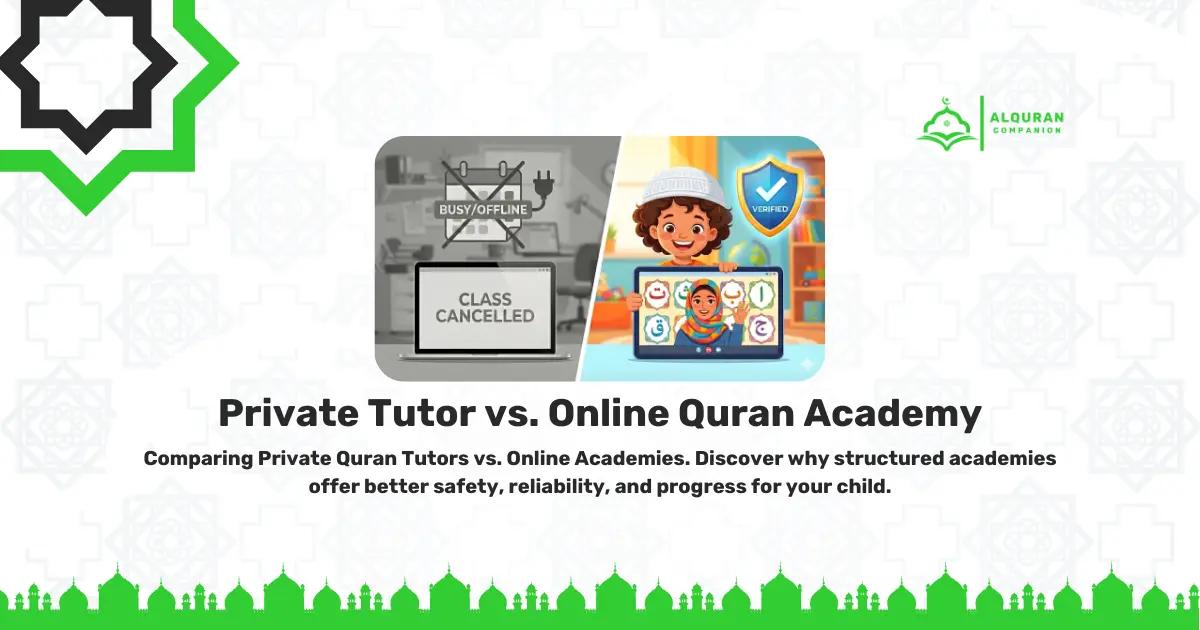
Parents who want a full parent-focused plan should read our UK online Quran learning guide. If you are still weighing a single tutor against an academy, this private tutor vs online academy comparison breaks down safety, cost, and consistency.
What Should UK Parents Look for in a Safe Online Quran Academy?
A safe online Quran academy for UK children must show enhanced DBS-checked tutors, live lesson recording, parent access, female teacher options, and a clear child protection policy. Al Quran Companion conducts comprehensive background checks and multi-stage reviews of every teacher before certification.
DBS checks are a basic UK safety standard. An enhanced DBS check with a barred list check is expected for adults working with children. Ask for proof that the academy repeats checks and keeps records current. A good academy also records every live class, limits chat, and gives parents a simple way to raise concerns. These steps protect your child and protect the teacher.
The Prophet (ﷺ) said, "The best among you (Muslims) are those who learn the Qur'an and teach it
The Hadith in Sahih Bukhari teaches that the best people learn Quran and teach it. That honor carries a duty of care. A certified teacher should hold Ijazah or an equivalent Quran credential, follow a clear curriculum, and correct Tajweed without harshness. At Al Quran Companion, our instructors use a 3-Step Pronunciation Feedback Loop: listen, model the correct Makhraj, then repeat with the student until the sound is stable.
Parents of daughters should ask for a female Quran teacher. This is not a small detail. Many girls learn better with a female role model, and some families require it. An online academy can match your daughter with a qualified female tutor who holds proper Quran credentials. Adult sisters and reverts also benefit from private, judgment-free lessons at their own pace.
The free trial class is your safety test. You can watch how the teacher speaks, how your child responds, and how the platform works. You can ask about DBS checks, recording, and progress reports. A zero-risk trial removes pressure. It lets you compare the online option with your local madrasah using real evidence, not hope.
How Do Online Quran Classes Fit Around British School Terms and Winter?
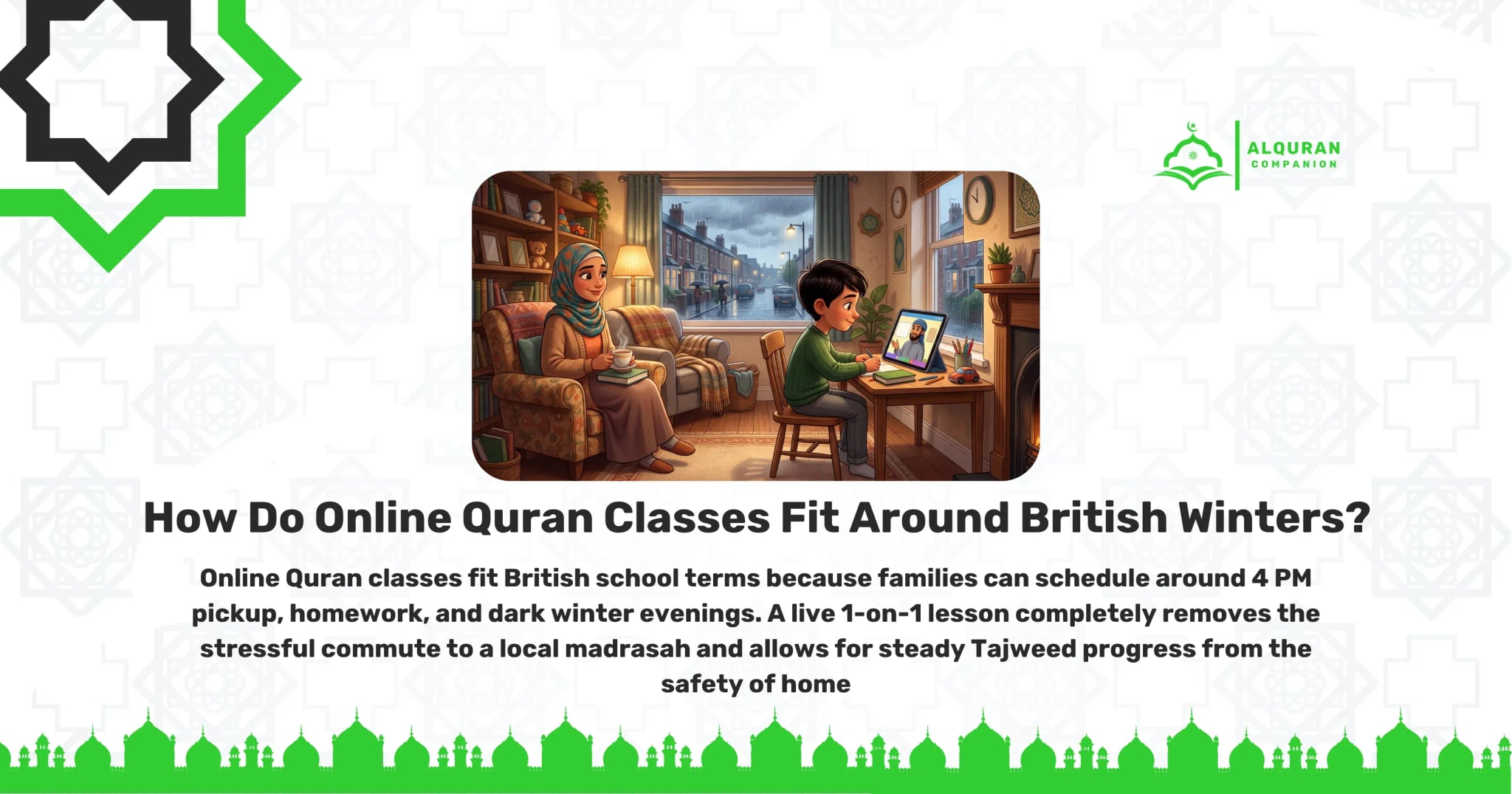
Online Quran classes fit British school terms because families can schedule around 4 PM pickup, homework, GCSE or A-Level revision, and dark winter evenings. A live 1-on-1 lesson removes the commute to a local madrasah and allows steady Tajweed progress from home.
A typical UK school day already drains a child. Add a wet walk to the car, traffic on the A38 or M6, and a crowded waiting room, and the Quran lesson becomes a battle. Online, your child can have a snack, pray Maghrib, and sit at a familiar desk. The lesson starts on time. The teacher gives full attention to your child. You save fuel, parking stress, and evening energy.
Term time also brings exams. A flexible online timetable can move a lesson to a lighter day or earlier slot. During half-term, you can add a booster session. This rhythm fits busy UK families better than a fixed mosque slot that clashes with parents' work shifts. The same logic helps expat families in Dubai and winter-bound families in Toronto, yet UK parents face a unique mix of early darkness and school run pressure.
Screen time balance matters. A Quran class on a tablet is not the same as endless scrolling. It is guided, interactive, and goal-based. Keep other entertainment screens off during the lesson. After class, close the app and let your child move, pray, or play. This routine protects attention and keeps Quran learning special.
Final Verdict: Safety and Progress for Your Child
The final verdict for UK parents is that online Quran classes vs local madrasah is not about rejecting the mosque. It is about choosing the safest daily learning environment. Use the 5-Factor Matrix, verify DBS checks, request a female tutor if needed, and book a free diagnostic trial.
A local madrasah can still give your child community, Friday prayer, and Eid joy. Keep those ties. But the daily recitation lesson needs attention, safety, and consistency. A tired child in a class of 20 will not learn Tajweed well. A focused child with a patient, checked teacher can improve every week. That is the practical choice many UK families are making.
Your child's love for Quran is fragile. Protect it with a calm teacher, a clear plan, and a safe platform. Start with a free 1-on-1 diagnostic class. See the teaching style. Ask your safety questions. Then decide with confidence.
Frequently Asked Questions About UK Quran Classes

Al Quran Companion Team
Verified AuthorThe official academic and editorial team at Al Quran Companion, a leading Online Quran Academy dedicated to simplifying Tajweed, Hifz, and Islamic studies for students worldwide.
Read more about author