
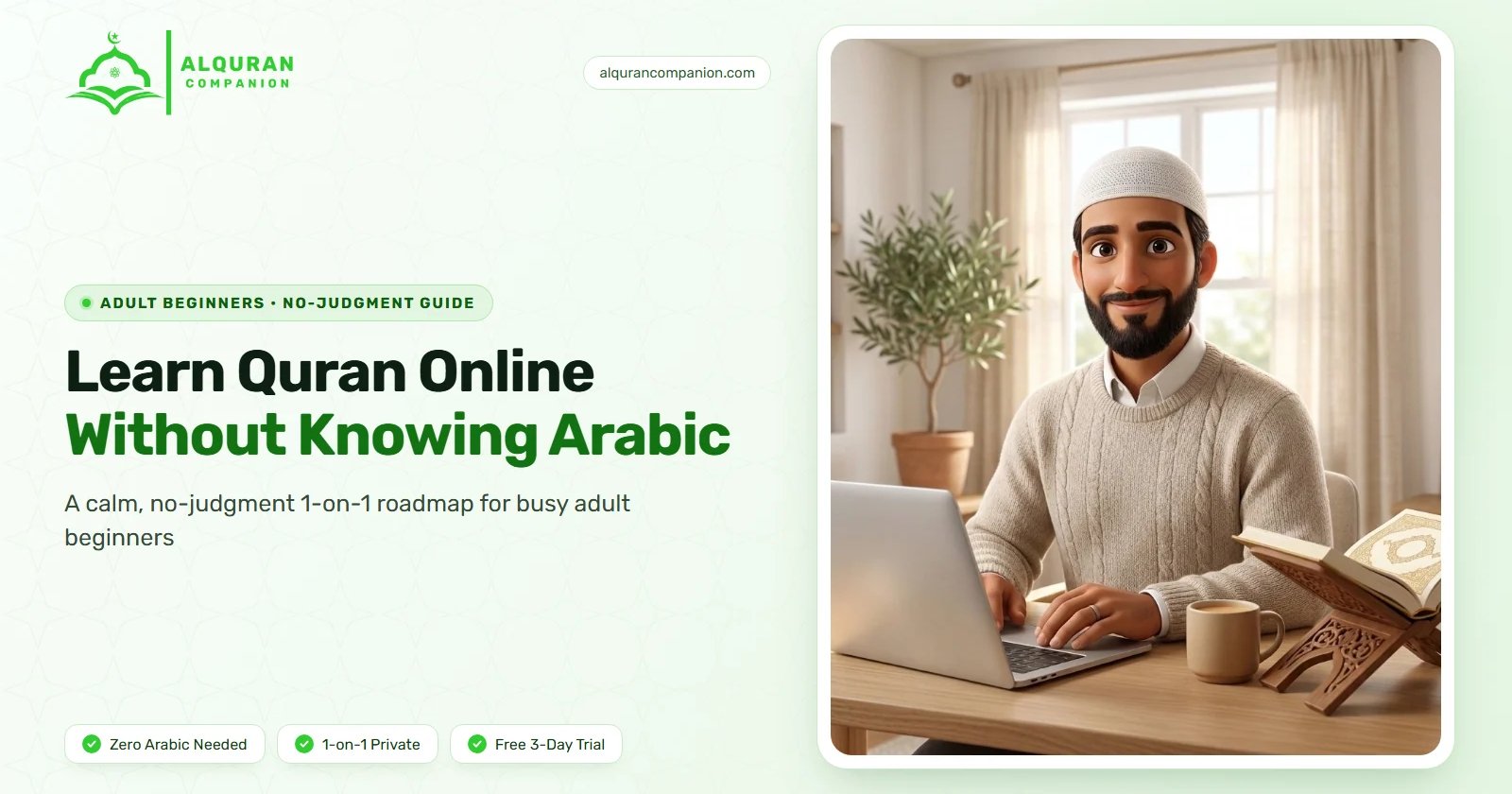
Yes—you can learn to read the Quran fluently online even if you do not speak or understand a single word of Arabic today. Roughly 80% of Muslims worldwide live outside the Arabic-speaking Middle East and North Africa and grew up speaking non-Arabic mother tongues—such as English, Urdu, Bengali, Indonesian, Turkish, or African and European languages—yet learned Quranic script step by step, just as adult beginners do today in Al Quran Companion's adult Quran program and Noorani Qaida.
Key Takeaways
- Decoding Arabic script in a Mushaf is a practical phonics skill—you do NOT need years of conversational Arabic grammar before reading Allah's Book.
- English transliteration helps beginners memorize short Surahs briefly, but staying stuck on Roman letters blurs distinct Arabic throat sounds.
- Busy adults who practice 15–20 focused minutes a day with live ear feedback progress far faster than binge-watching passive playlists.
- 1-on-1 Zoom or Microsoft Teams lessons keep classes free of peer audiences—just you and one supportive, vetted male or female instructor (backed by non-intrusive Quality Control oversight, with sessions unrecorded by default).
- Every new learner receives a Free 3-Day Trial (No Credit Card Required) to test pacing before paying a penny.
Do You Need to Speak Arabic Before Reading the Quran?
No—reading Quranic script and speaking conversational Arabic are two completely separate skills. Quran reading relies on recognizing 28 Arabic letter shapes (29 when Hamza is listed separately in traditional Qaida charts) and simple vowel markings above or below each letter, much like reading phonetic sheet music, allowing non-Arab adults to pronounce words accurately long before learning vocabulary.
Confessions across Reddit communities like r/islam, r/converts, and Islam StackExchange reveal how many grown Muslims carry quiet guilt about this gap. Working professionals in their late 20s, 30s, and 50s often admit that they skipped classes as children or forgot how to read after teenage years—and stay silent out of embarrassment around relatives. Meanwhile, adults trying to learn through random apps keep hitting a wall because an app cannot hear subtle throat articulation mistakes.
When you understand that you only need script recognition first—just as outlined in our foundational Arabic alphabet beginners guide—the mountain shrinks into an approachable staircase. Once your eyes decode verses smoothly, adding meaning through our Quranic Arabic basics pathway becomes twice as rewarding.
وَلَقَدْ يَسَّرْنَا ٱلْقُرْءَانَ لِلذِّكْرِ فَهَلْ مِن مُّدَّكِرٍ﴿١٧﴾
And We have certainly made the Qur’ān easy for remembrance, so is there any who will remember?
Why Staying on English Transliteration Holds Adult Readers Back
English transliteration acts like temporary training wheels, yet relying on Roman letters permanently distorts distinct Arabic sounds that English simply lacks. Pairs such as ح versus هـ, ق versus ك, or ع versus plain vowels collapse into identical English spellings, quietly changing Arabic words during recitation.
On r/converts and r/MuslimLounge, experienced learners emphasize that moving off English transliteration feels intimidating only for the first few lessons. Classical jurists and major contemporary fatwa councils—including Al-Azhar and Saudi Arabia's Permanent Committee—forbid writing the Quran in Latin script or treating transliteration as a substitute for the Arabic Mushaf, and many scholars advise learners to avoid transliteration altogether in favor of audio repetition with a qualified teacher. Where some contemporary scholars allow brief, private phonetic aids, they restrict them strictly as a temporary bridge while an adult or new Muslim actively transitions to Arabic script and proper pronunciation. Because rulings on recitation in Salah depend on personal circumstances and scholarly methodology, always consult a qualified local scholar or Mufti regarding your daily prayers while studying.
Transliteration vs. Noorani Qaida Script vs. Spoken Arabic Fluency
| Learning Path | Time to Basic Reading | Pronunciation Accuracy | Adult Reality Check |
|---|---|---|---|
| English Transliteration | Day one shortcut | Misses heavy/throat letters (ح، ع، ض، ق) | Temporary bridge only; hides real Mushaf beauty |
| Quranic Script (Noorani Qaida) | Joined words in weeks; full Qaida in 3–6 months | Authentic Makharij & vowel length accuracy | Sweet spot: opens every Mushaf page worldwide |
| Conversational Spoken Arabic | 1–3+ years | High grammar & daily dialogue | Valuable later goal, unnecessary before reciting |
English Transliteration
Quranic Script (Noorani Qaida)
Conversational Spoken Arabic
Why Adults Earn Double Honor—Starting at Any Age
Feeling embarrassed about stumbling over Arabic letters in adulthood runs completely against Islamic tradition. Prophet Muhammad ﷺ specifically promised double spiritual reward for the person who recites the Quran with difficulty and sincere effort, while Imam Al-Bukhari reminded seekers that the Companions themselves studied in their older years.
The Prophet (ﷺ) said, "Such a person as recites the Quran and masters it by heart, will be with the noble righteous scribes (in Heaven). And such a person exerts himself to learn the Quran by heart, and recites it with great difficulty, will have a double reward."
In Kitab al-'Ilm (the Book of Knowledge), Imam Al-Bukhari records the famous advice of 'Umar ibn al-Khattab (may Allah be pleased with him) to gain sacred knowledge before taking on communal responsibilities—and then immediately adds a comforting encouragement so older adults never feel locked out:
“And [even] after you become leaders, for indeed the Companions of the Prophet (ﷺ) learned in their old age.”
فَتَعَـٰلَى ٱللَّهُ ٱلْمَلِكُ ٱلْحَقُّ ۗ وَلَا تَعْجَلْ بِٱلْقُرْءَانِ مِن قَبْلِ أَن يُقْضَىٰٓ إِلَيْكَ وَحْيُهُۥ ۖ وَقُل رَّبِّ زِدْنِى عِلْمًا﴿١١٤﴾
So high [above all] is Allāh, the Sovereign, the Truth. And, [O Muḥammad], do not hasten with [recitation of] the Qur’ān before its revelation is completed to you, and say, "My Lord, increase me in knowledge."
The Prophet (ﷺ) said, "The best among you (Muslims) are those who learn the Quran and teach it."
How to Learn Quran Online Without Arabic: 5-Step Adult Roadmap
5-Step Adult Beginner Path from Zero Arabic to Mushaf Reading
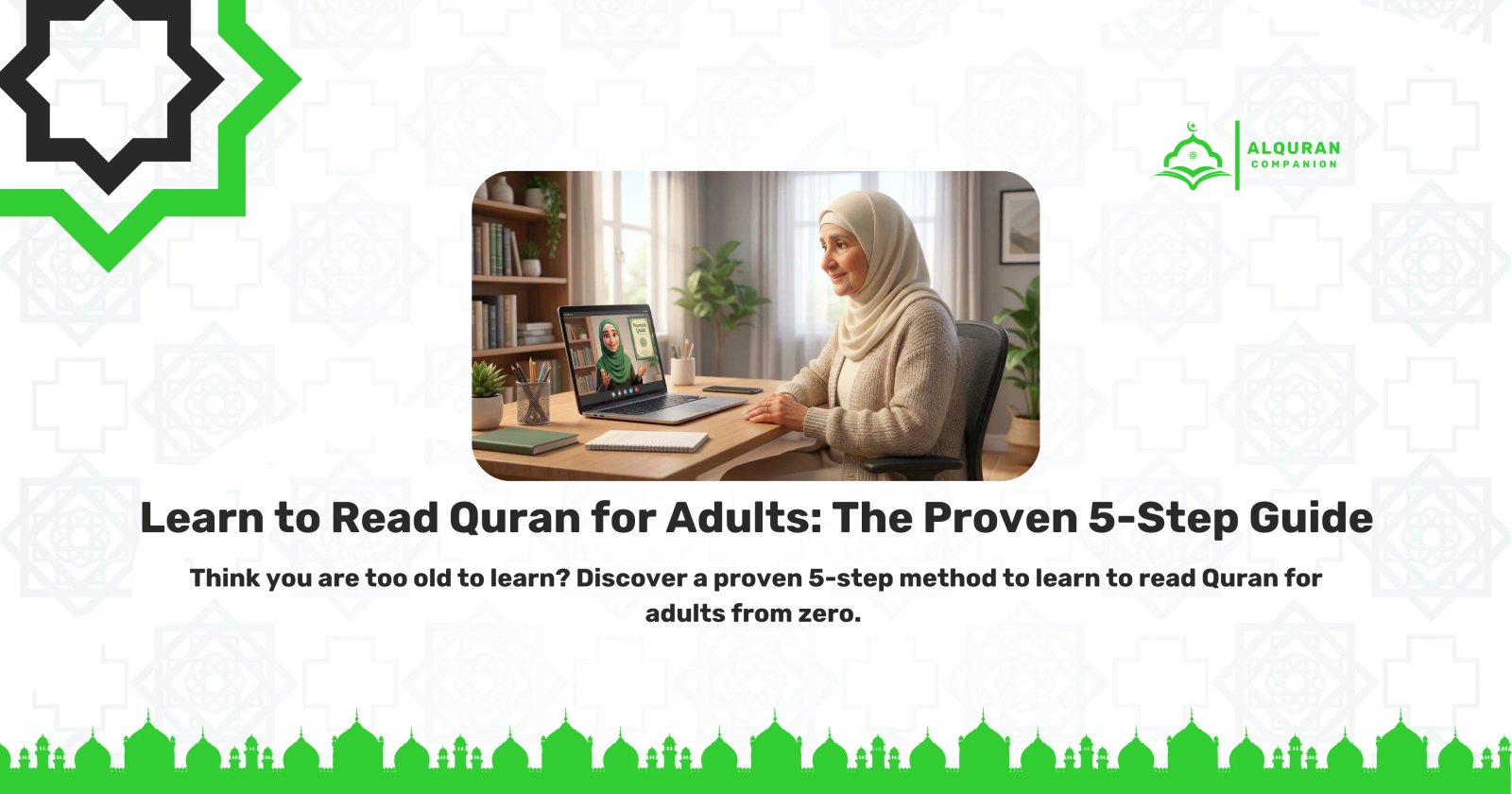
Adult beginners with zero Arabic can start reading the Quran online by booking a private 1-on-1 tutor, mastering the 28 Arabic letters inside Noorani Qaida, practicing short vowel markings, blending Surah Al-Fatihah and short Surahs, and maintaining a calm 15-minute daily review habit.
- 1
Match With One Patient 1-on-1 Tutor
Book a private Zoom or Teams trial with a vetted male instructor or female tutor so nobody listens except your teacher.
- 2
Master the 28 Letters Inside Noorani Qaida
Learn exact mouth and throat sounds alongside starting, middle, and ending connected letter shapes with live tongue correction.
- 3
Read Syllables Using Short Vowels
Practice Fatha, Kasra, and Damma markings cleanly so static Arabic letters instantly turn into smooth spoken sounds.
- 4
Blend Short Words and Juz Amma Surahs
Apply joining rules and pause signs inside Surah Al-Fatihah and short Surahs recited in daily Salah while leaving English transliteration behind.
- 5
Keep a Sustainable 15-Minute Daily Habit
Review two short lines daily between live classes—consistency beats marathon weekend sessions every single time.
For a deeper stage-by-stage breakdown of each Qaida lesson, review our 5-step adult Quran reading guide and see how professionals stay consistent using the 2-page daily rhythm. Sisters preferring female privacy can also explore our dedicated certified female Quran teachers page with optional camera-comfortable settings.
Why Private 1-on-1 Beats YouTube Playlists for Adult Beginners
Self-study videos teach letter recognition passively, yet a screen cannot listen to your voice and warn you when a heavy letter drifts soft. Working adults frequently get stuck in a start-stop YouTube loop—stopping within weeks whenever work gets busy because nobody expects them on a live call.
With teaching roots since 2009, Al Quran Companion supports 2,860+ active students across the USA, Canada, the UK, Europe, the UAE, and Australia with 300+ vetted male and female instructors and a 4.5 / 5 Trustpilot rating. Live 30-minute sessions run smoothly on Zoom or Microsoft Teams at clear monthly rates—from $25.99 to $55.99/mo USD on our US tuition page and £19.99 to £49.99/mo GBP on our UK pricing page, with zero setup fees, a 5% secure processing fee, a 10% yearly discount, and a Free 3-Day Trial (No Credit Card Required). Start from absolute zero Arabic privately on Zoom or Microsoft Teams with a patient, English-fluent male or female teacher.
Frequently Asked Questions from Adult Beginners
No. You only need to recognize the 28 Arabic letters, their connected shapes, and short vowel marks through Noorani Qaida. Millions of non-Arab Muslims recite fluently with proper Tajweed long before studying Arabic grammar.
Most focused adults attending 3 to 5 live 30-minute sessions weekly plus 15 minutes of daily review begin reading joined Arabic words within weeks and typically finish Noorani Qaida in 3 to 6 months, moving off English transliteration well before completing the book.
Never. Adults often progress faster than young children because you already understand structured focus and why the goal matters. As Imam Al-Bukhari highlighted, the Companions of the Prophet (ﷺ) themselves studied later in life.
Yes. Sisters and mothers are paired strictly with vetted female instructors, and adult learners can discuss comfortable camera or privacy preferences directly with Admissions before starting their Free 3-Day Trial.
Pre-recorded videos cannot listen to your breath or tongue placement to tell if two letters sound blurred together, and without a dedicated live appointment it is easy to skip practice after a tiring workday.
Every learner starts with a Free 3-Day Trial with no credit card required. Afterward, monthly 1-on-1 plans start from $25.99/mo in the US and £19.99/mo in the UK, plus a 5% processing fee and optional 10% yearly discount.