Every profound journey with the Holy Quran begins with a single, foundational step: mastering the arabic alphabet. For non-Arabic speaking Muslims, adult reverts, and diaspora parents raising children in the West, those beautiful, flowing characters can initially look intimidating. I understand this struggle deeply. As the Head of Quranic Education at Al Quran Companion, I have spent over 15 years guiding students across the United States, United Kingdom, and Australia through these exact initial hurdles.
Whether you are a professional in London trying to fit lessons around your busy 9-to-5, or a parent in Sydney managing weekend sports schedules alongside Islamic education, the anxiety is often the same. You want to read the words of Allah accurately, but you feel overwhelmed by right-to-left reading, unfamiliar throat sounds, and letters that change shape. You are not alone.
Over thousands of student assessments, our academic faculty has found that rote memorization creates frustration. True fluency requires a structured, logical approach. We developed The 5-Region Arabic Makharij & Phonics Framework to solve this exact problem. By breaking down the alphabet of arabic into visual patterns and physical pronunciation points, the brain stops seeing random lines and starts recognizing a highly logical, elegant system.
This guide provides everything you need to build that foundation. We will walk through the exact shapes, sounds, and connective rules required to move from absolute zero to confident recognition. Let us begin.
Table of Contents
- What Is the Arabic Alphabet? (Overview, 28 Letters & Direction)
- The Complete 28 Arabic Letters Chart: Names, Symbols & English Sounds
- Group 1: The Core Foundation Letters
- Group 2: The Throat and Middle Letters
- How Arabic Letters Connect: Isolated, Initial, Medial, and Final Forms
- The 6 Naughty Letters (Non-Connectors)
- The 5 Vocal Regions (Makharij): How to Pronounce Difficult Arabic Sounds
- 1. Al-Halq (The Throat)
- 2. Al-Lisan (The Tongue)
- 3. Ash-Shafatayn (The Lips)
- 4. Al-Khayshum (The Nasal Cavity)
- 5. Al-Jawf (The Empty Mouth Cavity)
- Short Vowels (Harakat): Fathah, Kasrah, Dammah & Sukoon Explained
- Fathah (The Upward Stroke)
- Kasrah (The Downward Stroke)
- Dammah (The Small Curl)
- Sukoon (The Rest Symbol)
- Frequently Asked Questions
Key Takeaways
- The Arabic script is read from right to left and features 28 distinct consonant letters.
- Letters change their visual shape depending on their position within a word (Initial, Medial, Final).
- Proper pronunciation requires mastering the 5 Makharij (articulation points) in the throat, tongue, and lips.
- Short vowel marks (Harakat) activate the static letters, creating flowing, readable syllables.
- Learning through structured visual recognition prevents frustration and builds rapid reading fluency.
What Is the Arabic Alphabet? (Overview, 28 Letters & Direction)
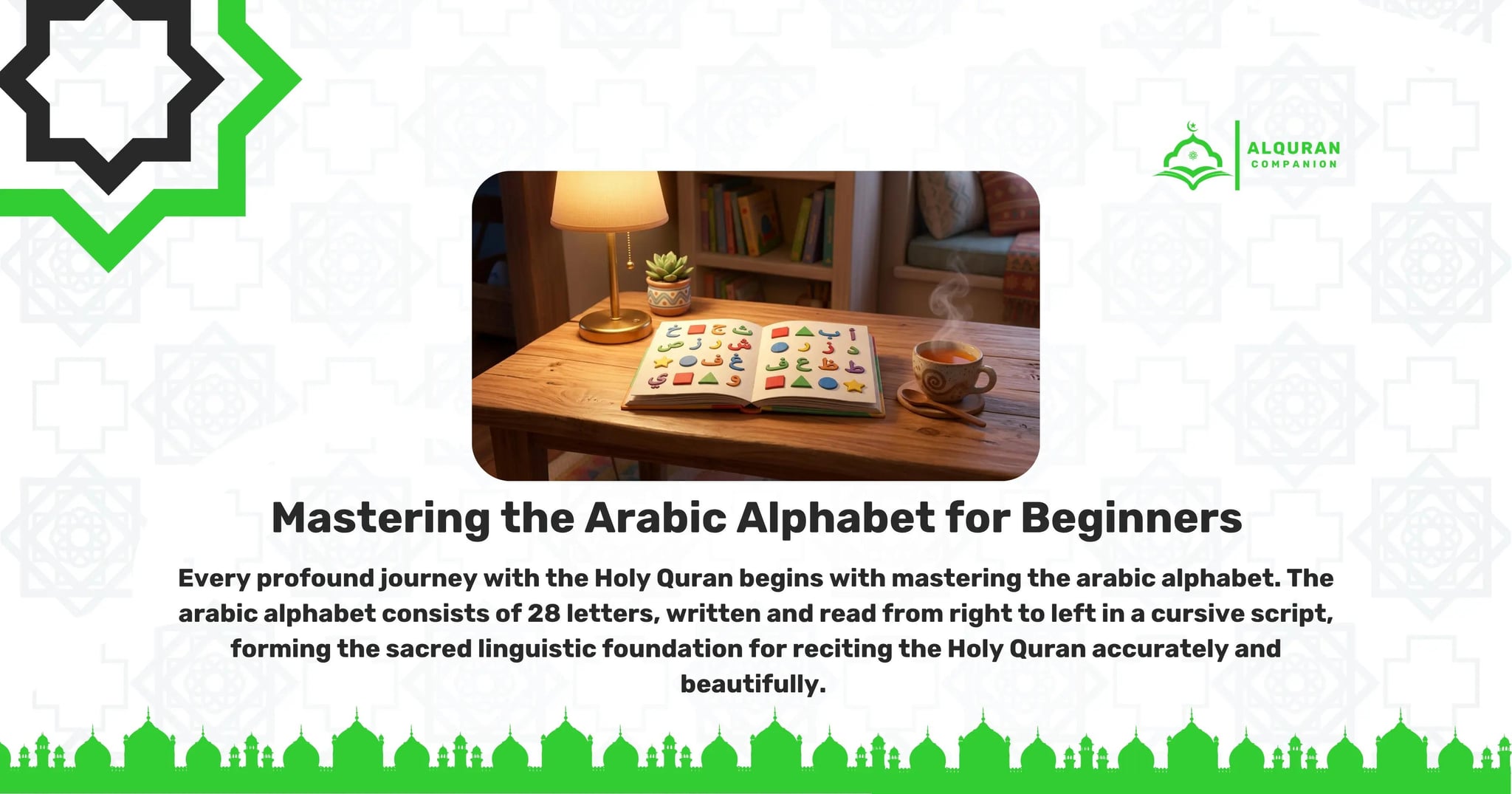
The arabic alphabet consists of 28 letters, written and read from right to left in a cursive script. All letters represent consonants except for three long vowels, forming the sacred linguistic foundation for reciting the Holy Quran accurately and beautifully.
Unlike the Latin alphabet used in English, the Arabic script operates on a root-based consonant system. This means the core meaning of any word is locked inside its consonant letters, while the vowels stretch and mold that meaning into different grammatical forms. This profound linguistic structure is why preserving the exact pronunciation of every single character is non-negotiable in Islamic theology.
For adult beginners, the right-to-left direction often presents the first mental hurdle. Your brain has spent decades tracking eyes from left to right. Reversing this visual flow requires dedicated neural rewiring. However, children adapt to this remarkably fast. Expat families in Dubai or Abu Dhabi frequently observe their young children absorbing right-to-left scanning within just a few weeks of consistent exposure. If you are wondering when to start Noorani Qaida, early exposure significantly reduces this initial friction.
Here is why the structure is uniquely brilliant: the letters are organized by shape families. Once you learn a base shape, you essentially learn three or four letters simultaneously, differentiated only by the placement of dots (Nuqat). This visual grouping makes memorizing the alphabets in arabic language much faster than rote repetition.
Expert Insight
"Do not attempt to memorize the entire alphabet in one sitting. Break the 28 letters into small, manageable shape families. Master the 'boat' shapes (Ba, Ta, Tha) on Monday, the 'hook' shapes (Jeem, Haa, Khaa) on Tuesday. Consistency always outperforms intensity when building new neural pathways."
The Complete 28 Arabic Letters Chart: Names, Symbols & English Sounds
The complete arabic letters chart includes 28 distinct characters from Alif to Ya. Each symbol possesses a unique name and phonetic equivalent, requiring students to build immediate visual and auditory recognition before progressing to complex Quranic vocabulary.
To effectively memorize arabic letters and their corresponding sounds, we must map them to familiar English equivalents where possible, while explicitly highlighting the sounds that do not exist in the English language. Below is the systematic breakdown of all 28 letters in their isolated (standalone) forms.
Group 1: The Core Foundation Letters
- Alif (ا): Acts as a long 'aa' vowel or a placeholder for the glottal stop (Hamzah). It has no sound of its own until a vowel mark is applied.
- Ba (ب): Equivalent to the English 'B'. A boat shape with one dot underneath.
- Ta (ت): Equivalent to a soft, frontal English 'T'. A boat shape with two dots on top.
- Tha (ث): Equivalent to the 'th' in 'think'. A boat shape with three dots on top. Your tongue must touch the edge of your upper teeth.
Group 2: The Throat and Middle Letters
- Jeem (ج): Equivalent to the English 'J'. Has a dot in its belly.
- Haa (ح): A sharp, breathy 'H' from the middle of the throat. No dots. This sound does not exist in English.
- Khaa (خ): A raspy, guttural sound from the top of the throat (similar to the Scottish 'loch'). One dot on top.
This pattern continues through the entire alphabet. We group Dal (د) and Dhal (ذ), Ra (ر) and Zay (ز), Seen (س) and Sheen (ش), and the heavy letters Saad (ص), Dhad (ض), Taa (ط), and Dhaa (ظ). Finally, we round out the alphabet with Ayn (ع), Ghayn (غ), Fa (ف), Qaf (ق), Kaf (ك), Lam (ل), Meem (م), Noon (ن), Ha (هـ), Waw (و), and Ya (ي).
Learning Methods: Arabic Text vs. English Transliteration
Pros
- Arabic Text trains the brain to recognize authentic shapes instantly.
- Arabic Text ensures exact articulation, preventing meaning-altering mistakes.
- Arabic Text builds a permanent foundation for reading the actual Quran directly.
Cons
- Transliteration creates severe pronunciation errors (e.g., mixing heavy 'Taa' with light 'Ta').
- Transliteration delays true reading fluency because the brain relies on English crutches.
- Transliteration makes applying advanced Tajweed rules virtually impossible later on.
At Al Quran Companion, we strictly avoid relying on transliteration in our syllabus. Our certified female and male tutors utilize immersive screen-sharing tools to point directly at the arabic letters in arabic script. We always conduct comprehensive Background Checks and detailed multi-stage reviews of every single teacher before they are certified to teach our students. This ensures that you or your child learn in a 100% safe, authentic, and highly effective environment.
How Arabic Letters Connect: Isolated, Initial, Medial, and Final Forms
Arabic cursive connectivity rules dictate that letters change shape based on their position within a word—whether isolated, initial, medial, or final. Six specific letters, including Alif and Waw, are non-connecting and never join to the subsequent character.
Understanding these connections is where reading actually begins. In English, we print letters individually with spaces between them. Arabic is entirely cursive. The letters hold hands. When they join together to form a word, they often drop their 'tails' or alter their base structure to merge smoothly with their neighbor.
Consider the letter Ba (ب).
- Isolated Form: It looks like a wide boat with a dot underneath.
- Initial Form (Beginning): It drops the left side of the boat and stretches its arm to connect to the next letter. It becomes a simple 'tooth' with a dot below.
- Medial Form (Middle): It has connecting arms on both sides, remaining a 'tooth' with a dot below.
- Final Form (End): It regains its full boat shape, anchoring the end of the word.
This rule applies to the vast majority of the alphabet. The identifying dots (Nuqat) remain the primary way you distinguish one letter from another when they are connected. A single tooth with a dot below is always Ba. Two dots above is always Ta. Three dots above is always Tha. This is the visual secret to understanding Quranic Arabic online rapidly.
The 6 Naughty Letters (Non-Connectors)
There are six special characters that break the cursive rule. I often call them the 'stubborn letters' in my classes. They willingly connect to the letter coming before them, but they refuse to connect to the letter coming after them. They create a mandatory break in the word.
These six letters are: Alif (ا), Dal (د), Dhal (ذ), Ra (ر), Zay (ز), and Waw (و). Whenever you encounter one of these letters, you must lift your pen. The following letter must start in its isolated or initial form, even though it is still part of the same word.
In our live 1-on-1 classes at Al Quran Companion, we frequently observe students struggling with word segmentation purely because they do not recognize these non-connecting breaks. By memorizing these six specific characters early, you instantly accelerate your reading speed.
The 5 Vocal Regions (Makharij): How to Pronounce Difficult Arabic Sounds
Makharij refers to the five distinct articulation points in the human vocal tract: the throat, tongue, lips, nasal cavity, and mouth cavity. Mastering these specific regions ensures accurate pronunciation of heavy letters and preserves the precise meaning of Quranic verses.
This is arguably the most critical component of essential Tajweed rules for beginners. Arabic contains sounds that simply do not exist in Germanic or Romance languages. If you try to map every Arabic letter to an English equivalent, you will alter the meaning of the Quran. For example, replacing the heavy 'Saad' (ص) with the light 'Seen' (س) changes the word for 'path' into the word for 'sword'. Proper pronunciation is an act of preserving divine revelation.
The Prophet (ﷺ) said: Beautify the Qur'an with your voices
We utilize a proprietary teaching model we call 'The 5-Region Arabic Makharij & Phonics Framework'. This framework maps the exact physical placement of the tongue and breath for every sound. Let us break down the five regions.
1. Al-Halq (The Throat)
Six distinct letters originate from the throat. We divide the throat into three specific levels:
- Bottom of the Throat (Aqsa Al-Halq): Produces Hamzah (ء) and Ha (هـ). These are deep, resonant sounds originating from the vocal cords.
- Middle of the Throat (Wasat Al-Halq): Produces Ayn (ع) and Haa (ح). This requires squeezing the epiglottis. It feels like a sharp, breathy whisper.
- Top of the Throat (Adna Al-Halq): Produces Ghayn (غ) and Khaa (خ). These are raspy, gargling sounds created just behind the uvula.
2. Al-Lisan (The Tongue)
The tongue is the most active organ in Arabic pronunciation, responsible for 18 letters. The exact placement of the tip, the middle, or the edges of the tongue against the palate or the teeth determines the sound. The heavy letters (Mufakhamah) such as Saad (ص), Dhad (ض), Taa (ط), and Dhaa (ظ) require you to elevate the back of your tongue toward the roof of your mouth, trapping the air and creating a deep, echoing sound.
3. Ash-Shafatayn (The Lips)
Four letters originate from the lips: Fa (ف), Waw (و), Ba (ب), and Meem (م). Fa requires the top front teeth to touch the inside of the bottom lip. Waw requires rounding the lips into a tight circle. Ba and Meem require pressing the lips together firmly.
4. Al-Khayshum (The Nasal Cavity)
This region does not produce a specific letter, but rather a characteristic sound called Ghunnah (nasalization). Ghunnah is the resonant hum produced in the nasal passage when pronouncing the letters Meem (م) and Noon (ن), especially when they possess a Shaddah (doubling mark). The sound should vibrate clearly in your nose for two counts.
5. Al-Jawf (The Empty Mouth Cavity)
The empty space inside the mouth and throat is used exclusively for the three long vowel extensions: the prolonged Alif (ا), Waw (و), and Ya (ي). When extending a sound, the breath flows freely without hitting any specific articulation point, creating a smooth, uninterrupted tone.
Short Vowels (Harakat): Fathah, Kasrah, Dammah & Sukoon Explained
Harakat are short vowel marks placed above or below consonant letters to activate pronunciation. Fathah creates an 'a' sound, Kasrah an 'i' sound, Dammah a 'u' sound, and Sukoon indicates the absence of a vowel, creating flowing syllables.
Letters alone are static. They are silent consonants. The Harakat act as the engine that drives the letters forward into actual speech. Without these diacritical marks, reading Arabic requires an advanced grasp of grammar and vocabulary to 'guess' the vowels from context. However, the Quran is fully vowelled to ensure absolute precision.
Any structured Noorani Qaida course for beginners will dedicate significant time to mastering these marks. Here is how they function:
Fathah (The Upward Stroke)
A small diagonal line placed above the letter. It produces a short, crisp 'a' sound. The physical mechanism requires opening the mouth vertically. When a Fathah is placed on the letter Ba (بَ), it is pronounced 'Ba'. It is quick and sharp—do not drag it into a long 'Baa'.
Kasrah (The Downward Stroke)
A small diagonal line placed beneath the letter. It produces a short 'i' sound (like the 'i' in 'sit'). The physical mechanism requires lowering the jaw slightly. When a Kasrah is placed on the letter Ba (بِ), it is pronounced 'Bi'.
Dammah (The Small Curl)
A small loop resembling a tiny 'Waw' placed above the letter. It produces a short 'u' sound (like the 'oo' in 'book'). The physical mechanism requires tightly rounding the lips. When a Dammah is placed on the letter Ba (بُ), it is pronounced 'Bu'.
Sukoon (The Rest Symbol)
A small circle placed over a letter indicating the absence of any vowel sound. It signifies a resting state. The letter retains only its base consonant sound and must join with the vowelled letter immediately preceding it to form a closed syllable. For instance, an Alif with a Fathah followed by a Ba with a Sukoon (أَبْ) is pronounced 'Ab'. Our senior Ijazah-certified tutors recommend a daily 15-minute spaced repetition schedule to overcome the friction of blending Sukoon syllables smoothly.
Mastering the arabic alphabet is not a race. It is the building of a lifelong relationship with the words of Allah. By understanding the visual shapes, committing to the physical articulation points, and applying the vowel mechanics, you transition from a state of hesitation to a state of confident recitation. At Al Quran Companion, we are honored to facilitate this beautiful journey for you and your family. We ensure an encouraging, zero-judgment environment where every student progresses at their ideal pace.
Frequently Asked Questions

Sheikh Abdullah Al-Hanif
Verified AuthorSheikh Abdullah Al-Hanif is the Head of Education at Al Quran Companion. With over 15 years of experience in Tajweed and Hifz, he specializes in bridging the gap between classical Islamic tradition and modern digital pedagogy. He is passionate about making the Quran accessible to everyone—from energetic toddlers to busy professionals.
Read more about author