It is 5:47 PM on a Tuesday in Bankstown. You have just picked up your eight-year-old from after-school care. The M5 is a parking lot. Your child is hungry, tired, and asking why they have to go to madrasah again. You are asking yourself the same question. This scene plays out in thousands of Sydney homes every week. The solution is not to abandon Quran education. It is to change how and where it happens. This guide explains why a growing number of Muslim parents in Western Sydney are choosing online quran classes for kids that replace the commute with a calm, focused 1-on-1 session from the family living room.
What This Sydney Parent Guide Covers
- Why Sydney Parents Are Switching from Madrasahs to Online Quran Classes
- Sydney Madrasah vs. 1-on-1 Online Learning: The 5-Point Safety Matrix
- How to Integrate Quran Lessons into Your Child's Sydney School Routine
- Stage 1: Map Your Child's Energy Window
- Stage 2: Build a Fixed 30-Minute Block
- Stage 3: Use NSW Term Breaks as Revision Sprints
- Stage 4: Track Progress with the 15-Minute Spaced-Repetition Hifz Cycle
- What Age Should Sydney Kids Start Online Quran Classes?
- How Do Certified Online Quran Tutors Keep Sydney Children Safe?
- Online Quran Classes vs. YouTube: The Screen-Time Question Sydney Parents Ask
- What Sydney Parents Should Look for in an Online Quran Tutor
- Frequently Asked Questions About Online Quran Classes in Sydney
Key Takeaways
- Western Sydney suburbs like Lakemba, Auburn, Bankstown, and Parramatta have some of Australia's highest Muslim populations, but madrasah commutes during peak hour add 60-90 minutes of stress to an already long school day.
- Al Quran Companion conducts comprehensive background checks and multi-stage reviews of every instructor, including WWCC-equivalent screening for Australian students.
- The 30-Minute After-School Stack is a proven scheduling method that places Quran learning between school pickup and dinner, avoiding late-night fatigue.
- Certified female Quran tutors are available for daughters and young children, providing a comfortable, private learning environment.
- NSW school term dates run from early February to mid-December, and online classes can flex around pupil-free days, school holidays, and exam periods without losing momentum.
Why Sydney Parents Are Switching from Madrasahs to Online Quran Classes
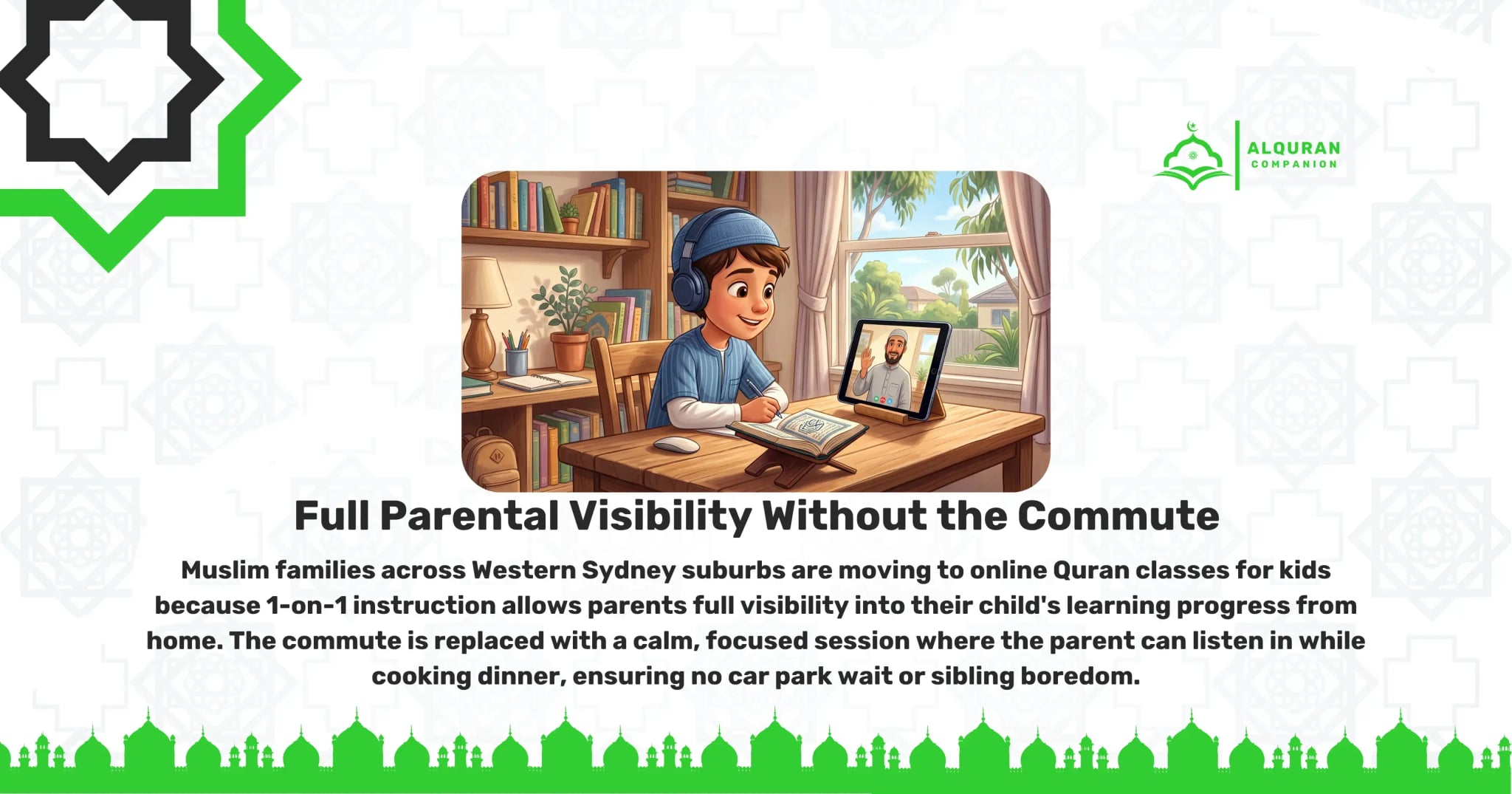
Muslim families across Western Sydney suburbs including Lakemba, Auburn, Bankstown, and Parramatta are moving to online Quran classes for kids because 1-on-1 instruction eliminates M4 and M5 traffic stress, allows personalized Tajweed pacing, and gives parents full visibility into their child's learning progress from home.
Here is what this looks like in practice. A parent in Greenacre finishes work at 4:30 PM. Instead of bundling three children into the car and fighting the Hume Highway, they open a laptop at 5:00 PM. Their ten-year-old logs into a live session with his teacher. The parent listens while cooking dinner. By 5:35 PM, the lesson is done. No car park wait. No sibling boredom. No missed Salah.
But that is not all. The academic difference matters more than the logistical one. In a typical weekend madrasah classroom in Lakemba or Mount Druitt, one teacher may manage fifteen to twenty-five students. Your child receives a few minutes of individual attention per session. In a 1-on-1 online Quran class, every minute belongs to your child. The teacher hears every letter, corrects every Makhraj, and adjusts the pace in real time.
According to the Australian Bureau of Statistics and multiple community studies, Sydney's Muslim population is concentrated in Auburn, Greenacre, Bankstown, Lakemba, and Punchbowl. Many local masjids run weekend maktab programs. Darul Tarbiyah in Lakemba, for example, offers a Weekend Maktab Program for boys aged seven and up covering Quran, Tajweed, and Islamic Studies. These programs serve a real need. The problem is capacity. Limited spots and fixed timetables mean families often accept whatever slot is available, even if it conflicts with sports, tutoring, or family time.
"The Quran was revealed to be easy to remember; it is our job to make the learning easy too."
Sydney Madrasah vs. 1-on-1 Online Learning: The 5-Point Safety Matrix
Physical Sydney mosque classrooms and online 1-on-1 platforms differ across five measurable safety and effectiveness criteria: student-teacher ratio, child safety vetting, schedule flexibility, parental supervision, and student engagement. The table below compares both options using the standards Australian parents in NSW should evaluate before enrolling their child.
Sydney Madrasah vs. Al Quran Companion Online Classes: Safety and Quality Comparison
| Criterion | Local Sydney Madrasah | Al Quran Companion Online |
|---|---|---|
| Student-Teacher Ratio | Often 1:15 to 1:25 | Strictly 1-on-1 |
| Child Safety Vetting | Varies by centre; WWCC required | Comprehensive Background Checks + Multi-Stage Reviews |
| Schedule Flexibility | Fixed weekend or weekday slots | AEST/AEDT time slots, 7 days a week |
| Parental Supervision | Drop-off model; limited visibility | Parent can observe every session live |
| Student Engagement | Group pacing; advanced students wait | Personalized pacing; no boredom gaps |
| Commute Time | 30-90 minutes round trip in peak hour | Zero commute; learn from home |
Student-Teacher Ratio
Child Safety Vetting
Schedule Flexibility
Parental Supervision
Student Engagement
Commute Time
At Al Quran Companion, we always conduct comprehensive background checks and detailed multi-stage reviews of every single teacher before they are certified to teach our students. For Australian families, this process includes identity verification, qualification authentication, and reference checks that meet NSW Working with Children Check standards. The Child Protection (Working with Children) Act 2012 requires all persons working with children in NSW, including religious teachers, to undergo screening. We do not cut corners on this.
How to Integrate Quran Lessons into Your Child's Sydney School Routine
Sydney parents can integrate Quran lessons into their child's school week using a 4-stage scheduling method called the 30-Minute After-School Stack. This method places a short Quran session between school pickup and dinner, when the child is still alert but evening fatigue has not yet set in. It works around NSW school term dates and requires no weekend sacrifice.
The 2026 NSW school year runs from Monday 2 February to Thursday 17 December for the Eastern division, with four terms and holiday breaks in April, July, September, and December. This predictable rhythm is actually an advantage for online learners. During term time, lessons maintain momentum. During breaks, students can either pause or use the extra daylight hours for Hifz revision. No madrasah enrolment forms. No term fees for missed weeks.
Stage 1: Map Your Child's Energy Window
Every child has a natural focus window. For most Sydney primary school students, it falls between 4:30 PM and 6:00 PM, after a snack but before dinner. High school students in Years 7-10 often focus better between 6:30 PM and 7:30 PM after a short rest. Track your child's alertness for three days. Write down when they seem most ready to sit and listen. That is your Quran slot.
Stage 2: Build a Fixed 30-Minute Block
Three to four sessions per week is the sweet spot for children aged 5-12. Thirty minutes per session is long enough for meaningful Tajweed work and short enough to prevent burnout. Unlike a madrasah class that runs for two hours with group instruction, a focused 1-on-1 session covers more ground in less time. The teacher can spend the full thirty minutes on your child's specific pronunciation challenges.
Stage 3: Use NSW Term Breaks as Revision Sprints
The autumn break in April and the winter break in July are perfect for consolidation. Instead of stopping lessons entirely, many families switch to a lighter schedule during holidays. Two sessions per week keeps the child's reading fluency from slipping while leaving plenty of time for family activities. Our instructors build holiday revision plans into each student's personalized learning path.
Stage 4: Track Progress with the 15-Minute Spaced-Repetition Hifz Cycle
At Al Quran Companion, our senior Ijazah-certified tutors recommend a daily 15-minute spaced-repetition schedule to overcome memorization plateaus. This proprietary method breaks new Ayahs into small chunks, reviews them on a staggered timeline, and integrates old material into every new lesson. The result is stronger retention with less frustration. We have refined this cycle over thousands of student assessments across Australia, the UK, and the USA.
What Age Should Sydney Kids Start Online Quran Classes?
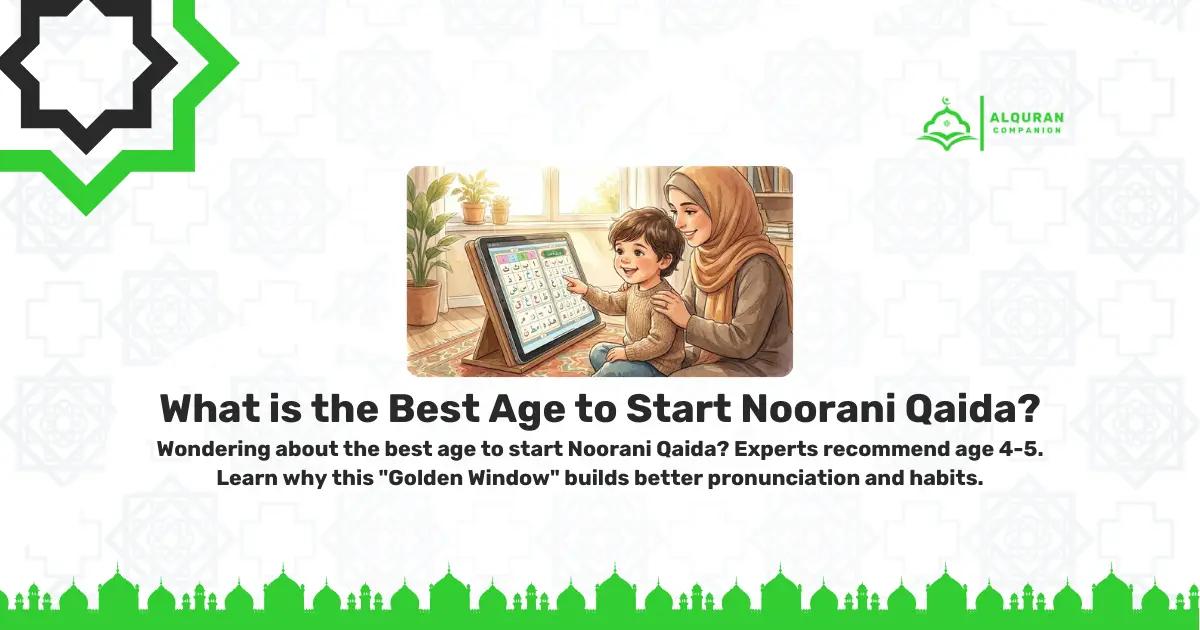
Children in Sydney can begin structured online Quran classes between the ages of four and five, starting with Noorani Qaida letter recognition and phonetic drills. The child does not need to read English fluently first. The optimal starting age depends on attention span, not academic grade. Most four-year-olds can manage 15-20 minute sessions; six-year-olds can handle 30 minutes.
We have a detailed breakdown of readiness signs in our guide on the best age to start Noorani Qaida. The key insight for Sydney parents is this: starting early with short, positive sessions builds a love for the Quran that lasts. Starting late with long, pressured sessions builds resentment. A child who begins Qaida at five and moves to Quran reading at seven is on a healthier trajectory than a child who is pushed into full Quran recitation at six before their Makharij are stable.
For families in Western Sydney, the first step is a diagnostic assessment. Our online Quran foundation course for kids begins with a free evaluation where a certified instructor listens to your child's letter pronunciation, assesses their current level, and recommends a personalized starting point. No guesswork. No age-based assumptions.
How Do Certified Online Quran Tutors Keep Sydney Children Safe?
Certified online Quran tutors keep Sydney children safe through mandatory background checks, live parental visibility, and platform controls that prevent private contact outside the classroom. At Al Quran Companion, every teacher undergoes comprehensive Background Checks and detailed multi-stage reviews before they are certified to teach. Parents can sit beside their child or observe from another room. The session is never recorded without permission.
For families with daughters, finding a suitable teacher is a common concern. Some parents prefer not to search for "quran classes near me" and visit unfamiliar locations. Al Quran Companion offers vetted female Quran teachers who are Ijazah-certified and experienced with young learners. Your daughter learns in her own room, with you nearby if you choose. This removes the safety concerns that sometimes keep families away from group settings.
The zero-risk free trial class is another layer of safety. Before you commit to any payment, your child experiences a live 1-on-1 diagnostic lesson. You meet the teacher. You watch how they interact with your child. You decide if the fit is right. No contracts, no pressure.
Online Quran Classes vs. YouTube: The Screen-Time Question Sydney Parents Ask
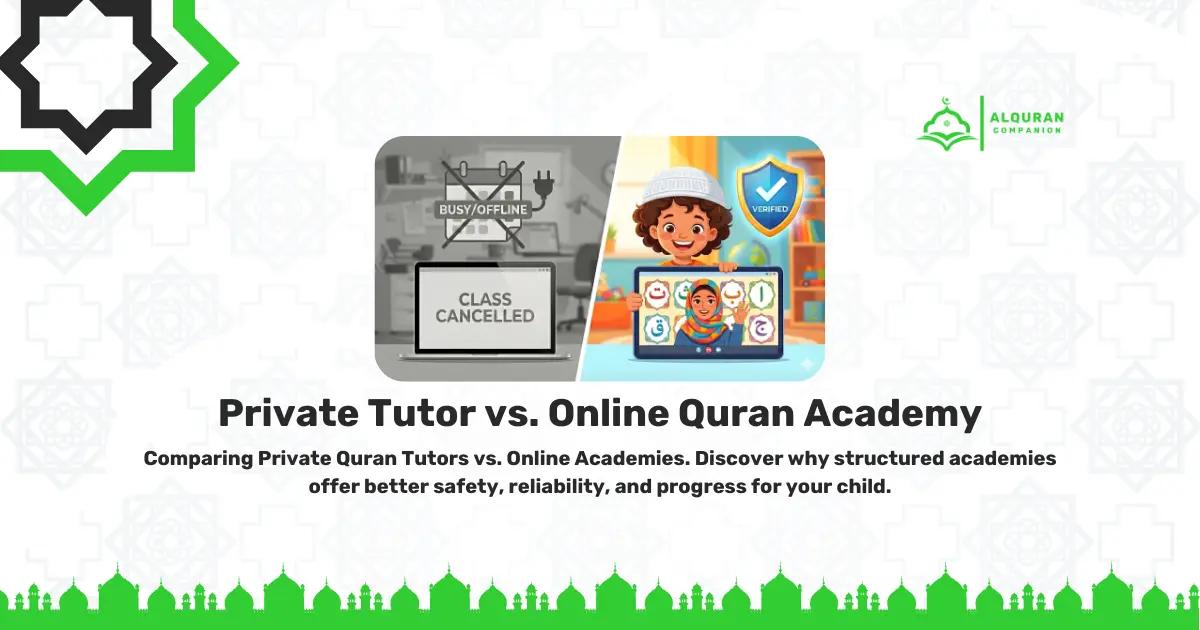
Online Quran classes differ from YouTube Quran videos in one critical way: interactive correction. A YouTube video cannot hear your child's recitation. It cannot stop them mid-letter and say 'Your Dhaad is missing its Isti'laa.' It cannot adapt tomorrow's lesson based on today's pronunciation. A certified tutor can do all three. This is why structured live tutoring produces measurable Tajweed improvement while passive screen watching often does not.
We understand the screen-time dilemma. Australian parents already worry about tablet hours. Our approach is to make those hours productive. A 30-minute live session with a teacher who listens and corrects is fundamentally different from an hour of scrolling. For a deeper look at this trade-off, read our analysis of Quran learning vs. YouTube. The bottom line for Sydney families: one focused interactive session beats three passive videos every time.
If tears and resistance have been part of your Quran class story, the problem is likely the format, not the child. Our guide on tear-free Quran classes for kids explains how patient 1-on-1 pacing, positive reinforcement, and age-appropriate session length transform the learning experience. We have seen children who dreaded madrasah become eager participants when the format changed.
What Sydney Parents Should Look for in an Online Quran Tutor
Sydney parents should verify four credentials before enrolling their child in any online Quran program: Ijazah certification in the Qira'ah being taught, experience with young learners, a verified background check, and a transparent trial process. An Ijazah is not a certificate of attendance. It is a license to teach, granted by a qualified scholar after the student recites the entire Quran from memory with perfect Tajweed.
For a step-by-step vetting framework, see our guide to online Quran classes in Australia. It covers the questions to ask, the red flags to avoid, and how to compare academies against private tutors. The Australian market has grown quickly, and not every provider maintains the same standards.
Frequently Asked Questions About Online Quran Classes in Sydney

Sheikh Abdullah Al-Hanif
Verified AuthorSheikh Abdullah Al-Hanif is the Head of Education at Al Quran Companion. With over 15 years of experience in Tajweed and Hifz, he specializes in bridging the gap between classical Islamic tradition and modern digital pedagogy. He is passionate about making the Quran accessible to everyone—from energetic toddlers to busy professionals.
Read more about author