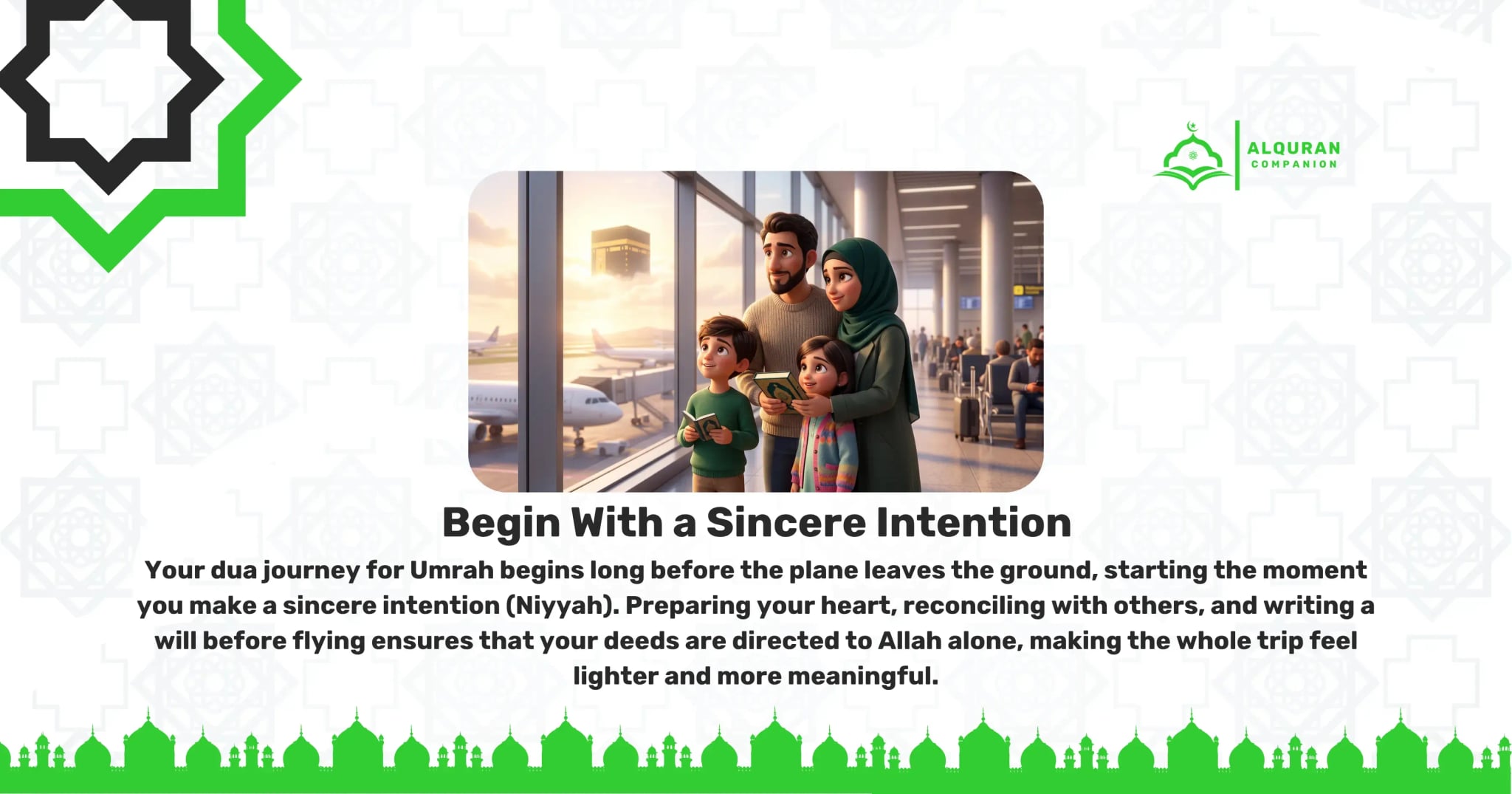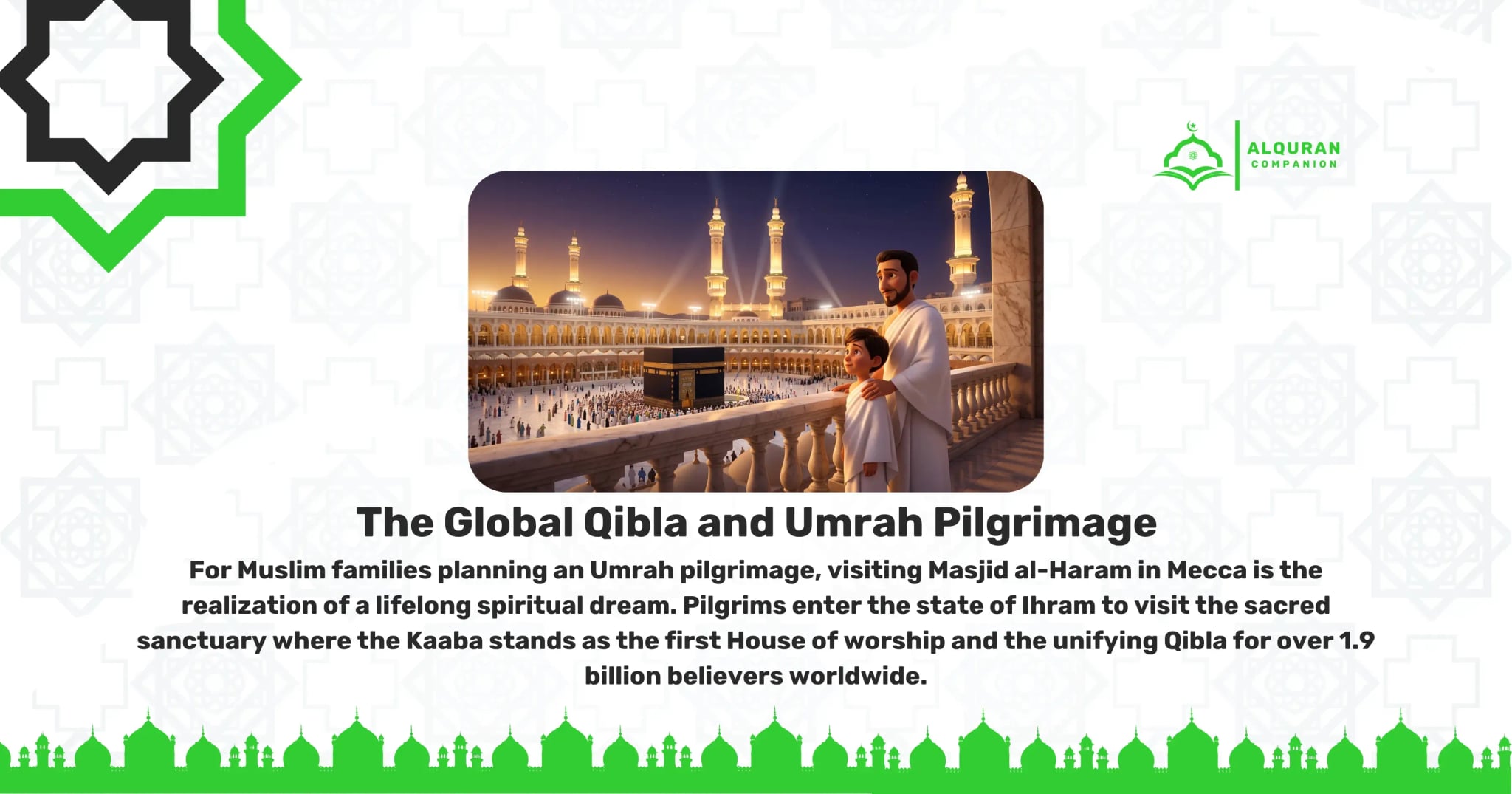
Labaik Allahuma Labaik is the first sentence most pilgrims say aloud on Umrah, and it is also the one they fear mispronouncing. Maybe you are a British Muslim booking your first trip from Manchester or Birmingham. Maybe you are a mother in Toronto holding a printed Dua card. Either way, you want the right words at the right place.
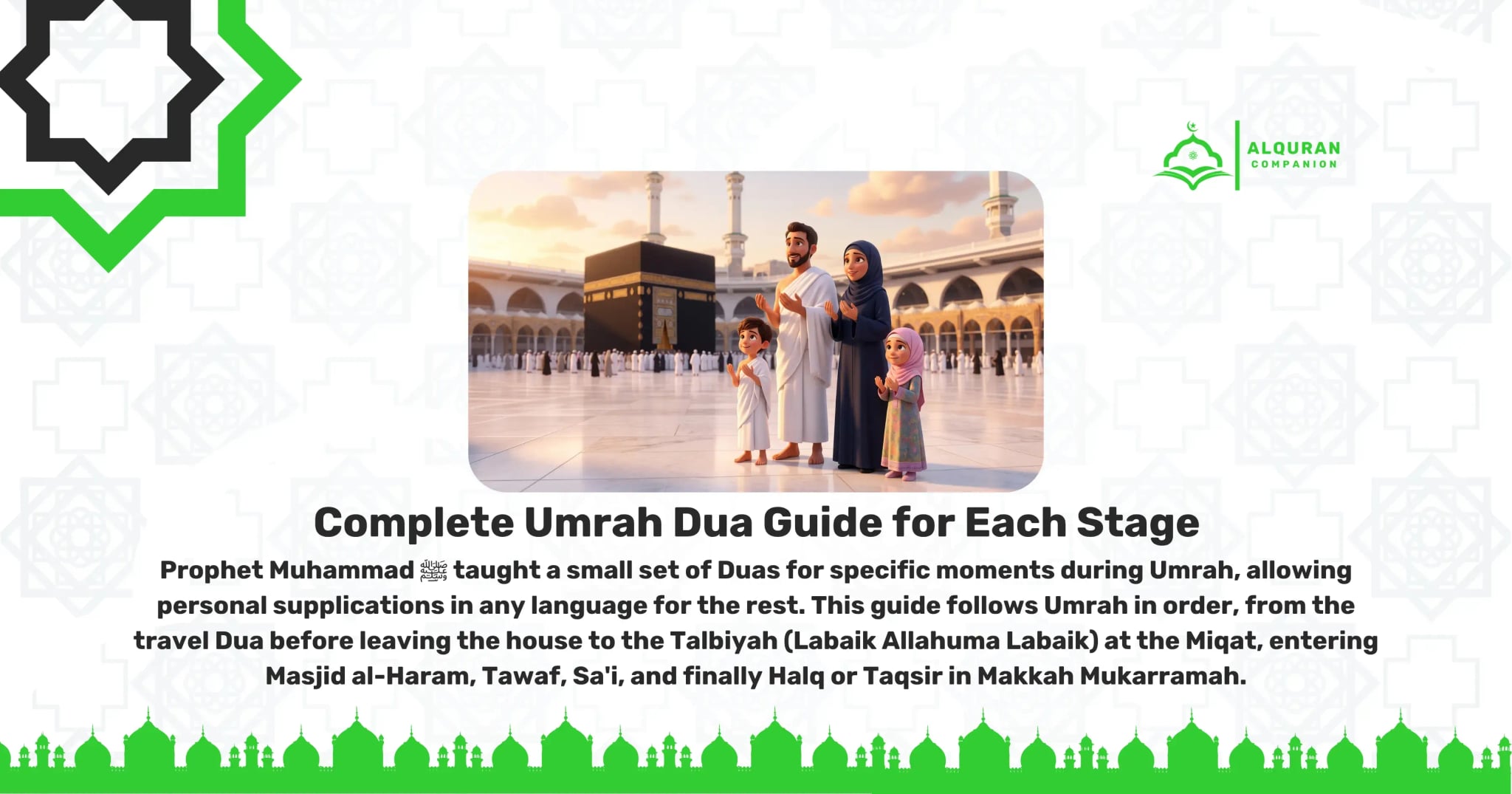
Here's the good news: Prophet Muhammad ﷺ did not hand pilgrims a long script. He taught a small set of Duas for specific moments, and the rest is personal supplication in any language. This guide follows Umrah in order, from your front door in the UK to Halq or Taqsir in Makkah Mukarramah.
Many British families begin by praying Salat al-Istikhara before booking your pilgrimage and then learn the Duas in the weeks before departure. In our live 1-on-1 classes at Al Quran Companion, we frequently observe that pilgrims who rehearse the Talbiyah aloud before they fly arrive at the Miqat calmer and clearer.
Jump to Any Stage of Umrah
- Labaik Allahuma Labaik and Every Umrah Dua: Complete Sunnah Overview
- What Is the Travel Dua Before Leaving for Umrah? Dua al-Safar Explained
- Dua When Entering Ihram and Making the Niyyah at the Miqat
- What Is the Talbiyah? Labaik Allahuma Labaik Meaning, Ruling, and When to Stop
- Dua When Entering Masjid al-Haram and First Seeing the Kaaba
- How to Perfect Your Umrah Duas and Tajweed with a Certified Teacher
- What Should You Say During Tawaf at the Hajar Aswad and Between the Two Corners?
- Dua During Sa'i Between Mount Safa and Mount Marwah
- Dua After Completing Umrah and Final Words for Pilgrims
- Frequently Asked Questions
Key Takeaways
- Prophet Muhammad ﷺ fixed only a few Duas for Umrah. Every other moment is open for personal Dua in any language.
- The Talbiyah, Labaik Allahuma Labaik, runs from the Miqat until Tawaf begins. Men raise their voices and women recite softly.
- The correct Travel Dua opens with Subhanal-ladhi sakhkhara lana, and the common spelling Subhanallah sakhara is a transliteration error (Surah Az-Zukhruf 43:13-14).
- At the Hajar Aswad say Allahu Akbar, and between the Yemeni Corner and the Hajar Aswad say Rabbana atina fid-dunya hasanah (Surah Al-Baqarah 2:201).
- On Safa and Marwah, recite the Tahlil as Jabir ibn Abdullah (RA) reported in Sahih Muslim 1218, and make personal Dua between each repetition.
- A free 1-on-1 Tajweed diagnostic with an Ijazah-certified teacher can fix your Dua pronunciation before you fly.
Labaik Allahuma Labaik and Every Umrah Dua: Complete Sunnah Overview
Umrah is the lesser pilgrimage to Makkah Mukarramah, from the Arabic root 'Ayn-Meem-Ra meaning to visit. No fixed Dua is compulsory at every step. Prophet Muhammad ﷺ taught specific supplications at key stations, including travel, Ihram, the Talbiyah, entering Masjid al-Haram, Tawaf, and Sa'i (Sahih Muslim 1218 and 1342). Knowing them removes guesswork for Muslims flying from the West.
Here's why that matters. Many booklets handed to pilgrims assign a different Dua to each circuit of Tawaf, and travelers treat them as required. The Sunnah gives you a handful of fixed Duas and an open invitation to ask Allah for anything else. If you book Umrah packages from the UK, your group may give you such a booklet, so it helps to know which lines come from Prophet Muhammad ﷺ.
For the wider picture of the rites, read our complete guide to Hajj and pilgrimage rituals. The table below lists every stage of Umrah in order.
Umrah Duas in Order: Stage, Occasion, Dua, and Source
| Stage | Occasion | Dua to Recite | Primary Source |
|---|---|---|---|
| Leaving Home | Stepping out the door | Dua of trust in Allah | Sunan Abi Dawud 5095 |
| Boarding Transport | Plane, car, or train | Dua al-Safar | Quran 43:13-14; Sahih Muslim 1342 |
| Ihram at the Miqat | Declaring the intention | Labbayk Allahumma bi-'Umrah | Sahih Muslim (Anas, RA) |
| Talbiyah | Miqat until Tawaf begins | Labbayk Allahumma Labbayk | Sahih al-Bukhari 1549; Sahih Muslim 1184 |
| Entering Masjid al-Haram | Right foot first | Allahumma iftah li abwaba rahmatik | Sahih Muslim 713 |
| First Sight of the Kaaba | Pause and ask Allah | Personal Dua in any language | No fixed Prophetic wording |
| Tawaf | Hajar Aswad and between corners | Allahu Akbar; Rabbana atina | Sahih al-Bukhari 1613; Quran 2:201 |
| Sa'i | Safa and Marwah | Tahlil and Quran 2:158 | Sahih Muslim 1218 |
| Completing Umrah | After Halq or Taqsir | Dua for acceptance | Sahih al-Bukhari 1727 (Halq) |
Leaving Home
Boarding Transport
Ihram at the Miqat
Talbiyah
Entering Masjid al-Haram
First Sight of the Kaaba
Tawaf
Sa'i
Completing Umrah
What Is the Travel Dua Before Leaving for Umrah? Dua al-Safar Explained
Dua al-Safar is the Sunnah travel Dua, from the Arabic root Seen-Fa-Ra meaning to journey. Abdullah ibn Umar (RA) reported that Prophet Muhammad ﷺ said Allahu Akbar three times and then recited the words of Surah Az-Zukhruf 43:13-14 when mounting (Sahih Muslim 1342). Every pilgrim leaving a Western airport can apply this travelling Dua to the plane.
لِتَسۡتَوٗا عَلٰى ظُهُوۡرِهٖ ثُمَّ تَذۡكُرُوۡا نِعۡمَةَ رَبِّكُمۡ اِذَا اسۡتَوَيۡتُمۡ عَلَيۡهِ وَتَقُوۡلُوۡا سُبۡحٰنَ الَّذِىۡ سَخَّرَ لَنَا هٰذَا وَمَا كُنَّا لَهٗ مُقۡرِنِيۡنَۙ ﴿١٣﴾
litastawū ʿalā ẓuhūrihi thumma tadhkurū niʿ'mata rabbikum idhā is'tawaytum ʿalayhi wataqūlū sub'ḥāna alladhī sakhara lanā hādhā wamā kunnā lahu muq'rinīna
That you may settle yourselves upon their backs and then remember the favor of your Lord when you have settled upon them and say, "Exalted is He who has subjected this to us, and we could not have [otherwise] subdued it.
Dua
Subhanal-ladhi sakhkhara lana haadha wa maa kunnaa lahu muqrineen, wa innaa ilaa Rabbinaa lamunqaliboon.
Glory be to Him who has subjected this to us, and we could never have subdued it ourselves. And indeed, to our Lord we will surely return.
The key word is sakhkhara. It comes from the Arabic root Seen-Kha-Ra and means to bring something under control for a purpose. The doubled Kha carries the emphasis, so press the shaddah firmly from the upper throat. The word muqrineen, from the root Qaf-Ra-Nun, means able to bind or control, so the verse admits that humans could never tame a camel or an aircraft alone.
Consider this common error. Many printed cards write Subhanallah sakhara. Subhanallah means glory be to Allah, but the Quranic words open with Subhanal-ladhi sakhkhara, which means glory be to Him who subjected. That relative pronoun connects the praise to the next clause, and the doubled Kha completes the verb. The duaBlock above gives the corrected transliteration.
Ibn Umar (RA) adds that Prophet Muhammad ﷺ then asked Allah for righteousness, piety, and deeds that please Him on the road (Sahih Muslim 1342). Our full guide to the travel Dua in Islam explains the whole supplication.
What about the dua for traveling on a plane? The Hadith names a camel because it was the vehicle of that era. The words praise Allah for placing the means of travel under our control, and that meaning fits an aircraft as well. Recite this dua for travel once you are seated and before takeoff. On short flights from Dubai or Abu Dhabi to Jeddah, say it before the doors close.
Before the Travel Dua comes the Dua for stepping out of the house. Sunan Abi Dawud 5095 records this supplication of trust in Allah, and it fits the moment you leave your front door in London or Sydney.
Supplication Leaving the House
bismillah, tawakkaltu 'alallah, la hawla wa la quwwata illa billah
In the name of Allah, I place my trust in Allah. There is no might nor power except with Allah.
Expert Insight
"In our live 1-on-1 classes at Al Quran Companion, we frequently observe pilgrims who read the Travel Dua fluently but flatten the doubled Kha in sakhkhara into a single soft sound. A few minutes of slow repetition at the upper throat fixes it, and the pilgrim then recites the whole Dua with confidence on the plane."
Dua When Entering Ihram and Making the Niyyah at the Miqat
Ihram for Umrah is the sacred state of ritual consecration, from the Arabic root Ha-Ra-Meem meaning forbidden, entered at or before the Miqat and voiced with the intention formula. Anas ibn Malik (RA) reported that Prophet Muhammad ﷺ named the rite aloud (Sahih Muslim). Pilgrims flying from London must make the intention before the plane passes the Miqat.
Dua
Labbayk Allahumma bi-'Umrah
Here I am, O Allah, for Umrah.
The intention sits in the heart, and speaking the rite aloud is Sunnah. Anas ibn Malik (RA) reported in Sahih al-Bukhari that Prophet Muhammad ﷺ praised Allah, glorified Him, and said the Takbir before he called out the Talbiyah. Ibn Hajar al-Asqalani discusses this report in Fath al-Bari, his commentary on Sahih al-Bukhari. On a flight from the UK or North America, you can say these words quietly in your seat and then voice the intention when the crew or your group leader announces the Miqat.
Pilgrims who start from Madinah Munawwarah enter Ihram at Dhul Hulayfah, the Miqat Prophet Muhammad ﷺ used for the people of Madinah. The rule is the same everywhere: do not cross the Miqat without the intention.
What Is the Talbiyah? Labaik Allahuma Labaik Meaning, Ruling, and When to Stop
The Talbiyah, Labaik Allahuma Labaik, is the foundational slogan of Tawheed, from the Arabic verb labba meaning to answer a call, chanted from the Miqat until Tawaf begins. Abdullah ibn Umar (RA) recorded its exact words (Sahih al-Bukhari 1549; Sahih Muslim 1184). Every British or American pilgrim should rehearse it aloud before departure.
Dua
Labbayk Allahumma labbayk, labbayk la shareeka laka labbayk, innal-hamda wan-ni'mata laka wal-mulk, la shareeka lak.
Here I am, O Allah, here I am. Here I am, You have no partner, here I am. Indeed all praise, grace, and sovereignty belong to You. You have no partner.
You will see the phrase written Labaik Allahuma Labaik on many travel cards. Arabic transliteration standards write it Labbayk Allahumma Labbayk, with doubled letters that mirror the shaddahs in the Arabic. Classical commentators such as Ibn Kathir link the Talbiyah to the answer to the call of Ibrahim (AS) in Surah Al-Hajj 22:27.
According to the consensus across the four established schools of Islamic jurisprudence (Hanafi, Maliki, Shafi'i, and Hanbali), men raise their voices with the Talbiyah and women recite softly.
Now the pronunciation. Labbayk has a doubled Ba, marked with a shaddah. The Ba is a lip letter, so press both lips together, hold the closure a little longer, and then release into the Fatha and the soft Ya. The final Kaaf comes from the back of the tongue meeting the soft palate, just ahead of the Qaf. Allahumma carries a shaddah on the Meem, which adds Ghunnah, a nasal hum held for two counts. In our live 1-on-1 classes at Al Quran Companion, we frequently observe pilgrims saying Labayk with a single quick Ba. That shortcut drops the repeated emphasis in the word, which means answering again and again.
When should you stop? The Hanafi, Shafi'i, and Hanbali schools stop the Talbiyah when Tawaf begins, which means as you reach the Hajar Aswad. The Maliki school stops earlier, once the pilgrim reaches the sacred boundary of Makkah. Ask your group scholar which opinion your tour follows and stay consistent with it.
Dua When Entering Masjid al-Haram and First Seeing the Kaaba
Masjid al-Haram is the sacred mosque surrounding the Kaaba in Makkah Mukarramah, from the Arabic root Seen-Jeem-Dal meaning to prostrate. Sahih Muslim 713 records the Dua for entering any mosque: Allahumma iftah li abwaba rahmatik. First-time pilgrims from the UK or Australia should enter with the right foot and arrive with these words ready.
Dua
Bismillaah, was-salaatu was-salaamu 'alaa Rasoolillaah, Allahumma iftah lee abwaaba rahmatik.
In the name of Allah, and peace and blessings be upon the Messenger of Allah. O Allah, open for me the doors of Your mercy.
This is the same dua before entering the mosque that you say at your local masjid in Birmingham or Chicago. Sunan Ibn Majah reports the greeting upon Prophet Muhammad ﷺ before the request for mercy. Read more about the sanctuary itself in our guide to Masjid al-Haram.
Now the Kaaba comes into view. No fixed wording for this first sight is established from Prophet Muhammad ﷺ. Stop for a moment, lower your gaze, raise your hands, and ask Allah in your own language.
Dua
Allahumma taqabbal 'umrati, waghfir dhunubi, wa zidni imaanan.
O Allah, accept my Umrah, forgive my sins, and increase me in faith.
The crowd will move around you, so step to the side of the courtyard when you finish. Allah hears your Dua from any spot.
How to Perfect Your Umrah Duas and Tajweed with a Certified Teacher
How to Perfect Your Umrah Duas and Tajweed with a Certified Teacher
The 4-Stage Makharij Diagnostic Ladder is the Al Quran Companion method for fixing Umrah Dua pronunciation, built on Makharij, the Arabic term for letter articulation points. Each rung adds one layer: letters, words, phrases, and pressure testing. A certified teacher listens live and corrects every sound before you fly.
- 1
Isolate the Hard Letters
Pick the letters that trip you, such as Kha in sakhkhara, Kaaf in Labbayk, and Ha in hasanah. Say each one alone from its Makharij point, then with Fatha, Kasra, and Damma. Your teacher marks which sounds are unclear.
- 2
Chunk Each Dua Into Short Words
Break Labbayk Allahumma Labbayk into three chunks and the Travel Dua into short phrases. Repeat each chunk five times at slow speed. Slow speed exposes the shaddah and Ghunnah mistakes that fast reading hides.
- 3
Join the Phrases in One Breath
Connect the chunks and add the correct pauses. Record yourself and compare the recording with your teacher's model recitation. Note every letter that changes when you speed up.
- 4
Test the Dua Under Crowd Conditions
Recite while standing, walking, and with background noise such as a busy kitchen or a train. This copies the Masjid al-Haram crowd. Repeat until every letter stays clean at normal speed.
Many pilgrims tell us they feel anxious about mispronouncing the Talbiyah in front of thousands of people. Allah does not burden a soul beyond its capacity (Surah Al-Baqarah 2:286), so a sincere pilgrim who is still learning is not turned away. Still, clear pronunciation gives you confidence, and the ladder above builds it. If shaddah and Ghunnah are new words, start with our Tajweed rules for beginners.
At Al Quran Companion, we always conduct comprehensive Background Checks and detailed multi-stage reviews of every single teacher before they are certified to teach our students. Our Ijazah-certified male and female teachers offer a live 1-on-1 diagnostic lesson with zero commitment and no payment upfront. Sisters learn with qualified female tutors. Adult learners and reverts receive private, patient, judgment-free guidance at their own pace, from Dublin to Sydney to a snowy January evening in Toronto.
Many pilgrims join our online Quranic Tajweed and Dua pronunciation course in the weeks before travel and practice the Talbiyah, the Travel Dua, and the Tawaf Duas with live feedback.
What Should You Say During Tawaf at the Hajar Aswad and Between the Two Corners?
Tawaf is the act of circling the Kaaba seven times, from the Arabic root Ta-Waw-Fa meaning to go around. Ibn Taymiyyah wrote that no specific Dua is fixed for each circuit. The Sunnah fixes words only at the Hajar Aswad and between the two corners (Sahih al-Bukhari 1613; Sunan Abi Dawud 1892), so booklets are optional.
Here's the catch. Many booklets assign a different Dua to each of the seven circuits and print them as if the Sunnah required them. Shaykh al-Islam Ibn Taymiyyah explained in Majmu' al-Fatawa that Prophet Muhammad ﷺ did not teach a specific Dua for each circuit, so a pilgrim may recite Quran, Dhikr, or any personal Dua.
At the Hajar Aswad, begin each circuit by facing the stone. Ibn Abbas (RA) reported that Prophet Muhammad ﷺ pointed toward the corner and said Allahu Akbar whenever he reached it (Sahih al-Bukhari 1613). When Ramadan or the December school holidays fill the Mataf, do not push toward the stone. Point with your right hand and say the Takbir from where you stand.
Dua
Allahu Akbar
Allah is the Greatest.
Between the Yemeni Corner (Ar-Rukn Al-Yamani) and the Hajar Aswad, Abdullah ibn as-Sa'ib (RA) reported that Prophet Muhammad ﷺ recited the Quranic Dua from Surah Al-Baqarah (Sunan Abi Dawud 1892).
وَمِنۡهُمۡ مَّنۡ يَّقُوۡلُ رَبَّنَآ اٰتِنَا فِى الدُّنۡيَا حَسَنَةً وَّفِى الۡاٰخِرَةِ حَسَنَةً وَّ قِنَا عَذَابَ النَّارِ﴿٢٠١﴾
wamin'hum man yaqūlu rabbanā ātinā fī l-dun'yā ḥasanatan wafī l-ākhirati ḥasanatan waqinā ʿadhāba l-nāri
But among them is he who says, "Our Lord, give us in this world [that which is] good and in the Hereafter [that which is] good and protect us from the punishment of the Fire."
The verse asks Allah for good in this world, good in the next, and protection from the Fire. Learn it by heart because it is short and you will repeat it many times. Say the Ha in hasanah from the middle of the throat, where it sounds tight, because many English speakers replace it with the lighter Ha of the word hat.
- Face the Hajar Aswad, point to it, and say Allahu Akbar.
- Walk with the Kaaba on your left and recite any Dhikr, Quran, or personal Dua.
- Between the Yemeni Corner and the Hajar Aswad, say Rabbana atina fid-dunya hasanah.
- After the seventh circuit, pray two Rak'ahs behind Maqam Ibrahim.
- Drink Zamzam water and make a Dua for what you need.
Jabir ibn Abdullah (RA) reported that Prophet Muhammad ﷺ recited Surah Al-Baqarah 2:125 about taking the station of Ibrahim as a place of prayer, then prayed two Rak'ahs behind Maqam Ibrahim (Sahih Muslim 1218). Sunan Ibn Majah 3062 reports that Prophet Muhammad ﷺ said Zamzam water is for whatever purpose it is drunk, so choose your Dua before you lift the cup.
Dua During Sa'i Between Mount Safa and Mount Marwah
Sa'i is the walking between the hills of Safa and Marwah seven times, from the Arabic root Seen-Ayn-Ya meaning to strive. Jabir ibn Abdullah (RA) reported in Sahih Muslim 1218 that Prophet Muhammad ﷺ recited Surah Al-Baqarah 2:158 near Safa, faced the Kaaba, and repeated the Tahlil three times. Pilgrims in Dubai or Toronto can rehearse this at home.
اِنَّ الصَّفَا وَالۡمَرۡوَةَ مِنۡ شَعَآٮِٕرِ اللّٰهِۚ فَمَنۡ حَجَّ الۡبَيۡتَ اَوِ اعۡتَمَرَ فَلَا جُنَاحَ عَلَيۡهِ اَنۡ يَّطَّوَّفَ بِهِمَا ؕ وَمَنۡ تَطَوَّعَ خَيۡرًا ۙ فَاِنَّ اللّٰهَ شَاكِرٌ عَلِيۡمٌ﴿١٥٨﴾
inna l-ṣafā wal-marwata min shaʿāiri l-lahi faman ḥajja l-bayta awi iʿ'tamara falā junāḥa ʿalayhi an yaṭṭawwafa bihimā waman taṭawwaʿa khayran fa-inna l-laha shākirun ʿalīmun
Indeed, aṣ-Ṣafā and al-Marwah are among the symbols of Allāh. So whoever makes ḥajj [pilgrimage] to the House or performs ʿumrah - there is no blame upon him for walking between them. And whoever volunteers good - then indeed, Allāh is Appreciative and Knowing.
"I begin with what Allah began with."
Here is the sequence Jabir (RA) described. Recite the verse when you first approach Safa. Climb until you see the Kaaba, face it, and declare Allah's Oneness and greatness. Then make a personal Dua, and repeat this three times. Prophet Muhammad ﷺ did the same on Marwah. Each lap ends at the opposite hill, so a full Sa'i has seven laps and finishes at Marwah.
Dua
La ilaha illallahu wahdahu la sharika lah, lahul-mulku wa lahul-hamd, wa huwa 'ala kulli shay'in qadeer. La ilaha illallahu wahdah, anjaza wa'dah, wa nasara 'abdah, wa hazamal-ahzaba wahdah.
There is no god but Allah alone, with no partner. His is the dominion and His is the praise, and He has power over all things. There is no god but Allah alone. He fulfilled His promise, gave victory to His servant, and defeated the confederates alone.
These opening words match the meaning and pronunciation of the Fourth Kalima (Kalima Tawheed), so a pilgrim who learned the Kalimas already knows the first lines. Between the repetitions, ask Allah for what matters most to you, in any language.
Dua After Completing Umrah and Final Words for Pilgrims
Halq is the shaving of the whole head for men, from the Arabic root Ha-Lam-Qaf meaning to shave, and Taqsir is trimming. Prophet Muhammad ﷺ prayed for mercy upon those who shave and then included those who trim (Sahih al-Bukhari 1727). Women trim a fingertip's length from their hair, which completes Umrah.
Dua
Allahumma taqabbal 'umrati, waghfir li dhunubi, wa taqabbal salati, wa thabbitni ba'da 'awdati ila bayti.
O Allah, accept my Umrah, forgive my sins, accept my prayers, and grant me steadfastness after I return home.
Dua To Make Heart Firm Upon Deen #1
ya muqallibal-qulubi thabbit qalbi 'ala dinik
O Changer of the hearts, make my heart firm upon Your religion.
The Umrah ends here, but the habit should not. Keep one Dua from each stage in your daily routine, and keep reciting the Quran at the pace you built before the trip.
Final words for British Muslims: Umrah is a journey of the heart, and every Dua you make there is between you and Allah. Say Labaik Allahuma Labaik with a clear heart and a steady tongue, and trust that He hears the effort of every sincere pilgrim. The team at Hajj Umrah Hub can help you plan the practical side of your trip, so you can spend your energy on worship. Insha'Allah, you will return home with accepted deeds and a recitation you are proud of.
Frequently Asked Questions

Sheikh Abdullah Al-Hanif
Verified AuthorSheikh Abdullah Al-Hanif is the Head of Education at Al Quran Companion. With over 15 years of experience in Tajweed and Hifz, he specializes in bridging the gap between classical Islamic tradition and modern digital pedagogy. He is passionate about making the Quran accessible to everyone—from energetic toddlers to busy professionals.
Read more about author