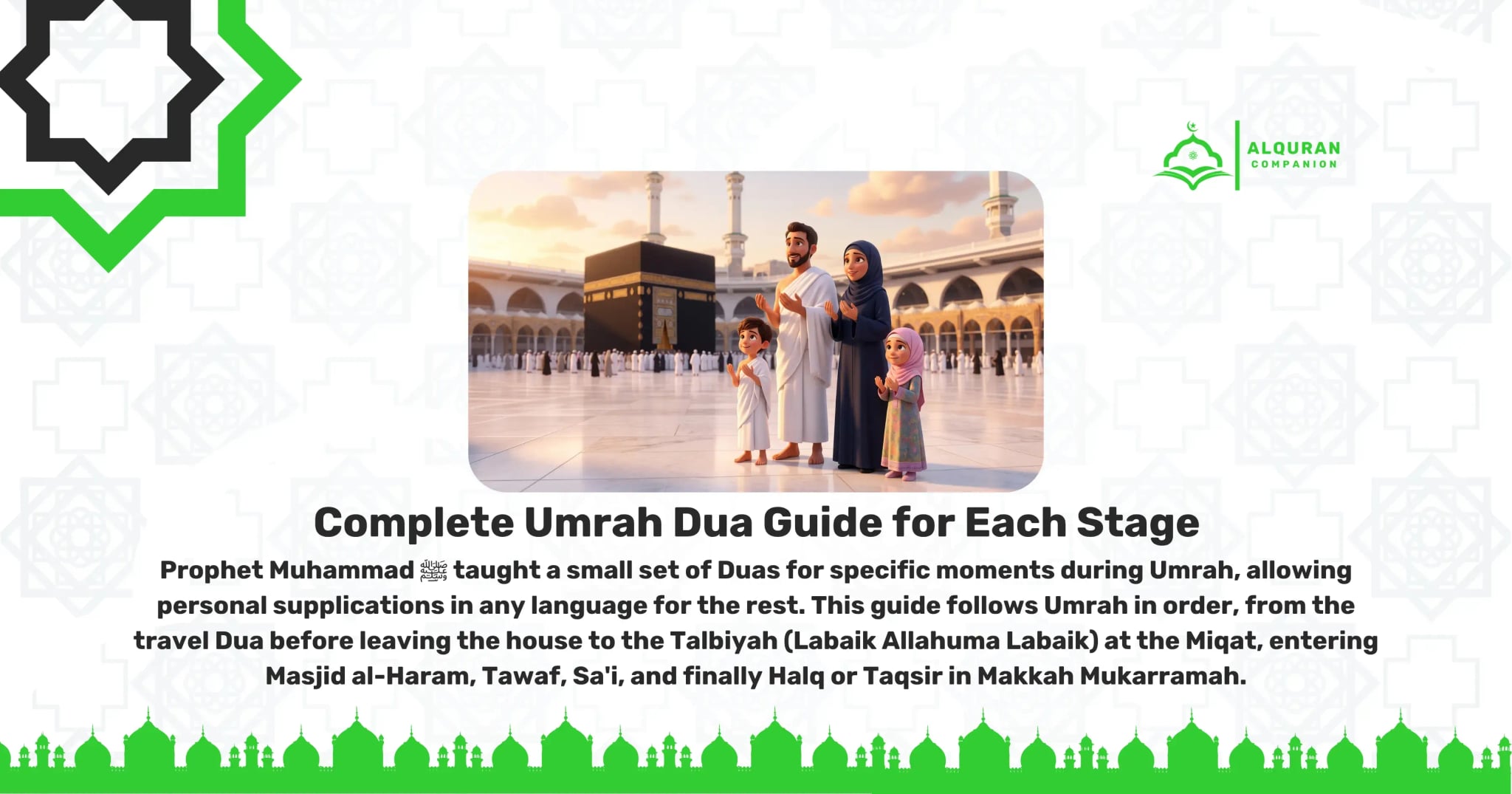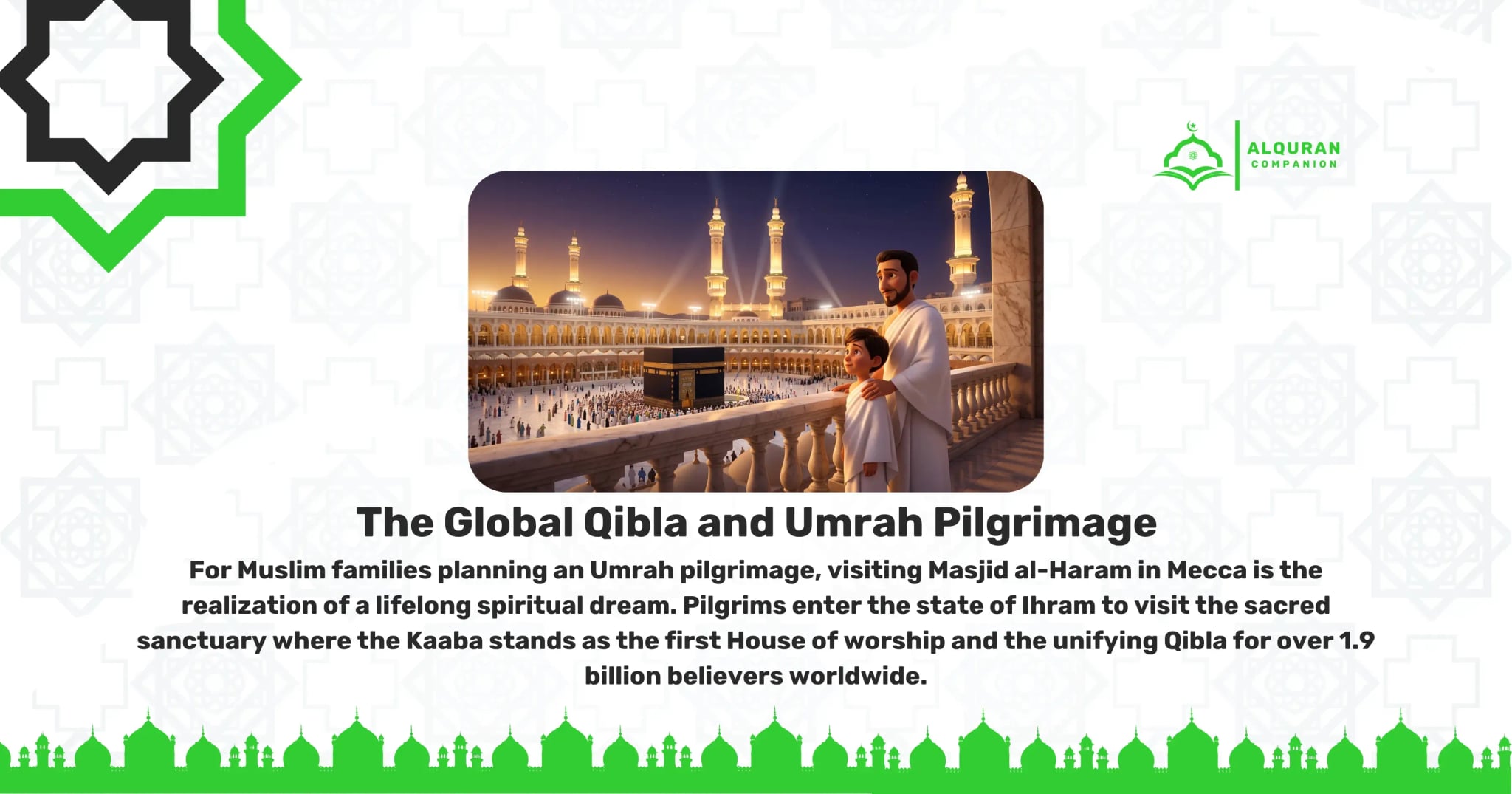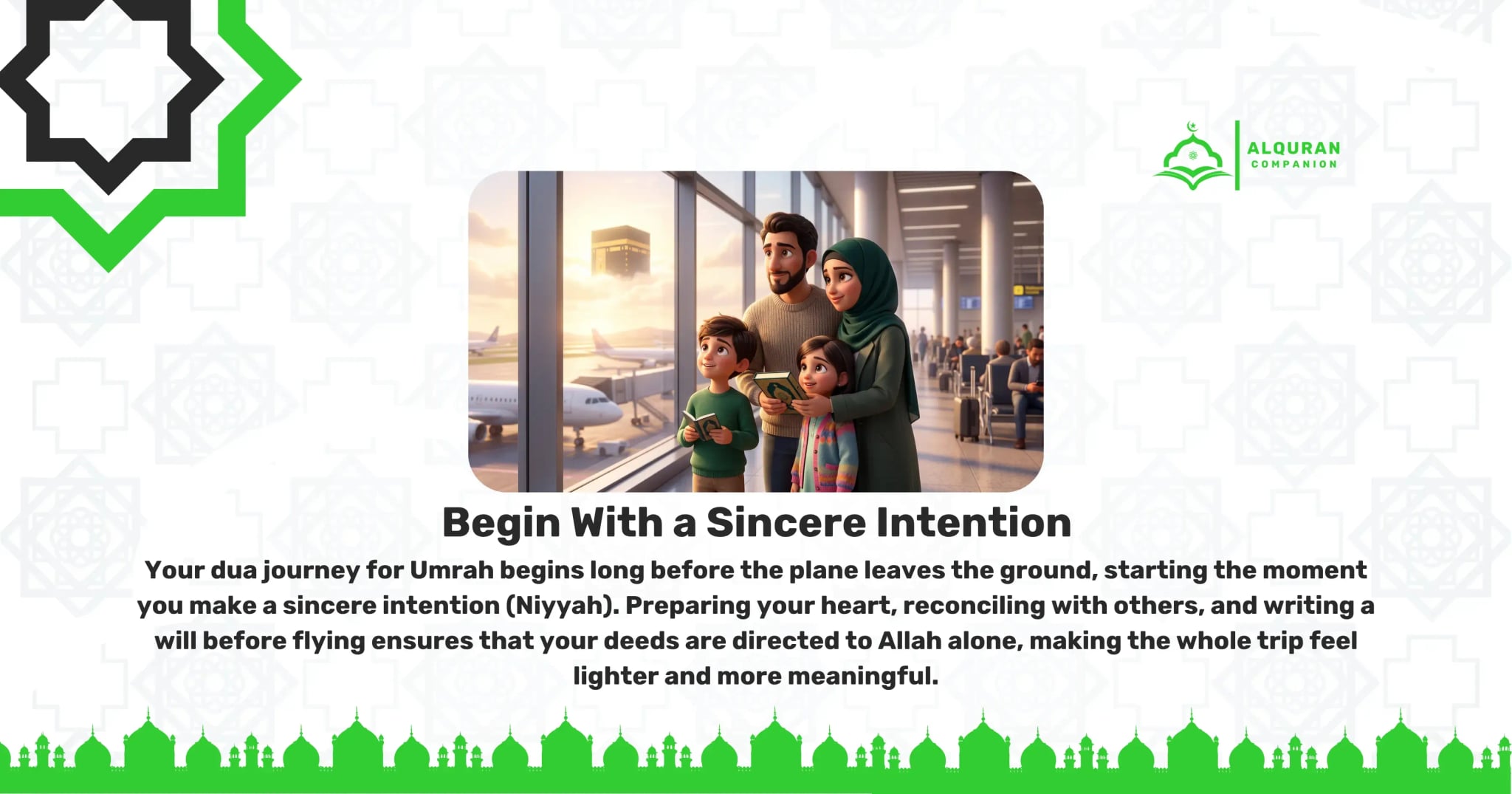
Every Umrah begins long before the plane leaves the ground. Your dua journey starts the moment you make the intention, and it carries on through the flight and the seven circuits around the Kaaba.
Many UK pilgrims arrive at Heathrow with a packed suitcase and a head full of worries. Will I remember the words? Will my children know what to say? Consider this: three or four weeks of small daily practice answers both questions.
This guide follows the order of the pilgrimage. Each stage has its Quranic verses and Prophetic Duas, along with the practice tips I use with my students. A four-week family plan at the end fits around work and school.
Table of Contents
- Why Does Intention (Ikhlas) Matter Before Your Dua Journey to Umrah?
- Surah Al-Bayyinah 98:5: The Command to Worship with Sincerity
- Quranic Guidance About Umrah: The Spiritual Reset Button
- Surah Al-Baqarah 2:196: Complete Hajj and Umrah for Allah
- Dua for Entering the Sacred Land of Makkah and Masjid Al-Haram
- Talbiyah for Umrah: Declaring Humility and Tawheed
- Labaik Allahuma Labaik: Pronunciation Tips for Every Pilgrim
- Dua for Travel: What to Say When the Plane Takes Off
- What Quranic Verses and Duas Should You Recite During Tawaf Around the Kaaba?
- Al-Hajar Al-Aswad: How to Greet the Black Stone
- Surah Al-Baqarah 2:201: The Dua Between the Two Corners
- Master Your Umrah Surahs and Duas Before You Fly
- Duas at Maqam Ibrahim: Surah Al-Kafirun and Drinking Zamzam Water
- Surah Al-Baqarah 2:125: Take the Station of Ibrahim as a Place of Prayer
- What Duas Do You Say During Sa'i Between Mount Safa and Mount Marwah?
- Surah Al-Baqarah 2:158: The Hills Are Symbols of Allah
- How to Prepare Spiritually 4 Weeks Before Umrah: Practical Tips for UK Pilgrims
- Conclusion: Turning Your UK Flight into a Lifelong Spiritual Turning Point
- Frequently Asked Questions
Key Takeaways
- Sincere intention (Niyyah and Ikhlas) comes first, as Surah Al-Bayyinah 98:5 and Sahih al-Bukhari 1 teach.
- Surah Al-Baqarah 2:196 is the Quranic command to complete Hajj and Umrah for Allah.
- The Talbiyah begins after Ihram, and the travel dua belongs to the moment your flight takes off.
- The two Rak'ahs behind Maqam Ibrahim are an emphasized Sunnah in the Shafi'i and Hanbali schools and wajib in the Hanafi school.
- Men jog between the two green lights during Sa'i, and women walk at a normal pace.
- Fifteen minutes a day for four weeks gives a working parent time to learn the core Umrah Duas.
Why Does Intention (Ikhlas) Matter Before Your Dua Journey to Umrah?
Niyyah (ن-و-ي) is the sincere intention in the heart that directs an act of worship to Allah alone, and Ikhlas (خ-ل-ص) is the purity of that intention. Surah Al-Bayyinah 98:5 commands sincere worship, and Sahih al-Bukhari 1 states that deeds are judged by intentions. For British Muslims, sincere intention means settling the heart before booking anything else.
Surah Al-Bayyinah 98:5: The Command to Worship with Sincerity
وَمَاۤ اُمِرُوۡۤا اِلَّا لِيَعۡبُدُوا اللّٰهَ مُخۡلِصِيۡنَ لَـهُ الدِّيۡنَ ۙ حُنَفَآءَ وَيُقِيۡمُوا الصَّلٰوةَ وَيُؤۡتُوا الزَّكٰوةَ وَذٰلِكَ دِيۡنُ الۡقَيِّمَةِ ؕ﴿٥﴾
wamā umirū illā liyaʿbudū l-laha mukh'liṣīna lahu l-dīna ḥunafāa wayuqīmū l-ṣalata wayu'tū l-zakata wadhālika dīnu l-qayimati
And they were not commanded except to worship Allāh, [being] sincere to Him in religion, inclining to truth, and to establish prayer and to give zakāh. And that is the correct religion.
The verse says people were ordered to worship Allah alone with sincere faith. Ibn Kathir explains in his Tafsir that sincerity means directing every act to Allah alone. Ikhlas comes from the Arabic root خ-ل-ص, which means to purify. Think of water filtered until nothing cloudy remains. Riya, from the root ر-أ-ي meaning to see, is the opposite: worship done to be seen. A pilgrim who posts every step for an audience risks emptying the deed of its meaning.
Here's the practical side. Clean your slate before you leave. The Prophet ﷺ forbade a Muslim from cutting off a brother for more than three nights (Sahih al-Bukhari). So phone the cousin you stopped speaking to after the wedding. Apologize to the colleague you snapped at last month. The Prophet ﷺ also taught that a Muslim who has something to leave behind should keep a written will ready (Sahih al-Bukhari, narrated by Ibn Umar (RA)). Write yours before you fly.
Once your heart is settled, look through the Umrah Packages from the UK and choose dates that suit your family and your leave from work. Book after you reconcile, and the whole trip feels lighter.
Quranic Guidance About Umrah: The Spiritual Reset Button
Umrah is the lesser pilgrimage to Makkah, from the Arabic root ع-م-ر meaning to visit. Surah Al-Baqarah 2:196 commands believers to complete Hajj and Umrah for the sake of Allah. For Muslims in London or Toronto with packed weeks, that command works as a spiritual reset button.
Surah Al-Baqarah 2:196: Complete Hajj and Umrah for Allah
وَاَتِمُّوا الۡحَجَّ وَالۡعُمۡرَةَ لِلّٰهِؕ فَاِنۡ اُحۡصِرۡتُمۡ فَمَا اسۡتَيۡسَرَ مِنَ الۡهَدۡىِۚ وَلَا تَحۡلِقُوۡا رُءُوۡسَكُمۡ حَتّٰى يَبۡلُغَ الۡهَدۡىُ مَحِلَّهٗ ؕ فَمَنۡ كَانَ مِنۡكُمۡ مَّرِيۡضًا اَوۡ بِهٖۤ اَذًى مِّنۡ رَّاۡسِهٖ فَفِدۡيَةٌ مِّنۡ صِيَامٍ اَوۡ صَدَقَةٍ اَوۡ نُسُكٍۚ فَاِذَآ اَمِنۡتُمۡ فَمَنۡ تَمَتَّعَ بِالۡعُمۡرَةِ اِلَى الۡحَجِّ فَمَا اسۡتَيۡسَرَ مِنَ الۡهَدۡىِۚ فَمَنۡ لَّمۡ يَجِدۡ فَصِيَامُ ثَلٰثَةِ اَيَّامٍ فِى الۡحَجِّ وَسَبۡعَةٍ اِذَا رَجَعۡتُمۡؕ تِلۡكَ عَشَرَةٌ كَامِلَةٌ ؕ ذٰ لِكَ لِمَنۡ لَّمۡ يَكُنۡ اَهۡلُهٗ حَاضِرِىۡ الۡمَسۡجِدِ الۡحَـرَامِؕ وَاتَّقُوا اللّٰهَ وَاعۡلَمُوۡٓا اَنَّ اللّٰهَ شَدِيۡدُ الۡعِقَابِ﴿١٩٦﴾
wa-atimmū l-ḥaja wal-ʿum'rata lillahi fa-in uḥ'ṣir'tum famā is'taysara mina l-hadyi walā taḥliqū ruūsakum ḥattā yablugha l-hadyu maḥillahu faman kāna minkum marīḍan aw bihi adhan min rasihi fafid'yatun min ṣiyāmin aw ṣadaqatin aw nusukin fa-idhā amintum faman tamattaʿa bil-ʿum'rati ilā l-ḥaji famā is'taysara mina l-hadyi faman lam yajid faṣiyāmu thalāthati ayyāmin fī l-ḥaji wasabʿatin idhā rajaʿtum til'ka ʿasharatun kāmilatun dhālika liman lam yakun ahluhu ḥāḍirī l-masjidi l-ḥarāmi wa-ittaqū l-laha wa-iʿ'lamū anna l-laha shadīdu l-ʿiqābi
And complete the ḥajj and ʿumrah for Allāh. But if you are prevented, then [offer] what can be obtained with ease of sacrificial animals. And do not shave your heads until the sacrificial animal has reached its place of slaughter. And whoever among you is ill or has an ailment of the head [making shaving necessary must offer] a ransom of fasting [three days] or charity or sacrifice. And when you are secure, then whoever performs ʿumrah [during the ḥajj months] followed by ḥajj [offers] what can be obtained with ease of sacrificial animals. And whoever cannot find [or afford such an animal] - then a fast of three days during ḥajj and of seven when you have returned [home]. Those are ten complete [days]. This is for those whose family is not in the area of al-Masjid al-Ḥarām. And fear Allāh and know that Allāh is severe in penalty.
The verse opens with a command: complete. Ibn Kathir notes in his Tafsir that the command binds a pilgrim to finish the rites once Ihram has begun. The four schools differ on the status of Umrah before that point. The Shafi'i and Hanbali schools say Umrah is obligatory once in a lifetime for those who are able. The Hanafi and Maliki schools say it is an emphasized Sunnah.
Why call it a reset button? Because a Western working week is loud. Emails and school runs fill every gap, and the Quran slips to the edge of the day. Umrah moves it back to the center. You stand in Makkah Mukarramah, where revelation first came to the Prophet Muhammad ﷺ, and you can visit Madinah Munawwarah, where he ﷺ built his mosque. Each year the days of Dhul Hijjah turn the whole Ummah toward Makkah, which makes them a natural reminder to prepare your own visit. For the full rules of the greater pilgrimage, read our complete guide to Hajj and pilgrimage in Islam.
Dua for Entering the Sacred Land of Makkah and Masjid Al-Haram
Isti'adhah (ع-و-ذ) is the act of seeking refuge in Allah, and the Prophet Muhammad ﷺ taught a refuge Dua for anyone who stops at a new place (Sahih Muslim 2708). He ﷺ also taught a mercy Dua for entering a mosque (Sahih Muslim 713). British pilgrims can use both from the first hour at a Makkah hotel.
Dua
A'udhu bi-kalimatillahi at-tammati min sharri ma khalaq
I seek refuge in the perfect words of Allah from the evil of what He has created.
Here's when to say it. Say the Dua when you reach your hotel in Makkah and at every new stop on the trip. Sahih Muslim 2708 records that whoever stops at a place and says these words will not be harmed by anything until they leave it. The words are short, so a young child can learn them in one evening.
Now the mosque. When you reach Masjid Al-Haram, enter with your right foot and ask Allah to open the doors of His mercy (Sahih Muslim 713).
Supplication Entering the Mosque
allahummaftah li abwaba rahmatik
O Allah, open the doors of Your mercy for me.
Then comes the moment that stays with a pilgrim for life: the first sight of the Kaaba. No wording is obligatory here, so ask Allah for what your heart needs in the language you know best. To understand why the sanctuary holds such weight, read our guide to Masjid Al-Haram in Makkah.
Talbiyah for Umrah: Declaring Humility and Tawheed
The Talbiyah is the Prophetic chant of pure monotheism and humble servitude, from the Arabic root ل-ب-ب meaning to answer a call. Pilgrims recite it from Ihram at the Miqat until Tawaf begins at Masjid Al-Haram (Sahih al-Bukhari 1549; Sahih Muslim 1184). Chanting it on a flight from London Heathrow or Manchester anchors the heart in Tawheed.
Dua
Labbayk Allahumma labbayk, labbayka la sharika laka labbayk, innal-hamda wan-ni'mata laka wal-mulk, la sharika lak
Here I am, O Allah, here I am. Here I am, You have no partner, here I am. Indeed all praise, favor and sovereignty belong to You. You have no partner.
Tawheed, from the Arabic root و-ح-د meaning one, is the Oneness of Allah. Every line of the Talbiyah declares it. 'Here I am, O Allah, here I am' is the answer of a servant who was called. 'You have no partner' removes every rival from the heart. Men raise their voices when reciting, and women recite quietly. That is the position across the four schools. The schools differ slightly on the exact point where an Umrah pilgrim stops the Talbiyah, so ask your group scholar which view to follow.
Labaik Allahuma Labaik: Pronunciation Tips for Every Pilgrim
Good Quran pronunciation starts with the Makharij. Makharij al-Huroof refers to the specific articulation points in the throat, tongue, lips and nasal cavity from which Arabic letters originate. Two details matter most in the Talbiyah. Labbayk carries a Shaddah on the letter Ba, so hold the doubled Ba for a full beat. Allahumma ends with a doubled Meem, which carries a nasal Ghunnah of two counts.
In our live 1-on-1 classes, we frequently hear adults flatten the doubled Ba into a single soft sound. A two-minute correction fixes it. Our Quranic Tajweed course trains these exact skills, and our guide to Labaik Allahuma Labaik walks through the full wording for each stage of Umrah.
Dua for Travel: What to Say When the Plane Takes Off
Travel Supplication
allahu akbar, allahu akbar, allahu akbar. subhanalladhi sakhkhara lana hadha wa ma kunna lahu muqrinin wa inna ila rabbina lamunqalibun. allahumma inna nas'aluka fi safarina hadhal-birra wat-taqwa wa minal-'amali ma tarda. allahumma hawwin 'alayna safarana hadha watwi 'anna bu'dah. allahumma antas-sahibu fis-safar. wal-khalifatu fil-ahl. allahumma inni a'udhu bika min wa'tha'is-safar wa ka'abatil-mandhari wa su'il-munqalabi fil-mali wal-ahl
Allah is the Greatest, Allah is the Greatest, Allah is the Greatest. Glory be to Him who has provided this for us, though we could never have had it by our own efforts. Surely to our Lord we are returning. O Allah, we ask You for righteousness and piety in this journey of ours, and for deeds that please You. O Allah, lighten for us the hardship of this journey and quickly bring us to our destination. O Allah, You are our Companion on the journey and the Guardian of our families. O Allah, I seek refuge in You from the hardship of travel, from a bad return, and from seeing something unpleasant concerning our wealth, family, or children.
The travel dua is the Sunnah supplication for anyone setting out on a journey. Sahih Muslim records that the Prophet ﷺ said Allahu Akbar three times and then recited it when he mounted his camel for a journey. The opening words echo Surah Az-Zukhruf 43:13-14. Today's camel is a plane from Heathrow or Manchester. On a flight of roughly six hours, you have time to repeat the Dua and to chant the Talbiyah once your intention is made. For a deeper look, read our guide to the travel dua in Islam.
What Quranic Verses and Duas Should You Recite During Tawaf Around the Kaaba?
Tawaf (ط-و-ف) is the act of circling the Kaaba seven times, and no single Dua is fixed for all seven circuits. Sahih al-Bukhari, narrated by Ibn Abbas (RA), records the Takbir at Al-Hajar Al-Aswad, and Surah Al-Baqarah 2:201 is recited between the Yemeni Corner and the Black Stone. Prepared short Duas help diaspora pilgrims stay focused.
Al-Hajar Al-Aswad: How to Greet the Black Stone
Al-Hajar Al-Aswad is the Black Stone set into the eastern corner of the Kaaba. Urdu-speaking families call it Hajr e Aswad. Each circuit begins and ends at the line of the stone. If the crowd allows, kiss it. If the crowd is too thick, point toward it and say Allahu Akbar, as Sahih al-Bukhari records the Prophet ﷺ doing in the report of Ibn Abbas (RA).
Dua
Bismillahi wallahu akbar
In the name of Allah, and Allah is the Greatest.
Umar ibn al-Khattab (RA) taught pilgrims the right attitude. He said that he knew the stone could neither harm nor benefit, and that he kissed it only because he saw the Prophet ﷺ kiss it (Sahih al-Bukhari). That is Ikhlas in action. Ibn Umar (RA) is also reported to have added Bismillah before the Takbir. Never push others to reach the stone. Pointing from a distance is a valid Sunnah.
Surah Al-Baqarah 2:201: The Dua Between the Two Corners
وَمِنۡهُمۡ مَّنۡ يَّقُوۡلُ رَبَّنَآ اٰتِنَا فِى الدُّنۡيَا حَسَنَةً وَّفِى الۡاٰخِرَةِ حَسَنَةً وَّ قِنَا عَذَابَ النَّارِ﴿٢٠١﴾
wamin'hum man yaqūlu rabbanā ātinā fī l-dun'yā ḥasanatan wafī l-ākhirati ḥasanatan waqinā ʿadhāba l-nāri
But among them is he who says, "Our Lord, give us in this world [that which is] good and in the Hereafter [that which is] good and protect us from the punishment of the Fire."
The verse asks for good in this life and the next, and for protection from the Fire. Sunan Abi Dawud records, from Abdullah ibn al-Sa'ib (RA), that the Prophet Muhammad ﷺ recited it between the Yemeni Corner (Ar-Rukn Al-Yamani) and the Black Stone. Touch the Yemeni Corner with your right hand if the crowd allows, and keep walking if it does not.
Fill the rest of each circuit with Dhikr. Sahih Muslim records, from Samurah ibn Jundub (RA), that the Prophet Muhammad ﷺ called four phrases the most beloved speech to Allah: SubhanAllah, Alhamdulillah, La ilaha illallah and Allahu Akbar. Here is a simple plan for all seven circuits:
- Begin each circuit at the line of the Black Stone and say Allahu Akbar.
- Recite Surah Al-Baqarah 2:201 between the Yemeni Corner and the Black Stone.
- Fill the rest of the circuit with SubhanAllah, Alhamdulillah, La ilaha illallah and Allahu Akbar.
- Make personal Dua in your own language at any point.
Master Your Umrah Surahs and Duas Before You Fly
Knowing a Dua on paper is easy. Saying it calmly in a crowd is harder. Here's the good news: a few weeks of guided practice closes that gap. At Al Quran Companion, we always conduct comprehensive Background Checks and detailed multi-stage reviews of every single teacher before they are certified to teach our students. Qualified female teachers are available for sisters and daughters, and male teachers are available for brothers and sons. Adult learners and first-time pilgrims get private, patient, judgment-free 1-on-1 guidance at their own pace. Your first lesson is a live 1-on-1 session with zero commitment and no payment upfront.
Duas at Maqam Ibrahim: Surah Al-Kafirun and Drinking Zamzam Water
Maqam Ibrahim, from the Arabic root ق-و-م meaning to stand, is the stone where Prophet Ibrahim (AS) stood while building the Kaaba. After Tawaf, pilgrims pray two Rak'ahs behind it, reciting Surah Al-Kafirun and Surah Al-Ikhlas after Al-Fatiha (Surah Al-Baqarah 2:125; Sahih Muslim 1218). Both Surahs are short, so diaspora families can learn them at home.
Surah Al-Baqarah 2:125: Take the Station of Ibrahim as a Place of Prayer
وَاِذۡ جَعَلۡنَا الۡبَيۡتَ مَثَابَةً لِّلنَّاسِ وَاَمۡنًا ؕ وَاتَّخِذُوۡا مِنۡ مَّقَامِ اِبۡرٰهٖمَ مُصَلًّى ؕ وَعَهِدۡنَآ اِلٰٓى اِبۡرٰهٖمَ وَاِسۡمٰعِيۡلَ اَنۡ طَهِّرَا بَيۡتِىَ لِلطَّآٮِٕفِيۡنَ وَالۡعٰكِفِيۡنَ وَالرُّکَّعِ السُّجُوۡدِ ﴿١٢٥﴾
wa-idh jaʿalnā l-bayta mathābatan lilnnāsi wa-amnan wa-ittakhidhū min maqāmi ib'rāhīma muṣallan waʿahid'nā ilā ib'rāhīma wa-is'māʿīla an ṭahhirā baytiya lilṭṭāifīna wal-ʿākifīna wal-rukaʿi l-sujūdi
And [mention] when We made the House [i.e., the Kaʿbah] a place of return for the people and [a place of] security. And take, [O believers], from the standing place of Abraham a place of prayer. And We charged Abraham and Ishmael, [saying], "Purify My House for those who perform ṭawāf and those who are staying [there] for worship and those who bow and prostrate [in prayer]."
The verse tells believers to take Maqam Ibrahim as a place of prayer. Sahih Muslim 1218 records that Jabir (RA) described the Prophet Muhammad ﷺ praying two Rak'ahs with the station between him and the Kaaba, reciting Surah Al-Kafirun and Surah Al-Ikhlas after Al-Fatiha. The Shafi'i and Hanbali schools classify these two Rak'ahs as an emphasized Sunnah, and the Hanafi school classifies them as wajib. None of the four schools says that missing them cancels the Tawaf.
You can strengthen this prayer by reciting Surah Al-Kafirun and Surah Al-Ikhlas (from the 4 Qul) daily for a month before travel. Surah Al-Kafirun has six verses and Surah Al-Ikhlas has four, so both fit inside a 15-minute daily session with time to spare.
Zamzam comes next. The Prophet Muhammad ﷺ said that the water of Zamzam is for whatever it is drunk for (Sunan Ibn Majah 3062). Face the Kaaba and drink in sips while you ask Allah for what you need most.
Supplication for Beneficial Knowledge, Good Provision, and Accepted Deeds
allahumma inni as'aluka 'ilman nafi'an, wa rizqan tayyiban, wa 'amalan mutaqabbalan
O Allah, I ask You for beneficial knowledge, good provision, and accepted deeds.
The Dua above, narrated by Umm Salamah (RA) in Sunan Ibn Majah, asks Allah for beneficial knowledge, good provision and accepted deeds. Before you leave for Sa'i, Jabir (RA) reports that the Prophet Muhammad ﷺ returned to the Black Stone and touched it (Sahih Muslim 1218). Do the same if the crowd is manageable, then head for Mount Safa.
What Duas Do You Say During Sa'i Between Mount Safa and Mount Marwah?
Sa'i, from the Arabic root س-ع-ي meaning to strive, is the seven-lap walk between Mount Safa and Mount Marwah that commemorates Hajar (AS) searching for water for her infant son, Prophet Ismail (AS). Surah Al-Baqarah 2:158 calls both hills symbols of Allah (Sahih Muslim 1218). Working parents in the West will recognize her effort.
Surah Al-Baqarah 2:158: The Hills Are Symbols of Allah
اِنَّ الصَّفَا وَالۡمَرۡوَةَ مِنۡ شَعَآٮِٕرِ اللّٰهِۚ فَمَنۡ حَجَّ الۡبَيۡتَ اَوِ اعۡتَمَرَ فَلَا جُنَاحَ عَلَيۡهِ اَنۡ يَّطَّوَّفَ بِهِمَا ؕ وَمَنۡ تَطَوَّعَ خَيۡرًا ۙ فَاِنَّ اللّٰهَ شَاكِرٌ عَلِيۡمٌ﴿١٥٨﴾
inna l-ṣafā wal-marwata min shaʿāiri l-lahi faman ḥajja l-bayta awi iʿ'tamara falā junāḥa ʿalayhi an yaṭṭawwafa bihimā waman taṭawwaʿa khayran fa-inna l-laha shākirun ʿalīmun
Indeed, aṣ-Ṣafā and al-Marwah are among the symbols of Allāh. So whoever makes ḥajj [pilgrimage] to the House or performs ʿumrah - there is no blame upon him for walking between them. And whoever volunteers good - then indeed, Allāh is Appreciative and Knowing.
Jabir (RA) reports in Sahih Muslim 1218 that the Prophet Muhammad ﷺ recited this verse as he approached Safa. He then said that he begins with what Allah began with, since the verse names Safa first.
Dua
Abda'u bima bada'Allahu bihi
I begin with what Allah began with.
At Safa, he ﷺ climbed until he saw the Kaaba, faced it, and declared the Oneness and greatness of Allah. He recited the words below three times with Dua in between.
Dua
La ilaha illallahu wahdahu la sharika lah, lahul-mulku wa lahul-hamdu wa huwa 'ala kulli shay'in qadir. La ilaha illallahu wahdah, anjaza wa'dah, wa nasara 'abdah, wa hazamal-ahzaba wahdah
There is no god but Allah alone, with no partner. His is the dominion and His is the praise, and He has power over all things. There is no god but Allah alone. He fulfilled His promise, gave victory to His servant, and defeated the confederates alone.
At Marwah he did the same. Each trip from one hill to the other counts as one lap, so Sa'i ends at Marwah after seven laps. Men jog lightly between the two green lights. The four schools agree that this jog applies to men only, and women walk at a normal pace. Children find Sa'i easy to love because it is a story they can walk. Tell them about Hajar (AS) before you arrive, so the hills mean something when they stand on them.
How to Prepare Spiritually 4 Weeks Before Umrah: Practical Tips for UK Pilgrims
How to Prepare Spiritually 4 Weeks Before Umrah: Practical Tips for UK Pilgrims
The 4-Week Pre-Umrah Family Quran & Dua Sprint is a daily 15-minute routine for memorizing Umrah Duas and reciting short Surahs with correct Tajweed. The Prophet Muhammad ﷺ taught that the most beloved deeds to Allah are the consistent ones (Sahih al-Bukhari 6464). The routine suits busy UK households.
- 1
Start Memorizing Duas 3 to 4 Weeks Early
Pick one Dua per stage: Talbiyah, entering Makkah, Tawaf, Zamzam, Sa'i. Learn one every few days for 15 minutes. Repeat each aloud ten times, then recite it from memory before bed. Short daily sessions beat one long weekend cram.
- 2
Prepare a Digital App and Pocket Booklet
Save a Quran app with audio on your phone and carry a printed pocket booklet of your Duas. The audio teaches correct Quran pronunciation. The booklet helps when a crowd leaves no space to take out a phone. Keep both in hand luggage.
- 3
Redeem Long-Haul Flight Hours in Dhikr
Treat the flight as a classroom. Recite the travel dua at take-off, then repeat your Duas quietly in your seat. Use the Dhikr of SubhanAllah, Alhamdulillah, La ilaha illallah and Allahu Akbar between meals and films. Switch off the screen for the final hour.
- 4
Practice Daily Co-Recitation With Your Children
Sit together for 15 minutes. Say each line once, then let the children repeat it. Start with the Talbiyah, then add one new Dua each week. Praise effort and avoid corrections in front of siblings. Short sessions keep young learners calm and interested.
- 5
Adjust to Makkah Time (GMT+3) to Protect Energy
Makkah runs on GMT+3, which is three hours ahead of the UK in winter and two hours ahead in summer. Shift bedtime and wake time by 20 minutes every two days. Pray Fajr on time each morning so you arrive rested for Tawaf and Sa'i.
Why does this plan work? Classical Quran learning moves in small daily portions and returns to them often. A teacher then listens and corrects the sound. In our live 1-on-1 classes, we frequently see pilgrims who learned a Dua once and lost it by the airport. Our senior Ijazah-certified tutors recommend a daily 15-minute spaced-repetition schedule to overcome that last-minute forgetting.
Schedules differ, so the plan bends to fit. Working professionals in London or Birmingham can read our tips on fitting 15-minute online Quran classes in the UK into your busy schedule to see how short lessons slot into a commute. Families in Toronto face icy evening commutes, so a lesson at the kitchen table helps. Families in Dubai or Sydney can pick a slot that fits their own school calendar. If you plan to travel in the school holidays or in Ramadan, begin your four weeks before you pay the final balance, because late bookings leave little time to practice.
Pronunciation deserves its own slot in the plan. Our online Quran Recitation and Tajweed course trains the Makharij and Tajweed rules behind every Dua, and a certified tutor listens to each recitation. Free apps teach the words. A live teacher fixes the sound. Fifteen focused minutes a day is the whole plan.
Save this quick reference on your phone before you travel.
Umrah Recitation Quick Reference
| Stage | What to Recite | Source |
|---|---|---|
| Arriving in Makkah | Refuge in Allah's perfect words | Sahih Muslim 2708 |
| Entering Masjid Al-Haram | Dua for the doors of mercy | Sahih Muslim 713 |
| Ihram to Tawaf | Talbiyah | Sahih al-Bukhari 1549 |
| Black Stone | Takbir | Sahih al-Bukhari |
| Yemeni Corner to Black Stone | Surah Al-Baqarah 2:201 | Quran; Sunan Abi Dawud |
| Behind Maqam Ibrahim | Surah Al-Kafirun, Surah Al-Ikhlas | Sahih Muslim 1218 |
| Drinking Zamzam | Any sincere Dua | Sunan Ibn Majah 3062 |
| Atop Safa and Marwah | Tawheed and Takbir | Sahih Muslim 1218 |
Arriving in Makkah
Entering Masjid Al-Haram
Ihram to Tawaf
Black Stone
Yemeni Corner to Black Stone
Behind Maqam Ibrahim
Drinking Zamzam
Atop Safa and Marwah
Self-study with an app is free and flexible. A live teacher adds correction and accountability. Here is the trade-off:
Learning Umrah Duas With a Live 1-on-1 Teacher
Pros
- Instant correction of Makharij and Tajweed errors
- Lessons matched to your Umrah dates
- A patient guide keeps children engaged
- Live feedback on every Dua before you travel
Cons
- Needs a fixed weekly time slot
- Requires a quiet space and stable internet
- Costs more than a free app
Expert Insight
"Pilgrims often ask me for the longest list of Duas. I tell them to choose six and know them well. A short Dua said with a present heart keeps you focused far better than ten read in a rush."
Conclusion: Turning Your UK Flight into a Lifelong Spiritual Turning Point
Tadabbur (د-ب-ر) is the careful reflection on the meanings of the Quran, from the Arabic root meaning to look at the end of a matter. Surah Sad 38:29 says the Quran was sent down so that people ponder its verses. For Muslims in the West, a prepared Umrah can reset the habits of a whole year.
Your dua journey begins with a clean intention and ends with a heart that keeps the Quran close. Tadabbur turns the verses you recite at Maqam Ibrahim and on Safa into meaning you carry home. The Prophetic Duas give your tongue the words to match. Here's the truth: the landing in Jeddah is the middle of the story, and the habits you build in the four weeks before it shape what you bring back.
When the heart is ready, the logistics matter. Bismillah Travel arranges Umrah packages from the UK. Ask the seller to confirm ATOL protection on your booking, and check that your dates and hotel distance suit your family.
At Al Quran Companion, our certified Ijazah-holding instructors use personalized diagnostic assessments to find the exact Makharij hurdles in your recitation. Book a free 1-on-1 Pre-Umrah Quran & Dua Readiness Assessment with our background-checked male and female Quran teachers, and master your Surahs and Umrah Duas from home. Insha'Allah, your Umrah will begin from a place of confidence.
Frequently Asked Questions

Sheikh Abdullah Al-Hanif
Verified AuthorSheikh Abdullah Al-Hanif is the Head of Education at Al Quran Companion. With over 15 years of experience in Tajweed and Hifz, he specializes in bridging the gap between classical Islamic tradition and modern digital pedagogy. He is passionate about making the Quran accessible to everyone—from energetic toddlers to busy professionals.
Read more about author