
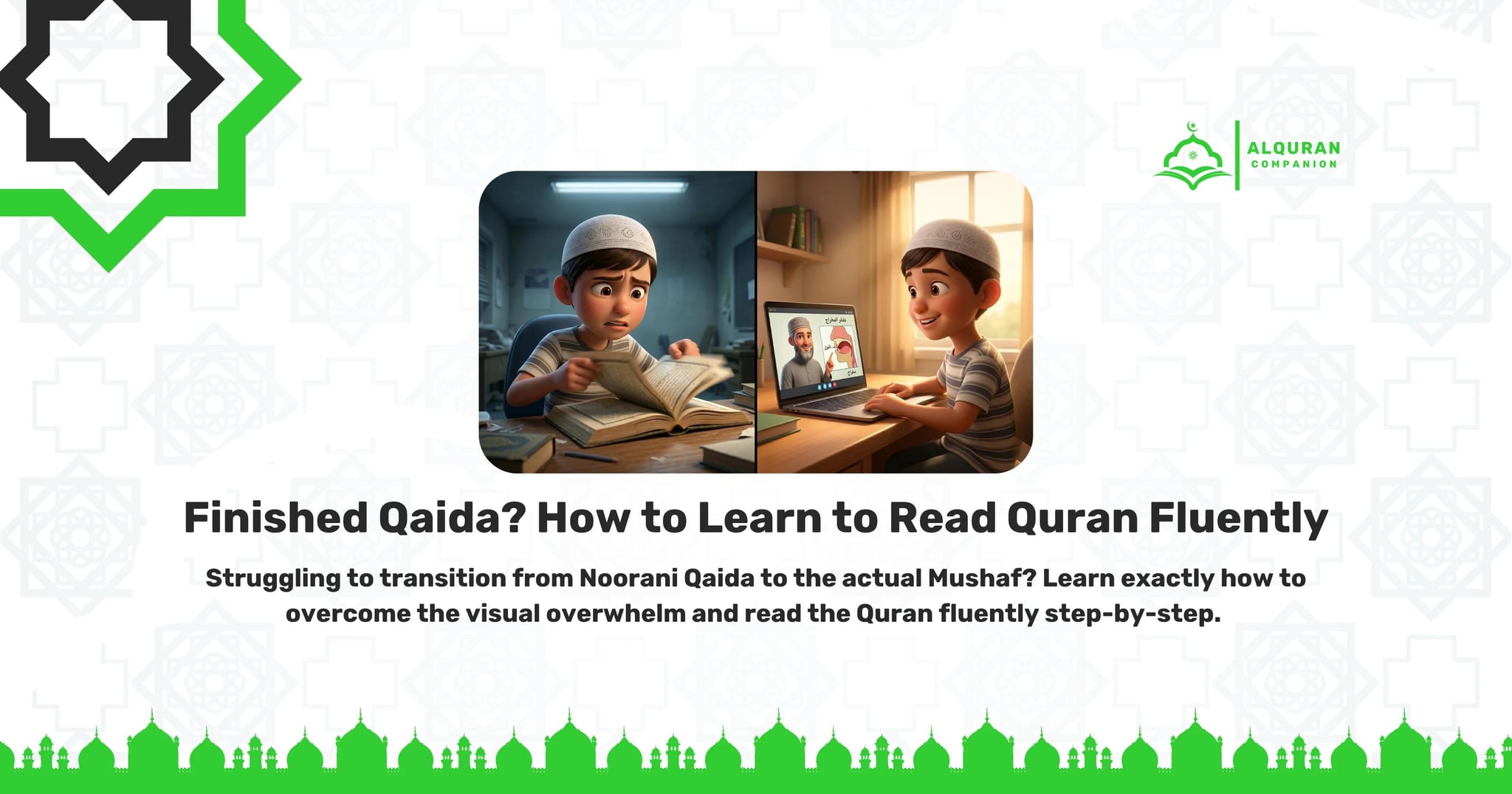
You proudly post on the family WhatsApp group: "My seven-year-old just finished their first Khatam!" Relatives flood the chat with heart emojis and praises. You feel a massive surge of parental pride. But then, you sit down to listen to them recite Surah Al-Fatiha during Maghrib Salah. Your heart sinks. The letters mash together into an unrecognizable blur. The Haa sounds exactly like the Khaa. The necessary elongations are completely missing. You suddenly realize a bitter truth: your child didn’t actually read the words of Allah. They just raced through them to cross a finish line.
This is the silent epidemic ruining the modern quran class for kids. We treat the Holy Book like a sprint. We measure our children's success by the calendar, not by the accuracy of their tongue. We push them to complete pages upon pages, ignoring the massive pronunciation errors piling up along the way. But rushing destroys pronunciation entirely. It builds deep-rooted, stubborn bad habits that will take your child years of painful, frustrating unlearning to fix.
If you want your child to truly connect with the Quran, you must completely rethink how they learn it. You must strip away the cultural pressure and return to the Prophetic method of recitation. Stop asking when they will finish, and start asking how they sound when they read.
The Cultural Trap of the "Speed Khatam"
A "speed Khatam" happens when parents prioritize finishing the Quran quickly over accurate recitation. This cultural pressure forces children to rush, leading to severe pronunciation errors and a lifelong struggle with incorrect Tajweed.
Many of us grew up in environments where the primary goal of Islamic education was sheer volume. The faster you finished the Noorani Qaida, the smarter you were deemed to be. Local mosques and traditional madrasahs often operated like assembly lines. Teachers, overwhelmed with thirty screaming students, would simply tap their sticks and nod as kids mumbled through verses at breakneck speeds. The only objective was to get to the end of the Juz.
This mindset completely ignores the fundamental purpose of revelation. Allah did not send down the Quran to be skimmed. He sent it to be pondered, understood, and recited with beauty and precision. When you prioritize speed, you actively train your child to disrespect the weight of the words they are carrying. You signal to them that the Quran is a chore to complete rather than a lifelong companion to cherish.
اَوۡ زِدۡ عَلَيۡهِ وَرَتِّلِ الۡقُرۡاٰنَ تَرۡتِيۡلًا ؕ﴿٤﴾
Or add to it, and recite the Qur’ān with measured recitation.
Understanding the health benefits of reciting Quran properly shows us that measured, rhythmic reading actually calms the nervous system. Rushing creates anxiety. Your child sits in front of their teacher, heart pounding, terrified of stumbling, just trying to get the page over with. This is not how we nurture a love for Islam.
Why Speed Destroys Tajweed (And Alters the Meaning)
Reading the Quran too fast destroys Tajweed by merging distinct letters, dropping essential vowels, and ignoring elongation rules. This careless speed can entirely change the meaning of Allah’s words during recitation.
Arabic is a surgically precise language. A millimeter of movement in the tongue changes the entire meaning of a sentence. When a child reads too quickly, their mouth physically cannot keep up with the demands of proper articulation (Makharij). The heavy letters become light. The throat letters get swallowed.
Here is exactly what happens when you let a child race through their daily lesson:
- Catastrophic Meaning Changes: The most famous example is the difference between Qalb (Heart) and Kalb (Dog). A rushing child will invariably pronounce the heavy 'Qaf' as a light 'Kaf'. Imagine the severity of changing the meaning of Allah's words during your daily prayers. If you want to understand the depth of this issue, review the 7 common Tajweed mistakes that change the meaning of your Salah.
- Erasing the Madd (Elongation): Speed readers chop off the natural flow of the Quran. The mandatory 2-beat, 4-beat, or 6-beat elongations completely vanish. The recitation sounds harsh, flat, and robotic.
- Swallowing the Ghunnah: The beautiful nasal hum of the double noon or meem is the signature sound of a polished reciter. Fast reading completely bypasses the nasal cavity, stripping the recitation of its intended beauty.
When you look back and analyze when the Quran was written and preserved, it was preserved with these exact phonetic rules intact. To ignore them for the sake of finishing a page five minutes earlier is a disservice to the preservation of the text.
The 3 Hidden Dangers of a Rushed Quran Class for Kids
A rushed Quran class for kids creates three hidden dangers: it builds permanent bad habits in muscle memory, causes severe spiritual burnout, and turns the sacred act of recitation into a stressful, robotic chore rather than an act of worship.
The damage goes far beyond just a few mispronounced words. You are actively wiring your child's brain to fail. The vocal cords and the tongue rely heavily on muscle memory. When an eight-year-old reads a word incorrectly fifty times because they are speeding, their brain locks that incorrect sound into their neural pathways.
The Prophet (ﷺ) said, "The best among you (Muslims) are those who learn the Qur'an and teach it
By the time they are teenagers and realize their Tajweed is weak, fixing it requires immense psychological effort. They have to actively fight their own muscles every time they open the Mushaf. Many adults simply give up because the unlearning process feels too humiliating and difficult.
The second hidden danger is the emotional disconnect. Children associate speed with stress. If every lesson is a race against the clock, the Quran becomes an antagonist in their daily routine. You will notice them sighing heavily when it's time to log on to their class. You might even find yourself bribing them to read the Quran just to get them to sit still. This resentment festers. Once they leave your house, they will likely never open the Book again because it only reminds them of pressure and anxiety.
Finally, rushing prevents any deep spiritual reflection. A child cannot possibly absorb the gravity of the words if they are reading at 100 miles per hour. They miss the rhythm, the emotional tone shifts, and the majestic flow of the Arabic language.
How to Fix Bad Pronunciation: The Quality Over Quantity Rule
To fix bad pronunciation, shift your focus from quantity to quality. Enroll your child in online programs that prioritize slow, deliberate reading, expert feedback, and the absolute mastery of foundational Arabic sounds.
You must stage an immediate intervention. If you notice your child rushing, close the Mushaf. Tell them directly: "I would rather you read one single line perfectly over ten minutes than five pages incorrectly in two minutes." You have to reset their entire paradigm.
Start by taking them back to the basics. Do not let your ego get in the way. If your child has finished the Qaida but still struggles with basic articulation, make them do it again. But this time, do it slowly. Focus exclusively on the throat letters (Haa, Ayn, Ghayn, Khaa). Make them practice these individual sounds in front of a mirror so they can physically see the shape of their mouth changing.
If you are trying to help them memorize, you must strictly implement the 1% rule of Quran memorization. Memorizing small, manageable chunks with absolute phonetic perfection builds extreme confidence. When a child knows they sound good, they naturally want to read more. They begin to enjoy the sound of their own voice reciting the words of their Creator. That is the exact moment the Quran shifts from a chore to a lifelong passion.
Choosing the Best Online Quran Classes for Kids
The best online quran classes for kids prioritize individual pacing over rigid timelines. Look for qualified tutors who enforce strict Tajweed rules, use interactive methods, and encourage a love for recitation rather than just a quick completion.
Your child's teacher makes or breaks their experience. You cannot rely on a tutor who lets mistakes slide just to keep parents happy with rapid progress. You need an educator who has the backbone to stop a student mid-sentence and correct a mispronounced letter, even if it means staying on the same page for three days straight.
When you decide to learn quran with tajweed, you need an environment built for focus. This is exactly why we stopped looking for local classes and moved online. A dedicated one-on-one session removes the pressure of peers. The teacher can zoom in on your child's specific vocal challenges. They can demonstrate the exact tongue placement required for difficult letters. This targeted approach is impossible in a crowded, noisy local mosque setting.
You must ask the right questions before hiring anyone. Before handing over your money, ask the institution directly: "What is your policy on speed versus accuracy?" If they boast about how fast their students finish the Quran, walk away immediately. Choose academies that explicitly state they do not compromise on Tajweed.
Prioritize Perfection Over Speed Today
Your child's spiritual foundation is entirely in your hands. Do not sacrifice their permanent connection to Allah’s Book for a temporary boast on social media. A Khatam completed with mangled words and rushed breaths holds no true value. You must completely shift your family's focus back to quality, patience, and absolute phonetic precision.
If you are tired of watching your child struggle, it is time to intervene. The right quran class for kids does not just teach them how to read; it teaches them how to revere the text. It builds their confidence, fixes their deeply ingrained bad habits, and shows them the profound beauty of authentic recitation. Stop the race today. Slow down, correct the foundation, and watch your child fall in love with the Quran.
Frequently Asked Questions

Al Quran Companion Team
Verified AuthorThe official academic and editorial team at Al Quran Companion, a leading Online Quran Academy dedicated to simplifying Tajweed, Hifz, and Islamic studies for students worldwide.
Read more about author