You watch your four-year-old effortlessly navigate a tablet. You marvel at their memory when they recite the dialogue of their favorite cartoon characters word for word. Yet, when you consider registering them to learn quran online for kids, a familiar hesitation creeps in. Are they too young? Will staring at a screen for a religious class bore them to tears?
You desperately want them to connect with the words of Allah. You dream of hearing their tiny voices reciting Surah Al-Fatiha correctly. But you are terrified that pushing them too early will breed resentment rather than love. Wait too long, and you miss the golden window of early childhood memorization. Start too aggressively with outdated methods, and you risk making the Book of Allah feel like a punishment. So, what is the right move?
The Cognitive Sweet Spot: Is 4 Years Old Too Early?
Four years old is not too early to start learning the Quran. In fact, ages four to five represent a golden cognitive window for phonetic absorption, allowing children to mimic correct Arabic pronunciation effortlessly. The secret lies entirely in a gentle, play-based introduction rather than rigid, hour-long memorization drills.
At this exact age, a child’s brain is highly plastic. They absorb languages naturally, completely bypassing the thick accents that adults struggle to shake off. When a four-year-old hears the deep, guttural sound of the Arabic letter 'Kha', they do not overthink the mechanics of their throat. They simply mimic the sound. This biological advantage makes establishing a foundation in Quranic Tajweed significantly easier during the toddler years. The best age to start Noorani Qaida aligns perfectly with this developmental burst.
However, there is a massive caveat. A four-year-old’s readiness is entirely dependent on the method of teaching. If your idea of a Quran class involves forcing a toddler to sit perfectly still on a hard floor for forty-five minutes while a strict teacher points a stick at a book, then yes, four is absolutely too early. But if the environment is interactive, brief, and highly encouraging, four is the perfect starting line.
Science Meets Sunnah: The Sponge Phase
Islamic tradition places an enormous emphasis on securing a child's spiritual foundation from the moment they enter the world. We whisper the Adhan into the ears of our newborns. We encourage them to stand beside us during Salah long before they understand the physical movements. This early exposure is not accidental; it is a deeply profound Prophetic methodology designed to normalize the remembrance of Allah in their daily routines.
The Prophet (ﷺ) said, "The best among you (Muslims) are those who learn the Qur'an and teach it
Teaching the Quran starts with familiarizing their ears with the recitation. When you prioritize finding the best online quran classes for kids, you actively fulfill this Sunnah. You take the initiative to ensure the Quran is one of the first structured subjects your child interacts with. Their young minds act like sponges, absorbing the rhythm and melody of the verses before they even fully grasp the linguistic meaning.
5 Clear Signs Your Child is Ready for an Online Quran Class
Not every child hits developmental milestones on the exact same day. While four is a strong baseline, you must observe your child’s specific behavior to gauge their true readiness. Look for these five distinct indicators before you book a trial session:
- They follow simple two-step instructions: If your child can listen to "pick up your shoes and put them by the door," they possess the working memory required to follow a tutor's basic prompts during an interactive lesson.
- They actively mimic sounds: The entire foundation of early Arabic learning relies on auditory imitation. If they constantly parrot your words or mimic sound effects, their phonetic engine is primed and ready for Arabic letters.
- They sit focused for 10 to 15 minutes: Expecting a toddler to sit completely still for an hour is a biological impossibility. A focused 15-minute burst is the sweet spot. If they can sit and color a picture for ten minutes, they can manage a short, structured class.
- They show curiosity about worship: When you roll out your prayer mat, do they try to stand next to you? Do they ask questions about your Hijab? That natural curiosity is your green light to introduce formal Islamic education.
- They are comfortable with screens: If they comfortably FaceTime their grandparents, an online quran class for kids will feel like a natural extension of their routine, entirely removing the friction of the screen time dilemma.
The Trap of Rushing the Process
One of the most destructive habits parents fall into is treating the Noorani Qaida like a race. You see your friend's five-year-old reciting fluently, and panic sets in. You push your tutor to move faster. You skip over pronunciation errors just to flip the page. This urgency completely destroys the foundation of their recitation. Understanding why reading the Quran 'fast' is ruining your child’s Tajweed is the first necessary step to fixing their learning journey.
At age four, speed means absolutely nothing. Accuracy and affection are the only two metrics that matter. If it takes your child three weeks to perfectly articulate the difference between a heavy 'Saad' and a light 'Seen', that is a massive victory. Rushing them through the alphabet guarantees they will have to unlearn and relearn everything when they turn ten. The transition from Qaida to the Quran requires a concrete, unhurried foundation. Demand patience from yourself, and demand it from your tutor.
Why the Local Madrasah Might Fail Your Toddler
Many of us grew up in local mosque classes where thirty students sat in a crowded circle. The teacher, though deeply well-meaning, was completely overwhelmed. In those environments, a four-year-old is either entirely ignored because they are quiet, or strictly disciplined because they act like a four-year-old. This mismatch in pedagogy is exactly why countless parents are completely rethinking their approach and evaluating online Quran classes vs local madrasah safety.
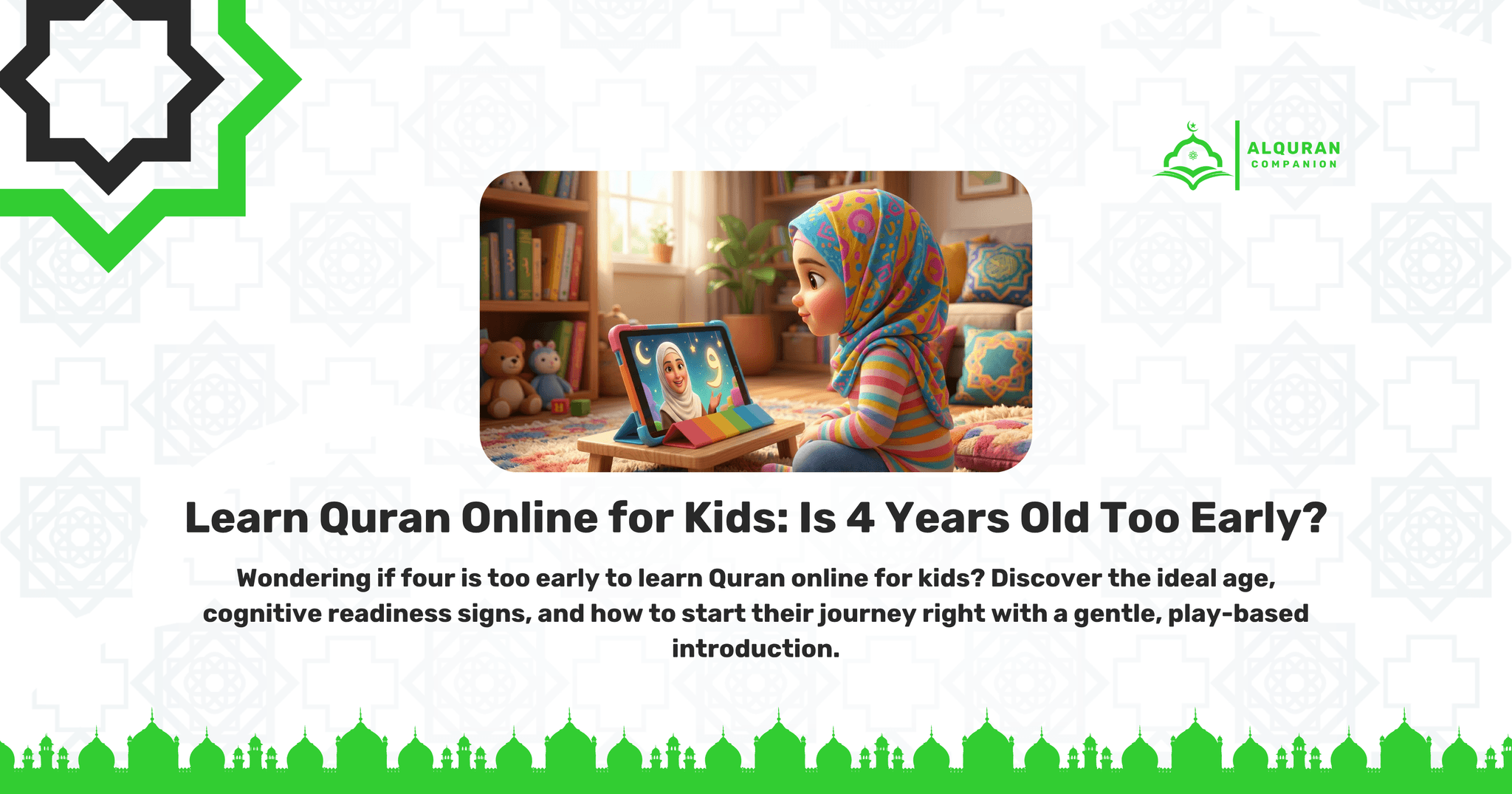
The digital format flips this outdated dynamic entirely. In a premium online setting, the ratio is strictly one-to-one. The teacher’s entire focus is locked onto your child’s micro-expressions. If your child looks away or seems bored, the teacher notices instantly and pivots to a new, engaging activity. There is no bullying from older kids. Your child learns from the absolute safety and comfort of their own living room.
The Difference Between a Teacher and a Toddler Specialist
Holding an Ijazah (certification) makes an individual a master of the Quranic sciences. It does absolutely nothing to equip them for dealing with a crying five-year-old who just dropped their favorite toy. When you evaluate an academy, you must understand that teaching toddlers is a highly specialized skill set. A true early-childhood specialist knows exactly how to make your child actually want to read Quran without relying on threats or endless candy bribes.
These specialists utilize high-energy vocal tones, colorful digital whiteboards, and interactive games. They know when to push for one more repetition and exactly when to call it a day. They do not deliver dry lectures; they build relationships. If your current tutor is essentially reading off a PDF in a monotone voice, your child is not failing—the teaching method is failing your child. You need an educator who speaks the language of a child.
Structuring Your Toddler's Online Routine for Success
Enrolling your child is only the first step. Your home environment dictates whether the lessons succeed or fail. To guarantee a smooth experience, implement these highly effective strategies immediately:
- Keep the sessions incredibly short: Limit classes to 15 to 20 minutes maximum. Do not negotiate this. Short, daily repetition builds long-term memory far better than a grueling one-hour weekend marathon.
- Anchor learning to a daily habit: Predictability removes resistance. Schedule the class immediately after their afternoon snack or right before their designated playtime. When the class becomes an automatic part of their daily routine, the tantrums completely disappear.
- Stay in the room, but stay out of the way: Be present as their silent technical support. If the audio drops, fix it. But absolutely do not hover over their shoulder and correct their Arabic mistakes. Let the tutor build authority and trust. If you interfere, the child will look to you instead of engaging with the teacher.
- Celebrate the effort, not just the accuracy: When they finish a class, do not interrogate them on how many lines they read. Tell them how proud you are of their focus. Praise their effort openly and enthusiastically.
Your Child's Lifelong Bond Starts Today
Starting early does not mean stealing their childhood. It means giving them an unparalleled head start on a lifelong, beautiful relationship with their Creator. By introducing the words of Allah during their most formative years, you establish the Quran as a source of comfort rather than an academic chore.
Finding the right environment to learn quran online for kids does not have to be an anxiety-inducing struggle. When you align your expectations with their cognitive abilities and partner with the right educators, the results are genuinely breathtaking. You are not just teaching them to read Arabic letters; you are planting spiritual seeds that will grow, flourish, and protect them for decades to come. Our specialized early-childhood tutors know exactly how to engage 4 and 5-year-olds. We do not do rigid lectures. We do joyful, interactive learning that makes them excited to log in. Start their journey gently with a free trial today.
Frequently Asked Questions

Al Quran Companion Team
Verified AuthorThe official academic and editorial team at Al Quran Companion, a leading Online Quran Academy dedicated to simplifying Tajweed, Hifz, and Islamic studies for students worldwide.
Read more about author