Parents living in the US, UK, and Australia often face a challenging question from their children: 'when was the quran written?' In Western secular classrooms, history textbooks sometimes frame the Holy Quran merely as an ancient text compiled long after Prophet Muhammad ﷺ passed away. This skeptical narrative creates confusion for young Muslim minds.
Here is the reality: Muslims do not view the Quran as a historically authored piece of literature. It is the uncreated Word of Allah. The process of its recording and preservation represents the most rigorous verification methodology in human history.
By understanding exactly how the verses were transcribed by dedicated scribes, independently verified by thousands of living memorizers, and ultimately compiled into a single authoritative codex, families can approach their faith with absolute, unshakable conviction.
Table of Contents
- When Was the Quran First Revealed and Written Down?
- The 3 Stages of Quranic Preservation: From Oral Recitation to Mus'haf
- Phase 1: Inscription During the Prophetic Era in Madinah Munawwarah
- Phase 2: Abu Bakr and the Official Suhuf Compilation (633 CE)
- Phase 3: Uthman and the Standardized Mus'haf (650 CE)
- Zaid ibn Thabit's Multi-Witness Verification Methodology
- Modern Historical Evidence: The Birmingham and Sana'a Manuscripts
- Oral Tradition (Tawatur) vs. Written Text: Why Both Matter Today
- The 3-Step Al Quran Companion Pronunciation Feedback Loop
- Frequently Asked Questions
Key Takeaways
- The Quran was documented in writing during the lifetime of Prophet Muhammad ﷺ by designated scribes.
- Caliph Abu Bakr (RA) commissioned the first official compilation in 633 CE using a flawless two-witness verification system.
- Caliph Uthman (RA) established the standardized Mus'haf in 650 CE to unite the expanding Muslim Ummah under one distinct dialect.
- Modern radiocarbon dating at the University of Birmingham proves ancient manuscripts perfectly match the Quran we recite today.
- The Quran relies on an unbroken chain of oral transmission (Tawatur) alongside the written text to ensure perfect pronunciation.
When Was the Quran First Revealed and Written Down?
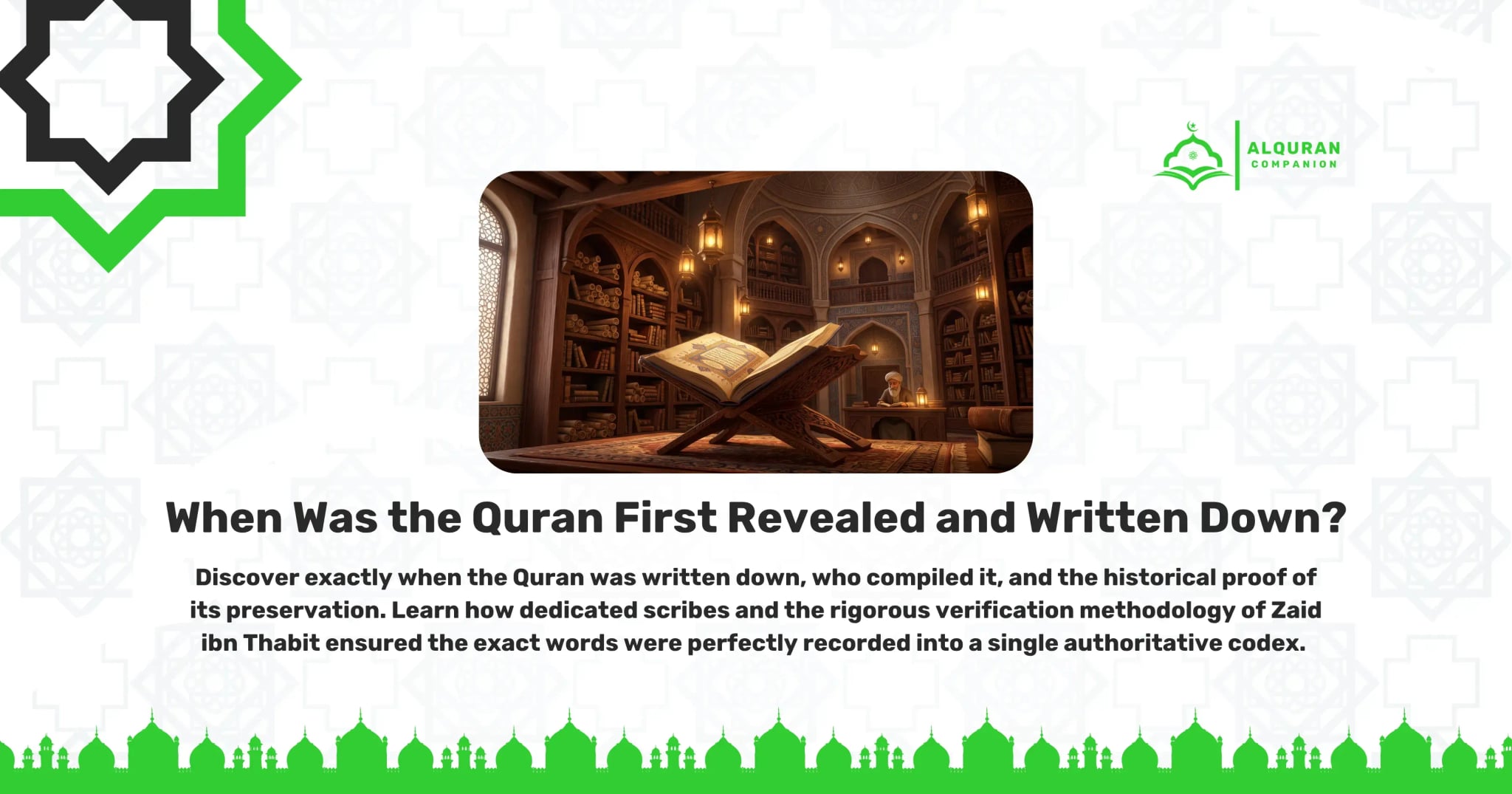
The Quran was revealed by Allah to Prophet Muhammad ﷺ through Angel Jibreel over 23 years, between 610 and 632 CE. Appointed scribes immediately transcribed these verses onto parchment, leather, and palm stalks during the Prophet's lifetime while thousands memorized them orally.
A common misconception is that the early Muslims relied entirely on memory. In truth, the preservation of the divine text was a dual process. Whenever a new Ayah (verse) descended, Prophet Muhammad ﷺ would instantly summon specific companions known as Kuttab al-Wahy (the Scribes of Revelation).
These noble scribes—including prominent figures like Zaid ibn Thabit, Ubayy ibn Ka'b, Mu'awiyah, and Ali ibn Abi Talib—recorded the exact words. To ensure absolute accuracy, the Prophet ﷺ would ask the scribe to read the newly written verse back to him. This immediate feedback loop eliminated any possibility of human scribal error.
اِنَّا نَحۡنُ نَزَّلۡنَا الذِّكۡرَ وَاِنَّا لَهٗ لَحٰـفِظُوۡنَ﴿٩﴾
Indeed, it is We who sent down the message [i.e., the Qur’ān], and indeed, We will be its guardian.
When asking
The 3 Stages of Quranic Preservation: From Oral Recitation to Mus'haf
The divine preservation of the Quran occurred in three distinct phases. First, scribes recorded verses during the Prophetic era. Second, Caliph Abu Bakr compiled these records into official sheets in 633 CE. Finally, Caliph Uthman standardized the authoritative Mus'haf in 650 CE.
Phase 1: Inscription During the Prophetic Era in Madinah Munawwarah
During the life of Prophet Muhammad ﷺ, the complete Quran existed in both written form and within the hearts of the believers. However, it was not bound into a single book format. Because revelation was ongoing—sometimes abrogating previous rulings or addressing specific real-time events—binding the materials prematurely was impractical.
Physical materials used included 'assib' (stripped palm branches), 'likhaf' (thin white stones), and 'riqa' (parchment). Thousands of companions accomplished complete Hifz (memorization) by consistently performing Salah and listening to the recitation in the mosque.
Phase 2: Abu Bakr and the Official Suhuf Compilation (633 CE)
Following the Prophet's passing, the Muslim Ummah faced a severe crisis during the Battle of Yamama. Approximately 70 prominent Huffaz (memorizers of the Quran) were martyred on the battlefield. This tragic loss prompted Umar ibn al-Khattab (RA) to urgently approach the first Caliph, Abu Bakr (RA), with a critical proposal: the scattered written records must be officially unified.
Although initially hesitant to initiate a task the Prophet ﷺ had not explicitly commanded, Abu Bakr (RA) recognized the necessity. He appointed Zaid ibn Thabit (RA)—a brilliant young scholar and primary scribe of revelation—to lead the momentous project. This event formally established the
Phase 3: Uthman and the Standardized Mus'haf (650 CE)
As Islam spread far beyond the Arabian Peninsula into modern-day Syria, Iraq, and North Africa, non-Arab populations began entering the faith. A companion named Hudhaifah ibn al-Yaman (RA) noticed troops from different regions arguing over the correct pronunciation of certain Arabic dialects during military expeditions in Azerbaijan.
To prevent fragmentation, Caliph Uthman (RA) requested the original Suhuf kept by Hafsa (RA). He assembled a committee to copy the text perfectly into the dominant Quraishi dialect. These standardized master copies—known as the Uthmanic Mus'haf—were distributed to major Islamic centers, and all conflicting dialectal copies were systematically retired.
Zaid ibn Thabit's Multi-Witness Verification Methodology
Head scribe Zaid ibn Thabit enforced a flawless evidentiary standard for compilation. He required two independent written manuscripts recorded in the Prophet's presence, cross-referenced against the memories of at least two living Huffaz, ensuring absolute fidelity for every single recorded verse.
Consider this: Zaid himself had memorized the entire Quran. He knew every word. Yet, his personal memory was not sufficient for this monumental institutional task. The methodology demanded objective, external verification.
"By Allah, if they had tasked me with moving a mountain from its place, it would not have been heavier for me than what they commanded me to do of compiling the Quran."
A public call was made in Madinah Munawwarah. Anyone who possessed written fragments of the Quran was asked to bring them forward. Zaid would only accept a physical fragment if two witnesses could testify on oath that it was written in the direct presence of Prophet Muhammad ﷺ. Then, that written text had to perfectly match the collective memory of the gathered Huffaz.
This rigorous cross-referencing process effectively eliminated any chance of individual error, alteration, or fabrication. When modern students inquire
Modern Historical Evidence: The Birmingham and Sana'a Manuscripts
Modern radiocarbon dating at the University of Birmingham confirms ancient Quranic manuscripts date precisely to the Prophet's lifetime, between 568 and 645 CE. These physical artifacts match the modern Quran letter-for-letter, refuting secular academic skepticism with tangible scientific proof.
For Muslim university students studying in the US, UK, and Canada, facing professors who question the authenticity of Islamic texts can be intimidating. However, the physical evidence overwhelmingly supports the traditional Islamic narrative.
In 2015, the University of Birmingham analyzed parchment leaves from a Quranic manuscript utilizing advanced radiocarbon dating techniques. The results were astounding. The parchment was dated with an accuracy probability of over 95% to the era of Prophet Muhammad ﷺ or the immediate decade following his passing.
Similarly, the Sana'a manuscripts discovered in Yemen further corroborate the Uthmanic standardization. While some lower textual layers (palimpsests) exhibit minor ordering differences reflecting early companion notebooks, the upper layer aligns completely with the Uthmanic text. This proves the successful consolidation effort undertaken by Caliph Uthman to protect the
Oral Tradition (Tawatur) vs. Written Text: Why Both Matter Today
The Quran remains an oral revelation preserved through continuous living transmission, known as Tawatur. While the written Mus'haf provides a standardized reference, authentic recitation requires an unbroken chain of human teachers holding an Ijazah back to Prophet Muhammad ﷺ.
Tawatur is a fundamental concept in Islamic sciences. It refers to a report or text transmitted by so many independent chains of reliable narrators in every generation that it is logically impossible for them to have conspired to forge it. The
Learning the Quran: Textual Self-Study vs. Authentic Oral Transmission
Pros
- Unbroken Chain (Sanad): You connect directly to the Prophet ﷺ through certified teachers.
- Correct Tajweed: Immediate correction of pronunciation errors (Makharij).
- Spiritual Mentorship: Real human guidance that apps and books cannot provide.
- Protection from Innovation: Ensures you read exactly as it was revealed.
Cons
- Silent Errors: Self-study leads to internalized pronunciation mistakes.
- Misinterpretation: Lack of scholarly context when reading English translations alone.
- Inconsistency: Without a live teacher, motivation often drops quickly.
- No Certification: Impossible to achieve a legitimate Ijazah through self-study.
For busy expat families in Dubai or professionals managing EST and CST time zones in the United States, managing weekend Sunday school commutes can be exhausting. Finding a local, certified scholar who deeply understands both classical Arabic and the modern diaspora experience is exceptionally difficult.
The 3-Step Al Quran Companion Pronunciation Feedback Loop
At Al Quran Companion, we bridge this gap. We do not just teach you to read a printed book. We integrate you into the living tradition of Tawatur. Our proprietary pedagogical framework, 'The 3-Step Al Quran Companion Pronunciation Feedback Loop', ensures that every letter you recite is accurately formed from its proper articulation point (Makharij al-Huroof).
This involves active listening, immediate gentle correction, and spaced-repetition testing. Whether you are enrolling a child to begin their journey or you are an adult revert seeking a 100% private, judgment-free environment, our platform adapts to your pace.
Furthermore, institutional trust is our priority. At Al Quran Companion, we always conduct comprehensive Background Checks and detailed multi-stage reviews of every single teacher before they are certified to teach our students. We provide highly qualified female teachers to ensure comfort and privacy for our sisters and young daughters. This strict vetting process guarantees that you are receiving instruction from genuine inheritors of this sacred knowledge.
If you are ready to master
Frequently Asked Questions

Al Quran Companion Team
Verified AuthorThe official academic and editorial team at Al Quran Companion, a leading Online Quran Academy dedicated to simplifying Tajweed, Hifz, and Islamic studies for students worldwide.
Read more about author