4 Qul: Meaning, Significance, and Benefits of the Four Protective Surahs
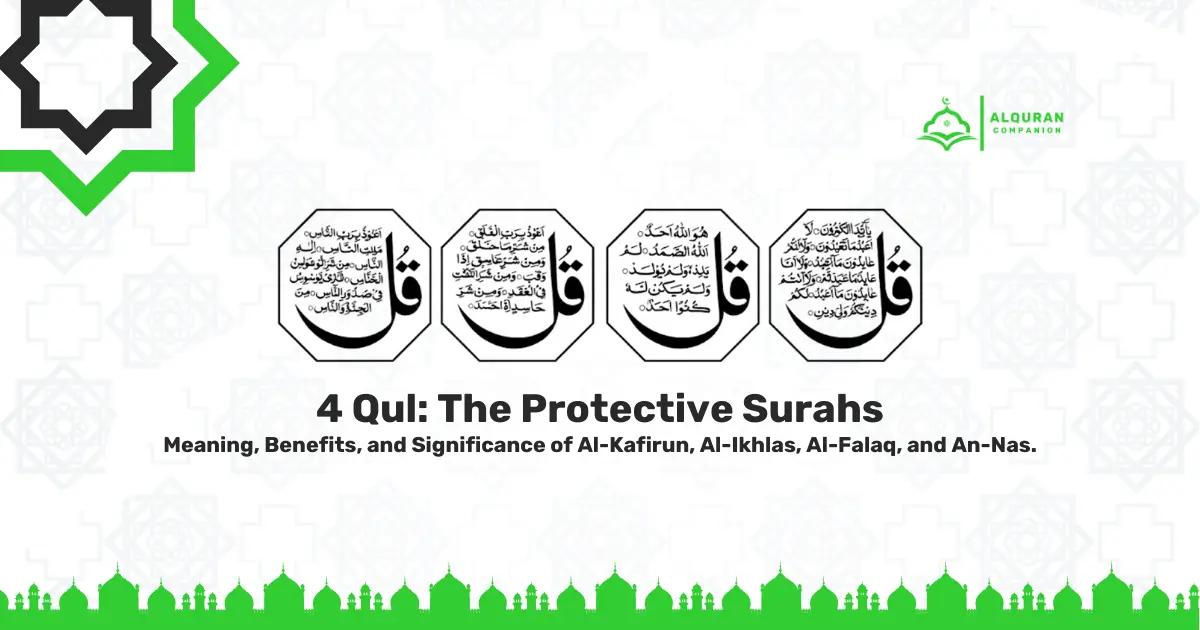
The 4 Qul refers to four short Surahs of the Quran that each begin with the Arabic word “Qul” (قُلْ, “Say”). Specifically, they are Surah Al-Kafirūn (109), Al-Ikhlāṣ (112), Al-Falaq (113), and An-Nās (114). These chapters carry profound meanings in Islam. Surah Al-Kafirūn emphasizes disavowal of false deities, Surah Al-Ikhlāṣ affirms the oneness of Allah, and the pair Al-Falaq and An-Nās (together known as al-Mu‘awwidhatayn, “the two chapters of seeking refuge”) teach seeking Allah’s protection from harm. The Prophet ﷺ urged regular recitation of these Quls for spiritual protection. For example, ʿĀ’isha (may Allah be pleased with her) reported that the Prophet ﷺ would recite Al-Ikhlāṣ, Al-Falaq, and An-Nās, blow into his hands, and wipe them over his body before sleeping. Insha’Allah, this post will explain the meanings and virtues of each Surah, supported by Qur’anic verses and authentic hadith, while also highlighting how one can learn and benefit from them (for example, through Al Quran Companion’s Tajwīd and Hifz classes).
What Are the “4 Qul” Surahs?
The term “4 Qul” is a popular way to refer to these four Surahs, each of which begins with the imperative قُل (Qul, “Say”). These Surahs are short but rich in meaning. Their names and numbers are:
- Surah Al-Kafirūn (109) – “O Disbelievers”
- Surah Al-Ikhlāṣ (112) – “Sincerity"
- Surah Al-Falaq (113) – “The Daybreak”
- Surah An-Nās (114) – “Mankind”
These Surahs are often recited together in prayers and daily adhkār (remembrances) because of their powerful supplications and lessons. They cover core Islamic teachings: strict monotheism (Tawḥīd), turning away from false gods, and seeking Allah’s refuge from various evils.
Surah Al-Kafirūn – Disavowal of Disbelief
Surah Al-Kafirūn begins with “Qul ya ayyuhal-kāfirūn” (قُلْ يَا أَيُّهَا الْكَافِرُونَ), meaning “Say: ‘O you disbelievers!’” (109:1). In this Surah, the Prophet ﷺ is instructed to declare that he does not worship the idols and false deities of the disbelievers, and likewise they do not worship Allah alone:
بِسْمِ ٱللَّهِ ٱلرَّحْمَٰنِ ٱلرَّحِيمِ
This clear statement establishes mutual respect: the Prophet ﷺ and Muslims will not compromise the worship of Allah, and likewise the disbelievers have their own path. The Surah ends with “Lakum dīnukum wa liya dīnī” – “To you your religion, and to me mine.” (109:6). It teaches us to stand firm in our faith while maintaining civility toward others. It also serves as a reminder to devote ourselves wholeheartedly to Allah alone.
Virtues of Surah Al-Kafirūn
One of the well-known virtues of this Surah is its use as spiritual protection. The Prophet ﷺ said: “Recite Surah al-Kafirūn before sleeping, for it is a protection from shirk (polytheism).” This narration is recorded in Sunan Abū Dāwūd (Hadīth 5016) and Jāmi‘ at-Tirmidhī (Hadīth 3403). In other words, by affirming Tawḥīd before bed, a believer seeks Allah’s shield against any form of disbelief affecting the heart. Scholars have noted that this Surah’s recitation can help purify one’s faith as one enters the night. As the hadīthanswers.com site explains, Prophet ﷺ told Nayfāl ibn Ashja‘ī: “Recite Surah al-Kafirūn before sleeping, for it is a protection from Shirk”. Thus regularly reciting Al-Kafirūn is a blessed Sunnah (practice of the Prophet) for preserving one’s Iman (faith) and devotion to Allah.
Surah Al-Ikhlāṣ – The Sincerity of Faith
Surah Al-Ikhlāṣ is a brief yet profound declaration of Allah’s uniqueness. It begins قُلْ هُوَ اللَّهُ أَحَدٌ – “Say, ‘He is Allah, [who is] One,’”“Say, ‘He is Allah, [who is] One,’” (112:1). This Surah consists of four verses defining who Allah is:
بِسْمِ ٱللَّهِ ٱلرَّحْمَٰنِ ٱلرَّحِيمِ
These verses affirm Tawḥīd in the most absolute terms: Allah is One, self-sufficient (Ṣamad), and unlike any created being (no offspring, none gave birth to Him, and nothing is comparable to Him). Surah Al-Ikhlāṣ is often described as encapsulating the essence of Tawḥīd.
Virtues of Surah Al-Ikhlāṣ
Several hadith emphasize the immense reward for reciting Al-Ikhlāṣ. For example, ʿAbū Sa‘īd al-Khudrī reported that a man was heard by the Prophet ﷺ reciting Surah Ikhlāṣ repeatedly. The Prophet ﷺ said: “By the One in Whose Hand is my soul, it is equivalent to one-third of the Qur’an.” (Bukharī 6643). In another narration, the Prophet ﷺ told his companions: “Qul Huwa Allahu Ahad is equal to one-third of the Qur’an.” (Muslim 811). This means in reward, reciting Al-Ikhlāṣ is as meritorious as reciting one-third of the entire Quran.
Scholars clarify that this equivalence refers to reward, not that it replaces other recitations. It is a divine bounty: a simple Surah yields great reward. The IslamQA summary explains that the Prophet ﷺ once gathered companions and recited Ikhlāṣ as one-third of the Quran. He then assured them that he had indeed fulfilled his promise. In practice, then, reciting Al-Ikhlāṣ three times in prayer or elsewhere brings incredible blessings and serves as a concise way to affirm Tawḥīd repeatedly. Additionally, it is reported that whoever recites Surah Al-Ikhlāṣ ten times (for example, in supplication) may earn a special station in Paradise.
Thus Al-Ikhlāṣ is central to Muslim belief. It reminds us that Allah is unique and beyond comparison. Learning its correct recitation is crucial; even children are taught this Surah early. A teacher or Quran app (such as those provided by Al Quran Companion) can help students with proper Tajwīd (pronunciation) to ensure this core message is internalized. As the Qur’an itself commands, “And recite the Qur’an with measured recitation” (al-Muzzammil 73:4), meaning each word should be pronounced accurately. By mastering Al-Ikhlāṣ under skilled guidance, believers fortify their understanding of Allah’s Oneness.
Surah Al-Falaq and An-Nās – Seeking Refuge
Surahs Al-Falaq and An-Nās are commonly called “al-Mu‘awwidhatayn” (ٱلْمُعَوِّذَتَيْنِ) meaning “the two [surahs of] seeking refuge.” They teach us how to ask Allah to protect us from all kinds of harm. (ٱلْمُعَوِّذَتَيْنِ) meaning “the two [surahs of] seeking refuge.” They teach us how to ask Allah to protect us from all kinds of harm.
- Surah Al-Falaq – Begins قُلْ أَعُوذُ بِرَبِّ الْفَلَقِ (“Say, ‘I seek refuge in the Lord of daybreak’”). The verses seek refuge from the evils of creation: darkness, witchcraft, envy, and every harmful thing. Allah says we can seek His protection “from the evil of that which He created”, and specifically from “the evil of darkness”, “the evil of those who blow on knots” (a reference to certain types of magic), and “the evil of an envier when he envies”.
بِسْمِ ٱللَّهِ ٱلرَّحْمَٰنِ ٱلرَّحِيمِ
Surah An-Nās – Begins قُلْ أَعُوذُ بِرَبِّ النَّاسِ (“Say, ‘I seek refuge in the Lord of mankind’”). It continues asking refuge in Allah from “the evil of the whisperer [Satan] who withdraws after whispering”“the evil of the whisperer [Satan] who withdraws after whispering”. This refers to Satan’s attempts to sow doubt and whisper evil thoughts into people’s hearts (whether jinn or humans).
بِسْمِ ٱللَّهِ ٱلرَّحْمَٰنِ ٱلرَّحِيمِ
Together, these Surahs teach that everything from atmospheric forces to unseen devils can harm us, and that Allah alone is capable of protecting against them. They were revealed in Makkah, and they are recited in times of fear or before sleeping. The Prophet ﷺ himself taught seeking Allah’s refuge in these chapters.
Virtues of the Mu‘awwidhatayn
There are several narrations highlighting their importance. One famous hadith is as follows: A man asked the Prophet ﷺ about how to protect himself on a dark night. The Prophet ﷺ said: “Say: ‘Qul Huwa Allahu Ahad’ and the Mu‘awwidhatayn, in the evening and in the morning, three times, and they will suffice you against all things.” This is recorded in Sunan Abū Dāwūd (5082) and At-Tirmidhī (3575). In other words, by reciting Al-Ikhlāṣ, Al-Falaq, and An-Nās three times each in the morning and evening, a believer is granted Allah’s protection from every harm – spiritual or physical. The Prophet ﷺ effectively said that these three Surahs are a comprehensive shield if recited regularly.
Another well-known tradition involves Hazrat ʿĀ’isha (may Allah be pleased with her) and the Prophet’s recovery from magic: When the Prophet ﷺ was afflicted by the evil spell of Labīd ibn Asamm, ʿĀ’isha was instructed to recite the Mu‘awwidhatayn over him and wipe his body with her hands. By Allah’s will, he was healed. This story shows the direct application of these Surahs for divine protection.
When combined with Al-Ikhlāṣ (making three Quls), these surahs cover the entire spectrum of seeking refuge: from disbelief (Kāfirūn) to affirming Allah’s unity (Ikhlāṣ) to seeking protection (Falaq and Nās). As a result, many Muslims recite all four Quls in order during daily prayers, before sleeping, or when feeling vulnerable. A popular nightly practice is to recite all three Quls and blow into one’s hands, then wipe the face and body, repeating this three times – following the example of the Prophet ﷺ.
In summary, Al-Falaq and An-Nās teach us to rely on Allah against unseen evils. The scholars say that by reciting them sincerely, the believer is safeguarded from black magic, envy, whispers of Satan, and more. This is why textbooks on Islamic mindfulness stress memorizing and reciting the Mu‘awwidhatayn daily.
Benefits of Reciting the 4 Qul
Collectively, the 4 Qul surahs offer immense spiritual benefits. Based on the Quran and Sunnah, we learn that their recitation:
- Strengthens Tawḥīd and protects faith. Surah Al-Kafirūn explicitly rejects associating partners with Allah (shirk), and Al-Ikhlāṣ affirms pure monotheism. Regular recitation keeps one’s creed clean. The Prophet ﷺ taught that reciting Al-Kafirūn before sleep protects a believer from shirk all night.
- Provides protection from harm. The Mu‘awwidhatayn (Al-Falaq and An-Nās) are the prescribed means for seeking Allah’s refuge from physical and spiritual evils. Reciting all four in the morning and evening is like wearing armor of faith. As one hadith summarized: these Surahs “will suffice you against all things” when recited three times in the morning and evening.
- Acts as a shield in prayer and life. Many Muslims include the 4 Quls in their daily supplications. For example, they may recite them in short prayer units (rak‘ahs) or in salah as chosen verses, believing that this practice fills their day with remembrance and Allah’s shelter.
- Brings spiritual rewards. Each Surah has promised rewards. Reciting Al-Ikhlāṣ alone yields a reward comparable to one-third of the Quran. Reciting Al-Kafirūn is said to cleanse the heart from polytheism. The Mu‘awwidhatayn have the merit of being revealed together in one ayah by Allah (the last verse of An-Nās is one of only two places in the Quran where Allah says “Say” and gives refuge formulae in sequence) and of being instruments of healing (as in the Prophet’s recovery).
- Ease of memorization and daily practice. Since the 4 Quls are short, they are easy to learn and frequently memorized by children and new students. This ensures that even beginners are armed with powerful verses of protection from a young age.
These benefits are mentioned in various traditions and scholarly works. For instance, it is reported that whoever recites the three Quls (Ikhlāṣ, Falaq, Nās) three times in the morning and evening will be protected from every conceivable evil. This hadīth encourages consistency in daily worship.
Incorporating the 4 Qul in Daily Practice
Given their importance, the 4 Qul are often integrated into Muslim daily routines. Common practices include:
- Morning and Evening Dhikr: Reciting the 4 Quls (often with Surah Al-Fātiḥah) after Fajr (morning) and Maghrib or ‘Isha (evening) prayers. The Prophet ﷺ instructed this sequence: “In the evening and in the morning, say: ‘Qul Huwallāhu Aḥad’ and the two Mu‘awwidhatayn three times”. This became a prescribed Adhkār for protection.
- Before Sleeping: As mentioned, reciting Surah Al-Kafirūn (and often Al-Falaq and An-Nās) before bed is a Sunnah for safeguarding faith overnight. Parents encourage children to recite them at bedtime so the home is covered by these blessings.
- In Daily Du‘ās: They can be included in personal du‘ā (supplication) or after the ritual prayers. Their meanings – affirming Allah’s Oneness and seeking His refuge – complement one’s regular prayers for guidance and safety.
- Teaching in Quran Classes: Given their central place in worship, qualified instructors always cover the 4 Quls early in Quran learning curricula. For example, children in Quran Foundation or Tajwīd classes are taught to pronounce each verse correctly, along with understanding their basic meanings. This ensures that even young students appreciate why these surahs are special.
At Al Quran Companion, our experienced teachers emphasize the correct recitation (Tajwīd) of these chapters. For instance, the articulation of قُلْ (Qul) and the emphatic vowels in these Surahs are practiced carefully in our Quranic Recitation and Tajwīd courses. Our one-on-one lessons allow the teacher to correct any articulation errors (makhārij) on the spot, reinforcing these sacred verses in the student’s heart and tongue.
Learning and Memorizing the 4 Qul
Because the 4 Qul are short, many new learners memorize them first. Our advice for students (or parents teaching children) is to use repetition with proper Tajwīd. Listening to skilled recitations can help; Al Quran Companion provides recorded Tajwīd examples and offers progress tracking so that students see their improvement over time.
Additionally, our Hifz (Memorization) program is structured to include these short surahs early in the plan. The Prophet ﷺ said memorizing the Qur’an brings the memorizer high ranks in Paradise, and even a small start (like the 4 Quls) is rewarded generously. With our certified tutors, students learn each verse’s meaning and pronunciation. Because Al Quran Companion also offers Tafsīr lessons, learners gain insight into the context and wisdom of these Quls as they memorize them. Understanding what one recites deepens its impact.
For adults who may have learned Arabic later in life, our Arabic Basics and Quran Foundation courses can reinforce reading skills so that reciting the 4 Qul becomes more fluent. In all cases, the platform’s 1-on-1 format ensures personalized attention: a teacher can focus on a student’s specific errors (like blending letters correctly) rather than a one-size-fits-all approach.
Moreover, our modern tools support learning: students can replay recorded sessions of their own recitation practice, receive digital progress reports, and earn certificates as milestones are reached. We even offer family discounts for multiple learners, encouraging families to learn these Surahs together. This way, the 4 Quls are preserved and passed down as part of regular family worship.
Choosing Authentic Guidance
When studying the 4 Quls (or any Quran), it is essential to rely on authentic sources. We emphasize classical Tafsīr (like those of Ibn Kathīr or Al-Jalālayn) to explain context. For instance, scholars note that “daybreak” (الفلق) in Al-Falaq signifies the moment of dawn when harmful things (like darkness and frightful creatures) are banished – reminding us Allah controls even natural phenomena. Meanwhile, “whispering into the breasts” in An-Nās refers to Satan’s stealthy influences on the heart. These explanations help believers appreciate why seeking refuge in Allah (the Lord of the Daybreak and Mankind) is profound.
Our Quranic Tafsīr course delves into such details with students. In Al Quran Companion lessons, teachers encourage students to reflect on the Arabic wording and historical background of the verses, referencing authentic exegesis. This deepens understanding of why these Surahs are so strongly emphasized in daily supplications.
Finally, we uphold respect for all scholars and schools of thought in explaining the 4 Quls. Interpretations from the four main Imams (Hanafī, Shāfi‘ī, Mālikī, Ḥanbalī) on these Surahs are harmonized so students see the breadth of commentary without confusion. All the while, our primary reverence is for the text of the Qur’an and the Sunnah of the Prophet ﷺ. We say “صلى الله عليه وسلم” with honor whenever mentioning him, as befits a humble Muslim scholar.
Conclusion
The 4 Qul are among the most beloved chapters of the Quran for Muslims worldwide. By reciting Surahs Al-Kafirūn, Al-Ikhlāṣ, Al-Falaq, and An-Nās, one both reaffirms core Islamic beliefs and seeks Allah’s protection in everyday life. As a scholar guiding you through this topic, I hope you now appreciate their meanings and virtues. Whether you are a parent teaching your child or a new learner, remember that these Surahs are both a declaration of faith and a powerful shield. Taking to heart the Prophet’s ﷺ advice to recite them morning and night (as recorded in authentic hadith) ensures we live under the divine shelter of Allah’s words.
Al Quran Companion is honored to be part of your Quranic journey. Our certified teachers and flexible online classes make it easy to master the Tajwīd (pronunciation), memorize these Surahs, and understand their tafsīr. We provide 24/7 support, progress tracking, and even free trial sessions so you can start confidently. Insha’Allah, may the 4 Qul become a constant light in your life, guiding you with their guidance and protection.
May Allah make us of those who remember His words frequently and act upon them. Ameen.
FAQs

Al Quran Companion Team
Verified AuthorThe official academic and editorial team at Al Quran Companion, a leading Online Quran Academy dedicated to simplifying Tajweed, Hifz, and Islamic studies for students worldwide.
Read more about author