The everyday phrases we use shape the spiritual atmosphere of our homes. For Muslim families living in the West, establishing the authentic greetings of Islam goes far beyond teaching children to say 'Hello' in Arabic. It establishes an active, daily connection to the Sunnah of Prophet Muhammad ﷺ. Whether you are rushing through a morning school drop-off in London, attending a community gathering in Sydney, or navigating a professional environment in Toronto, mastering these sacred words transforms routine interactions into profound acts of worship.
However, pronouncing 'As-Salamu Alaykum' correctly and understanding the exact legal obligations (Fiqh) surrounding its response often get lost in cultural habits. Many Muslims unknowingly slur the Arabic syllables or misunderstand when replying becomes a strict religious obligation. By returning to the foundational texts of the Quran and the classical Hadith compendiums like Sahih Al-Bukhari and Sunan Abi Dawud, we find a highly structured, deeply rewarding system of mutual respect.
Table of Contents
- What Are the Greetings of Islam? Meaning and Arabic Text
- The 3 Levels of Salam and Their Rewards: The 30-Hasanat Matrix
- Rules of Responding to Salam: When Is It Obligatory (Fard)?
- Prophetic Etiquettes: Who Should Say Salam First?
- Tajweed and Pronunciation Guide: How to Say Assalamu Alaikum Correctly
- Teaching the Greetings of Islam to Children in the West
- Etiquette for New Muslims and Reverts in Social Gatherings
- Frequently Asked Questions
Key Takeaways
- The primary greeting of Islam invokes Allah's divine name, As-Salaam, extending physical protection and spiritual peace.
- Initiating the greeting is a highly recommended Sunnah, but returning it is an absolute religious obligation (Fard).
- The complete phrase 'As-Salamu Alaykum wa Rahmatullahi wa Barakatuh' guarantees a maximum reward of 30 Hasanat.
- Proper Tajweed pronunciation is necessary to convey the correct meaning, requiring attention to letters like Seen (س) and Ayn (ع).
- Prophetic adab dictates specific social hierarchies for greeting, such as the younger greeting the elder and the walking greeting the sitting.
What Are the Greetings of Islam? Meaning and Arabic Text
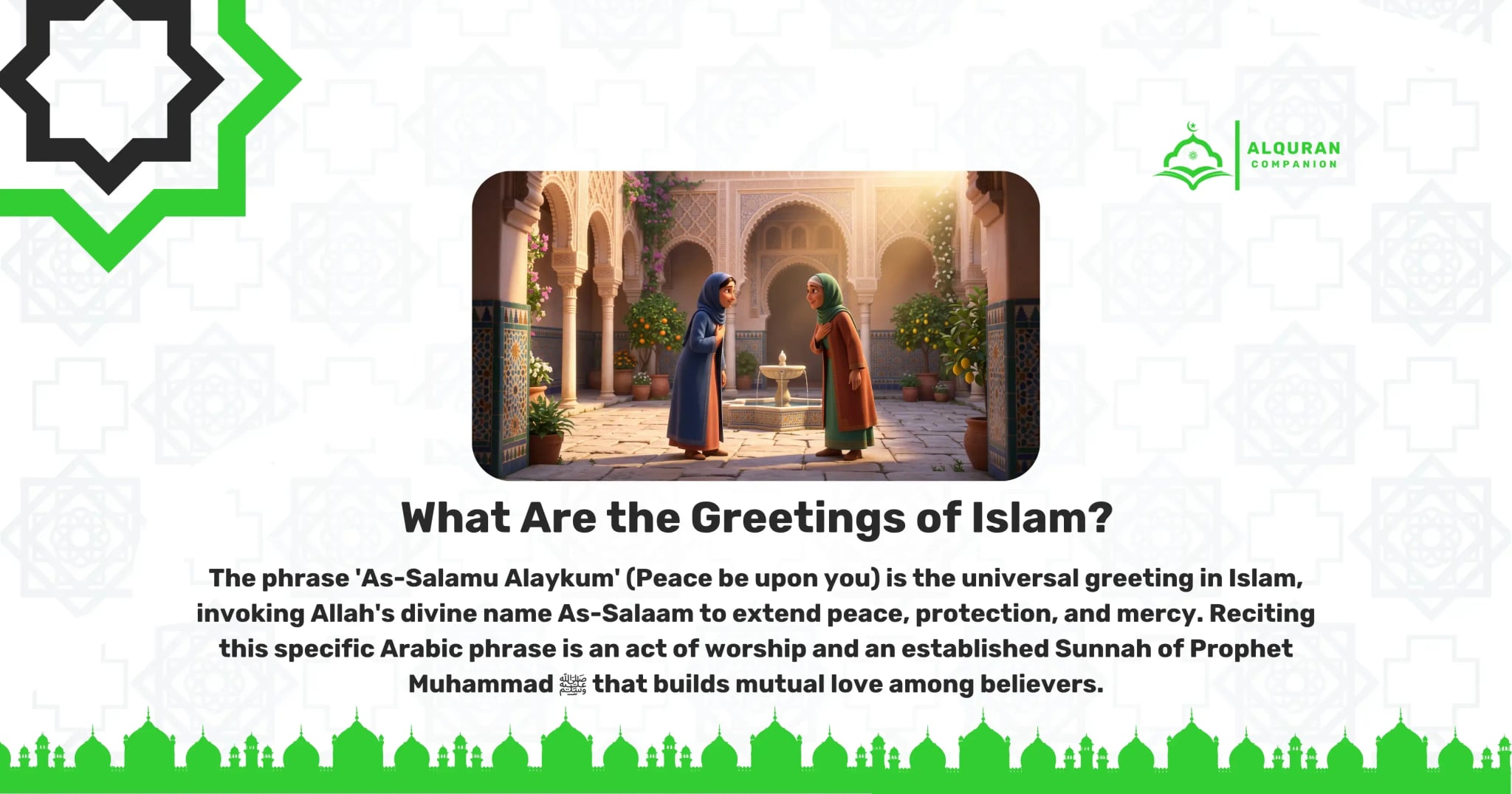
The phrase 'As-Salamu Alaykum' (Peace be upon you) is the universal greeting in Islam, invoking Allah's divine name As-Salaam to extend peace, protection, and mercy. Reciting this specific Arabic phrase is an act of worship and an established Sunnah of Prophet Muhammad ﷺ that builds mutual love among believers.
Salam is the linguistic foundation of mutual security in the Muslim Ummah. Derived from the Arabic root letters Seen-Laam-Meem (س-ل-م), the word implies safety from harm, flaws, and negative intentions. When you say these words to a fellow believer, you are formally offering them a guarantee of safety from your tongue and your hands. You are asking the Creator, As-Salaam (The Source of Peace), to envelop them in His divine protection.
Islamic greeting terminology is a precise invocation. It differs fundamentally from generic secular phrases like 'good morning' or 'good evening', which merely describe the time of day. Instead, this greeting transcends time and location. It is the greeting of the angels when they welcome the righteous into Jannah, and it remains the primary mechanism for Muslims globally to recognize one another, whether walking through the bustling streets of Madinah Munawwarah or a quiet suburban neighborhood in the United States.
The 3 Levels of Salam and Their Rewards: The 30-Hasanat Matrix
The Prophet ﷺ established a precise, three-tiered reward system for Islamic greetings recorded in Sunan Abi Dawud 5195. Stating 'As-Salamu Alaykum' earns 10 Hasanat (good deeds), adding 'wa Rahmatullah' earns 20 Hasanat, and reciting the complete phrase 'wa Rahmatullahi wa Barakatuh' earns 30 full Hasanat.
A man came to the Prophet (ﷺ) and said: Peace be upon you! He responded to his salutation. He then sat down. The Prophet (ﷺ) said: Ten. Another man came and said: Peace and Allah's mercy be upon you! He responded to his salutation when he sat down. He said: Twenty. Another man came and said: Peace and Allah's mercy and blessings be upon you! He responded to him and said when he sat down: and blessings be upon you! He responded to him and said when he sat down: Thirty
Here is why this progression matters so deeply. In Islamic theology, every Hasanah (singular of Hasanat) represents a distinct spiritual credit weighed on the Day of Judgment. The Prophet ﷺ systematically taught his companions how to maximize their spiritual returns through simple, daily habits. By implementing The 3-Tier Salam Etiquette & Sunnah Matrix, you transform a two-second interaction into a massive accumulation of divine reward.
Tier 1: The Basic Guarantee (10 Rewards). Saying 'As-Salamu Alaykum' sets the foundation. It establishes your Muslim identity and fulfills the basic requirement of the Sunnah.
Tier 2: The Addition of Mercy (20 Rewards). Adding 'wa Rahmatullah' translates to 'and the mercy of Allah'. You are now actively asking Allah to forgive the person and shower them with His divine care.
Tier 3: The Completion of Blessings (30 Rewards). Appending 'wa Barakatuh' means 'and His blessings'. Barakah in Islam refers to the divine multiplication of goodness. You are asking Allah to increase the person's wealth, health, time, and family in goodness.
Rules of Responding to Salam: When Is It Obligatory (Fard)?
Initiating the Salam is an emphasized prophetic practice (Sunnah Mu'akkadah), but returning the greeting with an equal or better reply is an absolute religious obligation (Fard). Based on Surah An-Nisa 4:86, this creates a binding social contract among Muslims.
وَاِذَا حُيِّيۡتُمۡ بِتَحِيَّةٍ فَحَيُّوۡا بِاَحۡسَنَ مِنۡهَاۤ اَوۡ رُدُّوۡهَا ؕ اِنَّ اللّٰهَ كَانَ عَلٰى كُلِّ شَىۡءٍ حَسِيۡبًا﴿٨٦﴾
And when you are greeted with a greeting, greet [in return] with one better than it or [at least] return it [in a like manner]. Indeed Allāh is ever, over all things, an Accountant.
According to the consensus across the four established schools of Islamic jurisprudence (Hanafi, Maliki, Shafi'i, and Hanbali), failing to return an Islamic greeting when you hear it without a valid excuse constitutes a sin. The Fiqh mechanics of this ruling operate on two distinct levels depending on the social setting.
If someone greets you individually, returning the greeting is Fard 'Ayn. This means it is an individual, non-transferable obligation resting entirely upon your shoulders. You cannot ignore it or expect someone else to answer for you.
If someone greets a group of people, returning the greeting becomes Fard Kifayah (a communal obligation). If at least one person in the group replies aloud, the religious obligation drops from the rest of the group. However, if the entire group remains silent, every single person present incurs a sin for ignoring the command of Allah.
The Quranic verse also introduces the concept of the 'superior reply'. If a brother says 'As-Salamu Alaykum', you must reply with at least 'Wa Alaykum As-Salaam'. But to fulfill the Quranic ideal of replying 'with a better one', you should respond with 'Wa Alaykum As-Salaam wa Rahmatullah'. The religion structurally mandates escalating kindness.
Prophetic Etiquettes: Who Should Say Salam First?
Sahih Al-Bukhari 6231 outlines precise prophetic adab regarding social hierarchies. The younger person greets the elder, the person walking greets the person sitting, the rider greets the walker, and the smaller group greets the larger gathering. This establishes natural humility and respect.
These prophetic guidelines eliminate social awkwardness and prevent ego from dictating human interactions. Consider this: when a rider (who physically looks down upon a pedestrian) initiates the greeting, it immediately diffuses arrogance. When a smaller group approaches a larger group and offers peace, it establishes safety and defuses potential tribal tension.
Another highly emphasized Sunnah is greeting young children. Prophet Muhammad ﷺ routinely stopped to offer salam to young children playing in the streets of Madinah. He did not view them as insignificant. Initiating peace with a child builds their self-esteem, validates their Muslim identity early on, and practically models the exact behavior parents wish to see. If you want your child to confidently exchange greetings at the local masjid, you must first establish the practice within the walls of your own home.
Initiating the Salam vs Waiting to Be Greeted
Pros
- Initiating first secures the highest spiritual reward.
- It actively breaks down personal ego and pride.
- It guarantees you the response of the angels if the person ignores you.
Cons
- Waiting allows someone else to take the initial 10-30 Hasanat.
- Delaying can cause mutual suspicion or awkwardness.
- Ignoring the greeting entirely results in a sin.
Tajweed and Pronunciation Guide: How to Say Assalamu Alaikum Correctly
Accurate Arabic articulation protects the meaning of the greeting. Non-Arabic speakers must clearly articulate the soft Seen (س) without harsh whistling and properly vocalize the deep throat letter Ayn (ع) in the word 'Alaykum' to avoid slurring the phrase into culturally distorted variations like 'Sam Alaykum'.
Makharij al-Huroof refers to the specific articulation points in the throat, tongue, lips, and nasal cavity from which Arabic letters originate. Without understanding these emission points, diaspora Muslims often accidentally utter phrases that hold entirely different, sometimes negative, meanings. For instance, rapidly slurring the greeting into 'Sam Alaykum' historically translates to 'death be upon you'—a severe distortion of the intended prayer for peace.
The letter Ayn (ع) is the most common casualty in English-speaking environments. It must emerge from the middle of the throat, producing a distinct, slightly constricted sound. Relying solely on English transliteration causes individuals to pronounce it as a flat 'A' (Alif), changing the linguistic structure of the sentence. This is exactly why learning proper Tajweed rules extends beyond reading the Quran—it actively governs our daily conversational worship.
At Al Quran Companion, our certified Ijazah-holding instructors utilize personalized diagnostic assessments to identify individual pronunciation hurdles. We correct these deeply ingrained habits early on through live feedback loops, ensuring that whether a student is
Teaching the Greetings of Islam to Children in the West
Raising confident Muslim children in the US, UK, Canada, and Australia requires intentionality. When children spend forty hours a week in secular schooling environments, their default vocabulary naturally shifts away from Islamic terminology. Parents notice this shift when a child walks through the front door and says 'Hi' instead of offering the Salam.
Reversing this trend begins with parental consistency. If you want your child to internalize this Sunnah, you must be the loudest and most consistent voice initiating it. When waking them up for school, open their door and say 'As-Salamu Alaykum'. When picking them up from soccer practice in Sydney or after-school clubs in London, greet them with the full 30-Hasanat phrase before asking about their day. Over time, the repetition builds cognitive familiarity.
Formal education bridges the gap between home habits and lifelong religious literacy. Enrolling young children in structured programs like our
Etiquette for New Muslims and Reverts in Social Gatherings
Navigating social expectations remains one of the largest hurdles for new Muslims. Walking into a crowded room or a new local community center can induce anxiety when you are still mastering the Arabic syllables. Recognizing the grace period afforded to new learners provides immense relief.
The Sunnah prioritizes sincere intention and gradual improvement over immediate perfection. If you struggle to articulate the full 'wa Rahmatullahi wa Barakatuh', stick to the foundational 'As-Salamu Alaykum' until your tongue grows accustomed to the phonetic shapes. When attending Eid prayers or Friday gatherings, you will notice cultural variations in physical greetings—some cultures embrace three times, while others prefer a right hand on the chest. The universal denominator always remains the verbal prayer of peace.
Adult learners thrive in environments devoid of criticism. This is exactly why Al Quran Companion maintains a zero-judgment environment for adults and reverts. Our highly trained instructors focus on progressive fluency. You receive 100% private, patient 1-on-1 guidance at your own pace, mastering everything from
Frequently Asked Questions

Al Quran Companion Team
Verified AuthorThe official academic and editorial team at Al Quran Companion, a leading Online Quran Academy dedicated to simplifying Tajweed, Hifz, and Islamic studies for students worldwide.
Read more about author