
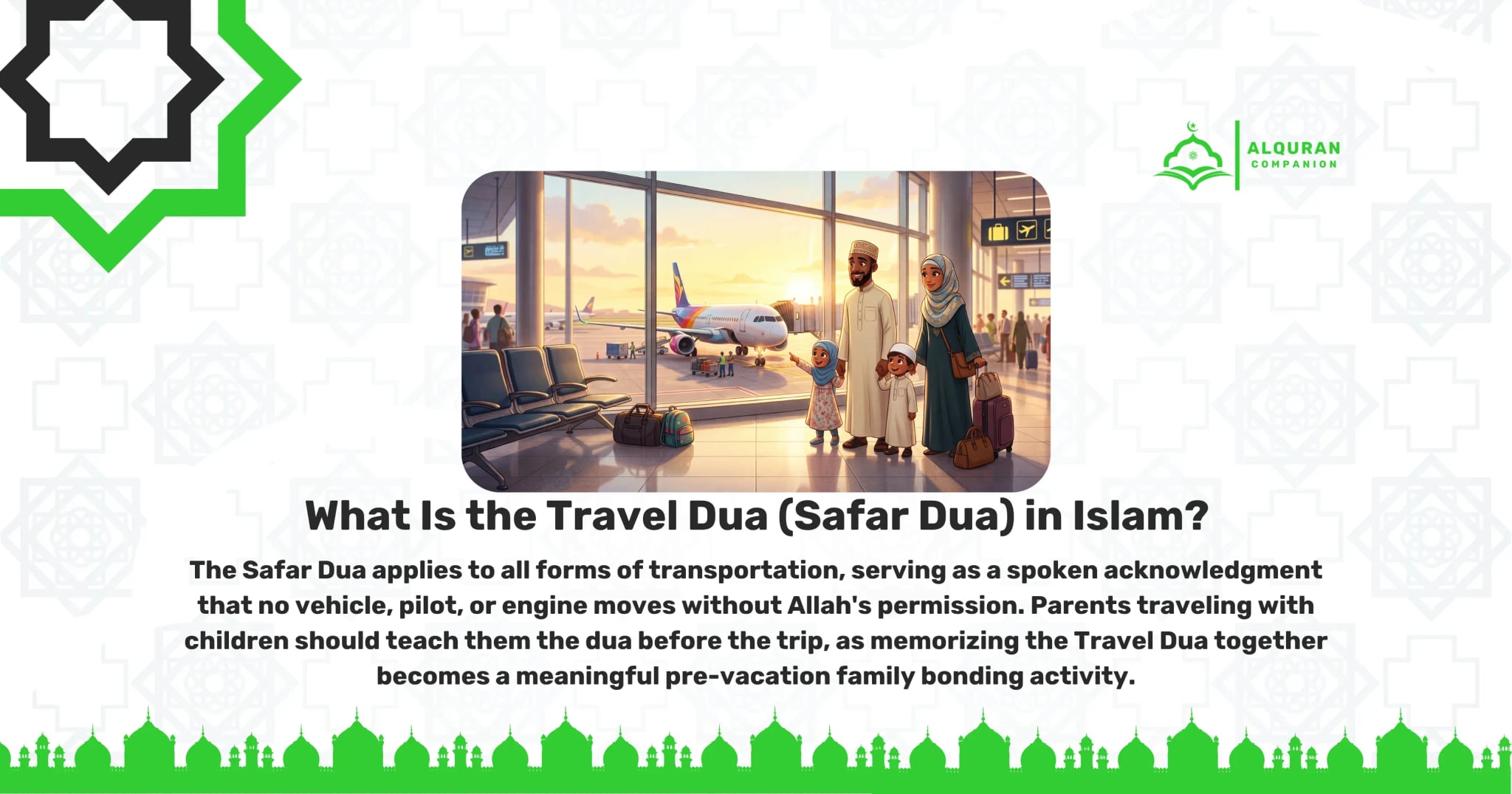
What Is the Travel Dua (Safar Dua) in Islam?
The travel dua (Safar Dua) is the Prophetic supplication recited when boarding a vehicle or beginning a journey. It comes from Sahih Muslim (1342), narrated by Abdullah ibn Umar (RA). The dua begins with Takbir and includes Surah Az-Zukhruf 43:13-14, asking Allah for Birr, Taqwa, ease, and protection from the hardships of travel. The travel dua is more than a ritual. It is a traveler's lifeline, a spoken acknowledgment that no vehicle, no pilot, and no engine moves without Allah's permission.
Muslim travelers across the US, UK, Canada, Australia, and the UAE face unique challenges. A parent in Toronto driving through a snowstorm to drop children at school. A student in London catching a late-night train after university. A pilgrim in Dubai preparing for Umrah. The travel dua anchors the heart before any of these journeys begin. Our senior Ijazah-certified tutors at Al Quran Companion have guided thousands of students through the memorization of this dua, and the most common feedback we receive is this: knowing the words changes the entire experience of travel.
Before you memorize the travel dua, you need to pronounce it correctly. Our online Quran recitation course connects you with certified teachers who correct every letter from day one.
What You Will Learn in This Guide
- What Is the Travel Dua (Safar Dua) in Islam?
- The Authentic Travel Dua (Safar Dua) in Arabic, Transliteration & Meaning
- The Quranic Foundation: Surah Az-Zukhruf (43:13-14)
- The Sacred Journey Traveler's Blueprint: Step-by-Step Sunnah Etiquettes
- Book Your Free 1-on-1 Recitation Assessment
- Salah While Traveling: Four-Madhab Rules on Shortening (Qasr) and Combining
- Practical Tips for the Modern Traveler
- The Dua for Returning Home
- The Dua When Traveling by Plane
- Frequently Asked Questions About the Travel Dua
Key Takeaways
- The travel dua comes from Sahih Muslim (1342) and begins with three Takbirs before the main supplication.
- Its Quranic foundation is Surah Az-Zukhruf (43:13-14), which teaches humility and gratitude for transportation.
- The Sacred Journey Traveler's Blueprint outlines four Sunnah steps: Nafl prayer before leaving, Takbir when boarding, the full Travel Dua, and continuous supplication during transit.
- Hanafi, Maliki, Shafi'i, and Hanbali schools agree on the permissibility of Qasr prayer during travel but differ on the exact distance and duration.
- Reciting the travel dua is a Sunnah that transforms an ordinary commute into an act of worship.
The Authentic Travel Dua (Safar Dua) in Arabic, Transliteration & Meaning
The authentic Travel Dua is recorded in Sahih Muslim (Hadith 1342), narrated by Abdullah ibn Umar (RA). Abdullah ibn Umar taught this dua to his students, saying that when the Messenger of Allah ﷺ mounted his camel for a journey, he would say Takbir three times, then recite Surah Az-Zukhruf 43:13-14, followed by a supplication asking Allah for Birr, Taqwa, ease of travel, and protection. The complete dua includes the return addition: 'Ayibuna, Ta'ibuna, 'Abiduna, li-Rabbina Hamidun.'
Dua
Allahu Akbar, Allahu Akbar, Allahu Akbar. Subhanalladhi sakh-khara lana hadha wa ma kunna lahu muqrinin. Wa inna ila Rabbina lamunqalibun. Allahumma inna nas-aluka fi safarina hadha al-birra wat-taqwa, wa minal-'amali ma tarda. Allahumma hawwin 'alayna safarana hadha watwi 'anna bu'dahu. Allahumma anta as-sahibu fis-safari wal-khalifatu fil-ahl. Allahumma inni a'udhu bika min wa'thais-safar, wa ka'abatil-manzar, wa su'il-munqalabi fil-mali wal-ahl.
Allah is the Greatest, Allah is the Greatest, Allah is the Greatest. Glory is to Him Who has subjected this to us, and we could have never had it. And verily, to Our Lord we indeed are to return. O Allah, we ask You in this journey of ours for righteousness and piety, and for deeds that please You. O Allah, ease for us this journey of ours and make its distance short for us. O Allah, You are the Companion on the journey and the Caretaker of the family. O Allah, I seek refuge in You from the hardships of travel, from a gloomy sight, and from an evil return regarding wealth and family.
The dua contains several layers. It opens with Takbir, affirming Allah's greatness above all things. The phrase 'Subhanalladhi sakh-khara lana hadha' means 'Glory to Him Who has subjected this to us.' This is a direct reference to Surah Az-Zukhruf 43:13. The word 'sakh-khara' (سَخَّرَ) carries the meaning of subjugation and facilitation. It reminds the traveler that the vehicle itself, whether a camel, a car, or a Boeing 777, was created and made manageable by Allah alone.
The request for 'Al-Birr' (righteousness) and 'At-Taqwa' (God-consciousness) is striking. Most travelers ask for safety and comfort. The Prophet ﷺ asked for moral excellence and awareness of Allah during the journey. This teaches a profound lesson: the traveler's character is tested on the road. Delayed flights, lost luggage, and difficult companions reveal what is inside the heart. The travel dua prepares the traveler for that test before it arrives.
The Quranic Foundation: Surah Az-Zukhruf (43:13-14)
The Travel Dua is not a free-standing supplication. It directly quotes the Quran. Specifically, it quotes Surah Az-Zukhruf, verses 13 and 14. The Prophet ﷺ recited these exact words when mounting his camel, and he ﷺ taught his companions to do the same.
لِتَسۡتَوٗا عَلٰى ظُهُوۡرِهٖ ثُمَّ تَذۡكُرُوۡا نِعۡمَةَ رَبِّكُمۡ اِذَا اسۡتَوَيۡتُمۡ عَلَيۡهِ وَتَقُوۡلُوۡا سُبۡحٰنَ الَّذِىۡ سَخَّرَ لَنَا هٰذَا وَمَا كُنَّا لَهٗ مُقۡرِنِيۡنَۙ ﴿١٣﴾
litastawū ʿalā ẓuhūrihi thumma tadhkurū niʿ'mata rabbikum idhā is'tawaytum ʿalayhi wataqūlū sub'ḥāna alladhī sakhara lanā hādhā wamā kunnā lahu muq'rinīna
That you may settle yourselves upon their backs and then remember the favor of your Lord when you have settled upon them and say, "Exalted is He who has subjected this to us, and we could not have [otherwise] subdued it.
وَاِنَّاۤ اِلٰى رَبِّنَا لَمُنۡقَلِبُوۡنَ﴿١٤﴾
wa-innā ilā rabbinā lamunqalibūna
And indeed we, to our Lord, will [surely] return."
Ibn Kathir explains in his Tafsir that these verses teach humility. The traveler acknowledges that the vehicle is a favor from Allah. 'We could never have done this ourselves,' the verse states. This is the core of travel spirituality. A pilot flies the plane, but the engines, the air currents, the navigation systems, and the pilot's own life all depend on Allah's sustaining power.
The verse then transitions: 'And verily, to Our Lord we indeed are to return.' Ibn Kathir notes that mention of earthly journeys draws attention to the journey of the Hereafter. Every trip, no matter how brief, is a reminder that the final destination is not a city on a map. It is the meeting with Allah.
The Sacred Journey Traveler's Blueprint: Step-by-Step Sunnah Etiquettes
The Sacred Journey Traveler's Blueprint is a four-step Sunnah framework that prepares the Muslim traveler spiritually before, during, and after the journey. Each step is rooted in authenticated Prophetic practice. Following these steps transforms a routine commute into a structured act of worship.
- Offer two Rakats of Nafl prayer before leaving your home. This establishes your intention and asks Allah for protection before you step out. It is a Sunnah that sets the spiritual tone for the entire journey.
- Say Takbir three times upon boarding the vehicle. Whether you board a car, a train, or a plane, raise your voice quietly and say 'Allahu Akbar' three times. This is the first act of the Travel Dua and it declares Allah's greatness above all created things.
- Recite the complete Travel Dua. Follow the three Takbirs with 'Subhanalladhi sakh-khara lana hadha...' and the full supplication. If you cannot memorize the entire dua immediately, start with the Quranic portion and add more words over time.
- Supplicate continually during transit. The Prophet ﷺ said that dua made during travel is answered. Use the time on the road or in the air to make dua for your family, your Ummah, and your own needs. Do not let the journey pass in silence.
Book Your Free 1-on-1 Recitation Assessment
Reciting the Travel Dua correctly requires proper Makharij. The word 'sakh-khara' and 'munqalibun' demand precise pronunciation of Arabic letters that many English speakers find challenging. A single mispronounced letter can change the meaning of the supplication.
At Al Quran Companion, our certified Ijazah-holding instructors provide personalized diagnostic assessments to identify your exact Makharij pronunciation hurdles. Whether you are a parent in Birmingham preparing your child for a family trip to Makkah Mukarramah, or an adult in Sydney who wants to recite the Safar Dua with confidence, we have a teacher for you. We always conduct comprehensive Background Checks and detailed multi-stage reviews of every single teacher before they are certified to teach our students. Certified female Quran tutors are available for daughters, young children, and adult sisters.
Salah While Traveling: Four-Madhab Rules on Shortening (Qasr) and Combining
Islamic law provides travelers with two major concessions: Qasr (shortening) and Jam' (combining). Qasr means praying four-Rakah prayers as two. Jam' means combining Dhuhr with Asr and Maghrib with Isha. All four Sunni schools permit Qasr during travel. The schools differ on the minimum distance, the duration of stay, and the details of combining prayers. The table below summarizes the rulings.
Four-Madhab Comparison: Qasr and Jam' During Travel
| Criterion | Hanafi | Maliki | Shafi'i | Hanbali |
|---|---|---|---|---|
| Minimum Distance | 77 km / 48 miles | 81 km / 50 miles | 81 km / 50 miles | 81 km / 50 miles |
| Qasr Ruling | Wajib (obligatory) | Sunnah | Sunnah | Sunnah |
| Jam' Permissibility | Only at Arafah | Permitted | Permitted | Permitted |
| Max Stay (Qasr) | 15 days | 4 days | 4 days | 4 days |
| Jam' Methods | Jam Suwari only | Taqdim & Ta'khir | Taqdim & Ta'khir | Taqdim & Ta'khir |
| Traveler-led Jama'ah | Full prayer | Full prayer | Full prayer | Full prayer |
Minimum Distance
Qasr Ruling
Jam' Permissibility
Max Stay (Qasr)
Jam' Methods
Traveler-led Jama'ah
The Hanafi position on distance is 77.25 kilometers, roughly 48 miles, which classical scholars described as three days of moderate travel by camel or on foot. The other three schools set it at approximately 81 kilometers, or 50 miles, which they calculated as four Burud (postal stations). If your journey crosses either threshold and you leave your city limits, Qasr becomes applicable.
The Hanafi school considers Qasr to be Wajib (obligatory) rather than merely permissible. This means a Hanafi traveler who completes four Rakats during a qualifying journey has left a Wajib act. The Maliki, Shafi'i, and Hanbali schools consider Qasr a Sunnah, meaning the traveler may complete the full prayer, though shortening is superior.
The Hanafi school does not permit Jam' during travel except at Arafah during Hajj. However, later Hanafi scholars adopted the majority position in practice. The Maliki, Shafi'i, and Hanbali schools permit combining prayers in either Taqdim (advancing the later prayer to the earlier time) or Ta'khir (delaying the earlier prayer to the later time). If you are preparing for Hajj or Umrah, our guide to Hajj covers the specific rulings for combining prayers at Arafah and Muzdalifah.
Practical Tips for the Modern Traveler
A family in Toronto driving to Calgary faces a 3,400-kilometer journey. Qasr applies from the moment they leave Toronto's city limits. A professional in London taking the train to Edinburgh can combine Dhuhr and Asr at the station before departure. A student in Melbourne flying to Perth for a weekend can pray Qasr in the airport prayer room. The rules are designed for the traveler's convenience, not hardship.
Before any major journey, learn how to pray Dua Istikhara to seek Allah's guidance on the trip itself. And for protection on the road, memorize Ayat ul Kursi for protection alongside the Travel Dua. These two supplications together provide a complete spiritual shield for the traveler.
The Dua for Returning Home
When returning from a journey, the Prophet ﷺ would recite the same Travel Dua and add a short phrase of gratitude. This addition is recorded in Sahih Muslim (1345) and narrated by Anas ibn Malik (RA). The words are: 'Ayibuna, Ta'ibuna, 'Abiduna, li-Rabbina Hamidun.' The translation is: 'We are returning, repenting, worshipping, and praising our Lord.'
Dua
Ayibuna, Ta'ibuna, 'Abiduna, li-Rabbina Hamidun.
We are returning, repenting, worshipping, and praising our Lord.
These four words carry immense weight. 'Ayibuna' means returning. 'Ta'ibuna' means repenting. ''Abiduna' means worshipping. 'Hamidun' means praising. The traveler returns home with a renewed spiritual state. The journey has not just moved the body from one city to another. It has moved the soul closer to Allah.
The Dua When Traveling by Plane
The Safar Dua applies to all forms of transportation. The Prophet ﷺ recited it when mounting a camel. Classical scholars like Imam An-Nawawi and Ibn Hajar Al-Asqalani explicitly state that the ruling extends to ships, animals, cars, trains, and planes. The underlying principle is the same: the traveler acknowledges that the vehicle has been subjected to human use by Allah's command alone.
For air travel, recite the dua after boarding and before takeoff. If the plane is moving and you cannot stand, recite it from your seat. The Takbirs can be said quietly. Many travelers find that reciting the Travel Dua when traveling by plane brings a deep sense of calm during turbulence. The words are not magic. They are a connection to Allah, and that connection produces genuine peace.
Parents traveling with children should teach them the dua before the trip. At Al Quran Companion, we frequently see families who memorize the Travel Dua together as a pre-vacation activity. The children learn it faster than the adults, and the shared memorization becomes a family bonding experience. If you are learning Tajweed, review the essential Tajweed rules for beginners to ensure your recitation of the dua is precise.
Frequently Asked Questions About the Travel Dua

Sheikh Abdullah Al-Hanif
Verified AuthorSheikh Abdullah Al-Hanif is the Head of Education at Al Quran Companion. With over 15 years of experience in Tajweed and Hifz, he specializes in bridging the gap between classical Islamic tradition and modern digital pedagogy. He is passionate about making the Quran accessible to everyone—from energetic toddlers to busy professionals.
Read more about author