The last two ayats of Surah Al Baqarah hold a uniquely elevated status within the Islamic tradition, offering a complete theological framework and a powerful nightly shield for believers. Amidst the demanding schedules of modern family life in the United States, United Kingdom, and the UAE, establishing a consistent bedtime routine often feels overwhelming. Yet, taking just two minutes to recite these specific verses transforms an ordinary night of sleep into a period of divine protection and worship. Prophet Muhammad ﷺ emphasized their immense virtue, making their recitation a foundational practice for every Muslim household.
Many adult learners and parents recognize the importance of these verses but struggle with precise Arabic pronunciation or maintaining a consistent recitation habit. Whether you are navigating the corporate rush in London, managing school drop-offs in Sydney, or settling into the evening in Dubai, integrating the last two ayats of Surah Baqarah into your nightly schedule provides profound spiritual stability. This comprehensive guide breaks down the text, the protective benefits, classical Fiqh rulings on timing, and practical steps for mastering their Tajweed.
Table of Contents
- What Are the Last Two Ayats of Surah Al Baqarah? (Verses 285 & 286)
- Why Is Reciting the Last Two Verses of Al Baqarah Essential Every Night?
- Fiqh Rulings: When Is the Best Time for Nightly Recitation?
- The Al Quran Companion 3-Layer Ayat Framework
- What Are the Most Common Pronunciation Mistakes in the Last 2 Ayat?
- Online Quran Classes vs Local Madrasah for Nightly Hifz
- How Does Surah Al Baqarah Last Two Verses Protect the Household?
- Building a 2-Minute Family Bedtime Sunnah Routine
- Frequently Asked Questions
Key Takeaways
- The last two ayats of Surah Al Baqarah (2:285-286) were revealed directly to Prophet Muhammad ﷺ during the night of Isra and Mi'raj.
- Reciting these verses nightly provides comprehensive spiritual protection, acting as a sufficient shield against harm as authenticated in Sahih Al-Bukhari.
- The Al Quran Companion 3-Layer Ayat Framework ensures accurate Tajweed, deep meaning comprehension, and lasting memorization for adult learners and children.
- Correcting common pronunciation mistakes in throat letters like Kha (خ) and Ayn (ع) is essential for preserving the divine meaning of the verses.
- Establishing a two-minute family bedtime routine centered on these verses invites angels of mercy and expels Shaytan from the household.
What Are the Last Two Ayats of Surah Al Baqarah? (Verses 285 & 286)
The last two ayats of Surah Al Baqarah (2:285–286) summarize the core tenets of Islamic faith, human submission, and divine mercy. Revealed directly to Prophet Muhammad ﷺ during the miraculous night journey of Isra and Mi'raj from beneath the Divine Throne, these verses serve as a comprehensive nightly spiritual shield for believers.
To truly appreciate the weight of these verses, we must look at their origin. Unlike the vast majority of the Quran, which was transmitted through the Angel Jibreel (AS) to Prophet Muhammad ﷺ on earth, these concluding verses of Surah Al Baqarah were given directly to the Prophet ﷺ during his ascension to the heavens. This direct divine communication highlights their unparalleled significance. The verses encapsulate the entire Islamic creed, affirming belief in Allah, His angels, His books, and His messengers, while recognizing the inherent weakness of human beings and pleading for divine leniency.
اٰمَنَ الرَّسُوۡلُ بِمَاۤ اُنۡزِلَ اِلَيۡهِ مِنۡ رَّبِّهٖ وَ الۡمُؤۡمِنُوۡنَؕ كُلٌّ اٰمَنَ بِاللّٰهِ وَمَلٰٓٮِٕكَتِهٖ وَكُتُبِهٖ وَرُسُلِهٖ لَا نُفَرِّقُ بَيۡنَ اَحَدٍ مِّنۡ رُّسُلِهٖ وَقَالُوۡا سَمِعۡنَا وَاَطَعۡنَا غُفۡرَانَكَ رَبَّنَا وَاِلَيۡكَ الۡمَصِيۡرُ﴿٢٨٥﴾
The Messenger has believed in what was revealed to him from his Lord, and [so have] the believers. All of them have believed in Allāh and His angels and His books and His messengers, [saying], "We make no distinction between any of His messengers." And they say, "We hear and we obey. [We seek] Your forgiveness, our Lord, and to You is the [final] destination."
Verse 285 establishes the foundation of Iman (faith). It declares the unwavering belief of the Messenger and the believers in the unseen realities. The phrase 'We hear and we obey' (Sami'na wa ata'na) represents the ultimate state of submission to the Shariah, contrasting sharply with the arrogance of previous nations who said 'We hear and we disobey'. This declaration of obedience is followed immediately by a plea for forgiveness, acknowledging that even in obedience, human beings fall short of the perfection that Allah deserves.
لَا يُكَلِّفُ اللّٰهُ نَفۡسًا اِلَّا وُسۡعَهَا ؕ لَهَا مَا كَسَبَتۡ وَعَلَيۡهَا مَا اكۡتَسَبَتۡؕ رَبَّنَا لَا تُؤَاخِذۡنَاۤ اِنۡ نَّسِيۡنَاۤ اَوۡ اَخۡطَاۡنَا ۚ رَبَّنَا وَلَا تَحۡمِلۡ عَلَيۡنَاۤ اِصۡرًا كَمَا حَمَلۡتَهٗ عَلَى الَّذِيۡنَ مِنۡ قَبۡلِنَا ۚرَبَّنَا وَلَا تُحَمِّلۡنَا مَا لَا طَاقَةَ لَنَا بِهٖ ۚ وَاعۡفُ عَنَّا وَاغۡفِرۡ لَنَا وَارۡحَمۡنَا اَنۡتَ مَوۡلٰٮنَا فَانۡصُرۡنَا عَلَى الۡقَوۡمِ الۡكٰفِرِيۡنَ ﴿٢٨٦﴾
Allāh does not charge a soul except [with that within] its capacity. It will have [the consequence of] what [good] it has gained, and it will bear [the consequence of] what [evil] it has earned. "Our Lord, do not impose blame upon us if we have forgotten or erred. Our Lord, and lay not upon us a burden like that which You laid upon those before us. Our Lord, and burden us not with that which we have no ability to bear. And pardon us; and forgive us; and have mercy upon us. You are our protector, so give us victory over the disbelieving people."
Verse 286 offers profound psychological comfort. It begins with the divine guarantee that Allah does not burden a soul beyond its capacity. This principle forms the bedrock of Islamic jurisprudence and personal resilience. The verse then transitions into a series of powerful Duas, asking Allah not to hold us accountable for forgetfulness or genuine errors, and pleading for protection against overwhelming trials. This is why incorporating these verses alongside performing Wudu before sleep forms the ultimate Sunnah bedtime routine.
Why Is Reciting the Last Two Verses of Al Baqarah Essential Every Night?
Reciting the last two verses of Surah Al Baqarah nightly is essential because Prophet Muhammad ﷺ declared in Sahih Al-Bukhari that whoever recites them at night, they are sufficient for him. This authentic tradition guarantees protection against spiritual harm, evil whispers, and physical afflictions throughout the night.
The Prophet (ﷺ) said, "If somebody recited the last two Verses of Surat Al-Baqara at night, that will be sufficient for him
According to the consensus across the four established schools of Islamic jurisprudence (Hanafi, Maliki, Shafi'i, and Hanbali), the Prophet's ﷺ statement 'they will be sufficient for him' (Kafatahu) carries multiple layers of meaning. Classical scholars, including Imam An-Nawawi, explain that this sufficiency operates on three distinct levels. First, the verses serve as a protective fortress against the unseen evils of the night, including the plotting of Shaytan and the harm of malicious entities. Second, they protect the reciter from physical calamities and sudden tragedies that might occur while the household is asleep. Third, they provide sufficient spiritual reward, acting as an equivalent to standing in the voluntary night prayer (Tahajjud or Qiyam al-Layl) for those who are too exhausted to perform it.
For busy professionals and parents residing in Western nations like Canada, Germany, and the United States, managing a demanding daytime schedule often leaves little energy for extensive evening worship. The divine mercy embedded in the last two ayats of Surah Baqarah ensures that even with a condensed evening routine, believers do not miss out on immense spiritual rewards. Just as the concluding Duas of Surah Baqarah bring peace to an anxious heart, consistent recitation anchors the soul before the vulnerability of sleep.
Fiqh Rulings: When Is the Best Time for Nightly Recitation?
The best time for nightly recitation of Surah Al Baqarah verses 285 and 286 begins immediately after the Maghrib Salah and extends until Fajr. Classical scholars agree that reciting these verses at any point during this period fulfills the Prophetic Sunnah of nighttime protection.
Understanding the Fiqh (jurisprudence) regarding the timing of this recitation helps families integrate the practice smoothly. The linguistic definition of 'night' (Al-Layl) in Islamic law begins at sunset (Maghrib). Therefore, according to the Hanafi and Shafi'i schools, if a person recites the last two ayat of Surah Baqarah immediately following their Maghrib or Isha prayers, they have successfully secured the protection mentioned in the Hadith. This flexibility is highly beneficial for young children who might go to bed early. Parents can recite the verses with them right after Maghrib before the children succumb to sleep.
However, many scholars recommend delaying the recitation until the actual moment of getting into bed. Performing this Sunnah as the very last action before sleeping ensures that the final words spoken by a believer are the words of Allah. If you forget to recite them before lying down, you are permitted to recite them while lying in bed. This leniency highlights the beauty of Islamic practice; the goal is consistent connection, not rigid hardship. Incorporating these verses into your evening gratitude Adhkar guarantees a peaceful transition into rest.
The Al Quran Companion 3-Layer Ayat Framework
The Al Quran Companion 3-Layer Ayat Framework is a proprietary pedagogical method designed to help students master Surah Al Baqarah. The framework systematically combines precise Makharij articulation correction, word-by-word meaning comprehension, and a 15-minute spaced-repetition Hifz cycle for permanent retention.
At Al Quran Companion, our certified Ijazah-holding instructors utilize personalized diagnostic assessments to identify individual pronunciation hurdles. We recognize that simply reading transliteration is insufficient and often leads to deeply ingrained errors that alter the Quranic meaning. Our methodology approaches the last two ayats of Surah Baqarah through three distinct layers. Layer one focuses entirely on phonetic accuracy, ensuring every letter originates from its correct articulation point (Makhraj). Layer two connects those sounds to their English translations, allowing the student to experience the emotional weight of the Duas. Layer three implements a structured revision schedule, moving the verses from short-term memory into lifelong retention.
This structured approach is particularly effective for adults beginning their adult Quran reading roadmap. Reverts to Islam and adults who have forgotten their childhood Quran classes often feel intimidated by the length of Surah Al Baqarah. The 3-Layer Ayat Framework removes this anxiety. We provide a zero-judgment environment for adults, where patient, highly qualified instructors guide you syllable by syllable. We always conduct comprehensive Background Checks and detailed multi-stage reviews of every single teacher before they are certified to teach our students, ensuring a safe, professional, and spiritually enriching experience.
What Are the Most Common Pronunciation Mistakes in the Last 2 Ayat?
The most common pronunciation mistakes in the last two ayats of Surah Al Baqarah include mispronouncing the deep throat letter Kha (خ) in 'Tu'akhidhna' as a flat English 'K', softening the heavy rolled Ra (ر) in 'Rabbana', and dropping the deep pharyngeal Ayn (ع).
Makharij al-Huroof is the precise identification of articulation points in the throat, tongue, lips, and nasal cavity from which Arabic letters originate. When reciting verse 286, many non-native Arabic speakers struggle with the phrase 'La Tu'akhidhna' (Do not hold us accountable). The letter Kha (خ) requires a light scraping sound from the top of the throat. Substituting it with a standard 'K' sound changes the root word entirely. Similarly, the letter Ayn (ع) in words like 'Na'fu' (pardon us) must be pronounced from the middle of the throat. Ignoring the Ayn and replacing it with a simple Alif (A) completely distorts the supplication.
Another frequent error occurs in the heavy letters (Huroof al-Isti'la), specifically the Qaf (ق) in 'Taqata' (strength/capacity). The Qaf must be pronounced from the very back of the tongue, striking the soft palate, producing a deep, echoing sound. Softening it into a 'K' alters the divine text. This is why selecting a certified Tajweed tutor is non-negotiable. Only a trained human ear can detect and correct these subtle phonetic shifts. At Al Quran Companion, we provide embedded audio Makharij check directives in our live sessions, allowing students to hear their own mistakes and immediately correct their tongue placement.
Online Quran Classes vs Local Madrasah for Nightly Hifz
Online Quran classes provide superior flexibility and personalized 1-on-1 attention compared to a traditional local Madrasah setting. For Muslim families living in Western societies, live digital sessions eliminate commute times and allow for customized pacing to master the last two ayats of Surah Al Baqarah.
In major metropolitan areas like Toronto, Chicago, and Birmingham, the logistics of transporting children to an evening Madrasah after a long day of public school presents a massive friction point. Winter weather, heavy traffic, and conflicting extracurricular activities often lead to inconsistent attendance. Furthermore, traditional Madrasah settings frequently rely on a 1-to-15 teacher-to-student ratio, making it impossible for the instructor to focus on the individual Makharij needs of every child.
Online Quran Academy vs Traditional Madrasah
Pros
- 1-on-1 personalized Tajweed correction with zero distractions.
- Zero commute time; learn comfortably from home in any weather.
- Flexible scheduling matches your specific timezone (EST, GMT, AEST).
- Access to a global pool of rigorously vetted, Ijazah-certified experts.
- Ability to review recorded sessions for consistent Hifz reinforcement.
Cons
- Requires a stable internet connection and a quiet room.
- Lacks the physical communal socialization found in a local mosque.
By opting for an online Quranic Tajweed course at Al Quran Companion, families gain access to qualified female Quran tutors for daughters and young children. The zero-risk free trial class allows parents to directly observe the teacher's methodology and ensure it aligns with their family's educational goals before making any long-term commitment.
How Does Surah Al Baqarah Last Two Verses Protect the Household?
Reciting the last two verses of Surah Al Baqarah aloud invites angels of mercy into the home and establishes an active divine barrier. This recitation explicitly prevents Shaytan from entering the residence for three consecutive nights, securing the physical and spiritual safety of the entire family.
The Prophet Muhammad ﷺ provided clear directives regarding the spiritual maintenance of a Muslim home. He warned against turning houses into graveyards by neglecting the recitation of the Quran. Specifically, he noted that Shaytan flees from the house in which Surah Al Baqarah is recited. When parents actively recite the concluding verses of this Surah with their children, they are not merely performing an educational exercise; they are actively fortifying their physical living space. The divine words construct an invisible shield that blocks negative influences, unresolved domestic tensions, and spiritual afflictions.
This protection extends beyond immediate spiritual threats. The Duas contained within verse 286 ask Allah for relief from unendurable trials and for victory over disbelief. When a family internalizes these meanings, the psychological atmosphere of the home shifts from anxiety to profound reliance on Allah (Tawakkul). The home becomes an environment where faith flourishes, making it a sanctuary against the external pressures of the modern world.
Building a 2-Minute Family Bedtime Sunnah Routine
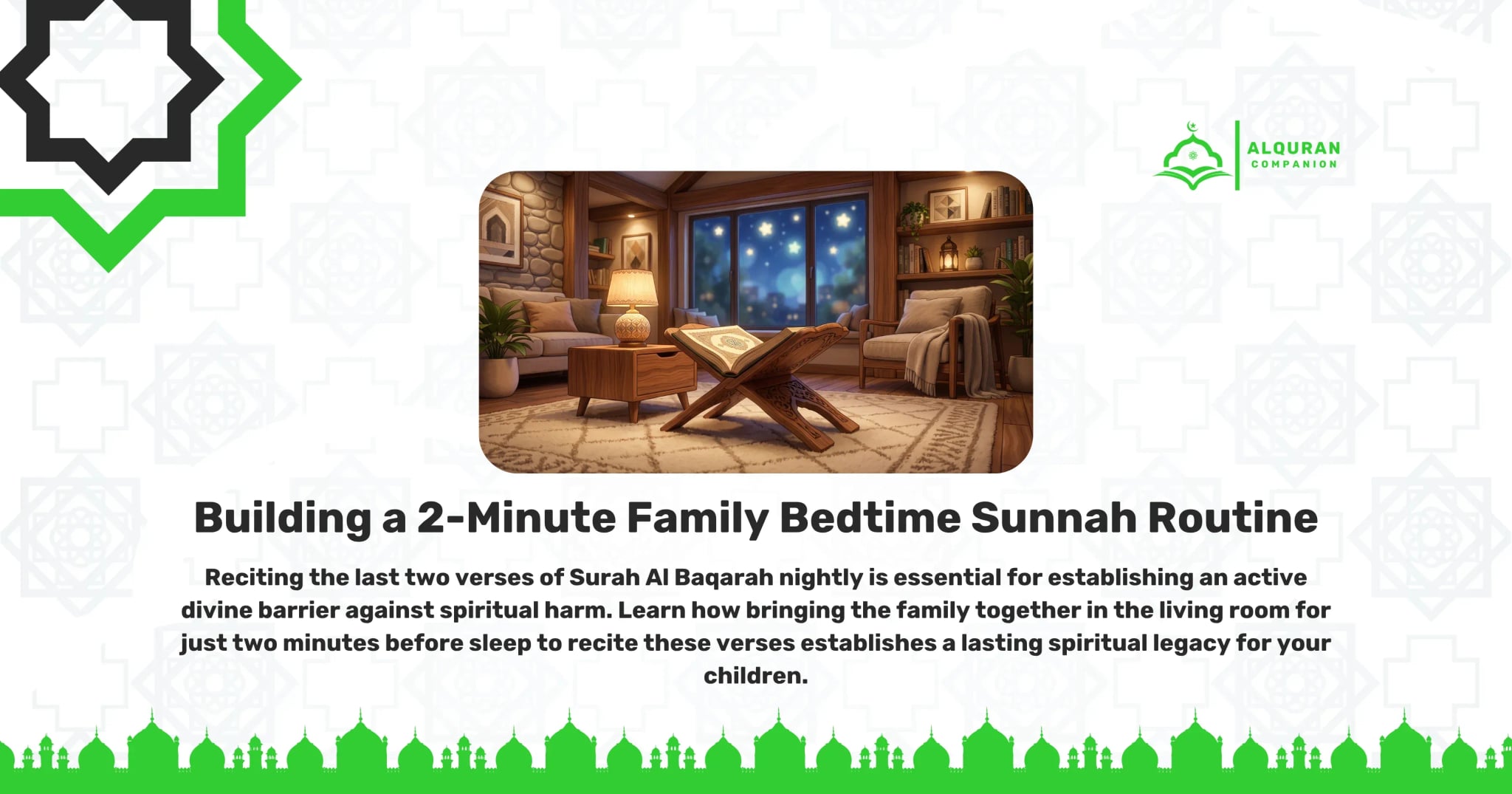
Building a family bedtime routine requires anchoring the habit to an existing daily action. By bringing the family together in the living room for just two minutes before sleep to recite the last two ayats of Surah Al Baqarah together, parents establish a lasting spiritual legacy for their children.
Consistency beats intensity when cultivating Islamic habits. Rather than demanding children memorize large portions of the Quran in one sitting, the prophetic approach favors small, consistent actions. Begin by reciting the verses loudly so your children can hear the correct pronunciation. Over weeks and months, they will naturally absorb the cadence and Makharij through passive listening. You can follow the recitation with the reading of Surah Al-Ikhlas, Surah Al-Falaq, and Surah An-Nas, completing the ultimate Sunnah bedtime fortress.
At Al Quran Companion, we support this family-centric model. Our instructors design customized learning plans that align with your family's schedule. Whether you require evening sessions in Australia or morning classes in Ireland, our educators provide the structured accountability needed to move from irregular reading to confident, daily recitation. Mastering the last two ayats of Surah Al Baqarah is not just about fulfilling a religious obligation; it is about bringing peace, mercy, and divine guardianship into your home every single night.
Frequently Asked Questions

Sheikh Abdullah Al-Hanif
Verified AuthorSheikh Abdullah Al-Hanif is the Head of Education at Al Quran Companion. With over 15 years of experience in Tajweed and Hifz, he specializes in bridging the gap between classical Islamic tradition and modern digital pedagogy. He is passionate about making the Quran accessible to everyone—from energetic toddlers to busy professionals.
Read more about author