How to Learn Quran Online in the UK: The 2026 Blueprint
British Muslims learn Quran online through live one-on-one video sessions with Ijazah-certified tutors who provide real-time Tajweed correction. The 4-Pillar British Quran Learning Framework combines accredited syllabi, enhanced DBS checks, GMT-aligned scheduling, and termly progress reports. Most UK students begin with a free diagnostic assessment to map their level before committing to a weekly timetable.
Finding reliable Quran education in Britain has always involved trade-offs. The local madrasah might sit a thirty-minute drive away. The volunteer teacher may lack formal Ijazah authorization. The 5pm class clashes with GCSE revision or a late shift at work. For families in smaller towns, qualified female teachers for older daughters can be almost impossible to find locally.
Online Quran classes solve these structural problems without sacrificing teaching quality. A student in Bradford accesses the same certified instructor as a student in Dubai. A working parent in London books a 7am session before the school run. An adult revert in Manchester learns at their own pace without sitting beside seven-year-olds.
This guide maps the complete British pathway for learning Quran online. You will see the 4-Pillar framework we use at Al Quran Companion, the curriculum stages from Noorani Qaida to Hifz, and the practical steps to start lessons this week.
What This Guide Covers
- How to Learn Quran Online in the UK: The 2026 Blueprint
- The 4-Pillar British Quran Learning Framework
- Why Are Online Quran Classes Becoming the Standard for UK Families?
- Online Quran Classes vs Local Madrasah: A UK Comparison
- What Age Is Best to Start Online Quran Classes for Kids?
- Curriculum Pathways: From Noorani Qaida to Fluent Recitation and Hifz
- Schedule Your Free 1-on-1 Level Assessment
- How to Start Online Quran Lessons in 3 Simple Steps
- Tajweed Rules for UK Beginners: What You Need to Know
- Balancing Quran Learning with UK School and Work Schedules
- Safety and Trust: How We Vet Our Teachers
- Why Al Quran Companion Is the Trusted Choice for UK Families
- Frequently Asked Questions About Learning Quran in the UK
Key Takeaways
- Ijazah-Certified Curriculum: Every lesson follows a structured syllabus from Noorani Qaida to Hifz, taught by tutors holding formal authorization in Quranic recitation.
- Strict Child Safeguarding: All UK-based teachers undergo enhanced DBS checks, barred list verification, and multi-stage background reviews before teaching any student.
- GMT-Aligned Scheduling: Classes run before school, after school, evenings, and weekends in both GMT and BST, fitting around UK school terms and work commitments.
- Termly Progress Evaluations: Parents receive structured progress reports each term, tracking pronunciation accuracy, fluency milestones, and memorization targets.
The 4-Pillar British Quran Learning Framework
The 4-Pillar British Quran Learning Framework is a structured approach designed specifically for UK Muslim families balancing secular education with Islamic studies. Each pillar addresses a distinct gap that British parents consistently report: curriculum coherence, child safety, time-zone friction, and measurable progress. Together, these pillars form the operational backbone of every class delivered through Al Quran Companion.
The first pillar is the Ijazah-Certified Curriculum. An Ijazah is a formal license authorizing its holder to teach Quran recitation with an unbroken chain of transmission back to Prophet Muhammad ﷺ. Every Al Quran Companion tutor holds this authorization. Lessons follow a graded syllabus, not ad-hoc reading sessions. A child in Year 3 working through Noorani Qaida learns the same phonetic rules as an adult beginner, but with age-appropriate pacing and materials.
The second pillar is Strict Child Safeguarding and DBS Checks. This is not optional for British parents. The Children Act 1989 and subsequent safeguarding legislation set clear expectations for any adult working with minors. At Al Quran Companion, we conduct comprehensive background checks and detailed multi-stage reviews of every single teacher before they are certified to teach our students. This includes enhanced DBS certificates with barred list information for all UK-based instructors.
The third pillar is GMT-Aligned Scheduling. UK families operate on a specific rhythm: school drop-off between 8am and 9am, pickup between 3pm and 4pm, homework, dinner, and extracurricular activities. Our timetable adapts to this rhythm. Sessions run before Fajr for early risers, after Isha for night owls, and throughout the weekend. During British Summer Time, slots shift automatically to maintain consistency.
The fourth pillar is Termly Progress Evaluations. British parents are accustomed to receiving school reports each term. Quran learning should follow the same transparency standard. Parents receive a structured report every twelve weeks detailing pronunciation accuracy, fluency benchmarks, memorization targets achieved, and areas requiring focused revision. This creates accountability on both sides of the screen.
Why Are Online Quran Classes Becoming the Standard for UK Families?
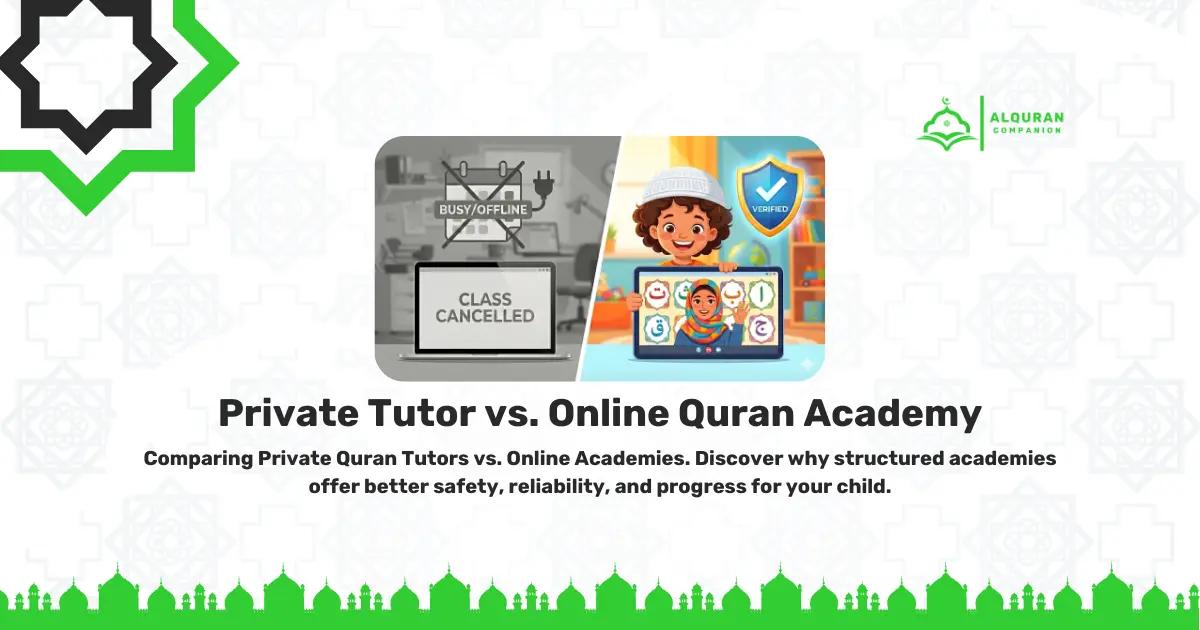
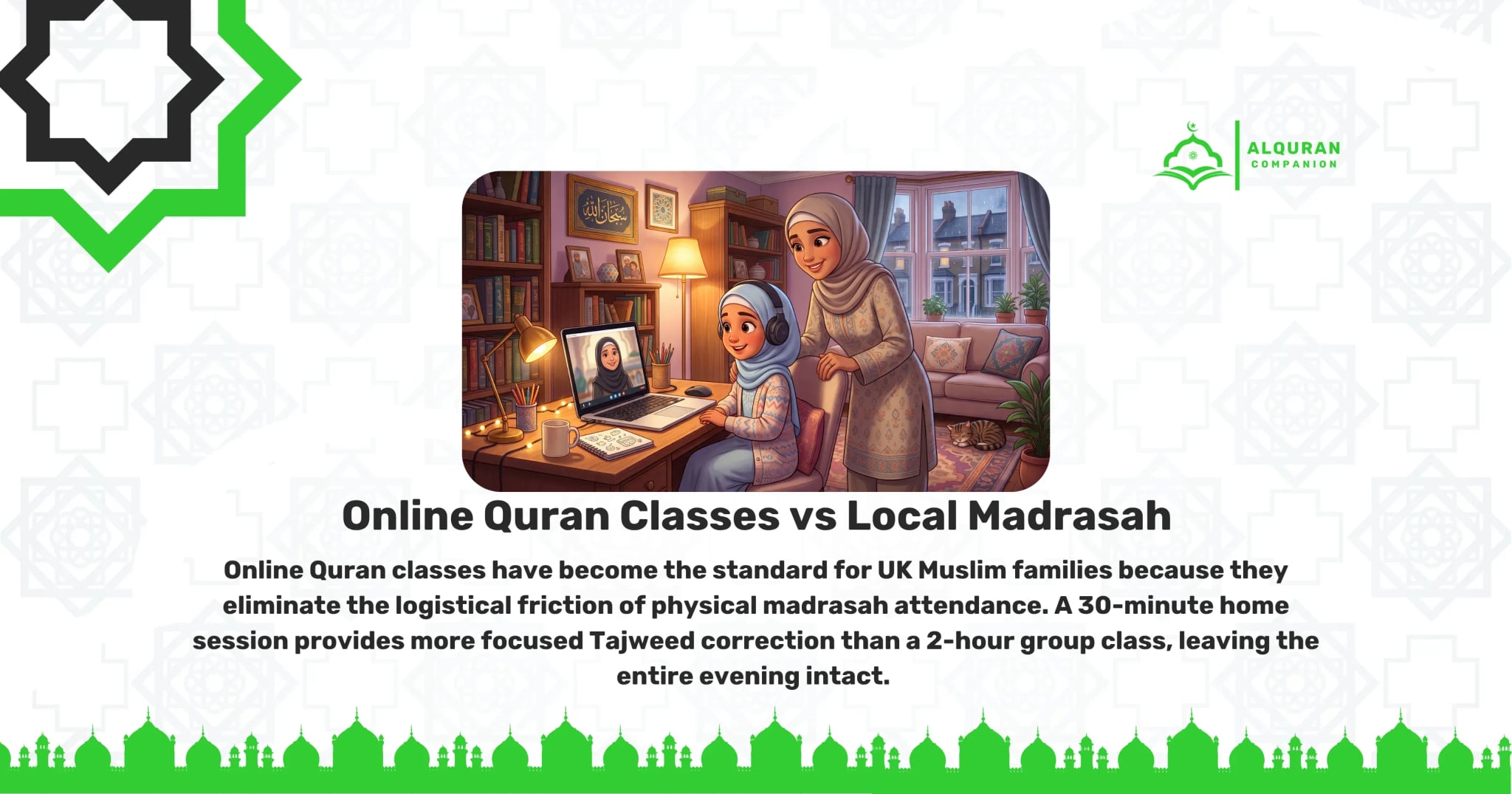
Online Quran classes have become the standard for UK Muslim families because they eliminate the logistical friction of physical madrasah attendance while providing access to higher-qualified teachers. A family in rural Norfolk can now access an Ijazah-holding instructor who would never relocate to their area. A parent in Birmingham can schedule lessons around shift work. This is not a compromise on quality; it is an expansion of access.
Consider the after-school rush that dominates British family life. School finishes at 3:15pm. By the time a child is collected, brought home, given a snack, and driven to madrasah, forty-five minutes have disappeared. The class runs from 5pm to 7pm. Then it is home for dinner, homework, and bed. There is no time for football in the park or a trip to the library. Online classes compress the commute to zero. A thirty-minute session at 4pm leaves the entire evening intact.
The same logic applies to working professionals. A nurse finishing a twelve-hour shift at 8pm cannot attend a mosque circle. An adult learner preparing for GCSE Islamic Studies may need focused Tajweed revision at 6am before school. Online scheduling makes these scenarios possible. Learn more about fitting Quran study into a demanding UK routine in our guide on how busy UK professionals fit online Quran classes into their day.
Online Quran Classes vs Local Madrasah: A UK Comparison
Online Quran Classes vs Local Madrasah: What British Families Should Know
Pros
- Access to Ijazah-certified teachers regardless of your UK postcode
- Flexible scheduling around school terms, shift work, and GCSE/A-Level commitments
- Enhanced DBS-checked instructors with verified safeguarding training
- One-on-one attention with real-time Tajweed correction every session
- Zero commute time, especially valuable during winter months and in rural areas
- Termly progress reports with measurable pronunciation and fluency benchmarks
Cons
- Requires reliable broadband and a quiet space at home
- Misses the communal atmosphere of a physical mosque setting
- Parents must actively supervise younger children during sessions
- Some children thrive better with in-person peer interaction
For a deeper analysis of safety considerations, read our full guide on online Quran classes vs local madrasah.
What Age Is Best to Start Online Quran Classes for Kids?
Most children are developmentally ready for structured online Quran lessons between ages four and five, when they can focus for fifteen to twenty minutes and respond to gentle correction. The Prophet Muhammad ﷺ established a clear educational anchor when he instructed parents to command their children to pray at seven years old, indicating that formal religious training begins before that age.
The Messenger of Allah (ﷺ) said: Command your children to pray when they become seven years old, and beat them for it (prayer) when they become ten years old; and arrange their beds (to sleep) separately
This Hadith establishes that a seven-year-old should already be praying. Quran learning precedes that milestone. At ages four to five, a child can begin Noorani Qaida, learning Arabic letter shapes, sounds, and basic joining rules. At six to seven, they transition to reading short Surahs. By eight to nine, Tajweed rules become the focus. For more detail on readiness signs, see our guide on the best age to start Noorani Qaida.
Adult learners face no upper age limit. Reverts to Islam often begin Quran reading in their thirties, forties, or later. The learning process differs from childhood because adults bring stronger analytical skills but may carry self-consciousness about pronunciation errors. A patient, private one-on-one format removes that anxiety entirely. Our article on online Quran courses in the UK covers the full range of adult pathways.
Curriculum Pathways: From Noorani Qaida to Fluent Recitation and Hifz
A structured Quran curriculum moves through five progressive stages: Noorani Qaida for letter recognition, Quran reading for fluency, Tajweed for precision, Hifz for memorization, and Tafsir for understanding. Each stage has distinct competencies and realistic timelines. Skipping stages creates gaps in pronunciation that become increasingly difficult to correct later.
The 5-Stage Quran Learning Pathway for UK Students
| Stage | Target Age / Level | Core Competencies | Typical Timeline |
|---|---|---|---|
| Stage 1: Noorani Qaida | Ages 4-6 or adult beginners | Arabic letter shapes, Makharij, vowel marks, joining rules | 4-8 months |
| Stage 2: Quran Reading (Nazra) | Ages 6-8 or post-Qaida | Fluent word recognition, basic recitation, short Surahs | 6-12 months |
| Stage 3: Tajweed Application | Ages 8-11 or intermediate | Noon Sakinah rules, Meem Sakinah, Madd, Qalqalah, Ghunnah | 12-18 months |
| Stage 4: Hifz (Memorization) | Ages 10+ or committed students | Juz-by-Juz memorization, revision cycles, retention methods | 2-5 years |
| Stage 5: Tafsir & Tarteel | Advanced students | Verse meanings, classical commentary, contemplative recitation | Ongoing |
Stage 1: Noorani Qaida
Stage 2: Quran Reading (Nazra)
Stage 3: Tajweed Application
Stage 4: Hifz (Memorization)
Stage 5: Tafsir & Tarteel
The Tajweed stage deserves particular emphasis. Tajweed is the science of reciting the Quran with correct pronunciation, articulation, and rhythm. Makharij al-Huroof refers to the specific articulation points in the throat, tongue, lips, and nasal cavity from which Arabic letters originate. A student who reaches Stage 3 without mastering Makharij will struggle with advanced rules. Our common Tajweed mistakes to avoid guide covers the errors that UK students make most frequently.
اَوۡ زِدۡ عَلَيۡهِ وَرَتِّلِ الۡقُرۡاٰنَ تَرۡتِيۡلًا ؕ﴿٤﴾
aw zid ʿalayhi warattili l-qur'āna tartīlan
Or add to it, and recite the Qur’ān with measured recitation.
Surah Al-Muzzammil establishes the standard for Quran recitation. The command to recite with Tarteel, measured and deliberate pacing, forms the spiritual foundation of Tajweed study. Classical scholars including Ibn Kathir explained that Tarteel means giving every letter its right, observing the rules of elongation and articulation without rushing. A student who memorizes Surahs while ignoring Tarteel memorizes sounds, not revelation.
Schedule Your Free 1-on-1 Level Assessment
How to Start Online Quran Lessons in 3 Simple Steps
Starting online Quran lessons requires three decisions: choosing a teacher, confirming your schedule, and committing to a weekly rhythm. The process takes less than a week from initial enquiry to first lesson.
- Book Your Free Diagnostic Trial: A thirty-minute live session with an accredited tutor assesses your current level, identifies pronunciation gaps, and recommends a starting stage. No payment is required.
- Meet Your Dedicated Teacher: You are matched with an Ijazah-certified instructor experienced in teaching British students. Female teachers are available for daughters and adult sisters.
- Confirm Your Weekly Timetable: Choose slots that fit around school pickup, work shifts, and weekend commitments. Sessions are available in GMT and BST with automatic adjustment.
Tajweed Rules for UK Beginners: What You Need to Know
Tajweed rules govern the precise pronunciation of Arabic letters, the timing of vowel elongations, and the nasalization of specific consonants. Noon Sakinah refers to the letter Noon without a vowel, and its four rules (Izhar, Idgham, Iqlab, and Ikhfa) determine how it interacts with following letters. Meem Sakinah has three rules with similar functions. These are not decorative refinements; mispronouncing them changes word meanings.
Madd, the elongation of vowels, has multiple categories. Madd Tabee'i extends a vowel for two counts. Madd Munfasil extends it for four to five counts when a word ends with a vowel and the next begins with Hamzah. Madd Lazim, found in words like Al-Dhaalleen, extends for six counts. These rules are not arbitrary; they preserve the rhythmic beauty of Quranic recitation across all seven canonical Qira'at.
For UK students, the most common Tajweed errors involve Makharij confusion. The letters Ha (ح) and Kha (خ) are often merged. Dad (ض) and Dha (ظ) are swapped. Tha (ث) and Sa (س) lose their distinction. These errors originate from the absence of these sounds in English phonology. A structured Tajweed course with a certified tutor corrects them through targeted drills. Our course on Quranic Tajweed covers all essential rules in a systematic progression.
Balancing Quran Learning with UK School and Work Schedules
British Muslim families face a specific calendar conflict: the school term runs from September to July, Ramadan shifts ten days earlier each year, and GCSE exams cluster in May and June. A Quran learning schedule must adapt to these cycles rather than compete with them.
During GCSE and A-Level preparation months, many families reduce Quran sessions from three per week to two. The curriculum adjusts, not the standard. During Ramadan, session frequency increases because students are spiritually motivated and school commitments often pause. Our instructors are trained to pace learning according to these seasonal rhythms.
For working professionals, the obstacle is rarely willingness. It is energy. After a nine-hour workday, the thought of a Quran lesson can feel overwhelming. The solution is scheduling sessions at peak energy times. Some adults prefer 6am before work. Others prefer 9pm after children are asleep. The tutor adapts to the student's rhythm, not the reverse.
Our comprehensive British learning guide on online Quran classes for kids in the UK covers additional strategies for integrating Quran study into a standard UK school week.
Safety and Trust: How We Vet Our Teachers
Every Al Quran Companion teacher undergoes enhanced DBS verification with barred list information before their first session with any student. This is non-negotiable for UK-based instruction. The DBS check covers criminal convictions, cautions, reprimands, and warnings held on the Police National Computer. For roles involving regulated activity with children, the barred list check confirms the individual is legally permitted to work with minors.
Beyond DBS, our vetting process includes verification of Ijazah credentials, two professional references, and a teaching demonstration evaluated by our academic team. Teachers are also required to complete safeguarding training aligned with UK standards. Parents can observe any session at any time. There are no unmonitored interactions.
For families seeking female instructors, certified female Quran tutors are available for daughters, young children, and adult sisters. This addresses a persistent gap in many UK communities where qualified female teachers are scarce. Adult learners and reverts receive 100% private, patient, judgment-free one-on-one guidance at their own pace.
Expert Insight
"A parent's most important question is not 'How fast will my child finish?' but 'Is my child safe, and is the teacher qualified?' When both answers are yes, progress follows naturally. We built our entire vetting framework around those two questions."
Why Al Quran Companion Is the Trusted Choice for UK Families
Al Quran Companion serves British Muslim families by combining the rigor of classical Ijazah scholarship with the practical demands of modern UK life. Our instructors hold formal authorization in Quranic recitation. Our scheduling adapts to GMT and BST. Our safeguarding standards meet and exceed UK requirements. And our free diagnostic trial lets every family experience the standard before committing a single pound.
Whether you are a parent in London seeking structured online Quran courses in the UK for your children, a professional in Manchester needing flexible evening slots, or a revert in Glasgow starting from the alphabet, our diagnostic assessment maps your starting point and builds a pathway from there.
Frequently Asked Questions About Learning Quran in the UK

Al Quran Companion Team
Verified AuthorThe official academic and editorial team at Al Quran Companion, a leading Online Quran Academy dedicated to simplifying Tajweed, Hifz, and Islamic studies for students worldwide.
Read more about author