What Is Masjid e Al-Aqsa and What Does Its Name Mean?
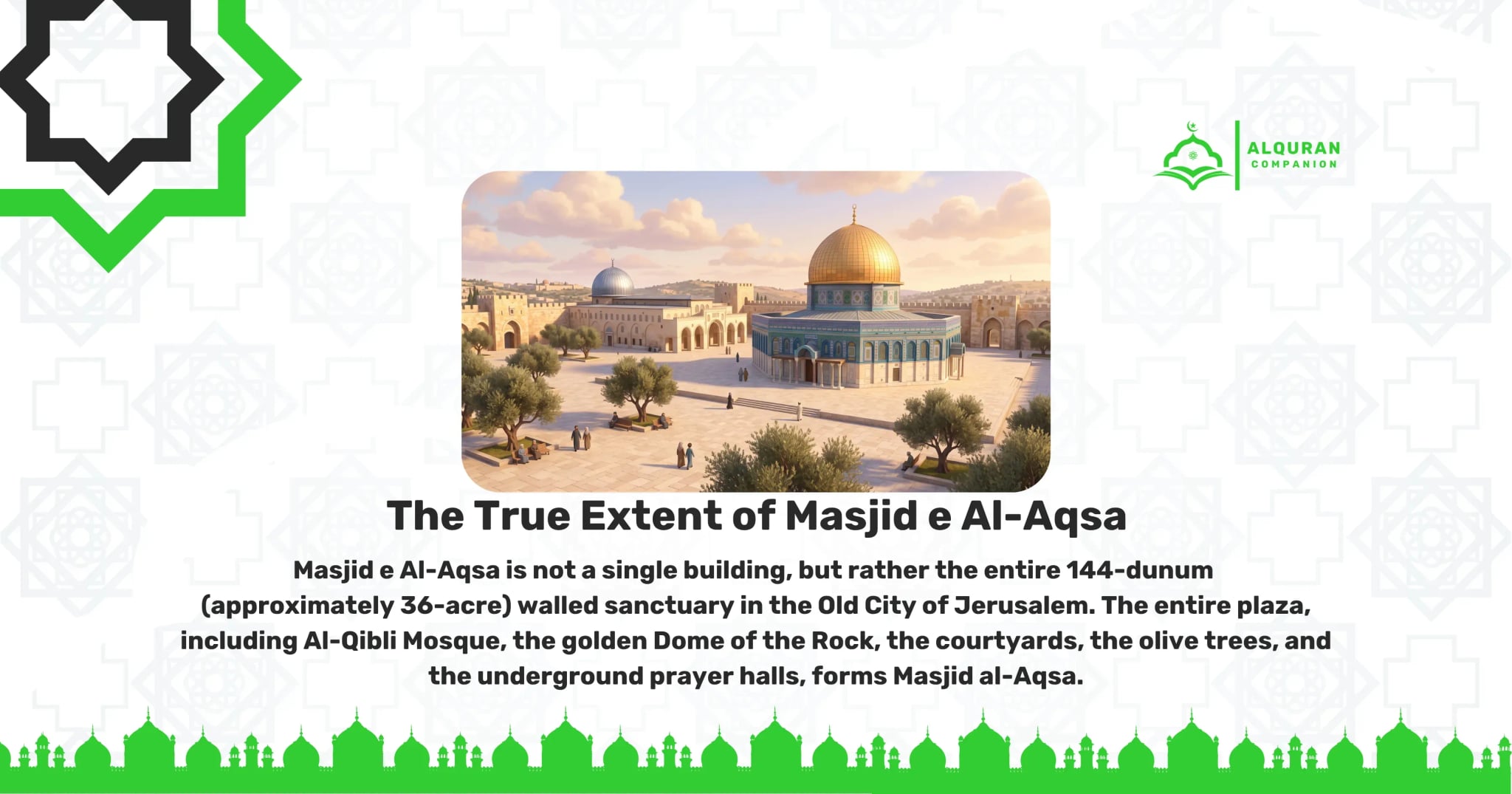
Masjid al-Aqsa is the entire 144-dunum walled sanctuary in the Old City of Jerusalem, known in Arabic as Al-Haram ash-Sharif. The name 'Al-Aqsa' means 'the farthest' because it was the most distant mosque from Makkah Mukarramah when Allah established it. Understanding what is a masjid begins with recognizing that this sacred compound is not a single building. It is a complete sanctuary that Allah honored in Surah Al-Isra (17:1).
The Arabic word 'masjid' literally means 'place of prostration' (sajdah). In Islam, a masjid is any purified space where Muslims gather for the five daily prayers facing the Qiblah. The term 'masjid in Islam' carries a weight far beyond architecture. It describes a physical boundary where worldly distractions stop and direct worship of Allah begins. This is why the Quran uses the word 'masjid' to describe the grandest sanctuaries on earth.
Al-Aqsa holds a unique rank among the three mosques that Muslims may travel to for worship. The Prophet ﷺ said: 'Do not set out on a journey except for three mosques: Al-Masjid al-Haram, the Mosque of the Messenger of Allah ﷺ, and Masjid al-Aqsa.' This Hadith is recorded in Sahih Al-Bukhari and Sahih Muslim. When Muslims ask what is the masjid that ranks third in Islam, the answer is Al-Aqsa.
Table of Contents
- What Is Masjid e Al-Aqsa and What Does Its Name Mean?
- The Architectural Distinction: Compound vs. Qibli vs. Dome of the Rock
- The Prophetic Construction Timeline: From Adam and Ibrahim to Sulayman
- The Quranic Foundation: The Night Journey (Surah Al-Isra 17:1)
- Book Your Free 1-on-1 Quran and Islamic History Diagnostic
- Islamic Significance: The First Qibla and Multiplied Prayer Rewards
- The 3-Sanctuary Comparative Matrix in Islam
- How Al Quran Companion Deepens Your Understanding of Sacred History
- Frequently Asked Questions About Masjid e Al-Aqsa
Key Takeaways
- Masjid al-Aqsa is the entire 144-dunum compound (Al-Haram ash-Sharif), not just one building
- Al-Aqsa means 'the farthest' and was the first Qibla before facing the Kaaba
- The Dome of the Rock (golden dome) and Al-Qibli Mosque (silver dome) are separate structures within the compound
- Prayer in Masjid al-Aqsa carries a reward of 250 to 500 times more than an ordinary mosque
- Its foundations were laid 40 years after Masjid al-Haram according to Sahih Al-Bukhari
- The Night Journey (Isra) in Surah Al-Isra connects Al-Aqsa directly to Prophet Muhammad ﷺ
The Architectural Distinction: Compound vs. Qibli vs. Dome of the Rock
Al-Haram ash-Sharif is the full 144-dunum (approximately 36-acre) walled compound in southeast Jerusalem. Within those walls sit two major prayer structures plus over 200 other monuments. Al-Qibli Mosque (Al-Jami' al-Qibli) has a silver-grey dome and faces the Qiblah. The Dome of the Rock (Qubbat as-Sakhrah) has a golden dome and is an octagonal shrine. These are not the same building. Confusing them is the most common mistake Muslims make about Al-Aqsa.
The Sacred Compound Clarification Blueprint
| Feature | Al-Haram Ash-Sharif (Full Compound) | Al-Qibli Mosque | Dome of the Rock |
|---|---|---|---|
| Arabic Name | Al-Haram ash-Sharif | Al-Jami' al-Qibli | Qubbat as-Sakhrah |
| Visual Identifier | 144-dunum walled plaza | Silver-grey dome | Golden dome |
| Historical Builder | Multiple Prophets, then Umar ibn al-Khattab | Umar ibn al-Khattab, expanded by Umayyads | Abd al-Malik ibn Marwan |
| Sacred Function | Entire sanctuary; prayer rewarded 250-500x | Main congregational mosque for daily prayers | Shrine marking the Rock of the Night Journey |
| Qiblah Direction | All structures face the Kaaba | Faces the Kaaba directly | Not a prayer hall; visit for reflection |
Arabic Name
Visual Identifier
Historical Builder
Sacred Function
Qiblah Direction
Consider this: when you see photographs of a golden dome in Jerusalem, you are looking at the Dome of the Rock, not Al-Qibli Mosque. The entire plaza, including both structures, the courtyards, the olive trees, and the underground prayer halls, forms Masjid al-Aqsa. Scholars of Fiqh across the four Sunni schools agree that prayer anywhere within this walled boundary carries the multiplied reward.
The confusion matters for a practical reason. When a Muslim visits and prays near the Dome of the Rock, that prayer is still within Al-Aqsa. But if someone believes the golden dome itself is the mosque, they misunderstand the Prophetic legacy of the site. Learning this distinction connects directly to understanding the the first Qibla in Salah and why this sanctuary mattered so deeply to the early Muslim community. At Al Quran Companion, our certified Ijazah-holding instructors use a personalized diagnostic method called the 3-Step Tafsir Discovery Loop to help students explore these connections between Quranic verses and sacred history.
The Prophetic Construction Timeline: From Adam and Ibrahim to Sulayman
According to Sahih Al-Bukhari (Hadith 3366), Masjid al-Aqsa was the second mosque whose foundations were laid on earth. Abu Dharr (RA) asked the Prophet ﷺ which mosque was built first. He ﷺ replied, 'Al-Masjid al-Haram.' Abu Dharr then asked which came next. He ﷺ said, 'Al-Masjid al-Aqsa.' When asked about the time between them, the Prophet ﷺ replied, 'Forty years.' This Hadith establishes Al-Aqsa as the second house of worship consecrated to Allah.
I said, "O Allah's Messenger (ﷺ)! Which mosque was first built on the surface of the earth?" He said, "Al-Masjid-ul-Haram (in Mecca)." I said, "Which was built next?" He replied, "The mosque of Al-Aqsa (in Jerusalem) ." I said, "What was the period of construction between the two?" He said, "Forty years." He added, "Wherever (you may be, and) the prayer time becomes due, perform the prayer there, for the best thing is to do so (i.e. to offer the prayers in time)
Classical scholars of Tafsir have discussed the lineage of Prophets who sanctified this site. Ibn Kathir recorded that the original foundation was laid by Adam (AS) or his descendants. Later, Prophet Ibrahim (AS) and his son Ishaq (AS) rebuilt and consecrated the site for worship. Then Prophet Dawud (AS) began the reconstruction that his son Sulayman (AS) completed. This chain of Prophetic care spans generations and shows that Al-Aqsa was never a single-era project. It carries the spiritual fingerprints of Islam's greatest messengers.
When Caliph Umar ibn al-Khattab (RA) entered Jerusalem, the site had been neglected. Historical records describe a rubbish heap covering the sacred rock. Umar (RA) personally helped clear the debris and established a simple prayer space. This act of restoration reconnected the Muslim Ummah to the Prophetic legacy of the site. Later Umayyad caliphs expanded the structures into the magnificent compound we recognize today.
The Quranic Foundation: The Night Journey (Surah Al-Isra 17:1)
The Quranic anchor for Al-Aqsa's sacred status comes directly from Surah Al-Isra. Allah describes the Night Journey from Masjid al-Haram to Masjid al-Aqsa, a journey that happened in a single night. This verse is the strongest Quranic evidence for the sanctity of Jerusalem and the third holiest mosque in Islam.
سُبۡحٰنَ الَّذِىۡۤ اَسۡرٰى بِعَبۡدِهٖ لَيۡلًا مِّنَ الۡمَسۡجِدِ الۡحَـرَامِ اِلَى الۡمَسۡجِدِ الۡاَقۡصَا الَّذِىۡ بٰرَكۡنَا حَوۡلَهٗ لِنُرِيَهٗ مِنۡ اٰيٰتِنَا ؕ اِنَّهٗ هُوَ السَّمِيۡعُ الۡبَصِيۡرُ﴿١﴾
sub'ḥāna alladhī asrā biʿabdihi laylan mina l-masjidi l-ḥarāmi ilā l-masjidi l-aqṣā alladhī bāraknā ḥawlahu linuriyahu min āyātinā innahu huwa l-samīʿu l-baṣīru
Exalted is He who took His Servant [i.e., Prophet Muḥammad (ﷺ)] by night from al-Masjid al-Ḥarām to al-Masjid al-Aqṣā, whose surroundings We have blessed, to show him of Our signs. Indeed, He is the Hearing, the Seeing.
Classical Tafsir from Ibn Kathir and Al-Tabari explains the deeper meaning of this verse. The Arabic word 'asra' refers specifically to a night journey, while the Mi'raj (ascension) followed from Al-Aqsa upward through the heavens. During this journey, Prophet Muhammad ﷺ led all previous Prophets in prayer at Al-Aqsa. Scholars across the four schools of jurisprudence cite this event as proof that Al-Aqsa is a place of unity for the entire Prophetic tradition.
The phrase 'whose surroundings We have blessed' in the verse refers to the agricultural abundance and spiritual barakah of Jerusalem and its surrounding lands. Al-Tabari recorded that early Muslims understood this blessing to include the fertile valleys, the olive groves, and the spiritual legacy of the Prophets buried throughout the region. Ibn Kathir added that the blessing includes the site's role as a gathering place for angels and the righteous.
For diaspora Muslims in the US, UK, and Canada, this Quranic verse is a direct link between their daily Salah and the sacred geography of Islam. Teaching children about Surah Al-Isra opens their understanding of the global Ummah. It shows that Jerusalem is not a distant political issue. It is part of their spiritual inheritance as Muslims.
Book Your Free 1-on-1 Quran and Islamic History Diagnostic
Deepen your family's connection to Islamic history and the Quranic verses that shape our understanding of sacred places. Our Ijazah-certified instructors specialize in Tafsir, Tajweed, and Islamic history through our online Quranic Tafsir course. Book your free 1-on-1 diagnostic lesson and experience a personalized approach to learning.
Islamic Significance: The First Qibla and Multiplied Prayer Rewards
Masjid al-Aqsa served as the Qiblah for Muslims for approximately 16 to 17 months after the Hijrah. During the Meccan period, Prophet Muhammad ﷺ would pray facing toward both the Kaaba and Al-Aqsa when possible. After migrating to Madinah Munawwarah, the Muslims faced Al-Aqsa in prayer until Allah revealed the command to change the Qiblah toward Masjid al-Haram. This period made Al-Aqsa the first Qiblah of Islam, a distinction no other mosque shares.
Expert Insight
"The changing of the Qiblah was a test of faith. The hypocrites questioned why the direction had changed, while the believers submitted immediately. Al-Aqsa's role as the first Qiblah established its permanent rank as the third holiest mosque in Islam."
The spiritual rewards tied to prayer in Masjid al-Aqsa are among the highest in Islam. The Prophet ﷺ said, 'One prayer at al-Masjid al-Haram is better than a hundred thousand prayers in any other mosque, a thousand prayers at my mosque, and five hundred prayers at Al-Aqsa Mosque.' This narration is recorded in Shu'ab Al-Eeman by Imam Al-Baihaqi. Some scholars also recorded a narration describing the reward as 250 prayers. Both numbers confirm that Al-Aqsa holds a rank far beyond ordinary mosques.
Prayer Reward Comparison Across the Three Sanctuaries
| Sanctuary | Location | Multiplied Reward | Primary Evidence |
|---|---|---|---|
| Masjid al-Haram | Makkah Mukarramah | 100,000 prayers | Sahih Al-Bukhari and Sahih Muslim |
| Masjid an-Nabawi | Madinah Munawwarah | 1,000 prayers | Sahih Al-Bukhari and Sahih Muslim |
| Masjid al-Aqsa | Jerusalem | 500 prayers (some narrations: 250) | Shu'ab Al-Eeman by Al-Baihaqi |
Masjid al-Haram
Masjid an-Nabawi
Masjid al-Aqsa
This ranking matters for the spiritual life of every Muslim. When a believer understands that a single prayer at Al-Aqsa carries the weight of five hundred prayers elsewhere, the site becomes a priority for spiritual investment. It is not merely a historical monument. It is a place where the believer's scale of good deeds can tilt massively toward Jannah. For those planning to learn more about sacred months and blessed places in Islam, Al-Aqsa deserves deep study.
The 3-Sanctuary Comparative Matrix in Islam
Islam designates three sanctuaries as the only mosques to which a Muslim may travel for worship. The Prophet ﷺ said, 'Do not set out on a journey except for three mosques.' This Hadith in Sahih Al-Bukhari and Sahih Muslim establishes the unique rank of these three sites. Each sanctuary carries distinct historical roles, Quranic references, and spiritual rewards. This matrix clarifies those differences.
The 3-Sanctuary Comparative Matrix
| Criterion | Masjid al-Haram | Masjid an-Nabawi | Masjid al-Aqsa |
|---|---|---|---|
| Location | Makkah Mukarramah | Madinah Munawwarah | Jerusalem |
| Quranic Reference | Surah Al-Baqarah (2:144) | Surah Al-Tawbah (9:108) | Surah Al-Isra (17:1) |
| Prayer Reward | 100,000 prayers | 1,000 prayers | 500 prayers (or 250) |
| Primary Historical Figure | Prophet Ibrahim (AS) | Prophet Muhammad ﷺ | Multiple Prophets from Adam to Sulayman |
| Journey Merit (Shadd ar-Rihal) | Obligatory for Hajj and Umrah | Highly recommended for visitation | Highly recommended for visitation |
| Direction of Qiblah | Current Qiblah for all Muslims | Faces the Kaaba | First Qiblah for 16-17 months |
Location
Quranic Reference
Prayer Reward
Primary Historical Figure
Journey Merit (Shadd ar-Rihal)
Direction of Qiblah
The three sanctuaries form a spiritual triangle that connects the life of Prophet Ibrahim (AS) in Makkah, the mission of Prophet Muhammad ﷺ in Madinah, and the legacy of all previous Prophets in Jerusalem. Learning this matrix helps Muslims understand that the Ummah's history is not linear. It is rooted in multiple lands, multiple Prophets, and a single message of Tawhid.
For diaspora families in Australia, Germany, and Ireland, this global perspective matters. Children growing up in Western societies often encounter narratives that separate Jerusalem from Islamic history. Teaching the 3-Sanctuary Matrix corrects that. It reconnects Muslim youth to the full geography of their faith. It shows that the Kaaba, the Prophet's Mosque, and Al-Aqsa are three chapters of one continuous story.
The Prophet ﷺ also linked the three mosques through the narration about the Dajjal. He ﷺ said that the Dajjal will not enter four mosques, and he named the two in Makkah and Madinah, plus Al-Aqsa. This Hadith in Sahih Muslim further confirms the spiritual protection and rank of Al-Aqsa. It is a sanctuary that carries divine safeguarding alongside the two mosques of the Hijaz.
How Al Quran Companion Deepens Your Understanding of Sacred History
Understanding the Quranic verses and Ahadith about Al-Aqsa requires more than reading translations. It requires guided study with teachers who know the Tafsir, the historical context, and the linguistic depth of the Arabic text. At Al Quran Companion, our certified Ijazah-holding instructors use the 4-Pillar Scriptural Deep-Dive Framework to help students connect Quranic verses to their historical reality.
We always conduct comprehensive Background Checks and detailed multi-stage reviews of every single teacher before they are certified to teach our students. Our academy offers qualified female Quran tutors for daughters, young children, and adult sisters. Adult learners and reverts receive 100% private, patient, judgment-free 1-on-1 guidance at their own pace. Whether you live in Dubai, Toronto, London, or Sydney, our teachers are available across all time zones.
Learning about Al-Aqsa also connects naturally to improving your Quran recitation. When you study Surah Al-Isra with proper Tajweed, the verse describing the Night Journey comes alive. The rhythm of the Arabic text mirrors the movement from Masjid al-Haram to Masjid al-Aqsa. Reciting Quran with proper Tajweed transforms the words from information into spiritual experience.
Frequently Asked Questions About Masjid e Al-Aqsa

Al Quran Companion Team
Verified AuthorThe official academic and editorial team at Al Quran Companion, a leading Online Quran Academy dedicated to simplifying Tajweed, Hifz, and Islamic studies for students worldwide.
Read more about author