Many Muslim families experience moments of deep overwhelm. Whether you are balancing public school commitments in the US, managing the fast-paced after-school rush in the UK, or raising an expat family in the UAE, the daily pressures of modern life carry a heavy weight. In these moments of anxiety,
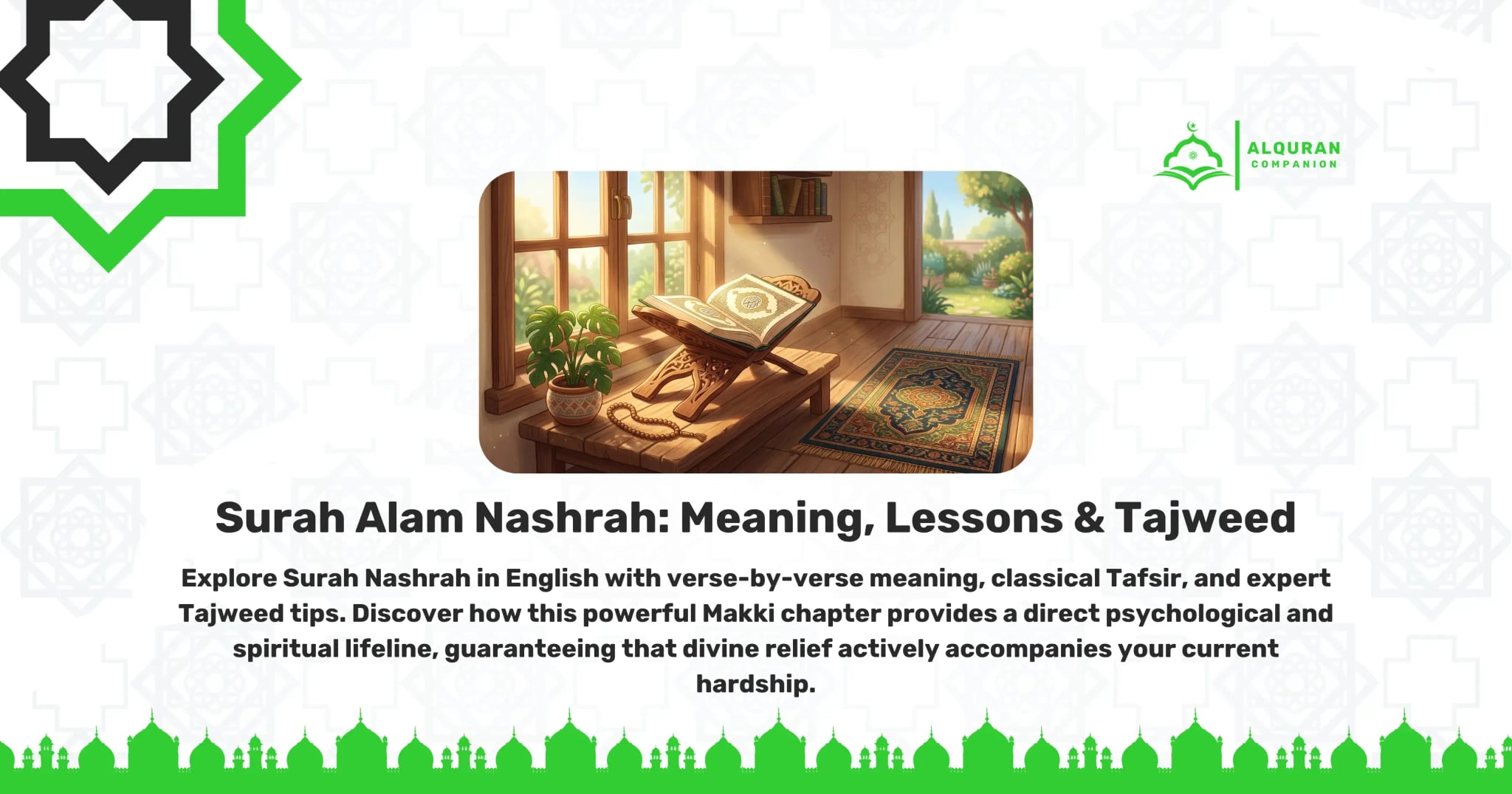
For believers today, the verses of this chapter provide a direct psychological and spiritual lifeline. When you feel cornered by professional stress, parenting challenges, or personal grief, reciting this Surah shifts your perspective from worldly despair to divine reliance. Here is why: Allah guarantees that ease is not just coming eventually, but it is actively paired with your current hardship.
Table of Contents
- Full Surah Alam Nashrah (Surah 94, Ash-Sharh)
- What Is Surah Alam Nashrah (Ash-Sharh) and Why Was It Revealed?
- The Linguistic Miracle: Why Hardship Is Mentioned Once but Ease Twice
- Verse-by-Verse Meaning, Tafsir and Arabic Translation (94:1-8)
- Tajweed Rules and Pronunciation Guide for Reciting Surah Ash-Sharh
- How to Apply Surah Inshirah for Daily Mental Peace and Stress Relief
- Frequently Asked Questions
Key Takeaways
- Surah Nashrah was revealed in Makkah to comfort Prophet Muhammad ﷺ during severe trials.
- The linguistic structure of verses 5 and 6 proves that one hardship is always overcome by multiple forms of ease.
- Mastering the Tajweed of this Surah requires strict attention to the throat letters Ha and Shin.
- Daily recitation serves as a powerful spiritual tool for managing modern anxiety and burnout.
Full Surah Alam Nashrah (Surah 94, Ash-Sharh)
Below is the complete text of Surah Alam Nashrah. This beautiful, short Surah is a pivotal element of
بِسْمِ ٱللَّهِ ٱلرَّحْمَٰنِ ٱلرَّحِيمِ
What Is Surah Alam Nashrah (Ash-Sharh) and Why Was It Revealed?
Surah Alam Nashrah (Surah 94, Ash-Sharh) is an eight-verse Makki chapter revealed to comfort Prophet Muhammad ﷺ during severe persecution in Makkah. It offers timeless divine reassurance that relief accompanies every trial, serving as a spiritual anchor for believers facing emotional burdens and worldly distress.
The early days of Islamic revelation in Madinah Munawwarah and Makkah Mukarramah were marked by intense opposition. The Quraysh mocked the Prophet ﷺ, boycotted his family, and subjected the early Muslims to physical and psychological torment. The burden of delivering the final message to a hostile society weighed heavily upon the Prophet ﷺ. During this intense period of isolation, Allah revealed Surah Ash-Sharh immediately following Surah Ad-Duha.
While Surah Ad-Duha reassured the Prophet ﷺ that he was not abandoned, Surah Nashrah focuses entirely on the internal state of the heart. The title 'Ash-Sharh' translates literally to 'The Expansion' or 'The Opening'. It refers to the physical and spiritual expansion of the chest, a metaphor for granting courage, tranquility, and immense emotional capacity. When a person is stressed, their chest feels tight and restricted. Allah directly addressed this human condition by reminding the Prophet ﷺ of the immense favors bestowed upon him.
The Linguistic Miracle: Why Hardship Is Mentioned Once but Ease Twice
The grammatical precision of verses 5 and 6 reveals a linguistic miracle. The Arabic word 'Al-Usr' (hardship) is definite, referring to a single specific difficulty. Conversely, 'Yusran' (ease) is indefinite, denoting vast, multiple forms of relief. Thus, one hardship can never overpower two eases.
This linguistic nuance is one of the most comforting realities in the entire Quran. In Arabic grammar, when a definite noun with the prefix 'Al-' (the) is repeated, it refers to the exact same object. So, 'Al-Usr' in verse 5 and 'Al-Usr' in verse 6 point to one single, specific problem you are facing. However, when an indefinite noun like 'Yusran' (ease) is repeated without the 'Al-' prefix, the second mention refers to a completely new, different instance of ease.
According to the consensus across the four established schools of Islamic jurisprudence (Hanafi, Maliki, Shafi'i, and Hanbali), this guarantees that divine relief outweighs worldly difficulty. The great companion Ibn Abbas (RA) beautifully summarized this grammatical rule by stating that one hardship will never conquer two eases. The math of divine mercy is stacked entirely in your favor.
When you are
Verse-by-Verse Meaning, Tafsir and Arabic Translation (94:1-8)
A comprehensive verse-by-verse breakdown of Surah Ash-Sharh requires engaging with classical exegesis from scholars like Ibn Kathir. By analyzing the Arabic transliteration, English translation, and foundational Tafsir, believers can extract profound daily guidance regarding emotional regulation, divine support, and spiritual devotion.
اَلَمۡ نَشۡرَحۡ لَـكَ صَدۡرَكَۙ﴿١﴾
Did We not expand for you, [O Muḥammad], your breast?
Tafsir Context (Ayah 1): This opening verse establishes the tone of the entire chapter. Allah addresses the Prophet ﷺ directly, reminding him of a tremendous past favor. 'Expansion of the breast' means illuminating the heart with wisdom, faith, and patience. Classical scholars note that this refers to both the physical event during his childhood when the Angel Jibril purified his heart, and the continuous spiritual expansion required to bear the immense weight of prophethood.
وَوَضَعۡنَا عَنۡكَ وِزۡرَكَۙ﴿٢﴾
And We removed from you your burden
Tafsir Context (Ayah 2): The word 'wizr' translates to a heavy, crushing load. Before receiving revelation, the Prophet ﷺ was deeply distressed by the moral corruption of Makkah. The 'burden' describes severe psychological distress and anxiety. Allah relieved this mental anguish by guiding him to the truth and sharing the responsibility of the message.
الَّذِىۡۤ اَنۡقَضَ ظَهۡرَكَۙ﴿٣﴾
Which had weighed upon your back
Tafsir Context (Ayah 3): This verse emphasizes the intensity of the burden described previously. It was so heavy that it physically 'broke his back' metonymically, indicating that the mental and emotional pressure of leading humanity toward guidance was immense before divine relief arrived.
وَرَفَعۡنَا لَـكَ ذِكۡرَكَؕ﴿٤﴾
And raised high for you your repute.
Tafsir Context (Ayah 4): Despite the Quraysh's attempts to slander him, Allah elevated the name of the Prophet Muhammad ﷺ. Today, his name is joined with Allah's name in the Shahada, the Adhan, and the daily Salah across the globe. This teaches us that when people attempt to lower your status unjustly, Allah possesses the ultimate power to honor you.
فَاِنَّ مَعَ الۡعُسۡرِ يُسۡرًا ۙ﴿٥﴾
For indeed, with hardship [will be] ease [i.e., relief].
Tafsir Context (Ayah 5): This is the central anchor of the Surah. Notice the preposition 'with' (ma'a) instead of 'after' (ba'da). This is a critical distinction. Relief does not merely follow the trial chronologically; it accompanies it simultaneously. While you endure the pain, Allah is actively manifesting the unseen solution.
اِنَّ مَعَ الۡعُسۡرِ يُسۡرًا ؕ﴿٦﴾
Indeed, with hardship [will be] ease.
Tafsir Context (Ayah 6): As discussed in the linguistic analysis section, the repetition here is a guarantee of certainty. It reinforces the heart’s Sabr (patience) and Tawakkul (reliance), ensuring that the believer remains steadfast because the promise of relief is divinely secured.
فَاِذَا فَرَغۡتَ فَانۡصَبۡۙ﴿٧﴾
So when you have finished [your duties], then stand up [for worship].
Tafsir Context (Ayah 7): Here lies the practical action plan. Anxiety creates paralysis. The divine prescription for stress is continuous, purposeful motion. Once you finish your worldly duties, do not sink into despair. Immediately shift your energy into spiritual worship. Turn your longing, complaints, and hopes exclusively toward Allah.
وَاِلٰى رَبِّكَ فَارۡغَب﴿٨﴾
And to your Lord direct [your] longing.
Tafsir Context (Ayah 8): This final verse directs the believer’s focus entirely toward Allah. Our deepest longing and ultimate desires should not be fixed upon worldly ease or results, but upon pleasing our Lord. He is the source of all ease, so focusing on Him is the ultimate solution to any difficulty.
Tajweed Rules and Pronunciation Guide for Reciting Surah Ash-Sharh
Mastering the Tajweed of Surah Ash-Sharh requires precise articulation from the throat and tongue. Reciters must clearly vocalize the pharyngeal letter Ha (ح) in Nashrah, the soft Shin (ش) in Sharh, the rolled Ra (ر) in Wizrak, and apply proper Ghunnah on the Nun Mushaddad to ensure technical accuracy and preserve the divine meaning.
For students living in Western societies, accessing authentic phonetic guidance can be challenging. Many rely on basic English transliterations, which often fail to capture the specific characteristics (Sifat) of Arabic letters. The science of Tajweed is the foundational system that ensures the Quran is recited exactly as it was revealed. Makharij al-Huroof refers to the specific articulation points in the throat, tongue, lips, and nasal cavity from which Arabic letters originate.
When focusing on
Step 1: The Pharyngeal Ha (ح) in 'Nashrah'
The word 'Nashrah' ends with the letter Ha (ح), which originates from the middle of the throat. It is sharp, breathy, and completely distinct from the soft English 'H'. Failing to push air from the middle throat changes the letter entirely. Practice tightening the throat muscles gently to produce a crisp, un-vocalized whisper.
Step 2: The Spreading Shin (ش) in 'Sharh'
The letter Shin possesses the characteristic of 'Tafashshi', which means the spreading of sound throughout the mouth. When reciting 'Ash-Sharh', allow the middle of your tongue to rise slightly while sound disperses outward. Do not restrict the airflow; let the 'shhh' sound fill the oral cavity fully before concluding the word.
Step 3: The Heavy Ra (ر) and the Ghunnah
In the word 'wizrak', the Ra carries a Fatha, requiring it to be pronounced with a full, heavy tone (Tafkheem). Your tongue should strike the upper palate firmly. Furthermore, in verses 5 and 6, the word 'Inna' begins with a Nun Mushaddad (a Nun with a Shaddah). This mandates a mandatory Ghunnah (nasalization) held for exactly two beats. Rushing past this nasal sound is a common major error in recitation.
At Al Quran Companion, we always conduct comprehensive Background Checks and detailed multi-stage reviews of every single teacher before they are certified to teach our students. This ensures that your
How to Apply Surah Inshirah for Daily Mental Peace and Stress Relief
You can apply Surah Inshirah for daily mental peace by establishing a structured reflection habit. This involves reciting the Surah during morning Adhkar, reflecting on past divine favors, actively seeking the hidden 'ease' within current struggles, and redirecting all lingering anxiety into focused, intentional worship.
Understanding the Tafsir is the first step, but true healing requires daily application. Modern psychologists often emphasize cognitive reframing and gratitude journaling to combat depression. Over fourteen centuries ago, the Quran established the ultimate psychological framework for resilience through this very Surah.
Here is how you execute The 3-Step Inshirah Resilience & Recitation Model in your daily life:
1. Anchor with Past Blessings: When struck by sudden panic regarding finances, career, or family, physically pause. Recite the first three verses. Just as Allah reminded the Prophet ﷺ of past burdens that were lifted, force your brain to document three major crises in your past that you thought would destroy you, but which Allah resolved perfectly. Past performance is proof of future divine support.
2. Hunt for the Parallel Ease: When reading verse 5, stop viewing your hardship in isolation. If you lost a job, look for the 'Yusran'. Did the job loss grant you more time to focus on your family? Did it force you to pray Tahajjud? Relying on
3. Transition into Productive Worship: Idle time feeds anxiety. The final verses command us to stand up in worship the moment our worldly tasks conclude. Instead of doomscrolling on a screen, channel that nervous energy into the
Learning Surah Nashrah: Self-Study vs. 1-on-1 Academy
Pros
- Live 1-on-1 feedback fixes embedded pronunciation errors instantly.
- Zero-risk free trial class removes financial hesitation for adult learners.
- Certified female tutors provide a secure environment for sisters and daughters.
- Structured curriculums track daily progress and ensure consistent motivation.
Cons
- Self-study often results in permanent phonetic errors (Lahn Jali).
- Pre-recorded YouTube videos cannot analyze your specific throat articulation.
- Reading English transliteration severely damages authentic Arabic pronunciation.
- Lack of accountability leads to inconsistent practice and eventual abandonment.
Frequently Asked Questions

Sheikh Abdullah Al-Hanif
Verified AuthorSheikh Abdullah Al-Hanif is the Head of Education at Al Quran Companion. With over 15 years of experience in Tajweed and Hifz, he specializes in bridging the gap between classical Islamic tradition and modern digital pedagogy. He is passionate about making the Quran accessible to everyone—from energetic toddlers to busy professionals.
Read more about author