
You are about to pray Asr. You washed your face, arms, and feet just twenty minutes ago in the office washroom. Then your phone buzzes. You reach into your pocket, touch your private area to adjust your clothing, and a thought hits you: did that just break my Wudu? For thousands of UK Muslims, this exact scenario plays out daily. What breaks Wudu is one of the most searched Fiqh questions in the UK, and for good reason. The four Sunni schools of jurisprudence differ on several key points. Some rulings depend on your madhab, others depend on your specific situation. This guide cuts through the confusion. You will learn exactly what invalidates Wudu across all four madhabs, how to handle real UK scenarios, and how to pray with certainty instead of doubt.
What This Guide Covers
- What Breaks Wudu? The Core Fiqh Definition of Hadath
- Unanimous Nullifiers of Wudu: What All Four Madhabs Agree On
- The Four-Madhab Wudu Comparison Matrix: Key Differences Explained
- Start Your Personalized Islamic Studies Assessment
- Modern Diaspora Dilemmas: UK Commuting, Medical Discharges and Office Life
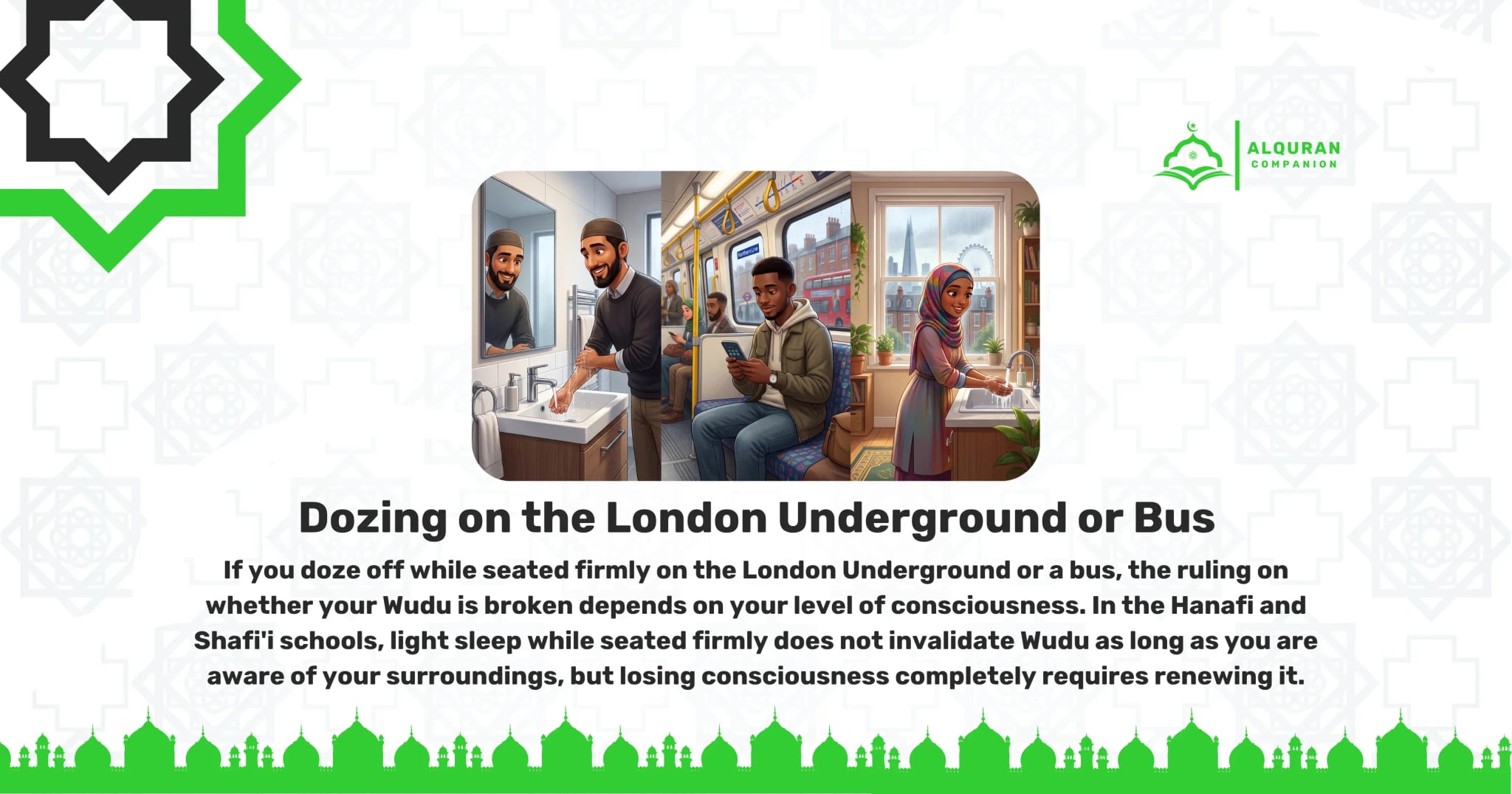
- Dozing on the London Underground or Bus
- Alcohol-Based Hand Sanitiser in the Office
- Chronic Medical Conditions and Ma'dhur Status
- Handling Paper Cuts and Accidental Bleeding at Work
- Frequently Asked Questions About Wudu Invalidation
Key Takeaways
- Urine, stool, gas, and deep sleep are unanimous nullifiers across all four Sunni schools.
- Bleeding, vomiting, touching private parts, and touching a spouse are debated. The ruling depends on your madhab.
- UK commuters who doze upright on the Tube generally do not break their Wudu according to Hanafi and Shafi'i fiqh.
- Chronic medical conditions qualify for Ma'dhur status, allowing one Wudu per prayer time.
- Doubt alone does not break Wudu. Your prayer remains valid until you are certain a nullifier occurred.
What Breaks Wudu? The Core Fiqh Definition of Hadath
Wudu is nullified by specific ritual events (Hadath) that terminate the state of purification required for Salah. Grounded in Surah Al-Ma'idah (5:6) and authentic prophetic Sunnah, nullifiers include natural bodily emissions, deep sleep, loss of consciousness, and debated physical occurrences across the four Sunni legal schools.
يٰۤـاَيُّهَا الَّذِيۡنَ اٰمَنُوۡۤا اِذَا قُمۡتُمۡ اِلَى الصَّلٰوةِ فَاغۡسِلُوۡا وُجُوۡهَكُمۡ وَاَيۡدِيَكُمۡ اِلَى الۡمَرَافِقِ وَامۡسَحُوۡا بِرُءُوۡسِكُمۡ وَاَرۡجُلَكُمۡ اِلَى الۡـكَعۡبَيۡنِ ؕ وَاِنۡ كُنۡتُمۡ جُنُبًا فَاطَّهَّرُوۡا ؕ وَاِنۡ كُنۡتُمۡ مَّرۡضَىٰۤ اَوۡ عَلٰى سَفَرٍ اَوۡ جَآءَ اَحَدٌ مِّنۡكُمۡ مِّنَ الۡغَآٮِٕطِ اَوۡ لٰمَسۡتُمُ النِّسَآءَ فَلَمۡ تَجِدُوۡا مَآءً فَتَيَمَّمُوۡا صَعِيۡدًا طَيِّبًا فَامۡسَحُوۡا بِوُجُوۡهِكُمۡ وَاَيۡدِيۡكُمۡ مِّنۡهُ ؕ مَا يُرِيۡدُ اللّٰهُ لِيَجۡعَلَ عَلَيۡكُمۡ مِّنۡ حَرَجٍ وَّلٰـكِنۡ يُّرِيۡدُ لِيُطَهِّرَكُمۡ وَ لِيُتِمَّ نِعۡمَتَهٗ عَلَيۡكُمۡ لَعَلَّكُمۡ تَشۡكُرُوۡنَ﴿٦﴾
yāayyuhā alladhīna āmanū idhā qum'tum ilā l-ṣalati fa-igh'silū wujūhakum wa-aydiyakum ilā l-marāfiqi wa-im'saḥū biruūsikum wa-arjulakum ilā l-kaʿbayni wa-in kuntum junuban fa-iṭṭahharū wa-in kuntum marḍā aw ʿalā safarin aw jāa aḥadun minkum mina l-ghāiṭi aw lāmastumu l-nisāa falam tajidū māan fatayammamū ṣaʿīdan ṭayyiban fa-im'saḥū biwujūhikum wa-aydīkum min'hu mā yurīdu l-lahu liyajʿala ʿalaykum min ḥarajin walākin yurīdu liyuṭahhirakum waliyutimma niʿ'matahu ʿalaykum laʿallakum tashkurūna
O you who have believed, when you rise to [perform] prayer, wash your faces and your forearms to the elbows and wipe over your heads and wash your feet to the ankles. And if you are in a state of janābah, then purify yourselves. But if you are ill or on a journey or one of you comes from the place of relieving himself or you have contacted women and do not find water, then seek clean earth and wipe over your faces and hands with it. Allāh does not intend to make difficulty for you, but He intends to purify you and complete His favor upon you that you may be grateful.
The Arabic term Hadath refers to a ritual impurity that removes your eligibility to perform Salah. Classical scholars define two categories: Hadath Asghar (minor impurity) requires Wudu, and Hadath Akbar (major impurity) requires Ghusl. Knowing which category applies to your situation prevents unnecessary doubt. Before you can pray with confidence, you need a reliable foundation in complete guide to Wudu steps. Once you have that foundation, understanding the nullifiers becomes straightforward.
Unanimous Nullifiers of Wudu: What All Four Madhabs Agree On
All four Sunni schools agree on a core set of Wudu invalidators with zero scholarly disagreement. These are the essential rules every Muslim should memorise.
- Urine exiting the private part
- Stool (feces) exiting the anus
- Passing wind (flatus)
- Deep sleep or loss of consciousness
- Intoxication or insanity
- Post-pubescent laughing loudly during a prayer that includes audible recitation
Allah's Messenger (ﷺ) said, "The prayer of a person who does Hadath (passes urine, stool or wind) is not accepted till he performs the ablution." A person from Hadaramout asked Abu Huraira, "What is 'Hadath'?" Abu Huraira replied, " 'Hadath' means the passing of wind
The Four-Madhab Wudu Comparison Matrix: Key Differences Explained
The four schools differ on several practical matters. This table gives you a quick-reference comparison for the most debated points.
Four-Madhab Comparison: What Breaks Wudu
| Action / Event | Hanafi | Maliki | Shafi'i | Hanbali |
|---|---|---|---|---|
| Flowing Blood from Wound | Breaks if it flows beyond the wound | Does not break | Does not break | Breaks if large amount |
| Touching Spouse's Skin | Does not break | Breaks only with desire | Breaks even without desire | Breaks only with desire |
| Touching Private Parts (no barrier) | Does not break | Breaks if palm touches skin | Breaks with any touch | Breaks with any touch |
| Eating Camel Meat | Does not break | Does not break | Does not break | Breaks Wudu |
| Vomiting a Mouthful | Breaks Wudu | Does not break | Does not break | Breaks if large amount |
Flowing Blood from Wound
Touching Spouse's Skin
Touching Private Parts (no barrier)
Eating Camel Meat
Vomiting a Mouthful
Start Your Personalized Islamic Studies Assessment
In our live 1-on-1 classes at Al Quran Companion, we frequently observe adult students carrying years of confusion about Wudu nullifiers because nobody ever explained the madhab differences clearly. At Al Quran Companion, our certified instructors provide personalised diagnostic assessments to identify exactly where your understanding of Taharah needs strengthening. Whether you follow a specific school or you are still learning, our foundational Islamic studies and prayer classes give you the certainty you need to pray without anxiety.
Modern Diaspora Dilemmas: UK Commuting, Medical Discharges and Office Life
Classical Fiqh texts were written for a different world. UK Muslims need rulings for the Northern Line, the M25, and the office washroom. Here is what you need to know.
Dozing on the London Underground or Bus
You are seated on the Tube after a long day. Your head nods. You catch yourself drifting. Does this break your Wudu? In the Hanafi and Shafi'i schools, light sleep while seated firmly does not invalidate Wudu. The determining factor is whether you lose consciousness completely. If you are aware of your surroundings and can hear announcements, your Wudu remains valid. For deeper sleep where you lose all awareness, Wudu breaks. This ruling is especially relevant for UK commuters in London, Manchester, and Birmingham who travel during prayer times.
Alcohol-Based Hand Sanitiser in the Office
Office hygiene routines often involve alcohol-based hand sanitiser. Touching this substance on your hands does not break Wudu. The alcohol evaporates quickly and does not reach the skin in a ritual sense. According to the majority of contemporary scholars, using sanitiser is permissible and does not nullify your ablution. You can sanitise your hands before prayer without performing Wudu again.
Chronic Medical Conditions and Ma'dhur Status
If you suffer from a condition that causes continuous impurity release, such as chronic gas, incontinence, or a persistent nosebleed, you may qualify for Ma'dhur (excused) status. A Ma'dhur person performs one Wudu after the prayer time begins. That Wudu remains valid for the entire prayer time, even if the condition continues. You can pray Fard and Sunnah prayers with that single Wudu. For UK Muslims managing IBS, incontinence, or post-surgery recovery, this ruling removes an enormous burden.
Handling Paper Cuts and Accidental Bleeding at Work
Office life brings minor injuries. A paper cut, a nicked finger from a stapler, or a scratch from a filing cabinet. If you follow the Hanafi school, blood that flows beyond the wound opening breaks Wudu. If you follow the Shafi'i or Maliki school, it does not. In either case, clean the wound, apply a plaster, and if your madhab requires it, perform Wudu again before the next prayer. This is one of the most common sources of unnecessary stress for Muslim office workers in the UK. Book your free 1-on-1 trial at Al Quran Companion to get personalised guidance on your specific fiqh questions.
Frequently Asked Questions About Wudu Invalidation
Understanding what breaks Wudu is not about memorising a list of rules. It is about building confidence in your daily worship. The four Sunni schools offer clear guidance. Choose the madhab you follow, learn its rulings, and pray with certainty. For UK Muslims navigating commutes, office environments, and modern health challenges, that certainty is achievable. Al Quran Companion exists to help you get there. Our qualified teachers offer patient, private instruction for adults, children, and reverts. Book your free trial today and take the first step toward prayer without doubt.

Al Quran Companion Team
Verified AuthorThe official academic and editorial team at Al Quran Companion, a leading Online Quran Academy dedicated to simplifying Tajweed, Hifz, and Islamic studies for students worldwide.
Read more about author