Growing up in Western societies across the US, UK, Canada, and Australia, Muslim students frequently face a direct question from classmates or university professors: exactly
The orthodox Islamic answer is clear. Allah is the sole author. It is His literal, uncreated speech. To truly grasp
Table of Contents
- Who Wrote the Quran? (The Definitive Islamic Answer)
- Why Prophet Muhammad ﷺ Could Not Have Authored the Quran
- The Scribes of Revelation (Kuttab al-Wahy): Who Physically Wrote It Down?
- Refuting Misconceptions: Did the Quran Borrow From Previous Scriptures?
- Why Understanding Quranic Authorship Transforms Your Recitation and Study
- Frequently Asked Questions
Key Takeaways
- Allah is the exclusive author of the Quran; it is His literal, uncreated speech (Kalam Allah).
- Prophet Muhammad ﷺ was unlettered (Ummi) and served as the transmitter of revelation, not the author.
- Over forty designated companions (Sahaba) immediately transcribed the verses as they were revealed.
- The linguistic challenge (Tahaddi) remains unmatched by the greatest Arab poets of history.
- Recognizing divine authorship transforms daily study, making Tajweed and Tafsir essential practices.
Who Wrote the Quran? (The Definitive Islamic Answer)
Allah is the sole author of the Quran. According to orthodox Islamic theology, it is His literal, uncreated speech (Kalam Allah) revealed word-for-word to Prophet Muhammad ﷺ through Angel Jibreel over 23 years. No human authored, edited, or altered any part of this sacred text.
To fully comprehend this reality, we must rely on the 3-Dimensional Divine Authorship Framework. This framework separates the process into Origin, Transmission, and Transcription. The origin of the words belongs exclusively to Allah. The transmission occurred via Angel Jibreel directly to the heart of Prophet Muhammad ﷺ. Finally, the transcription was handled by the trusted companions. A common misunderstanding arises when people confuse the physical transcription with the actual authorship.
Kalam Allah is the precise, unambiguous definition of the Quran as the uncreated, eternal speech of God. It represents an attribute of Allah Himself. When you recite the words upon the page, you are vocalizing the exact phrasing spoken by the Creator of the universe. This distinction separates the Quran from all other religious literature.
According to the consensus across the four established schools of Islamic jurisprudence (Hanafi, Maliki, Shafi'i, and Hanbali), believing in the divine authorship of every single letter is a foundational requirement of Iman (faith). Any claim that the Prophet ﷺ inserted his own philosophy or cultural ideas into the text contradicts the very definition of Islam. If you are researching
Why Prophet Muhammad ﷺ Could Not Have Authored the Quran
Historical records universally confirm Prophet Muhammad ﷺ was unlettered (Ummi), meaning he could not read or write. Additionally, the linguistic challenge (Tahaddi) presented in Surah Al-Baqarah proved that the master Arab poets of the 7th century could not match its divine eloquence.
Consider this historical context. The Arabian Peninsula during the 7th century represented an oral society. Poetry served as their primary currency, historical record, and source of pride. The Quraysh tribe boasted the most articulate linguists in the region. Yet, when the Prophet ﷺ presented the verses of the Quran, these masters of the Arabic language found themselves entirely paralyzed by its structure. The text did not conform to the established patterns of Arabic poetry, nor did it match normal rhymed prose. It stood completely outside human linguistic categories.
وَاِنۡ کُنۡتُمۡ فِىۡ رَيۡبٍ مِّمَّا نَزَّلۡنَا عَلٰى عَبۡدِنَا فَاۡتُوۡا بِسُوۡرَةٍ مِّنۡ مِّثۡلِهٖ وَادۡعُوۡا شُهَدَآءَكُمۡ مِّنۡ دُوۡنِ اللّٰهِ اِنۡ كُنۡتُمۡ صٰدِقِيۡنَ ﴿٢٣﴾
And if you are in doubt about what We have sent down [i.e., the Qur’ān] upon Our Servant [i.e., Prophet Muḥammad (ﷺ)], then produce a sūrah the like thereof and call upon your witnesses [i.e., supporters] other than Allāh, if you should be truthful.
This open challenge is known as the Tahaddi. Allah dares all of humanity to produce just one Surah like it. Over fourteen centuries have passed. Despite immense opposition to Islam throughout history, no linguist, philosopher, or poet has successfully met this challenge. The structural perfection, the predictive prophecies, and the internal consistency over a 23-year revelation period make human authorship an absolute impossibility.
A stark contrast exists between the Hadith literature and the Quran. Hadith represents the personal words, actions, and approvals of Prophet Muhammad ﷺ. When you read Sahih Al-Bukhari or Sahih Muslim, the Prophet's speech is remarkably eloquent but clearly human in its structure. It sounds like a wise leader giving practical advice. The Quran, however, carries a commanding, transcendent rhythm that completely shifts in tone. If the Prophet ﷺ authored both, linguistic analysis would show identical stylistic markers. Instead, experts find two entirely different linguistic profiles.
Learning about the
The Scribes of Revelation (Kuttab al-Wahy): Who Physically Wrote It Down?
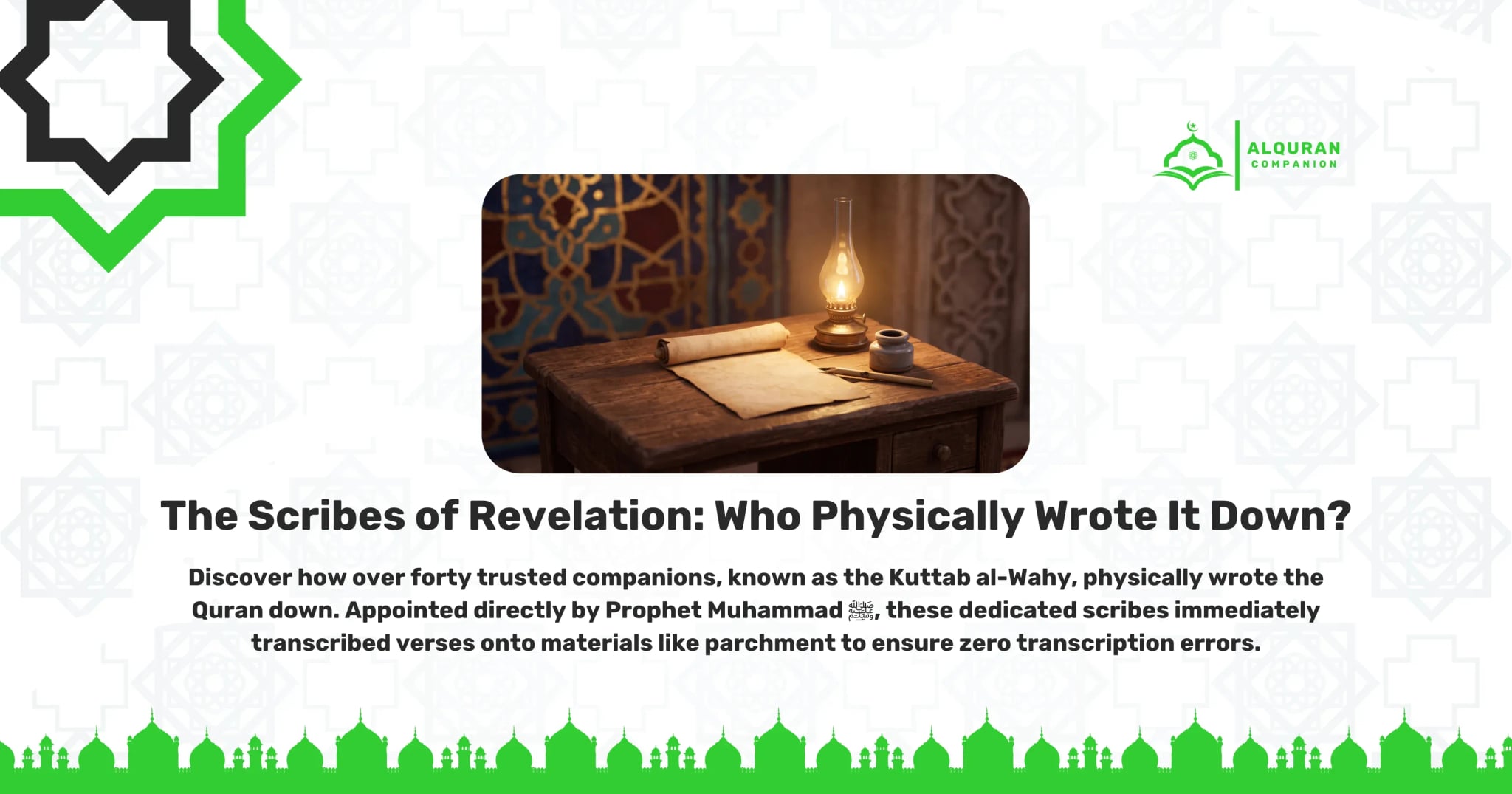
Over forty trusted companions (Sahaba), known as the Kuttab al-Wahy, physically wrote the Quran down. Appointed by Prophet Muhammad ﷺ, scribes including Zaid ibn Thabit, Ali ibn Abi Talib, Ubayy ibn Ka'b, and Mu'awiyah transcribed verses immediately onto parchment, leather, and bone.
While the Prophet ﷺ could not write, he established a rigorous system of documentation. Whenever Angel Jibreel delivered a new revelation, the Prophet ﷺ would immediately recite it aloud to his companions. He would then summon specific literate companions—the Kuttab al-Wahy. He dictated the exact verses to them, specifying exactly where the new Ayah belonged within the structure of the Surah.
After a scribe finished writing, Prophet Muhammad ﷺ commanded them to read it back to him. This immediate verification process ensured zero transcription errors. The primary scribe, Zaid ibn Thabit, held a tremendous responsibility in this physical documentation. He later played the leading role in compiling these written fragments into a single bound manuscript during the caliphate of Abu Bakr (RA).
Abu Bakr As-Siddiq sent for me when the people of Yamama had been killed (i.e., a number of the Prophet's Companions who fought against Musailima). (I went to him) and found `Umar bin Al- Khattab sitting with him. Abu Bakr then said (to me), "`Umar has come to me and said: "Casualties were heavy among the Qurra' of the Qur'an (i.e. those who knew the Qur'an by heart) on the day of the Battle of Yamama, and I am afraid that more heavy casualties may take place among the Qurra' on other battlefields, whereby a large part of the Qur'an may be lost. Therefore I suggest, you (Abu Bakr) order that the Qur'an be collected." I said to `Umar, "How can you do something which Allah's Apostle did not do?" `Umar said, "By Allah, that is a good project." `Umar kept on urging me to accept his proposal till Allah opened my chest for it and I began to realize the good in the idea which `Umar had realized." Then Abu Bakr said (to me). 'You are a wise young man and we do not have any suspicion about you, and you used to write the Divine Inspiration for Allah's Messenger (ﷺ). So you should search for (the fragmentary scripts of) the Qur'an and collect it in one book." By Allah If they had ordered me to shift one of the mountains, it would not have been heavier for me than this ordering me to collect the Qur'an. Then I said to Abu Bakr, "How will you do something which Allah's Messenger (ﷺ) did not do?" Abu Bakr replied, "By Allah, it is a good project." Abu Bakr kept on urging me to accept his idea until Allah opened my chest for what He had opened the chests of Abu Bakr and `Umar. So I started looking for the Qur'an and collecting it from (what was written on) palme stalks, thin white stones and also from the men who knew it by heart, till I found the last Verse of Surat at-Tauba (Repentance) with Abi Khuzaima Al-Ansari, and I did not find it with anybody other than him. The Verse is: 'Verily there has come unto you an Apostle (Muhammad) from amongst yourselves. It grieves him that you should receive any injury or difficulty..(till the end of Surat-Baraa' (at-Tauba) (9.128-129). Then the complete manuscripts (copy) of the Qur'an remained with Abu Bakr till he died, then with `Umar till the end of his life, and then with Hafsa, the daughter of `Umar
Understanding exactly
Refuting Misconceptions: Did the Quran Borrow From Previous Scriptures?
The Quran did not borrow from previous scriptures. Shared prophetic narratives regarding Ibrahim, Musa, and Isa simply affirm the unified message of monotheism (Tawheed). The Quran actively corrects earlier textual distortions and provides unique historical details verified by modern archaeology.
A frequent orientalist argument claims that because the Quran mentions biblical figures, the Prophet ﷺ must have copied from Christian and Jewish sources. This assumption falls apart under historical scrutiny. Prophet Muhammad ﷺ lived in Makkah, a pagan society disconnected from rabbinical study centers. He did not read Hebrew, Aramaic, or Greek. More importantly, the Quran routinely corrects theological errors found in the altered remnants of previous scriptures.
Consider a fascinating linguistic miracle regarding historical Egypt. In the biblical narrative, the ruler during the time of Prophet Yusuf (Joseph) and Prophet Musa (Moses) is uniformly referred to as 'Pharaoh'. However, the Quran makes a precise historical distinction. It refers to the ruler during Musa's time as 'Pharaoh' (Fir'awn), but identifies the ruler during Yusuf's time simply as 'King' (Malik). Modern archaeology and the deciphering of the Rosetta Stone confirmed that the title 'Pharaoh' only came into use during the New Kingdom era, long after the time of Yusuf. An unlettered man in the Arabian desert could not have known this precise historical timeline. Such details solidify the reality of divine authorship.
Why Understanding Quranic Authorship Transforms Your Recitation and Study
Recognizing the Quran as the direct, living speech of the Creator transforms daily recitation into an intimate spiritual dialogue. This conviction motivates learners to master Tajweed and Tafsir, ensuring they pronounce and understand the divine words exactly as they were revealed.
When a student internalizes that they are reading the literal words of Allah, the desire to learn correct pronunciation (Makharij) becomes a priority. At Al Quran Companion, we utilize The 3-Step Al Quran Companion Pronunciation Feedback Loop to help students achieve this precision. First, the instructor identifies the specific articulation point error. Second, they model the correct Arabic linguistic origin. Third, the student applies the correction in real-time under patient observation.
For parents managing busy schedules in the US, UK, Australia, and the UAE, finding safe, authentic Islamic education is a serious challenge. Securing a reliable environment is critical. At Al Quran Companion, we always conduct comprehensive Background Checks and detailed multi-stage reviews of every single teacher before they are certified to teach our students. We provide highly qualified female teachers to ensure a comfortable, appropriate learning environment for daughters and adult sisters.
Adult learners and reverts often feel intimidated by the idea of starting from scratch. We guarantee a 100% private, zero-judgment environment. You progress entirely at your own pace. Whether you are exploring
Al Quran Companion 1-on-1 Classes vs Self-Study Apps
Pros
- Immediate, real-time correction of Tajweed mistakes.
- Interactive Q&A regarding Quranic Tafsir and context.
- Accountability and structured progression schedules.
- Strict background-checked, Ijazah-holding instructors.
- Zero-judgment, completely private learning environment.
Cons
- Self-study apps cannot correct subtle pronunciation errors.
- Pre-recorded videos lack personal accountability.
- No opportunity to ask historical or theological questions.
- High risk of memorizing verses with incorrect Tajweed.
- Lack of human connection and spiritual mentorship.
Frequently Asked Questions

Al Quran Companion Team
Verified AuthorThe official academic and editorial team at Al Quran Companion, a leading Online Quran Academy dedicated to simplifying Tajweed, Hifz, and Islamic studies for students worldwide.
Read more about author