You hear it in a busy London office when a colleague finishes a tough project. You hear it at a weekend soccer game in Sydney when a team scores a goal. You even see it printed on bumper stickers during the morning school run in the United States. The phrase is alhamdulillah.
But what is alhamdulillah, really?
For many non-Muslim friends, colleagues, and newly curious individuals, this single Arabic word seems to function as a greeting, a sigh of relief, and a prayer all at once. In reality, it is the absolute beating heart of Islamic gratitude.
Here is why:
Understanding the alhamdulillah define process goes far beyond pulling a simple dictionary translation. It requires looking deeply at how practicing Muslims view the world, their Creator, and their daily blessings.
In this comprehensive guide, our Al Quran Companion Team breaks down the precise alhumdulillah meaning. We explore the deep theology behind the phrase, the exact physical moments Muslims use it, and how you can apply this powerful expression of thankfulness in your own daily routine.
Table of Contents
Key Takeaways
- Alhamdulillah translates to 'All praise and gratitude belong to Allah' and serves as the core pillar of Islamic thankfulness.
- Muslims recite the phrase in daily situations, including waking up, eating, sneezing, and responding to greetings.
- Unlike conditional human gratitude, Hamd involves praising Allah for His inherent perfection regardless of current personal circumstances.
- Teaching the phrase to children requires connecting the Arabic words to tangible, daily blessings rather than mere rote memorization.
- The phrase forms the opening verse of Surah Al-Fatiha and is recited at least seventeen times a day during obligatory Salah.
What Is Alhamdulillah and How Do You Define It?
Alhamdulillah is an Arabic phrase meaning 'All praise and gratitude belong to Allah.' It serves as the foundational expression of thankfulness in Islam. Muslims recite this exact phrase daily to acknowledge that every single blessing, success, and even sudden hardship comes entirely from the Creator, Allah.
To truly grasp the concept, we must break down the Arabic root words. Arabic is a remarkably precise language, and every single syllable carries profound theological weight.
Consider this word-by-word breakdown:
- The prefix 'Al' means 'The' or 'All.' It makes the word comprehensive and absolute.
- The root 'Hamd' translates directly to 'Praise' and 'Gratitude.' It represents a highly specific type of praise given out of love, reverence, and profound respect.
- The particle 'Li' means 'For' or 'Belonging strictly to.'
- The name 'Allah' is the proper, exclusive name of the One True God in the Islamic faith.
When you combine these linguistic elements, you understand why the alhamdulilah spelling variant—or the frequently searched alhamdullilah—all point back to the exact same absolute truth regarding the Creator.
Alhamdulillah is the definitive Islamic declaration of absolute praise and total gratitude directed exclusively to Allah.
This phrase is so central to the faith that it forms the very first verse of Surah Al-Fatiha, the opening chapter of the Holy Quran. Every practicing Muslim recites this Surah, and thereby this phrase, at least seventeen times a day during their obligatory Salah. Without this recitation, a Muslim's prayer is literally considered invalid.
But that is not all.
To understand the alhumdulillah meaning fully, you must compare it directly to ordinary human thankfulness. In the English language, we say 'thank you' when someone does something highly specific for us. If a coworker holds the office door, we express thanks. If a friend buys us coffee, we show gratitude.
However, Islamic Hamd is entirely independent of the action itself. Muslims praise Allah not just for what He gives, but for Who He inherently is. He remains worthy of absolute praise whether we are experiencing a moment of immense personal joy or facing a severe physical trial. This unconditional gratitude builds a resilient, unbreakable mindset that protects a believer from despair.
When Do Muslims Say Alhamdulillah in Daily Life?
Muslims say Alhamdulillah throughout the day during routine actions and major life events. You will hear this exact phrase after someone sneezes, finishes a daily meal, wakes up from sleep, or receives good news. It is also recited seventeen times daily within Surah Al-Fatiha.
Islam represents a deeply practical religion. It ties spiritual mindfulness directly to physical, everyday actions. You do not need to be sitting quietly in Madinah Munawwarah to practice gratitude. Whether you are navigating a rainy morning commute in the United Kingdom or rushing to a Sunday school class in the United States, opportunities for Dhikr (remembrance of Allah) surround you.
A practicing Muslim begins their entire day with gratitude. The very first action upon waking up is to recite a highly specific Dua that immediately centers the human heart on Allah.
Supplication Upon Waking Up
alhamdulillahilladhi ahyana ba'da ma amatana wa ilayhin-nushur
All praise is for Allah who gives us life after He has caused us to die, and to Him is the resurrection.
Why do Muslims perform this specific action?
Because waking up is viewed as a literal return to life after the minor death of sleep. Recognizing this incredible gift immediately sets a positive, humble tone for the entire day ahead.
We also use the phrase around our food. In a modern world filled with fast food and rushed desktop lunches, the Islamic tradition forces us to physically slow down. When a Muslim finishes eating or drinking, they say Alhamdulillah. This simple verbal act transforms a mundane biological necessity into a powerful act of daily worship.
Supplication After Eating
alhamdulillahilladhi at'amani hadha wa razaqanihi min ghayri hawlin minni wa la quwwah
All praise is to Allah who has fed me this and provided for me without any power or strength from me.
You will also frequently hear this phrase utilized as a standard social response.
If you ask a Muslim colleague in the office, 'How are you doing today?' their very first instinct is often to reply naturally, 'Alhamdulillah, I am doing well.' This response is far more than a cultural habit. It represents a conscious recognition that regardless of their current stress levels, financial pressures, or intense workload, their overall state of existence remains a blessing from Allah.
Even automatic bodily functions like sneezing prompt this phrase.
The Prophet (ﷺ) said, " If anyone of you sneezes, he should say 'Al-Hamduli l-lah' (Praise be to Allah), and his (Muslim) brother or companion should say to him, 'Yar-hamuka-l-lah' (May Allah bestow his Mercy on you). When the latter says 'Yar-hamuka-llah", the former should say, 'Yahdikumul-lah wa Yuslih balakum' (May Allah give you guidance and improve your condition)
When a person sneezes, their body forcefully expels physical irritants. Recognizing this immediate physical reset, a Muslim says Alhamdulillah to thank Allah for continuous health and bodily protection.
Why Is Alhamdulillah the Ultimate Expression of Gratitude?
Alhamdulillah combines both active praise (Hamd) and gratitude (Shukr) into a single, profound statement. While standard gratitude reacts only to specific favors, Alhamdulillah praises Allah for His inherent perfection and continuous blessings, maintaining a believer's faith during both immense joy and sudden distress.
To understand the sheer psychological power of this phrase, we must introduce The Al Quran Companion Islamic Dhikr Trilogy. This proprietary pedagogical framework effectively breaks down the three core phrases every practicing Muslim uses to navigate their life: Bismillah, Subhanallah, and Alhamdulillah.
Many students and curious observers frequently ask about the subhanallah meaning in relation to absolute gratitude.
SubhanAllah translates directly to 'Glory be to Allah' or 'Allah is entirely free from any imperfection.' A Muslim says SubhanAllah when they see something breathtakingly beautiful, like a mountain sunset, or when they encounter a highly shocking situation. It serves as a declaration of pure awe.
If SubhanAllah clears the human mind of any possible doubts regarding Allah's ultimate perfection, then Alhamdulillah steps in to fill the believer's heart with profound thankfulness for His highly active role in our daily lives.
Here is why the distinction matters:
In the classical Arabic language, there exists a specific word for standard transactional gratitude: Shukr. Shukr remains highly reactive. You give me a financial gift; I show you Shukr. But what happens when that expected gift is delayed? What happens when you face a sudden job loss in Canada or an unexpected physical illness in Ireland?
If your personal faith relies solely on Shukr, a severe personal tragedy might completely destroy your connection to Allah.
This is exactly where the concept of Hamd steps in to protect the believer.
Because Hamd means praising Allah for His inherent majesty, a Muslim says Alhamdulillah even when trapped in deep distress. The Prophet Muhammad ﷺ actively taught his companions that when a believer faces a severe calamity, they confidently say 'Alhamdulillah ala kulli haal,' which translates directly to 'All praise is due to Allah in every circumstance.'
This powerful mindset completely neutralizes despair. It openly acknowledges that human understanding remains strictly limited. The Creator's divine wisdom is infinite. What feels like a devastating tragedy today may actually serve as an invisible shield against a much greater harm tomorrow. This is the core teaching behind Dua Istikhara when seeking guidance.
How Does Saying Alhamdulillah Benefit the Heart and Mind?
Reciting Alhamdulillah actively reduces human anxiety and fosters a resilient, positive mindset by shifting our focus from what is missing to what is present. Islamic tradition confirms that consistent verbal gratitude protects the heart from arrogance and physically fills the believer's scale of good deeds.
Modern clinical psychology often speaks extensively about the immense power of maintaining a 'gratitude journal.' Countless peer-reviewed studies show that physically writing down three things you are thankful for each night can significantly lower cortisol levels, improve overall sleep architecture, and reduce the heavy symptoms of depression.
Islam systematically institutionalized this exact psychological concept over 1,400 years ago.
By weaving this powerful phrase directly into the standard fabric of daily life—after eating, after sleeping, during the five daily prayers, and when hearing any news—Islam successfully creates a continuous, unbreakable loop of positive internal reinforcement.
According to the consensus across the four established schools of Islamic jurisprudence (Hanafi, Maliki, Shafi'i, and Hanbali), regular Dhikr fundamentally purifies the human soul. But the phrase we are actively discussing holds a uniquely heavy theological status.
It is narrated on the authority of Jarir b. 'Abdullah that the Messenger of Allah (may peace and blessings be upon him) asked him on the occasion of the Farewell Pilgrimage to make the people silent and then said:Do not return to unbelief after me by striking the necks of one another
When the Prophet Muhammad ﷺ explicitly stated that 'Alhamdulillah fills the scales,' he was referencing the literal, physical weighing of human deeds on the Day of Judgment. A single, highly mindful utterance of this specific word carries enough spiritual mass to directly tip the scales in favor of the believer.
However, there is a massive spiritual distinction to make between mindful recitation and empty, robotic repetition.
Mindful Dhikr vs Habitual Repetition
Pros
- Focuses the mind on specific blessings given by Allah
- Reduces anxiety by shifting focus away from worldly lack
- Fulfills the prophetic sunnah of true internal gratitude
- Fills the scale of good deeds heavily on the Day of Judgment
Cons
- Saying the word quickly without pondering its meaning
- Treating the phrase purely as a cultural filler word
- Complaining internally while saying the phrase externally
- Missing the opportunity to connect deeply with the Creator
To truly unlock these immense benefits, one must practice our Four-Level Expression Depth Method. First, you understand the exact literal translation. Second, you grasp the deep theological depth. Third, you recognize the proper physical moments to say it. Finally, you internalize the profound spiritual joy it brings into your chest.
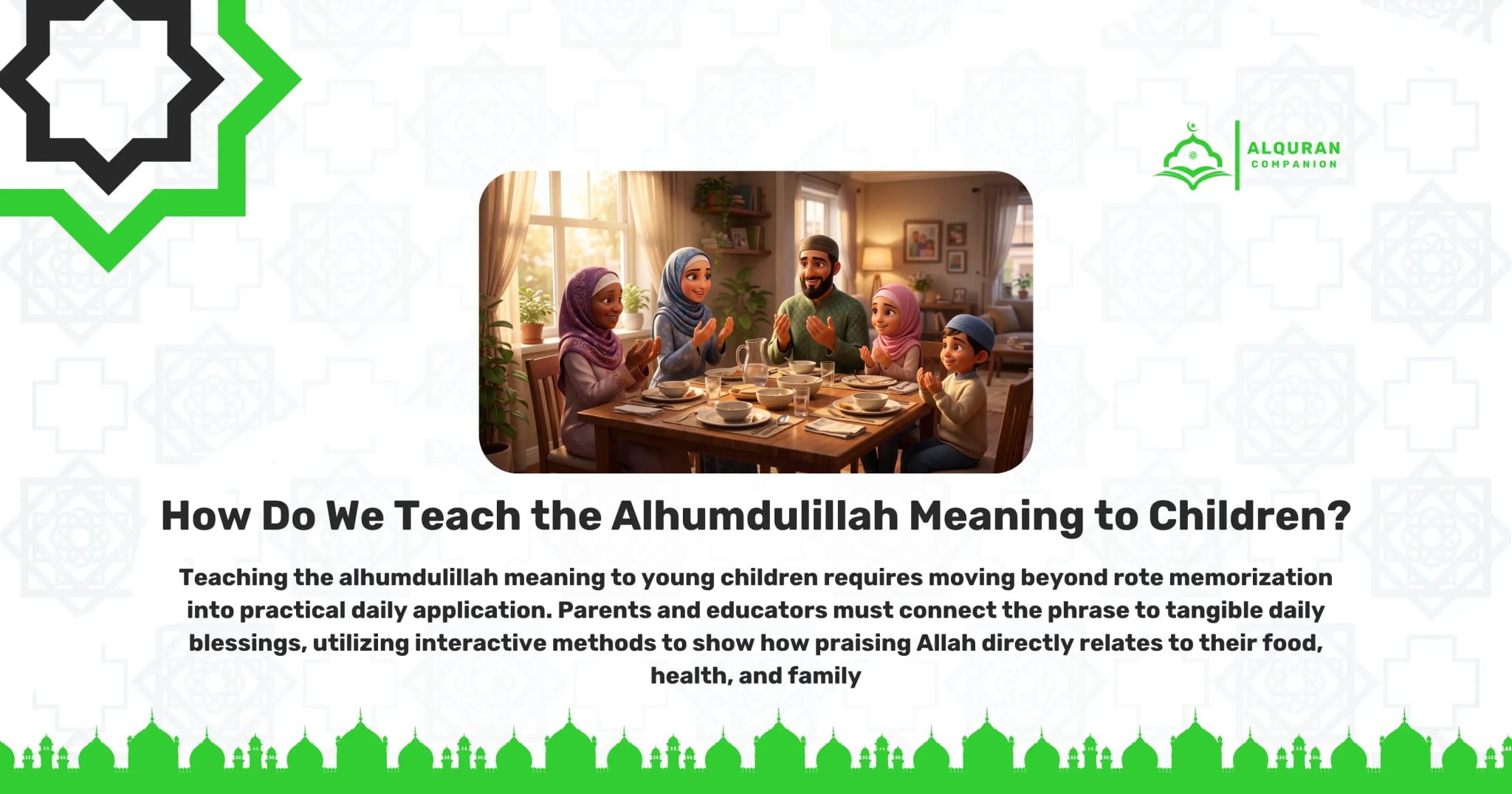
How Do We Teach the Alhumdulillah Meaning to Children?
Teaching the alhumdulillah meaning to young children requires moving beyond rote memorization into practical daily application. Parents and educators must connect the phrase to tangible daily blessings, utilizing interactive methods to show how praising Allah directly relates to their food, health, and family.
Raising Muslim children in Western environments—whether actively balancing the fast-paced public school schedules of the United States or navigating the diverse cultural landscape of the United Kingdom—presents highly unique challenges for modern Muslim parents.
Often, children merely memorize Arabic phrases without ever understanding the emotional weight resting behind them. They learn the alhamdullilah spelling perfectly for weekend Islamic school tests, but they do not feel a shred of gratitude when they look down at their warm dinner plate.
We have seen this exact scenario play out countless times.
In our live 1-on-1 classes at Al Quran Companion, we frequently observe students struggling heavily with lesson engagement simply because they do not understand what they are reciting. They treat the Holy Quran as a textbook rather than a living guide.
This is precisely why our academic faculty developed The 4-Pillar Child Engagement Model. We do not just teach a child to read; we actively teach them to connect.
Consider this practical approach:
When initially teaching the opening verses of Surah Al-Fatiha in our Quran Foundation course, our instructors intentionally pause at the very first ayah. Instead of rushing rapidly to the next verse, we ask the child directly, 'What makes you happy today?' If the child replies 'My new bicycle' or 'My family,' the teacher responds, 'Exactly! And who gave you those wonderful gifts? Allah. So we say Alhamdulillah to thank Him directly for the bike and the family.'
This highly specific interaction transforms a dry academic exercise into a deeply personal spiritual moment.
Parents understandably often worry about the overall quality and safety of online Islamic education. At Al Quran Companion, we always conduct comprehensive Background Checks and detailed multi-stage reviews of every single teacher before they are certified to teach our students. Our senior Ijazah-certified tutors recommend a daily 15-minute spaced repetition schedule to help young children internalize both the precise pronunciation and the deep meaning of these core phrases.
For young girls and adult sisters seeking a highly comfortable, zero-judgment learning environment, we provide exceptionally qualified female Quran tutors.
If you want your child to truly grasp the beauty of these words, they need proper expert guidance. Our instructors integrate proper Quranic Tajweed right from the very beginning, ensuring the child pronounces the letter 'Ha' from the exact correct articulation point deep in the throat. You can also explore our highly structured approach regarding safe educator selection in our guide to Online Quran Classes USA: How to Pick the Safest One.
Whether you are an expat family operating in the UAE seeking highly structured progression or a busy professional in London looking for flexible evening classes, our educational platform adapts seamlessly to your unique schedule.
The phrase alhamdulillah is much more than a simple cultural greeting. It is the absolute anchor of a Muslim's entire spiritual life. By understanding its linguistic roots, applying it thoughtfully during daily physical activities, and teaching it correctly to the next generation, we transform simple spoken words into heavy actions that fill the scales on the Day of Judgment.
Frequently Asked Questions

Al Quran Companion Team
Verified AuthorThe official academic and editorial team at Al Quran Companion, a leading Online Quran Academy dedicated to simplifying Tajweed, Hifz, and Islamic studies for students worldwide.
Read more about author