You hear it everywhere today. A famous MMA fighter wins a championship belt and shouts it into the microphone. Your Muslim co-worker says it when looking at a beautiful photo of a sunset. You might even catch second-generation Western Muslims slipping it into casual English conversations. But if you stop and ask for the exact subhanallah meaning, many people struggle to give a clear answer beyond 'praise God'. The truth is much deeper. This phrase carries a heavy theological weight. It serves as a mental reset button for believers. Understanding this word gives you direct access to the mindset of a practicing Muslim. We use it to navigate everything from shocking news to our quiet moments after the five daily prayers.
Table of Contents
- What is the exact subhanallah meaning?
- The Linguistic Roots: Keeping God Above the Mud
- When and Why Do Muslims Say It?
- The Nightly Habit: Saying It 33 Times
- Beyond Praise: Other Everyday Islamic Meanings
- Alhamdulillah Define: The Attitude of Gratitude
- What Does Bismillah Mean?
- The Real Inshallah Meaning
- Allahumma Barik for Protection
- Why Pronunciation and Context Matter
- From Rote Repetition to Genuine Connection
- Frequently Asked Questions
Key Takeaways
- Subhanallah literally means 'God is free of imperfection'.
- Muslims use it to express awe, amazement, and shock at the world.
- It forms the core of daily meditation (dhikr), repeated 33 times after prayers.
- Understanding related phrases like Inshallah and Alhamdulillah completes the spiritual mindset.
What is the exact subhanallah meaning?
The exact subhanallah meaning is 'Glory be to Allah' or 'Allah is free from imperfection.' Muslims use this phrase to express pure amazement, awe, or surprise at God's creation. It serves as a reminder that God is entirely perfect and above any flaws we experience in this world.
The Linguistic Roots: Keeping God Above the Mud
Arabic is a deeply visual language. Every word traces back to a core root structure that paints a picture. The root letters for this phrase are S-B-H. In classical Arabic, this root describes the action of swimming or floating. It means keeping something afloat above dirt or water. When a Muslim says the word, they are mentally 'keeping God afloat' above any negative attributes, weaknesses, or human limitations. It is a declaration of absolute perfection.
Consider this: Human beings get tired. We forget things. We make mistakes. When we look at the complexity of a human eye or the vastness of the night sky, we realize the creator of these things does not suffer from our human flaws. Declaring the subhan allah meaning aloud reinforces this belief. In Turkish communities, you will often hear it pronounced as sübhanallah, but the core intention remains exactly the same. It protects the believer's mind from assigning any weakness to their Creator.
When and Why Do Muslims Say It?
Muslims do not reserve this phrase for the mosque. It is an active part of daily life. You will hear it in primarily three distinct situations.
First, we say it when witnessing something beautiful or mind-blowing in nature. Seeing a massive waterfall or learning a bizarre fact about marine biology prompts an automatic reaction. The beauty of the creation points directly back to the perfection of the Creator.
Second, it serves as an expression of shock or surprise. If someone tells you a wild, unexpected story, saying it grounds you. It reminds you that while humans are unpredictable, God is in control.
Third, and most formally, it forms the backbone of Islamic meditation known as dhikr. This is where the phrase transforms from a spontaneous reaction into a structured spiritual discipline. Connecting this practice to your daily routine requires a solid Quran Foundation, ensuring the words move past your tongue and enter your heart.
The Nightly Habit: Saying It 33 Times
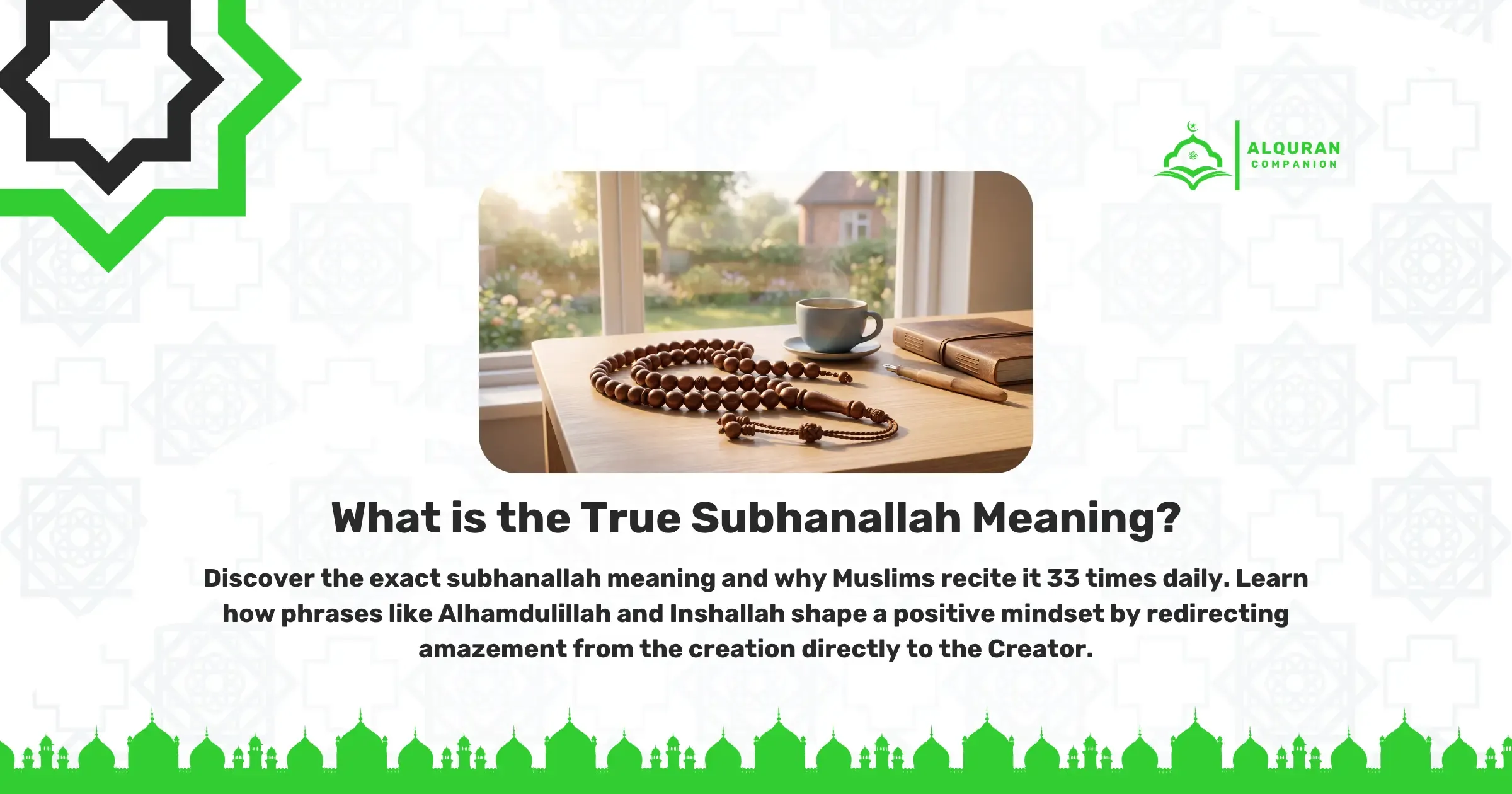
After completing the physical movements of Salah, you will often see Muslims remain seated, moving their fingers or holding beads. They are counting. The Prophet Muhammad taught his followers a specific formula for finding peace and washing away daily anxieties. This practice originates from a beautiful interaction with his daughter, Fatima.
Fatima worked hard grinding grain and carrying water until her hands blistered. She approached her father asking for a servant to help with the physical labor. Instead of giving her an employee, he gave her something he promised was better: a spiritual tool.
Fatima complained of what she suffered from the hand mill and from grinding, when she got the news that some slave girls of the booty had been brought to Allah's Messenger (ﷺ). She went to him to ask for a maid-servant, but she could not find him, and told `Aisha of her need. When the Prophet (ﷺ) came, Aisha informed him of that. The Prophet (ﷺ) came to our house when we had gone to our beds. (On seeing the Prophet) we were going to get up, but he said, 'Keep at your places,' I felt the coolness of the Prophet's feet on my chest. Then he said, "Shall I tell you a thing which is better than what you asked me for? When you go to your beds, say: 'Allahu Akbar (i.e. Allah is Greater)' for 34 times, and 'Al hamdu Li llah (i.e. all the praises are for Allah)' for 33 times, and Subhan Allah (i.e. Glorified be Allah) for 33 times. This is better for you than what you have requested
He instructed her to say Subhanallah 33 times, Alhamdulillah 33 times, and Allahu Akbar 34 times before sleeping. This simple act of counting shifts focus away from physical exhaustion. It forces the brain to slow down. It replaces the endless loop of daily worries with a rhythmic declaration of truth.
Beyond Praise: Other Everyday Islamic Meanings
You cannot fully grasp the daily Muslim mindset by looking at one word in isolation. The Arabic vocabulary weaves together into a complete worldview. If you are a non-Muslim trying to understand your friends, or a revert building your knowledge, exploring these other islamic meanings is highly practical.
Alhamdulillah Define: The Attitude of Gratitude
How do you define alhamdulillah? It translates to 'All praise and thanks belong to Allah'. But its functional use is much broader. Muslims say it when they receive a promotion. They also say it when their car breaks down. Here's why: true gratitude acknowledges that God knows best, even when a situation looks difficult on the surface. We say it to anchor ourselves. When you understand the alhamdulillah define concept, you stop complaining about minor inconveniences.
What Does Bismillah Mean?
Before you eat, before you drive, and before you open a book to study Arabic Basics, you say it. What does bismillah mean exactly? It means 'In the name of Allah'. It is an active transition. By saying it, you are asking for blessing in the action you are about to perform. It transforms a mundane habit into an act of worship. It reminds you that your ability to even perform the task comes from God.
The Real Inshallah Meaning
Internet culture jokes that this word is the Muslim way of politely saying no. That is completely false. The true inshallah meaning is 'If God wills it'. It is an expression of humility. When making plans for tomorrow, we acknowledge that we do not control the future. We intend to show up for the meeting, but we admit our plans rely entirely on God's permission.
Allahumma Barik for Protection
Jealousy ruins relationships. When a Muslim sees something beautiful belonging to someone else—like a friend's new house or a healthy child—they say allahumma barik. It means 'O Allah, bless it'. This actively kills envy in the heart. Instead of wishing you had what they have, you ask God to increase their blessing. It is a powerful psychological tool for maintaining clean intentions.
Why Pronunciation and Context Matter
Knowing the translation is just the first step. Speaking the words correctly changes how they feel. Arabic letters carry specific weights and sounds that do not exist in English. A soft 'h' means something entirely different from a harsh, back-of-the-throat 'H'. This is why mastering Quranic Tajweed is a core focus for any serious student.
We often push our kids to memorize these phrases quickly. We want them to sound like good Muslims in front of family members. But empty repetition does not build faith. If you find yourself struggling to keep your child engaged with these concepts, read our guide on how to Stop Bribing Them: How to Make Your Child Actually Want to Read Quran. Real love for the language comes through gentle, informed teaching, not rigid force.
From Rote Repetition to Genuine Connection
Grasping the true subhanallah meaning elevates your daily life. You stop saying words simply because your parents told you to. Instead, you declare them intentionally. You begin to notice the perfection of God in the small details of your day. You find calm counting on your fingers after a stressful commute. The anxiety of modern living softens when you actively remember who is in charge.
But reading a single article is only a starting point. To truly experience the depth of these words, you need to engage with the Quran directly. Many Muslims spend years reciting words they cannot translate. It is time to bridge that gap. Learning Quranic Arabic online transforms blind repetition into an active, emotional connection with your Creator. You do not have to do it alone.
Frequently Asked Questions

Al Quran Companion Team
Verified AuthorThe official academic and editorial team at Al Quran Companion, a leading Online Quran Academy dedicated to simplifying Tajweed, Hifz, and Islamic studies for students worldwide.
Read more about author