What Is the Authentic Dua for Breaking Fast According to Sunnah?
The primary authentic dua for breaking fast is recorded in Sunan Abi Dawud 2357, narrated by Ibn Umar (RA). The Prophet Muhammad ﷺ would say upon completing his fast: 'Dhahaba al-zama'u wabtallat al-'urooq wa thabata al-ajru in sha Allah' (The thirst is gone, the veins are moistened, and the reward is confirmed, if Allah wills). This supplication is the most widely transmitted dua for iftar across the four Sunni schools of jurisprudence (Hanafi, Maliki, Shafi'i, and Hanbali).
Dua
Dhahaba al-zama'u wabtallat al-'urooq wa thabata al-ajru in sha Allah
The thirst is gone, the veins are moistened, and the reward is confirmed, if Allah wills.
Many Muslims in the UK and across the West were taught to recite a different dua at Iftar: 'Allahumma inni laka sumtu wa bika aamantu wa 'ala rizq-ika aftartu.' This supplication appears in some hadith collections but is classified as weak (da'if) by several scholars of Hadith, including Al-Albani. The authentic sequence places the primary dua after the first sip of water or bite of a date. At Al Quran Companion, our certified instructors regularly guide adult students through this exact Prophetic sequence during one-on-one Iftar preparation sessions, ensuring their worship aligns with verified practice from the outset.
What This Guide Covers
- What Is the Authentic Dua for Breaking Fast According to Sunnah?
- Authentic Prophetic Hadith Citations on Fast-Breaking Duas
- When Exactly Should You Recite the Iftar Dua? (Before vs After)
- Book Your Free 1-on-1 Quran and Islamic Studies Trial
- Fasting in the UK: Managing Winter Fasts, Desks and Commutes
- The Virtue of Voluntary Fasts in the UK
- Common Mistakes Muslims Make with the Iftar Dua
- How to Build a Consistent Iftar Dua Habit Across the UK
- What Should You Recite If Someone Provides Your Iftar Meal?
- How Al Quran Companion Supports Your Ramadan and Beyond
- Frequently Asked Questions About Duas for Breaking Fast
Key Takeaways
- The authentic dua for breaking fast is from Sunan Abi Dawud 2357: 'Dhahaba al-zama'u wabtallat al-'urooq wa thabata al-ajru in sha Allah.'
- The supplication of a fasting person at the moment of breaking fast is not rejected, as recorded in Sunan Ibn Majah 1825.
- Make general Duas for your needs before the Adhan of Maghrib, say Bismillah and break your fast, then recite the Sunnah dua after the first sip.
- UK winter fasts end as early as 4:00 PM, making workplace planning and discreet fast-breaking packs essential.
- Habit-stacking 15 minutes of Quran recitation before Isha prayer builds a sustainable spiritual routine during Ramadan.
Authentic Prophetic Hadith Citations on Fast-Breaking Duas
The strongest evidence for the Iftar dua comes from Sunan Abi Dawud. The hadith states that when the Prophet ﷺ broke his fast, he would recite the supplication confirming the departure of thirst, the moistening of veins, and the certainty of reward. The grading of this hadith is Hasan according to Al-Albani, making it a reliable basis for practice. This narration provides the exact wording Muslims should use at the moment of breaking their fast.
Marwan ibn Salim al-Muqaffa' said: I saw Ibn Umar holding his beard with his hand and cutting what exceeded the handful of it. He (Ibn Umar) said that the Prophet (ﷺ) said when he broke his fast: Thirst has gone, the arteries are moist, and the reward is sure, if Allah wills
A second critical hadith establishes the spiritual power of this moment. The Prophet Muhammad ﷺ said: 'When the fasting person breaks his fast, his supplication is not turned back.' This narration is recorded in Sunan Ibn Majah 1825. The scholars of Hadith have discussed its chain, and while some classify it as da'if, the meaning is supported by multiple narrations and the general principle that the fasting person's dua is accepted.
Ibn Umar narrated that:the Messenger of Allah enjoined Zakatul-Fitr, one Sa of dates or one Sa of barley.Abdullah said: The people made two Mudd (equal to half of a Sa) of wheat as its equivalent
Imam Al-Tirmidhi also recorded a narration stating that three supplications are never rejected: the supplication of a fasting person until they break their fast, the supplication of a just leader, and the supplication of an oppressed person. This hadith underscores the importance of making the most of the Iftar moment for personal Duas, seeking forgiveness, and asking Allah for your needs before the fast is formally concluded.
When Exactly Should You Recite the Iftar Dua? (Before vs After)
The precise timing of Iftar supplications creates genuine confusion for many UK Muslims. The Prophet's ﷺ practice, as understood by the classical scholars, involved three distinct phases: making general Duas for your needs in the minutes before Maghrib, saying Bismillah and breaking the fast with dates or water at the Adhan, and then reciting the specific Sunnah dua after the first sip or bite. The four schools of jurisprudence agree that the reported supplication 'Dhahaba al-zama'u' is recited after the fast is physically broken, not before.
Iftar Dua Timing: Three-Phase Sunnah Sequence
| Phase | Timing | What to Recite |
|---|---|---|
| Phase 1: General Dua | 5-10 minutes before Maghrib Adhan | Make heartfelt Duas for your needs and seek forgiveness |
| Phase 2: Breaking the Fast | At Maghrib Adhan | Say Bismillah, eat a date or drink water |
| Phase 3: Sunnah Dua | Immediately after first sip or bite | 'Dhahaba al-zama'u wabtallat al-'urooq wa thabata al-ajru in sha Allah' |
Phase 1: General Dua
Phase 2: Breaking the Fast
Phase 3: Sunnah Dua
Some scholars note that it is permissible to make Dua before breaking the fast as well, combining humility and the state of fasting. Imam Ibn Hajar al-Haitami and Imam Ramli, both Shafi'i scholars, held that the reported supplication is recited right after breaking the fast. The practical takeaway for UK Muslims is simple: use the minutes before Maghrib for your personal Duas, then follow the Prophetic sequence after the Adhan. Do not delay breaking the fast to finish a long Dua, as hastening to break the fast is itself a Sunnah.
Book Your Free 1-on-1 Quran and Islamic Studies Trial
Strengthen your Islamic knowledge, Tajweed, and daily prayer habits with certified tutors at Al Quran Companion. Our Ijazah-holding instructors offer personalized one-on-one sessions tailored to your schedule, whether you are in London, Manchester, or the West Midlands. Every new student can book a free diagnostic lesson with zero commitment or payment upfront.
Fasting in the UK: Managing Winter Fasts, Desks and Commutes
UK winter fasts present a unique challenge. When Ramadan falls in the winter months, Maghrib can arrive as early as 4:00 PM in cities like London, Birmingham, and Manchester. For professionals working in offices or commuting on the Underground, breaking your fast at your desk or on a train requires planning. The good news is that the Prophetic Sunnah makes this simple. Combine the practical tips below with your Iftar dua routine to maintain both your worship and your work commitments.
- Prepare a discreet Iftar pack: three dates, a small bottle of water, and a packet of nuts fit easily into a laptop bag. This allows you to break your fast immediately at Maghrib without waiting to get home.
- Communicate with your manager: Most UK employers are familiar with Ramadan and can adjust meeting schedules. The CIPD guidance recommends scheduling important meetings earlier in the day and offering flexible working arrangements during Ramadan.
- Use the commute for Dhikr and Dua: If your train or bus arrives just before Maghrib, use those minutes for Istighfar and personal supplication. The fasting person's Dua is not rejected, and the commute becomes a mobile place of worship.
- Habit-stack 15 minutes of Quran recitation: After breaking your fast and praying Maghrib, set aside 15 minutes for Quran reading before Isha. This builds a sustainable daily spiritual habit that continues after Ramadan.
- Plan your Suhoor the night before: A protein-rich Suhoor with slow-release carbohydrates sustains energy through the workday. See our guide to the best Suhoor foods for energy.
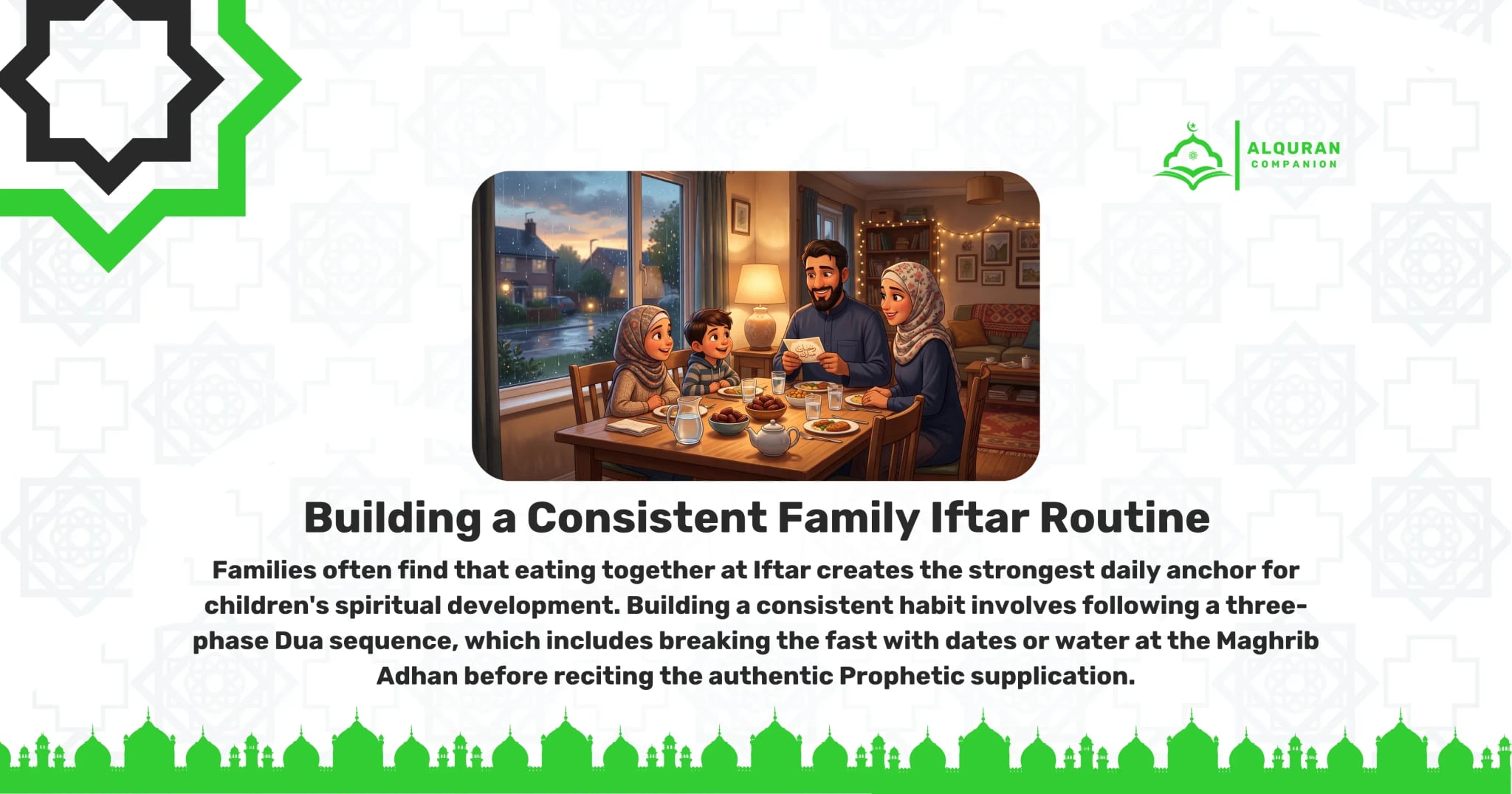
Parents in the UK face an additional layer of complexity. School pick-up times, evening tuition, and dinner routines all revolve around Iftar during winter fasts. Families in Birmingham and Bradford often find that eating together at Iftar creates the strongest daily anchor for children's spiritual development. Our guide to online Quran classes for adults explores how parents can also maintain their own learning alongside family commitments.
The Virtue of Voluntary Fasts in the UK
Many UK Muslims maintain a rhythm of voluntary fasting on Mondays and Thursdays throughout the year. The Prophet Muhammad ﷺ said: 'Deeds are presented on Monday and Thursday, so I love that my deeds be presented while I am fasting.' This narration, recorded by Imam Al-Tirmidhi, makes the Monday and Thursday fasts a powerful weekly spiritual reset. The fast of Prophet Dawud (peace be upon him), which involves fasting every other day, is described in Sahih Al-Bukhari and Sahih Muslim as the most beloved fasting to Allah.
At Al Quran Companion, our academic faculty has found that students who maintain voluntary fasts alongside their Quran studies report stronger focus and consistency in their memorization. The discipline of fasting and the discipline of Quran study reinforce each other. If you are preparing for Ramadan or want to build a year-round fasting habit, our online Quran classes for adults provide structured support from certified tutors who understand the demands of UK Muslim life.
Common Mistakes Muslims Make with the Iftar Dua
One of the most common mistakes is reciting the Iftar dua before breaking the fast. The wording itself refers to thirst having already gone and veins being moistened, indicating it is a post-Iftar supplication. Reciting it before eating creates a grammatical and theological mismatch.
A second mistake is neglecting the pre-Iftar window entirely. The minutes before Maghrib are among the most valuable for Dua. The Prophet ﷺ said that three supplications are never rejected, and the first is the fasting person's Dua until they break their fast. Instead of filling this time with food preparation, use it for seeking forgiveness and asking Allah for your needs.
A third mistake is replacing the Sunnah dua with a weak or fabricated supplication. The 'Allahumma inni laka sumtu' dua is widely circulated but classified as weak by several Hadith scholars. Stick to the authentic narration from Sunan Abi Dawud and supplement it with your own Duas in any language, as the fasting person's supplication is answered regardless of the language used.
How to Build a Consistent Iftar Dua Habit Across the UK
Building a habit around Iftar requires the same principles as building any other routine: cue, action, and reward. The cue is the Maghrib Adhan. The action is your three-phase Dua sequence. The reward is the physical relief of breaking the fast combined with the spiritual satisfaction of following the Sunnah.
For families in Sydney or Melbourne observing Ramadan during the Australian winter, the same principle applies with different timings. For expat families in Dubai and Abu Dhabi, the structured Iftar routine becomes a shared family ritual that anchors the entire household. The geographic location changes the clock, but the Prophetic practice remains constant.
In Canada, families in Toronto and Calgary have found that the harsh winter months make home-based Iftar routines essential. The commute home during a snowstorm can delay Iftar by 30 minutes or more. Keeping a fast-breaking pack in the car or bag solves this problem instantly. The same principle applies to UK Muslims in Leeds or Glasgow facing unpredictable weather.
For parents in Germany or Ireland seeking authentic English-speaking Quran educators, the Iftar routine can also become a teaching moment. Ask your children to lead the Dua after Iftar. This small act of participation builds their confidence and reinforces the family's collective spiritual identity.
What Should You Recite If Someone Provides Your Iftar Meal?
The Prophet Muhammad ﷺ taught a specific supplication for the person who provides food for a fasting person to break their fast. The wording is: 'Aftara 'indakum al-saa'imoon, wa akala ta'amakum al-abraar, wa sallat 'alaykum al-mala'ikah' (May the fasting people break their fast in your home, and may the righteous eat your food, and may the angels send blessings upon you). This narration is recorded in Sunan Abi Dawud and is a beautiful way to show gratitude to your host while earning spiritual reward.
Many UK mosques and community centres hold daily Iftar gatherings during Ramadan. If you attend one, this dua is a sunnah to revive. It also creates a moment of connection with the volunteers who prepared the meal. For Muslims in the USA attending Sunday school Iftar events or community gatherings, the same practice applies. The dua is short, easy to memorize, and carries immense reward.
How Al Quran Companion Supports Your Ramadan and Beyond
Ramadan is a month of heightened Quran recitation, but the habits built during this month should extend beyond it. Our structured courses at Al Quran Companion are designed to integrate seamlessly with your daily worship routine. Whether you are learning Tajweed to improve your Salah, memorizing Surahs for Taraweeh, or studying Tafsir to deepen your understanding, our certified instructors provide the guidance and accountability that busy UK Muslims need.
Every teacher at Al Quran Companion undergoes comprehensive background checks and detailed multi-stage reviews before being certified to teach our students. We also provide qualified female Quran tutors for daughters, young children, and adult sisters who prefer a female instructor. Adult learners and reverts receive 100% private, patient, judgment-free one-on-one guidance at their own pace.
Our Ijazah-holding instructors use a proprietary diagnostic assessment to identify each student's Makharij pronunciation hurdles, Tajweed gaps, and fluency level. This allows us to create a personalized learning path that fits your schedule, whether you are in the United States balancing public school commitments, in the UK managing GCSE or A-Level term balance, or in Australia coordinating weekend sports schedules.
Frequently Asked Questions About Duas for Breaking Fast

Al Quran Companion Team
Verified AuthorThe official academic and editorial team at Al Quran Companion, a leading Online Quran Academy dedicated to simplifying Tajweed, Hifz, and Islamic studies for students worldwide.
Read more about author