
Understanding the exact ramadan fasting rules elevates your worship from simple starvation to profound spiritual discipline. Every year, Muslims across the globe welcome the blessed month of Ramadan with immense joy. However, navigating the specific regulations of Sawm (fasting) in a modern context often brings confusion. Questions arise regarding asthma inhalers, accidental eating, travel exemptions, and long summer daylight hours in non-Muslim countries. Grounded in the consensus of the four Sunni schools of jurisprudence (Hanafi, Maliki, Shafi'i, and Hanbali), this comprehensive guide clarifies exactly what validates, breaks, or exempts you from the fast.
Fasting in Islam is a deliberate, conscious act of devotion. It requires proper knowledge to ensure your efforts are accepted by Allah. Whether you are balancing corporate meetings in London, attending university in Sydney, or managing a household in Dubai, knowing the precise boundaries of Sawm empowers you to observe the month with confidence. At Al Quran Companion, we prioritize providing authentic, accessible Islamic education. Our certified, background-checked instructors guide adult learners and children through the intricacies of Quranic recitation and Fiqh every single day.
Table of Contents
- What Are the Core Rules of Fasting in Ramadan (Sawm)?
- What Validates and Breaks a Fast: The 4-Tier Sawm Fiqh Matrix
- Tier 1: Valid Actions (Fast Remains Intact)
- Tier 2: Invalidators Requiring Qada Only
- Tier 3: Invalidators Requiring Kaffarah (Major Penalty)
- Tier 4: Makruh (Disliked) Actions
- Medical Exemptions and Modern Rulings: Inhalers, Injections & Illness
- Authentic Sunnah Practices for Suhoor and Iftar
- Managing Fasting in the West: Work, Exams & 16-Hour Summer Fasts
- Frequently Asked Questions
Key Takeaways
- Sawm (fasting) requires a clear intention (Niyyah) and complete abstinence from food, drink, and intimacy from true dawn (Fajr) to sunset (Maghrib).
- The 4-Tier Sawm Fiqh Matrix categorizes actions into Valid, Invalidating with Qada, Invalidating with Kaffarah, and Makruh (disliked).
- Modern medical treatments like asthma inhalers, IV drips, and eye drops have specific rulings based on classical Fiqh consensus.
- Delaying Suhoor and hastening Iftar are highly emphasized Sunnah practices recorded in Sahih Al-Bukhari.
- Diaspora Muslims in the US, UK, and Canada can adopt practical routines to manage 16-hour fasts alongside work and study commitments.
What Are the Core Rules of Fasting in Ramadan (Sawm)?
Sawm is the fourth pillar of Islam, defined as the intentional abstinence from food, drink, and marital relations from true dawn (Fajr) until sunset (Maghrib). Established in Surah Al-Baqarah, this obligatory worship requires a firm internal intention (Niyyah) made before Fajr each day.
The foundation of fasting rests entirely on the command of Allah found in the Holy Quran. The physical act of withholding nourishment trains the soul in self-restraint (Taqwa). Fasting is an individual obligation upon every sane, healthy, adult Muslim. Children are not obligated to fast until they reach puberty, though many families gently encourage partial fasts to build a love for Ramadan early on.
يٰٓـاَيُّهَا الَّذِيۡنَ اٰمَنُوۡا كُتِبَ عَلَيۡکُمُ الصِّيَامُ کَمَا كُتِبَ عَلَى الَّذِيۡنَ مِنۡ قَبۡلِکُمۡ لَعَلَّكُمۡ تَتَّقُوۡنَۙ﴿١٨٣﴾
O you who have believed, decreed upon you is fasting as it was decreed upon those before you that you may become righteous -
Niyyah (Intention) is the absolute prerequisite for a valid fast. According to the consensus across the four established schools of Islamic jurisprudence (Hanafi, Maliki, Shafi'i, and Hanbali), the intention must be present in the heart. While verbalizing the intention is common in many cultures, the internal resolve to fast the upcoming day for the sake of Allah is the actual requirement. The Shafi'i school requires this intention to be renewed every single night before Fajr, whereas the Maliki school permits a single intention made at the beginning of Ramadan for the entire month. To be safe, silently affirming your intention each night is the strongest practice.
The timing of the fast is strictly bound by the movement of the sun. The fast begins at the entry time of Fajr prayer, often called 'true dawn' or As-Subh As-Sadiq. It ends exactly at the entry time of Maghrib prayer, which is sunset. Even one minute of intentional eating before Maghrib or after Fajr completely invalidates that day's fast.
What Validates and Breaks a Fast: The 4-Tier Sawm Fiqh Matrix
The 4-Tier Sawm Fiqh Matrix categorizes daily actions during Ramadan into four definitive rulings: Valid acts that do not break the fast, acts requiring Qada (making up the day), acts requiring Kaffarah (severe penalty), and Makruh (disliked) actions that reduce spiritual reward.
Understanding this matrix prevents unnecessary anxiety. Many Muslims assume their fast is broken by minor incidents. We utilize this structured matrix at Al Quran Companion to teach adult learners exactly how to handle daily uncertainties.
Tier 1: Valid Actions (Fast Remains Intact)
Certain actions have no negative impact on your fast. The most common scenario is forgetful eating. If you genuinely forget you are fasting and consume food or drink, your fast is perfectly valid. You must stop chewing and swallow nothing the exact second you remember. This is considered a provision from Allah.
The Prophet (ﷺ) said, "If somebody eats or drinks forgetfully then he should complete his fast, for what he has eaten or drunk, has been given to him by Allah
Other valid actions include brushing teeth (provided no toothpaste or water is swallowed), using a Miswak, showering to cool down, swallowing one's own natural saliva, and unintentional vomiting. Applying scented oils (Ittar) or wearing perfume is also entirely permissible.
Tier 2: Invalidators Requiring Qada Only
Qada refers to making up a missed day of fasting at a later date before the next Ramadan. Actions that require Qada include breaking the fast due to sudden severe illness, the onset of menstruation or postnatal bleeding, or being compelled by force to eat or drink. If water accidentally slips down the throat while rinsing the mouth during Wudu, the fast is broken, and a Qada fast is required. This highlights why scholars advise against gargling deeply during ablution while fasting.
Tier 3: Invalidators Requiring Kaffarah (Major Penalty)
Kaffarah is a severe expiation required for deliberately and knowingly violating the sanctity of the Ramadan fast without a valid excuse. This primarily applies to engaging in intentional marital relations during fasting hours, or deliberately eating and drinking. The penalty for this violation is immense: fasting 60 consecutive days for a single broken fast. If a person is physically incapable of this, they must feed 60 people in need.
Tier 4: Makruh (Disliked) Actions
Makruh actions do not technically break the fast, but they diminish its spiritual reward. These include tasting food unnecessarily while cooking (even if spat out immediately), gathering saliva in the mouth to swallow deliberately, and wasting time in idle arguments. Fasting is a discipline of the tongue and eyes just as much as the stomach.
Medical Exemptions and Modern Rulings: Inhalers, Injections & Illness
Contemporary Islamic scholars generally agree that intramuscular injections, eye drops, and ear drops do not break the fast because they bypass the digestive tract. However, intravenous (IV) nutritional drips and asthma inhalers that deliver medication particles directly to the throat invalidate the fast, requiring a makeup day (Qada).
Medical questions are among the most frequently asked during Ramadan. Islam is a religion of ease, and Allah does not place a burden upon a soul greater than it can bear. Those suffering from acute, temporary illnesses are exempt from fasting. They are permitted to take their prescribed oral medication, eat to regain strength, and then perform Qada (makeup fasts) after Ramadan concludes.
Injections are a common point of contention. The scholarly consensus differentiates between non-nutritive and nutritive injections. A standard intramuscular vaccine or pain relief injection does not enter the stomach cavity or provide nourishment; therefore, it does not break the fast. Conversely, an IV saline or vitamin drip provides direct hydration and sustenance to the body, thereby invalidating the fast.
Asthma inhalers require careful consideration. The Hanafi and Shafi'i schools note that inhalers release pressurized medicine and particulate matter that travel through the throat. Because a physical substance enters the body cavity, the use of an inhaler breaks the fast. Asthmatic patients should consult their physicians to adjust medication schedules to nighttime hours if possible. If an attack occurs during the day, the inhaler must be used to preserve life, and the fast is made up later.
Understanding Fidyah vs. Qada
Pros
- Qada: Required for temporary illness, travel, or menstruation. The exact number of missed days must be fasted before the next Ramadan.
- Qada: Can be fasted consecutively or spaced out over the year.
- Qada: No monetary payment is required, only the physical makeup fast.
Cons
- Fidyah: Required for chronic, incurable illnesses or extreme old age where fasting is permanently impossible.
- Fidyah: Involves feeding one person in need for every single missed day.
- Fidyah: Substitutes the physical act of fasting entirely due to medical necessity.
Authentic Sunnah Practices for Suhoor and Iftar
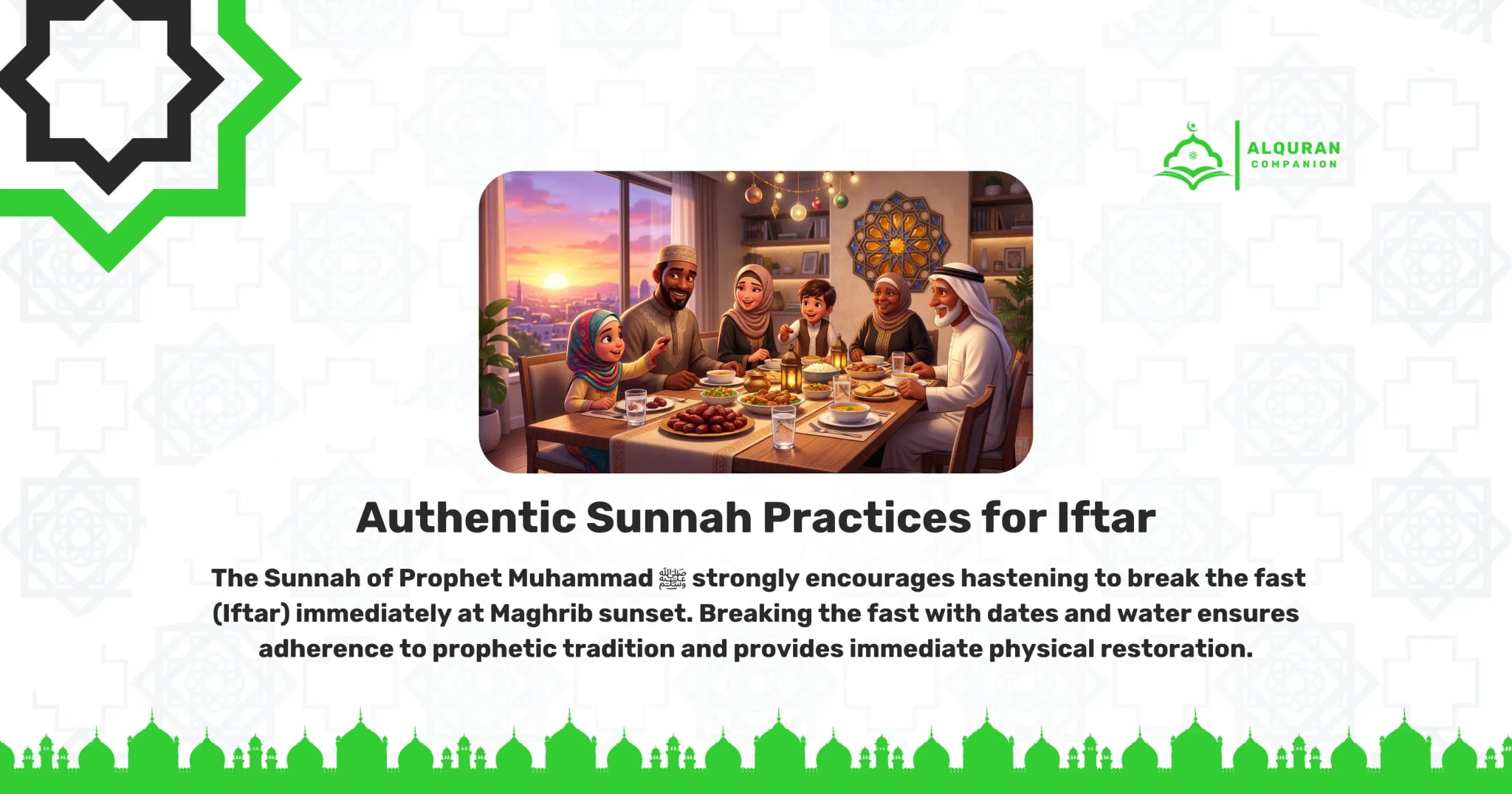
The Sunnah of Prophet Muhammad ﷺ strongly encourages delaying the pre-dawn meal (Suhoor) until shortly before Fajr, and hastening to break the fast (Iftar) immediately at Maghrib sunset. Breaking the fast with odd numbers of dates and water ensures adherence to prophetic tradition and provides immediate physical restoration.
Many Muslims mistakenly skip Suhoor due to sleepiness. This directly contradicts the advice of the Prophet ﷺ, who stated there is profound blessing (Barakah) in the pre-dawn meal. Eating Suhoor fortifies the body against the physical exhaustion of the day. A nutritious meal consisting of complex carbohydrates, proteins, and plenty of water is highly recommended. You can learn more about proper physical preparation in our guide to best suhoor foods for energy ramadan nutrition.
The Prophet (ﷺ) said, "Take Suhur as there is a blessing in it
At sunset, hastening the Iftar is a sign of obedience. Delaying Iftar intentionally under the assumption that it brings more reward is an innovation against the Sunnah. The moment the sun dips below the horizon, the fast is complete. It is highly recommended to break the fast exactly as the Prophet ﷺ did: with fresh or dry dates and a sip of water. This is immediately followed by reciting the authentic supplication for breaking the fast.
Dua
Dhahabadh-dhama'u wabtallatil-'urooqu, wa thabatal-ajru inshaa-Allah
Thirst has gone, the arteries are moist, and the reward is sure, if Allah wills.
Managing Fasting in the West: Work, Exams & 16-Hour Summer Fasts
Diaspora Muslims balancing corporate jobs or rigorous university exams during 16-hour summer fasts in the US, UK, and Canada must prioritize sleep optimization and hydration. Negotiating flexible working hours and scheduling complex mental tasks for the early morning prevents mid-afternoon cognitive fatigue.
Fasting in non-Muslim majority countries requires deliberate planning. A Muslim software engineer in California or a medical student in London faces different logistical challenges compared to someone living in Madinah Munawwarah or Dubai. When Ramadan falls in the summer months of the Northern Hemisphere, fasts can extend beyond 16 or 17 hours. Managing this effectively is critical to maintaining both physical health and spiritual focus.
For professionals, communication is highly effective. Inform your managers and colleagues that you are observing Ramadan. Most modern corporate environments in the US, UK, and Australia accommodate flexible scheduling. Requesting to start your workday earlier, skipping lunch hours to leave early, or working remotely a few days a week significantly reduces physical strain. Arrange demanding presentations or complex analytical work for the morning hours when your energy and hydration levels are highest.
Students facing GCSEs, A-Levels, or university finals while fasting must manage their cognitive load. The brain consumes massive amounts of glucose during intense study sessions. Breaking up study periods into shorter intervals, studying immediately after Fajr, and sleeping during the late afternoon helps manage exhaustion. Building a consistent spiritual habit is just as important as exam prep. You can maintain your recitation schedule by following an easy daily quran reading habit even during peak exam seasons.
At Al Quran Companion, we understand the unique pressures faced by diaspora families. Finding time to study the Quran amidst school runs and corporate commutes is difficult. We offer fully flexible, live 1-on-1 sessions tailored to your time zone—whether you are on Eastern Standard Time in New York or Greenwich Mean Time in London. We always conduct comprehensive Background Checks and detailed multi-stage reviews of every single teacher before they are certified to teach our students. We provide highly qualified female tutors for sisters and young daughters, ensuring a completely safe, zero-judgment environment. By integrating online Quran classes for adults into your Ramadan routine, you maintain spiritual momentum without disrupting your professional life.
Ultimately, knowing the rules of fasting brings peace of mind. By following the guidelines established by classical scholars and adopting practical strategies for modern life, you ensure your Sawm is both valid and deeply rewarding. Prepare yourself for the ultimate nights of the month by learning about the signs and worship for Laylatul Qadr, fulfilling your charitable obligations by calculating Zakat al-Fitr, and perfecting your connection to Allah by performing daily Salah and Tarawih.
Frequently Asked Questions

Al Quran Companion Team
Verified AuthorThe official academic and editorial team at Al Quran Companion, a leading Online Quran Academy dedicated to simplifying Tajweed, Hifz, and Islamic studies for students worldwide.
Read more about author