
What Is the Janazah Prayer and Why Is It a Communal Obligation?
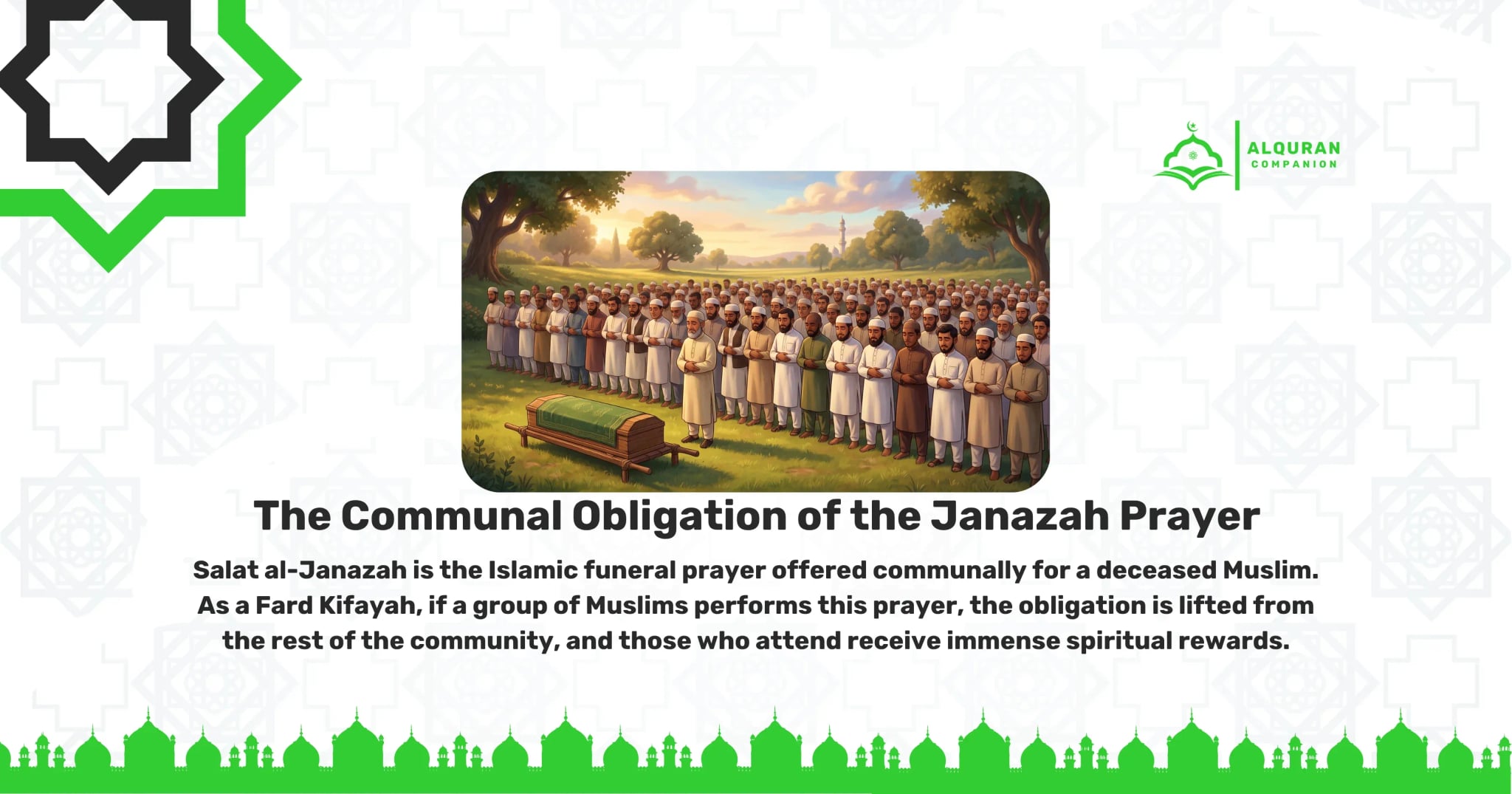
Salat al-Janazah is the Islamic funeral prayer offered communally for a deceased Muslim. It is a Fard Kifayah, a communal obligation. This means if some members of the community perform it, the rest are absolved. The Prophet Muhammad ﷺ said, 'Whoever attends the funeral procession till he offers the funeral prayer for it, will get a reward equal to one Qirat, and whoever accompanies it till burial, will get a reward equal to two Qirats.' Each Qirat is like the size of Mount Uhud.
Understanding how to pray Janazah prayer is a duty for every Muslim community. The prayer is a right the deceased has upon the living. It is a final act of honor and a powerful supplication for forgiveness. In our live 1-on-1 classes at Al Quran Companion, we often find that adult learners and reverts feel uncertain about the specific steps. This guide removes that uncertainty with clear, Sunnah-based instructions.
What You Will Learn in This Guide
- What Is the Janazah Prayer and Why Is It a Communal Obligation?
- Why Is Learning the Janazah Prayer Compulsory for Every Muslim Community?
- The 4-Takbir Funeral Prayer Blueprint: Step-by-Step Guide
- The Primary Authentic Supplication for the Deceased in Janazah
- Book Your Free 1-on-1 Quran and Prayer Assessment
- Four-Madhab Rulings on Janazah: Fatihah Recitation and Hand Placement
- What to Do If You Arrive Late for the Janazah Prayer?
- Can Women Attend the Janazah Prayer?
- What Is Janazah in Absentia (Salat al-Gha'ib)?
- Frequently Asked Questions About the Janazah Prayer
Key Takeaways
- Salat al-Janazah is a Fard Kifayah, a collective duty on the Muslim community.
- The prayer consists of four Takbirs, with specific recitations and supplications between each.
- The primary Dua for the deceased is 'Allahummaghfir lihayyina wa mayyitina...' recorded in Sunan Abi Dawud.
- The four Madhabs (Hanafi, Maliki, Shafi'i, Hanbali) differ on details like reciting Surah Al-Fatihah and hand placement.
- If you arrive late, you join the Imam at the current Takbir and complete the remaining Takbirs without reciting the missed portions.
Why Is Learning the Janazah Prayer Compulsory for Every Muslim Community?
The Janazah prayer is a Fard Kifayah, meaning it is a collective obligation upon the entire Muslim community. If a group performs it, the obligation is lifted from everyone. However, if no one performs it, the entire community shares the sin. This ruling is based on the consensus of the four established schools of Islamic jurisprudence (Hanafi, Maliki, Shafi'i, and Hanbali).
This prayer is not just a ritual. It is a profound act of intercession. You stand before Allah, asking Him to forgive your brother or sister in faith. The Prophet Muhammad ﷺ emphasized its reward. He said, 'Whoever attends the funeral procession till he offers the funeral prayer for it, will get a reward equal to one Qirat, and whoever accompanies it till burial, will get a reward equal to two Qirats.' Each Qirat is equivalent to the size of Mount Uhud. This immense reward shows the spiritual weight of this communal duty.
The 4-Takbir Funeral Prayer Blueprint: Step-by-Step Guide
The Janazah prayer is structured around four Takbirs. You start by making the intention and raising your hands for the first Takbir. Then you recite Surah Al-Fatihah. After the second Takbir, you recite the Salawat on the Prophet Muhammad ﷺ. After the third Takbir, you make a Dua for the deceased. After the fourth Takbir, you make a short Dua for yourself and the Ummah, then conclude with Tasleem. This format is consistent across all schools of jurisprudence, though details vary.
- First Takbir: Make the intention (Niyyah) to pray the Janazah prayer for the deceased. Raise your hands to your ears and say 'Allahu Akbar'. Then fold your hands and recite Surah Al-Fatihah.
- Second Takbir: Say 'Allahu Akbar' without raising your hands (according to the Hanafi school). Then recite the Salawat (Durood-e-Ibrahim), the same supplication for blessings upon the Prophet ﷺ that you recite in Salah.
- Third Takbir: Say 'Allahu Akbar'. Then recite the primary Dua for the deceased. The most authentic and comprehensive supplication is 'Allahummaghfir lihayyina wa mayyitina...' (O Allah, forgive our living and our dead...).
- Fourth Takbir: Say 'Allahu Akbar'. Then recite a short Dua for yourself, your family, and the entire Muslim Ummah. Finally, conclude the prayer by making Tasleem (saying 'Assalamu alaikum wa rahmatullah') to the right, and then to the left (two Tasleems according to the Hanafi school).
The Primary Authentic Supplication for the Deceased in Janazah
The Prophet Muhammad ﷺ taught this comprehensive Dua for the deceased. It seeks forgiveness for all Muslims, the living and the dead. It is recorded in Sunan Abi Dawud (3201) on the authority of Abu Hurairah (RA).
Dua Salat al-Janazah
Allahumma-ghfir lihayyina wa mayyitina, wa shahidina wa gha-ibina, wa sagheerina wa kabeerina, wa dhakarina wa unthana.Allahumma man ahyaytahu minna fa ahyihi ‘ala-l-islam, wa man tawaffaytahu minna fatawaffahu ‘ala-l-iman.Allahumma la tahrimna ajrahum wa la tudillna ba‘dahu.
O Allah, forgive those of us who are living and those of us who are dead, those of us who are present and those of us who are absent, our young and our old, our male and our female. O Allah, to whomsoever of us Thou givest life grant him life as a believer, and whomsoever of us Thou takest in death take him in death as a follower of Islam. O Allah, do not withhold from us the reward (of faith) and do not lead us astray after his death.
Book Your Free 1-on-1 Quran and Prayer Assessment
Four-Madhab Rulings on Janazah: Fatihah Recitation and Hand Placement
The four Sunni schools of jurisprudence agree on the core structure of the Janazah prayer. However, they differ on specific details. These differences are matters of legal interpretation, not fundamental belief. Knowing them helps you follow your community's practice correctly. The Hanafi school prefers reciting the Thana (subhanaka Allahumma...) after the first Takbir. The Shafi'i and Hanbali schools consider reciting Surah Al-Fatihah obligatory. The Maliki school does not recite Surah Al-Fatihah and instead makes Dua after each Takbir.
Four-Madhab Comparison of Janazah Prayer Details
| Action / Ruling | Hanafi | Maliki | Shafi'i | Hanbali |
|---|---|---|---|---|
| Reciting Surah Al-Fatihah | Thana preferred | Not recited | Obligatory (after 1st Takbir) | Obligatory (after 1st Takbir) |
| Raising Hands at Every Takbir | Only at first Takbir | Not raised | Recommended at every Takbir | Recommended at every Takbir |
| Number of Tasleems | Two (obligatory) | One (recommended) | Two (recommended) | One (obligatory) |
| Hand Position During Dua | Folded (right over left) | Folded (right over left) | Folded (right over left) | Folded (right over left) |
| Recitation After First Takbir | Thana (Subhanaka Allahumma) | No specific recitation | Surah Al-Fatihah | Surah Al-Fatihah |
Reciting Surah Al-Fatihah
Raising Hands at Every Takbir
Number of Tasleems
Hand Position During Dua
Recitation After First Takbir
According to the consensus across the four established schools of Islamic jurisprudence, the Janazah prayer is valid with any of these methods. The key is to follow the practice of your local mosque or the school of thought you follow. For a deeper understanding of prayer rulings, you can explore our guide on how to perform Wudu properly, as purity is a prerequisite for all prayers.
What to Do If You Arrive Late for the Janazah Prayer?
If you arrive late for the Janazah prayer, you join the congregation at the current Takbir. You do not need to make up the missed Takbirs with their specific recitations. Instead, you follow the Imam for the remaining Takbirs. After the Imam makes the final Tasleem, you stand up and complete the missed Takbirs on your own. You recite the Takbir and then say the required recitation for that position. This is the majority position among scholars.
Online Learning vs. In-Person Mosque Learning for Janazah Prayer
Pros
- Learn from certified Ijazah-holding teachers from home.
- Flexible scheduling for busy families in the US, UK, and Australia.
- One-on-one attention to correct pronunciation and steps.
- Access to female tutors for daughters and adult sisters.
Cons
- No physical congregation experience.
- Requires a stable internet connection.
- Cannot substitute for actual community participation.
Expert Insight
"The Janazah prayer is a communal obligation. It is a right the deceased has upon the living. The format is unique: four Takbirs with specific supplications. Understanding this format ensures we fulfill our duty correctly and earn the immense reward promised by the Prophet Muhammad ﷺ."
"Whoever attends the funeral procession till he offers the funeral prayer for it, will get a reward equal to one Qirat, and whoever accompanies it till burial, will get a reward equal to two Qirats."
Can Women Attend the Janazah Prayer?
Yes, women can attend the Janazah prayer. According to the majority of scholars across the four schools of jurisprudence, it is permissible for women to attend and participate in the funeral prayer. This is based on the general commands of the Prophet Muhammad ﷺ to pray and seek forgiveness for the deceased. However, women are encouraged to maintain modesty and avoid mixing freely with men. In many communities, women pray in a separate area or behind the men's rows. The prayer itself is the same for men and women.
What Is Janazah in Absentia (Salat al-Gha'ib)?
Janazah in absentia, known as Salat al-Gha'ib, is the funeral prayer performed for a deceased Muslim who is not present in the same location. The Prophet Muhammad ﷺ performed this prayer for the Negus, the ruler of Abyssinia, when he passed away. According to the Shafi'i and Hanbali schools, this prayer is permissible and recommended, especially for a person who died in a distant land and has no one to pray for them. The Hanafi and Maliki schools generally do not practice Salat al-Gha'ib except under specific conditions, such as when the deceased was in a place with no Muslims to perform the prayer.
Frequently Asked Questions About the Janazah Prayer

Al Quran Companion Team
Verified AuthorThe official academic and editorial team at Al Quran Companion, a leading Online Quran Academy dedicated to simplifying Tajweed, Hifz, and Islamic studies for students worldwide.
Read more about author