Learning how to become Muslim is a deeply personal and transformative decision that begins with a single, profound realization of faith. Every year, thousands of seekers across the United States, the United Kingdom, Canada, and Australia choose to enter Islam. The pathway is straightforward, free of complex rituals, and open to anyone who believes in the oneness of Allah and the prophethood of His final messenger. This comprehensive guide walks you through the exact declaration of faith, the initial purification steps, and a structured learning path designed to support your spiritual growth.
Table of Contents
- What Does It Mean to Become Muslim?
- The Core Beliefs of Islam: The Six Articles of Iman
- Why Do People Say 'Revert' Instead of 'Convert'?
- How to Take the Shahada: Step-by-Step
- Pronunciation Breakdown for New Learners
- Do You Need Witnesses or a Mosque to Take the Shahada?
- Taking the Step: Private Shahada vs Mosque Declaration
- What Happens to Your Past Sins After Converting?
- The Al Quran Companion New Muslim Roadmap: Your First 24 Hours
- Step 1: Perform the Ritual Purification (Ghusl)
- Step 2: Learn the Basics of Ablution (Wudu)
- Step 3: Establish Your Daily Prayer (Salah)
- Step 4: Master Surah Al-Fatiha and Basic Quran Literacy
- Navigating Daily Life as a New Revert in Western Societies
- How Al Quran Companion Supports Your Revert Journey
- Frequently Asked Questions
Key Takeaways
- Becoming Muslim requires only a sincere belief in the oneness of Allah and the verbal declaration of the Shahada.
- No formal ceremony, official witnesses, or institutional paperwork are strictly required for your conversion to be valid before Allah.
- Upon pronouncing the Shahada with true conviction, all prior sins are completely forgiven, granting you a fresh spiritual beginning.
- The theological concept of Fitrah explains why many choose the term 'revert' to signify returning to an innate human state of monotheism.
- Your first practical actions involve taking a full ritual bath (Ghusl), learning basic prayer purification (Wudu), and establishing daily Salah.
- Structured 1-on-1 guidance from background-checked instructors provides a safe, judgment-free space to master prayer and Quran recitation at your own pace.
What Does It Mean to Become Muslim?
To become Muslim means consciously submitting your will to Allah by affirming absolute monotheism (Tawheed) and accepting Prophet Muhammad ﷺ as His final messenger. A Muslim is one who adheres to the sacred guidance outlined in the Holy Quran and authentic Sunnah, committing to live with moral integrity, spiritual awareness, and sincere devotion.
The word Islam originates from the Arabic root S-L-M, which signifies peace, submission, and safety. Entering Islam is not a cultural adoption or an ethnic transition; it is a direct spiritual contract between the individual and the Creator. Regardless of your ancestry, language, or prior life circumstances, embracing Islam establishes an unmediated connection with Allah.
When you declare your faith, you join a global brotherhood and sisterhood—the Ummah—bound together not by geography, but by shared belief. You do not need to change your legal name unless it contains a meaning that contradicts monotheism, nor do you need to abandon your cultural heritage as long as it aligns with basic Islamic ethics.
The Core Beliefs of Islam: The Six Articles of Iman
The Six Articles of Iman form the non-negotiable theological foundation that every individual must accept in their heart before declaring the testimony of faith. According to classical Islamic consensus, internal conviction in these six pillars is what validates your public and private commitment to Islam.
Consider this: understanding these core doctrines brings mental clarity and removes common misconceptions about Islamic theology. Here are the six pillars of faith:
- Belief in Allah (Tawheed): Affirming that Allah is One, without partners, children, or equal rivals. He is the sole Creator, Sustainer, and Ruler of the universe, possessing perfect attributes.
- Belief in the Angels (Malaikah): Acknowledging the unseen, noble beings created from light who carry out the commands of Allah, including Jibreel (Gabriel), who delivered divine revelation.
- Belief in the Divine Scriptures (Kutub): Believing in the original books revealed to humanity, including the Tawrat of Musa (Moses), the Zabur of Dawud (David), the Injeel of Isa (Jesus), and the final, fully preserved Holy Quran revealed to Prophet Muhammad ﷺ.
- Belief in the Prophets and Messengers (Rusul): Honoring all the prophets sent to guide mankind, starting from Adam and including Nuh (Noah), Ibrahim (Abraham), Musa (Moses), Isa (Jesus), and concluding with Prophet Muhammad ﷺ as the final seal.
- Belief in the Day of Judgment (Yawm al-Qiyamah): Recognizing that all human beings will be resurrected, held accountable for their deeds, and granted entry to Jannah (Paradise) or Jahannam (Hellfire) by divine justice and mercy.
- Belief in Divine Decree (Al-Qadr): Trusting that Allah holds supreme knowledge over all events, past, present, and future, and that everything unfolds according to His wisdom.
Why Do People Say 'Revert' Instead of 'Convert'?
The term 'revert' is rooted in the theological concept of Fitrah, which describes the pure, innate spiritual inclination toward monotheism with which every human soul is created. While 'converting to Islam' is the conventional English phrase, 'reverting' reflects returning to one's original, unblemished spiritual state before societal influences occurred.
Islamic theology explains that every individual is born with an intuitive awareness of God. Life experiences, environmental conditioning, and cultural upbringing may veil this awareness over time. When a seeker embraces the truth of monotheism, they are not adopting an unfamiliar philosophy; they are rediscovering what their soul already knew.
"Every child is born upon the natural disposition (Fitrah), but his parents convert him to Judaism, Christianity, or Zoroastrianism."
Whether you choose to call yourself a convert or a revert, the spiritual reality remains identical. What matters most is the sincerity of your intention (Niyyah) and your commitment to walk the straight path (Sirat al-Mustaqeem).
How to Take the Shahada: Step-by-Step
The Shahada is the verbal testimony of faith that serves as the official entrance into the fold of Islam. To take the Shahada, you simply speak the two statements of testimony in Arabic and their translation with firm heart conviction, understanding the profound responsibility they carry.
Here is the exact phrasing in Arabic, followed by its transliteration and English translation:
Dua
Ash-hadu an la ilaha ill-Allah, wa ash-hadu anna Muhammadan Rasul-Allah
I testify that there is no deity worthy of worship except Allah, and I testify that Muhammad is the Messenger of Allah.
Pronunciation Breakdown for New Learners
If Arabic is entirely new to you, do not feel intimidated. You can pronounce the words slowly, syllable by syllable:
- Ash-hadu (I bear witness)
- an la ilaha (that there is no deity worthy of worship)
- ill-Allah (except Allah)
- wa ash-hadu anna (and I bear witness that)
- Muhammadan (Muhammad)
- Rasul-Allah (is the Messenger of Allah)
Do You Need Witnesses or a Mosque to Take the Shahada?
According to the consensus across the four established schools of Islamic jurisprudence (Hanafi, Maliki, Shafi'i, and Hanbali), witnesses are not an absolute prerequisite for entering Islam. If you utter the Shahada alone in your room with genuine belief, you are fully Muslim in the sight of Allah.
However, repeating your Shahada at a local Islamic centre or before Muslim mentors is strongly recommended. It allows your local community to celebrate your decision, register your conversion for official documentation (such as for Hajj or Umrah visas), and provide ongoing friendship and emotional support.
Taking the Step: Private Shahada vs Mosque Declaration
A private Shahada is an immediate declaration made directly to Allah in personal solitude, whereas a public Shahada takes place in an Islamic center with witnesses. Both methods hold equal theological validity, yet they offer distinct practical advantages depending on your personal comfort, safety, and living circumstances.
To help you decide which setting suits your current situation, review the differences below:
Private Declaration vs Public Mosque Declaration
Pros
- Private: Zero social pressure or performance anxiety while taking your first step.
- Private: Complete confidentiality if you live with non-Muslim family members.
- Public: Immediate access to a welcoming community and local brotherhood or sisterhood.
- Public: Easy access to official conversion certificates required for administrative records and travel.
Cons
- Private: Potential feeling of isolation without immediate local peer connections.
- Private: Lack of immediate hands-on correction for physical prayer movements.
- Public: Can feel overwhelming for introverts or individuals facing family scrutiny.
- Public: Requires scheduling travel around local mosque prayer timings and administrative hours.
At Al Quran Companion, we always conduct comprehensive Background Checks and detailed multi-stage reviews of every single teacher before they are certified to teach our students. This ensures new Muslims have a secure, confidential environment to practice recitation and ask foundational questions without fear of judgment.
What Happens to Your Past Sins After Converting?
Upon sincerely embracing Islam, every past sin and mistake committed prior to your Shahada is entirely wiped clean by the infinite mercy of Allah. You begin your life as a Muslim with an unblemished slate, while all your previous good deeds and charitable actions are preserved and rewarded.
This profound theological reality provides immense peace of mind for anyone worrying about past errors. The Prophet Muhammad ﷺ offered direct comfort to Amr ibn al-Aas (RA) when he hesitated to accept Islam out of concern for his former actions.
It is reported on the authority of Ibn 'Abbas that Mu'adh said:The Messenger of Allah sent me (as a governor of Yemen) and (at the time of departure) instructed me thus: You will soon find yourself in a community one among the people of the Book, so first call them to testify that there is no god but Allah, that I (Muhammad) am the messenger of Allah, and if they accept this, then tell them Allah has enjoined upon them five prayers during the day and the night and if they accept it, then tell them that Allah has made Zakat obligatory for them that it should be collected from the rich and distributed among the poor, and if they agree to it don't pick up (as a share of Zakat) the best of their wealths. Beware of the supplication of the oppressed for there is no barrier between him and Allah
Not only are previous sins erased, but classical scholars also highlight that Allah transforms prior sincere remorse into increased spiritual rank. You are gifted a fresh start, free from guilt, ready to build a life centered on virtue and devotion.
The Al Quran Companion New Muslim Roadmap: Your First 24 Hours
The Al Quran Companion New Muslim Roadmap is a structured, four-phase pedagogical framework created to eliminate overwhelm and guide new Muslims systematically through their first 24 hours of faith. Rather than trying to memorize everything at once, this framework prioritizes physical purification, foundational prayer, and incremental learning.
Step 1: Perform the Ritual Purification (Ghusl)
Ghusl is a full-body ritual bath performed with the intention of purifying yourself physically and spiritually for worship. Classical scholars recommend taking a complete shower where clean water reaches every part of the body, including the hair, scalp, and mouth, symbolizing the washing away of your prior life.
Step 2: Learn the Basics of Ablution (Wudu)
Wudu is the precise minor ablution required before performing daily prayers. It involves washing the hands, rinsing the mouth and nose, washing the face, arms up to the elbows, wiping over the head, and washing the feet up to the ankles in a designated sequence.
Step 3: Establish Your Daily Prayer (Salah)
Salah is the second pillar of Islam and forms the spiritual anchor of a Muslim’s daily routine across five designated times: Fajr, Dhuhr, Asr, Maghrib, and Isha. For a new revert, the priority is learning the physical postures (standing, bowing, prostrating) while reciting simple phrases of remembrance like SubhanAllah and Alhamdulillah before memorizing full Arabic passages.
Step 4: Master Surah Al-Fatiha and Basic Quran Literacy
Surah Al-Fatiha is the opening chapter of the Quran and an essential component of every single unit of prayer. Starting with a structured Quran Foundation course or Arabic Basics will help you master the accurate pronunciation of Arabic letters through systematic Quranic Tajweed.
Expert Insight
"Islam is a lifelong journey of incremental growth, not an overnight sprint. When a person accepts Islam, Allah rewards every ounce of effort. Focus first on your core connection with Allah through sincere prayer and steady Quranic literacy, allowing your knowledge to blossom naturally."
Navigating Daily Life as a New Revert in Western Societies
Living as a new Muslim in non-Muslim majority environments presents unique social, dietary, and practical adjustments that require patience and wisdom. Understanding how to navigate workplace schedules, family conversations, and social expectations ensures a balanced and sustainable transition.
Whether you are balancing public school or corporate schedules in the United States, managing post-work commutes in London or Birmingham, or coordinating family routines in Toronto, Sydney, or Melbourne, practical adaptation is key.
- Navigating Family Relationships: Maintain kindness, respect, and unconditional love with your non-Muslim parents and relatives. Islam places profound emphasis on honoring parents; show them through your improved character, generosity, and calm behavior that Islam has made you a more loving son, daughter, or sibling.
- Halal Dietary Adjustments: Begin substituting non-halal items gradually by switching to certified halal meats, avoiding pork products, and eliminating alcohol consumption. Look for trusted local halal grocers and certified food labels in your city.
- Managing Workplace and University Commitments: Most Western employers and academic institutions readily accommodate quiet prayer breaks. A simple, polite request to step away for 10 minutes during your lunch break is usually all that is required to fulfill your Dhuhr or Asr prayer.
- Finding Reliable Mentorship: Avoid relying on unverified internet forums or aggressive social media debates for religious rulings. Seek verified, credentialed tutors who offer patient instruction aligned with the Quran and authentic Sunnah.
How Al Quran Companion Supports Your Revert Journey
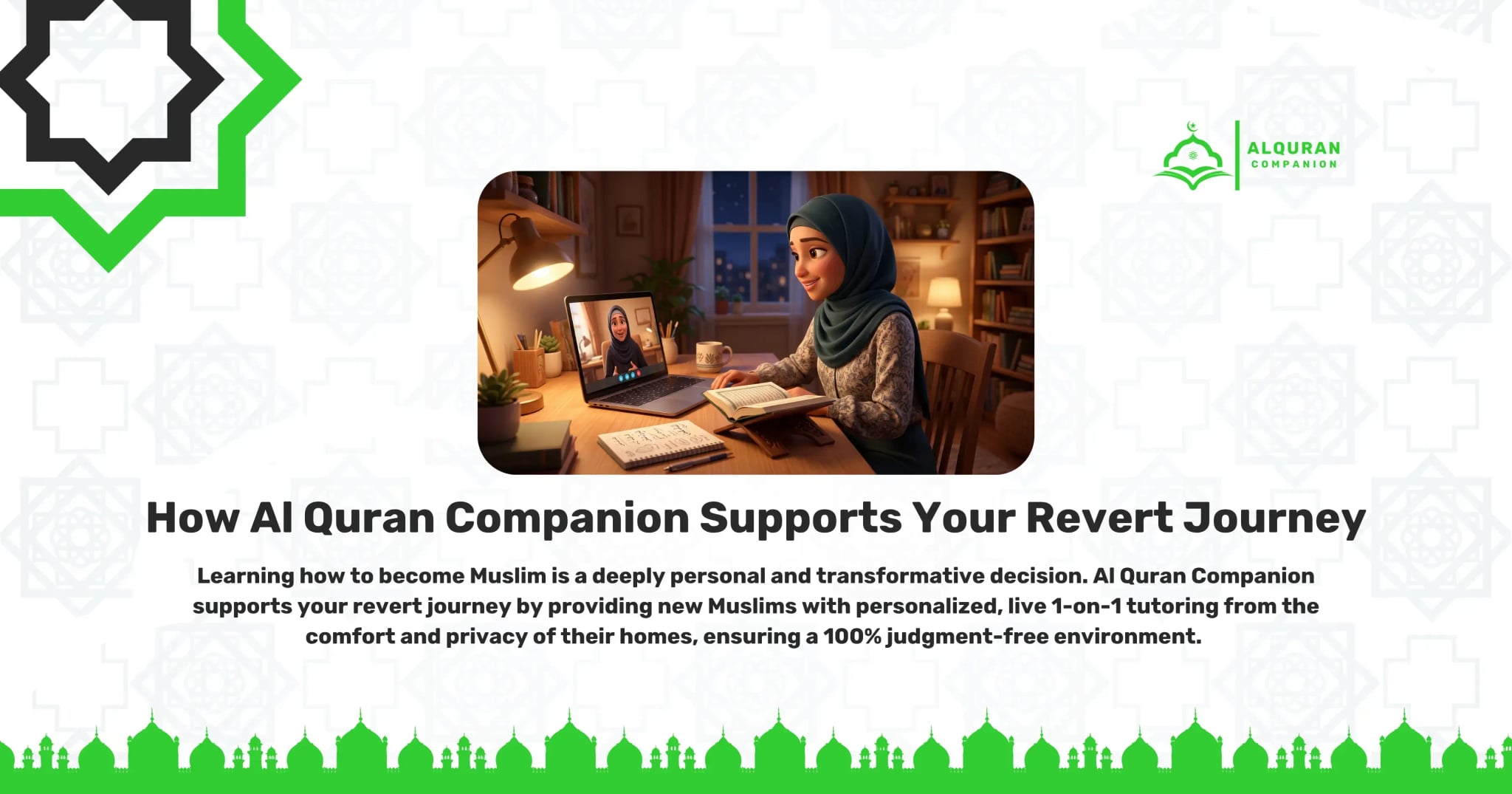
Al Quran Companion is an international online educational institute dedicated to providing new Muslims and their families with personalized, live 1-on-1 tutoring from the comfort and privacy of their homes. We recognize that learning Arabic, prayer steps, and Quran recitation can feel intimidating without patient, empathetic guidance.
We pair you with certified tutors who understand the Western revert experience and tailor every lesson to your personal pace:
- Rigorous Teacher Vetting: Every single instructor undergoes thorough background checks, academic verifications, and multi-stage teaching evaluations before being approved.
- Qualified Female Instructors: We have dedicated, certified female tutors available for sisters and young daughters, ensuring maximum comfort and privacy.
- 100% Judgment-Free Environment: Whether you are starting with letter recognition in Quran Recitation or advancing toward Quranic Tafsir, your classes remain warm, encouraging, and confidential.
- Zero-Risk Free Trial: You can experience a full live diagnostic lesson with no credit card required, allowing you to meet your teacher and explore our personalized curriculum firsthand.
Understanding how to become Muslim marks the start of an extraordinary, fulfilling relationship with your Creator. As you move forward, remember that every step you take toward Allah is met with His infinite guidance and support.
Frequently Asked Questions

Al Quran Companion Team
Verified AuthorThe official academic and editorial team at Al Quran Companion, a leading Online Quran Academy dedicated to simplifying Tajweed, Hifz, and Islamic studies for students worldwide.
Read more about author