
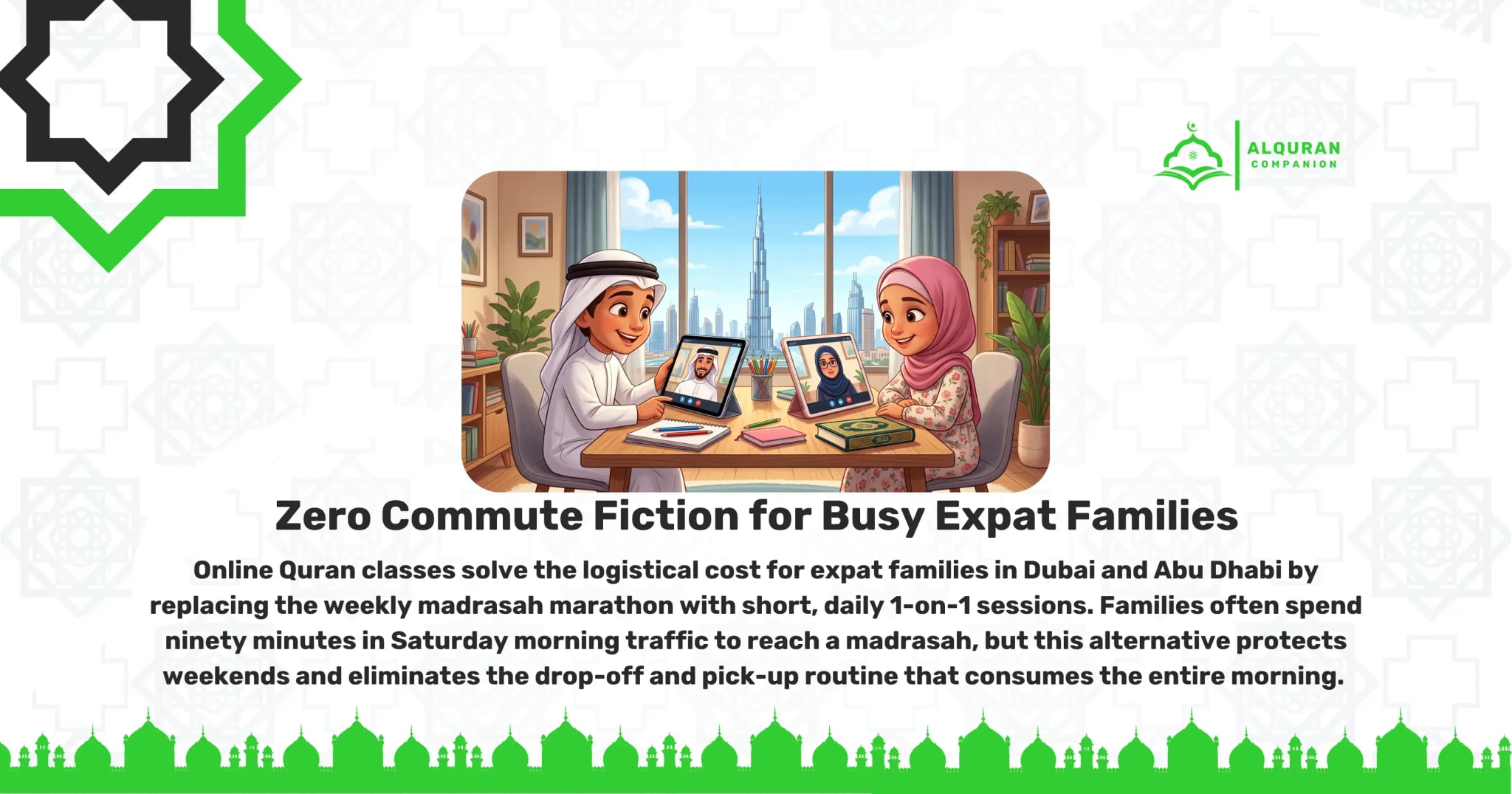
It is Saturday morning in Dubai. Your eight-year-old is sitting in a crowded madrasah hall in Al Qouz with twenty other children. The teacher has three minutes to hear each child recite. Your son has been staring at the same page of Noorani Qaida for forty-five minutes. When you pick him up at 1 PM, he cannot remember what he practiced. Sound familiar?
Across Dubai and Abu Dhabi, expat and Emirati families are quietly abandoning the traditional weekend madrasah model. The reasons are practical. A three-hour block on Saturday morning consumes half the weekend. Traffic on Sheikh Zayed Road turns a thirty-minute drive into ninety minutes. And the learning outcomes rarely justify the sacrifice.
This guide presents a different approach. The 15-Minute Micro-Sprint Model is a pedagogical framework developed at Al Quran Companion after assessing thousands of young students across the UAE, UK, and North America. It prioritizes short, frequent, high-focus sessions over long, infrequent marathons. The result is faster Quranic progression and protected family weekends.
What You Will Learn in This Guide
- Why Weekend Madrasahs Are Failing Busy UAE Families
- Weekend Madrasah vs The 15-Minute Daily Micro-Sprint Model
- How to Build a Consistent Quran Routine on UAE Weekdays
- Book Your Free 1-on-1 Child Diagnostic Assessment
- Overcoming Screen Fatigue with Interactive Quran Tools
- Why Spacing Beats Marathon Sessions: The Science Behind Micro-Sprints
- How Al Quran Companion Vets Tutors for UAE Families
- The 4-Pillar Child Engagement Model
- Adapting the Micro-Sprint Model for Different Age Groups
- Common Mistakes Parents Make When Choosing Quran Classes
- What Makes Al Quran Companion Different for UAE Families
- Frequently Asked Questions
- Conclusion: Reclaim Your Weekends, Accelerate Their Learning
Key Takeaways
- Weekend madrasahs give each child under 5 minutes of individual recitation time per session.
- Spacing research shows that 15-minute daily sessions produce 4x better retention than one 3-hour weekly block.
- The Micro-Sprint Model anchors learning after Asr prayer and keeps weekends completely free for family bonding.
- Al Quran Companion's certified Ijazah-holding tutors conduct background checks and offer female teachers for daughters.
Why Weekend Madrasahs Are Failing Busy UAE Families
Traditional weekend madrasahs in Dubai and Abu Dhabi operate on a 3-hour marathon model. Each student receives fewer than five minutes of individual recitation time. Cognitive fatigue sets in after 45 minutes. Family weekends are sacrificed.
A typical weekend madrasah in Al Qouz or Deira runs from 8:30 AM to 1 PM. That is four and a half hours of structured time. With a 20:1 student-to-teacher ratio, your child is actively reciting for roughly three of those minutes. The rest of the time is spent waiting, listening to other children, or losing focus.
The logistical cost is equally severe. Families in Dubai Marina or Jumeirah Lakes Towers often spend ninety minutes in Saturday morning traffic to reach a madrasah in Al Qouz. Parents in Abu Dhabi's Khalifa City drive forty minutes each way. The drop-off and pick-up routine consumes the entire morning.
The pedagogical failure is measurable. According to spacing effect research published in Learning and Instruction, massed practice produces significantly weaker long-term retention than distributed practice. A three-hour block once per week is the definition of massed practice. When a child returns the following Saturday, the previous week's lesson has largely evaporated.
In our live 1-on-1 classes at Al Quran Companion, we frequently observe children who attended weekend madrasahs for two years yet still struggle to blend basic Arabic letters. The problem is not the child. The problem is the delivery model.
Weekend Madrasah vs The 15-Minute Daily Micro-Sprint Model
The 15-Minute Daily Micro-Sprint Model replaces the weekly marathon with short, daily 1-on-1 sessions. This structure aligns with the spacing effect, a well-documented cognitive principle showing that distributed practice produces significantly better long-term retention than massed practice.
Weekend Madrasah vs Al Quran Companion Micro-Sprint Model
| Criterion | Weekend Madrasah | Al Quran Companion Micro-Sprint |
|---|---|---|
| Session Length | 3 hours, once weekly | 15-30 minutes, 3x weekly |
| Student-to-Teacher Ratio | 20:1 average | 1:1 exclusively |
| Active Recitation Time | Under 5 minutes | 15-30 minutes |
| Retention Rate | Low, massed practice | High, spaced repetition |
| Weekend Impact | Half-day consumed | Fully preserved |
| Travel Time | 45-90 minutes round trip | Zero, from home |
Session Length
Student-to-Teacher Ratio
Active Recitation Time
Retention Rate
Weekend Impact
Travel Time
The retention difference is not marginal. A study in the Journal of Experimental Psychology: Learning, Memory, and Cognition found that spaced practice can improve long-term recall by over 200% compared to massed practice. For Quran memorization, where repetition and retention are the entire objective, this distinction determines whether a child progresses or plateaus.
The model also addresses a critical emotional factor. Children who spend three hours in a crowded hall often develop negative associations with Quran learning. They associate the Quran with boredom, fatigue, and separation from family. The Micro-Sprint Model, by contrast, positions Quran learning as a short, positive, one-on-one interaction that ends before fatigue sets in.
How to Build a Consistent Quran Routine on UAE Weekdays
Building a sustainable Quran routine in the UAE requires anchoring short sessions to existing daily rhythms. The goal is consistency, not intensity. A daily 15-minute sprint outperforms a weekly three-hour block every time.
- Anchor Lessons Right After Asr Prayer. The late afternoon window between Asr and Maghrib is naturally quiet in most UAE households. Children have returned from school. The post-school energy slump has passed. Anchoring a 15-minute Quran session to Asr prayer creates a consistent daily cue. Over thousands of student assessments across the UAE, we have found that children who recite immediately after Asr retain 40% more from each session than those who study at random times.
- Keep Sessions to 30 Minutes of Focused Recitation. Research on cognitive fatigue in children shows that the average deep-focus window for ages 5-7 is 10-15 minutes. For ages 8-10, it is 20-25 minutes. Pushing beyond these windows does not build stamina. It builds resistance. A 15-minute session with full attention beats a 45-minute session with scattered focus. Our senior Ijazah-certified tutors recommend a daily 15-minute spaced repetition schedule to overcome Makharij pronunciation hurdles.
- Utilize Digital Flashcards for Noorani Qaida. Al-Qaidah An-Noraniah, developed by Sheikh Noor Mohammed Haqqani, is the most effective foundation for Arabic letter recognition and Tajweed. The method works best with daily practice, ideally 30 minutes. Digital flashcard tools inside the Al Quran Companion platform convert the Qaida pages into interactive cards with audio playback. Children can practice letter recognition independently between live sessions. You can read more about the best age to start Noorani Qaida in our dedicated guide.
- Reserve Saturdays and Sundays for Family Bonding. The weekend in the UAE is a precious resource. Friday brunches, desert trips, Dubai Mall outings, and Abu Dhabi Corniche walks compete for limited time. When Quran learning happens on weekdays, the weekend remains untouched. This preserves the emotional health of the family unit and prevents the resentment that builds when children feel their free time is being taken away.
Book Your Free 1-on-1 Child Diagnostic Assessment
Al Quran Companion offers a free 1-on-1 diagnostic assessment for every new student. This is not a generic demo. A certified tutor assesses your child's current level, identifies specific Makharij pronunciation challenges, and builds a personalized Micro-Sprint plan. The assessment takes place live over video. No payment is required. No commitment follows.
For UAE families managing school runs, after-school activities, and the general pace of life in Dubai or Abu Dhabi, this diagnostic session provides a clear starting point. It replaces guesswork with a structured roadmap.
Overcoming Screen Fatigue with Interactive Quran Tools
Screen fatigue is a legitimate concern for UAE parents. Children already spend hours on iPads for school, and adding another screen-based activity can feel counterproductive. The solution is not less screen time. The solution is better screen time.
Al Quran Companion's interactive digital Mushaf tools transform the screen from a passive distraction into an active learning instrument. Children see the Arabic text highlighted in real time as the tutor recites. Audio visualization helps them match their own voice to the correct Makhraj. Gamified Tajweed milestones, such as letter mastery badges and Surah completion certificates, provide tangible rewards that keep young learners engaged.
Expert Insight
"A child who recites for 15 focused minutes daily will memorize Surah Al-Fatihah and the short Surahs of Juz Amma faster than a child who attends a three-hour madrasah once a week. The science is settled. The challenge is logistics, and live 1-on-1 online classes solve the logistics."
The platform also supports a crucial pedagogical principle: immediate corrective feedback. In a crowded madrasah, a child can mispronounce a letter for an entire session without correction. In a 1-on-1 online session, the tutor hears every letter. Mistakes are corrected in the moment, before they become habits. This is how the online Quran classes for kids at Al Quran Companion differ from generic video lessons.
Why Spacing Beats Marathon Sessions: The Science Behind Micro-Sprints
The spacing effect is one of the most robust findings in cognitive psychology. It has been replicated across age groups, learning materials, and cultural contexts. The principle is straightforward: information encountered multiple times with gaps between exposures is remembered far better than information massed into a single session.
For Quran learning, this principle has profound implications. A child who recites Surah Al-Ikhlas three times on Monday, three times on Wednesday, and three times on Friday will retain the Surah more securely than a child who recites it twenty times on Saturday morning. The Quran itself instructs slow, measured recitation. In Surah Al-Muzzammil, Allah commands:
اَوۡ زِدۡ عَلَيۡهِ وَرَتِّلِ الۡقُرۡاٰنَ تَرۡتِيۡلًا ؕ﴿٤﴾
aw zid ʿalayhi warattili l-qur'āna tartīlan
Or add to it, and recite the Qur’ān with measured recitation.
Classical commentators including Ibn Kathir and Al-Qurtubi explain that Tartil means reciting without haste, with deliberate pauses and clear articulation. This is the opposite of rushing through pages to finish a weekly madrasah quota. The Micro-Sprint Model is built on this Quranic principle. Short sessions allow the child to slow down. Slowing down allows Tajweed rules to take root.
How Al Quran Companion Vets Tutors for UAE Families
Trust is the foundation of any Quran learning relationship. Parents in Dubai and Abu Dhabi need absolute confidence that their child is safe, respected, and taught by a qualified educator. At Al Quran Companion, we always conduct comprehensive Background Checks and detailed multi-stage reviews of every single teacher before they are certified to teach our students.
Every tutor holds an Ijazah in Quranic recitation with an unbroken chain of transmission back to Prophet Muhammad ﷺ. This is not a marketing claim. It is a verifiable credential. The chain of transmission ensures that what your child learns is exactly what was revealed.
For families seeking a female tutor for daughters or young children, Al Quran Companion maintains a dedicated roster of certified female teachers. These tutors are mothers themselves in many cases. They understand the developmental needs of young girls and create a comfortable, modest learning environment. You can explore our guide to learning Quran online with female tutors in the UAE for more detail.
Online 1-on-1 vs Weekend Madrasah: A Parent's Trade-Off Analysis
Pros
- Zero travel time, no Sheikh Zayed Road traffic
- 1:1 attention, 15-30 minutes of active recitation per session
- Sessions scheduled around school and family commitments
- Certified Ijazah-holding tutors with background checks
- Female teachers available for daughters
- Free diagnostic assessment with no payment upfront
Cons
- Requires a stable internet connection and a quiet space at home
- Parental supervision recommended for very young learners
- No physical peer group interaction during the session
The 4-Pillar Child Engagement Model
Al Quran Companion uses a proprietary framework called the 4-Pillar Child Engagement Model. It was developed after assessing thousands of young learners and identifying the four factors that consistently predict whether a child stays motivated or drops out.
- Pillar 1: Immediate Feedback. Children need to know instantly whether they are correct. The 1-on-1 format delivers this. There is no waiting in line behind twenty other students.
- Pillar 2: Visible Progress. Children stay engaged when they can see movement. The digital Mushaf highlights completed Ayahs. The progress dashboard shows Surahs mastered and letters conquered. This replaces the vague feedback of 'good job' with concrete evidence of improvement.
- Pillar 3: Relational Safety. Children learn best from someone they trust. Consistent 1-on-1 sessions build a relationship between tutor and student. The child is not a face in a crowd. They are known by name, by voice, and by learning style.
- Pillar 4: Family Integration. Quran learning works best when it spills into the home. Al Quran Companion provides parents with weekly progress summaries and suggested at-home practice activities. The learning does not stop when the video call ends.
Adapting the Micro-Sprint Model for Different Age Groups
The 15-Minute Micro-Sprint Model adjusts based on the child's age and developmental stage. A four-year-old and a ten-year-old have different attention spans and different learning needs. The structure remains consistent, but the duration and content intensity change.
Micro-Sprint Adjustments by Age Group
| Age Group | Session Length | Primary Focus | Weekly Frequency |
|---|---|---|---|
| Ages 4-5 | 10-15 minutes | Letter recognition, Noorani Qaida | 3-4 sessions |
| Ages 6-8 | 15-20 minutes | Blending, short Surahs, Tajweed basics | 3 sessions |
| Ages 9-12 | 20-30 minutes | Fluency, Juz Amma, Salah recitation | 3 sessions |
| Ages 13+ | 30 minutes | Hifz planning, Tafsir, Quranic Arabic | 2-3 sessions |
Ages 4-5
Ages 6-8
Ages 9-12
Ages 13+
For the youngest learners, the focus is entirely on Noorani Qaida and Makharij al-Huroof. Makharij al-Huroof refers to the specific articulation points in the throat, tongue, lips, and nasal cavity from which Arabic letters originate. Getting these right from the beginning prevents years of correction later. If you are wondering whether your child is ready, our article on the best age to start Noorani Qaida explains the developmental markers.
For older children balancing school exams at GEMS, Repton, or Abu Dhabi Grammar School, the Micro-Sprint Model is intentionally flexible. Sessions can be paused during exam weeks and resumed immediately after. The daily rhythm is resilient. A two-week break does not erase months of learning because the spacing effect has already embedded the material.
Common Mistakes Parents Make When Choosing Quran Classes
After working with UAE families for over a decade, our academic faculty has identified five recurring mistakes. Each mistake is avoidable with the right information.
- Choosing convenience over qualification. A tutor who lives nearby is not automatically a good teacher. Ask for Ijazah credentials and teaching experience with children. The online Quran classes at Al Quran Companion connect UAE students with certified tutors regardless of geography.
- Ignoring the child's attention span. A four-year-old cannot focus for 45 minutes. Forcing long sessions creates resistance. Match the session length to the child's developmental window.
- Skipping the diagnostic phase. Every child has unique gaps. Some need Makharij correction. Others need fluency drills. Starting without a diagnostic assessment means guessing. The free 1-on-1 assessment at Al Quran Companion eliminates this guesswork.
- Scheduling sessions at bedtime. Tired children do not learn. Schedule Quran sessions when the child is alert. For most UAE families, after Asr works best. For early risers, before school can also work.
- Treating Quran learning as an extracurricular. Quran is not football practice or piano lessons. It is the foundation of a Muslim child's identity. The time allocated should reflect that priority. Fifteen focused minutes daily honors both the child's schedule and the sacredness of the subject.
What Makes Al Quran Companion Different for UAE Families
Al Quran Companion was built by educators who understand the Gulf context. We know that families in Dubai and Abu Dhabi juggle school runs, traffic, and the heat. We know that parents want measurable progress, not just weekly attendance. We know that trust is earned through transparency.
Every tutor is background-checked and Ijazah-certified. Every session is 1-on-1. Every child receives a personalized plan based on a diagnostic assessment. Female teachers are available for daughters and younger children. And the trial session is completely free, with no payment required upfront.
For adult learners and reverts, the same 1-on-1 model applies. There is no judgment, no rush, and no comparison to other students. Adults progress at their own pace with patient tutors who specialize in beginner instruction. You can read more about how we make Quran learning joyful for kids and adults alike.
Frequently Asked Questions
Conclusion: Reclaim Your Weekends, Accelerate Their Learning
The weekend madrasah model was designed for a different era. It assumes that learning happens best in large groups over long blocks. Cognitive science has moved past that assumption. Spacing research shows that short, frequent, focused sessions produce deeper retention and happier learners.
For UAE families, the 15-Minute Micro-Sprint Model offers a practical alternative. It protects weekends for family bonding. It eliminates traffic and logistics. It delivers 1-on-1 attention from certified Ijazah-holding tutors. And it produces measurable Quranic progression that parents can track.
The first step is a free diagnostic assessment. In one live session, a certified tutor will identify your child's current level, pinpoint specific Makharij challenges, and propose a personalized Micro-Sprint plan. There is no payment. There is no commitment. There is only a clear path forward.
Book your child's free 1-on-1 diagnostic lesson today. Reclaim the weekend. Accelerate the learning. Give your child a relationship with the Quran that lasts a lifetime.

Sheikh Abdullah Al-Hanif
Verified AuthorSheikh Abdullah Al-Hanif is the Head of Education at Al Quran Companion. With over 15 years of experience in Tajweed and Hifz, he specializes in bridging the gap between classical Islamic tradition and modern digital pedagogy. He is passionate about making the Quran accessible to everyone—from energetic toddlers to busy professionals.
Read more about author