There is a moment in the deep silence of the night when the world sleeps, but your Lord descends to the lowest heaven and asks, 'Who is asking Me, so that I may give him?' That moment belongs to Tahajjud. As Head of Education at Al Quran Companion, I have guided thousands of students across the UK, USA, and Australia to build a sustainable night prayer habit. Whether you are a busy professional in London, a university student in Toronto, or a revert in Dubai, this guide gives you the exact formula to pray Tahajjud with confidence and purpose.
Table of Contents
- What Is Tahajjud Prayer? (Definition, Meaning & Quranic Status)
- When Is Tahajjud Time? How to Calculate the Last Third of the Night
- How to Pray Tahajjud Step-by-Step: Rakahs, Recitation & Method
- What If You Already Prayed Witr? (Fiqh Rules and Consensus)
- Authentic Duas for Tahajjud: What to Ask in Sujood and After Prayer
- Frequently Asked Questions
Key Takeaways
- Tahajjud is an optional night prayer performed after waking from sleep, best in the last third of the night.
- Calculate the last third by dividing the time between Maghrib and Fajr by three and adding that to Maghrib.
- Pray Tahajjud in sets of two Rakahs, up to eight Rakahs, with slow, reflective recitation.
- If you already prayed Witr after Isha, do not repeat Witr. Pray Tahajjud in pairs only.
- Sujood during Tahajjud is the closest moment to Allah; make abundant personal Duas there.
What Is Tahajjud Prayer? (Definition, Meaning & Quranic Status)
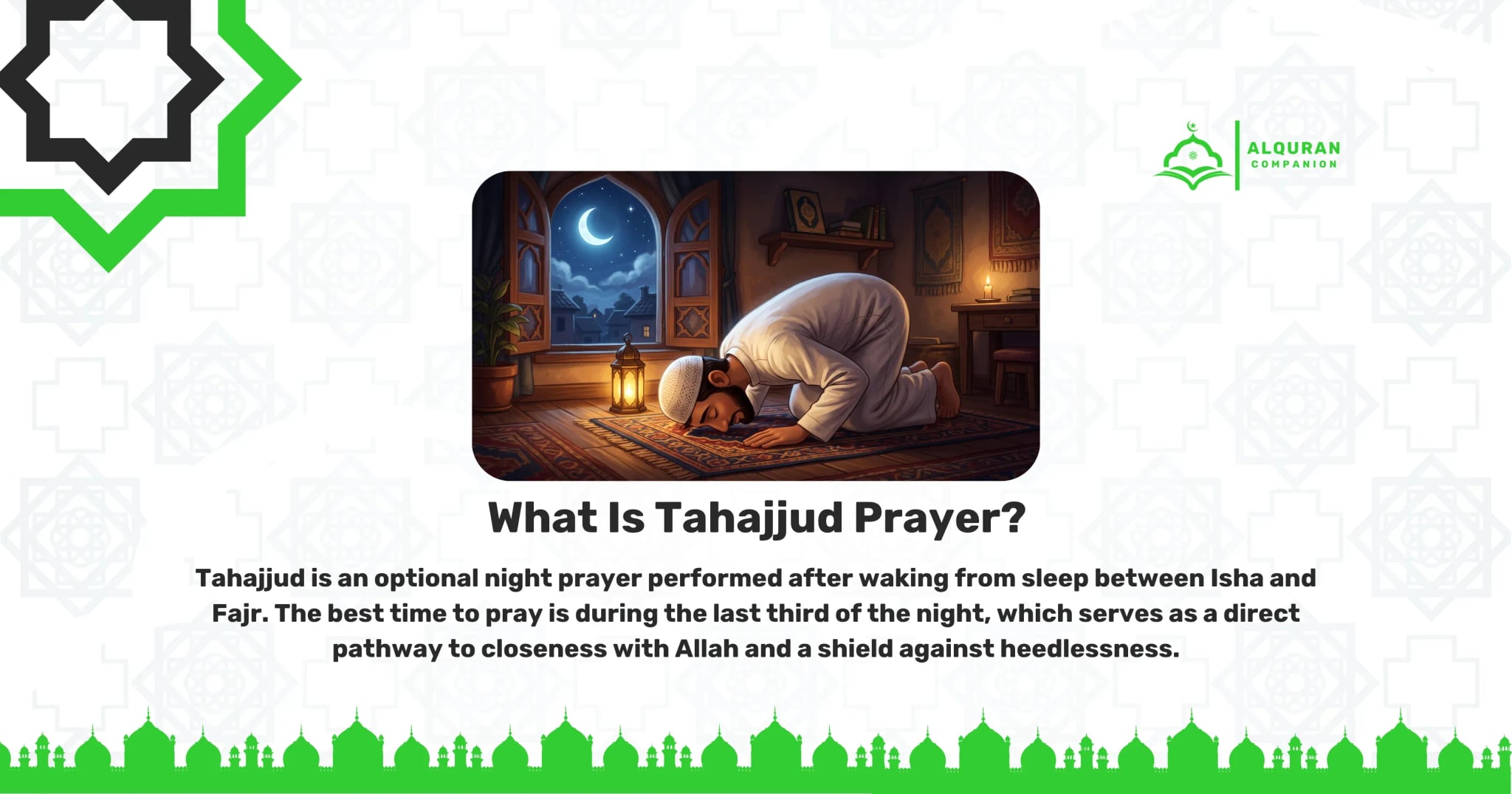
Tahajjud is an optional night prayer performed after waking from sleep between Isha and Fajr. While voluntary, the Quran singles it out in Surah Al-Isra 17:79 as a means to attain the elevated station of Maqam Mahmud. This prayer is a direct pathway to closeness with Allah and a shield against heedlessness.
وَمِنَ الَّيۡلِ فَتَهَجَّدۡ بِهٖ نَافِلَةً لَّكَ ۖ عَسٰۤى اَنۡ يَّبۡعَـثَكَ رَبُّكَ مَقَامًا مَّحۡمُوۡدًا﴿٧٩﴾
And from [part of] the night, pray with it [i.e., recitation of the Qur’ān] as additional [worship] for you; it is expected that your Lord will resurrect you to a praised station.
The word Tahajjud comes from the Arabic root 'hajada', meaning to stay awake at night. It is synonymous with Qiyam al-Layl, though some scholars distinguish Tahajjud as prayer after sleep. Prophet Muhammad ﷺ consistently prayed Tahajjud, and his companions followed. In our live 1-on-1 classes at Al Quran Companion, I often see students who struggle to wake up, but once they taste the sweetness of that private conversation with Allah, they never want to miss it.
But why is Tahajjud so powerful? Because it is hidden worship. No one sees you except Allah. It breaks the ego and builds Ikhlas. The Quran mentions in Surah Al-Muzzammil 73:6 that the night vigil is more intense in impression and more upright in speech. If you want to transform your relationship with Allah, Tahajjud is the fastest route.
اِنَّ نَاشِئَةَ الَّيۡلِ هِىَ اَشَدُّ وَطۡـاً وَّاَقۡوَمُ قِيۡلًا ؕ﴿٦﴾
Indeed, the hours of the night are more effective for concurrence [of heart and tongue] and more suitable for words.
When Is Tahajjud Time? How to Calculate the Last Third of the Night
Tahajjud time begins after Isha and extends until Fajr, but the best time is the last third of the night. Calculate it by measuring the hours between Maghrib (sunset) and Fajr (true dawn), dividing by three, and adding the final third to Maghrib time. This final window before dawn is when Allah descends to the lowest heaven, accepting supplications.
Allah's Messenger (ﷺ) said, "Our Lord, the Blessed, the Superior, comes every night down on the nearest Heaven to us when the last third of the night remains, saying: "Is there anyone to invoke Me, so that I may respond to invocation? Is there anyone to ask Me, so that I may grant him his request? Is there anyone seeking My forgiveness, so that I may forgive him?
Here's a simple formula: If Maghrib is at 6:00 PM and Fajr is at 6:00 AM, the night lasts 12 hours. Divide 12 by 3 equals 4 hours. Add 4 hours to Maghrib (6 PM + 4 = 10 PM) to find the start of the last third. So the optimal Tahajjud window is from 10 PM until 6 AM, with the most blessed being the final hour before Fajr. In the UK winter, nights are long and this window is generous. In Canada or Germany, it may shift dramatically by season. Use a reliable prayer timetable or app to get exact local times.
Consider this: many scholars prefer the last sixth of the night for those who cannot stay awake the whole last third. Prophet Muhammad ﷺ said the most beloved prayer to Allah is the prayer of Dawud (AS) who slept half the night, prayed a third, then slept a sixth. That means waking up after five-sixths of the night. For a 12-hour night, that is around 4 AM. In cities like Sydney or Dubai, where dawn comes early in summer, adjust accordingly.
How to Pray Tahajjud Step-by-Step: Rakahs, Recitation & Method
Pray Tahajjud in sets of two Rakahs after performing Wudu. Begin with two short opening Rakahs, then continue up to eight Rakahs as the Sunnah of Prophet Muhammad ﷺ. Recite familiar Surahs slowly with Tajweed, and end with Witr if not already prayed. The key is not quantity but presence of heart.
Here is the 3-Stage Night Vigil Blueprint I teach my students at Al Quran Companion:
Stage 1: Wake up and make Wudu with mindfulness. Splash cold water on your face, recite the Wudu Dua, and feel the sleep leave your body. This is not just physical purification; it is spiritual preparation.
Stage 2: Begin with two light Rakahs. Recite Surah Al-Fatiha and a short Surah like Al-Ikhlas or Al-Kafirun in each. This 'warm-up' wakes your tongue and heart. Then stand for longer Rakahs. The Sunnah is up to eight Rakahs in sets of two. You can pray two, four, six, or eight. The most common practice of Prophet Muhammad ﷺ was eight Rakahs plus Witr.
Stage 3: End with Witr. If you have not prayed Witr after Isha, make Witr your final prayer of the night. Witr can be one Rakah, three Rakahs, five, or more, but the minimum is one. The Prophet ﷺ said, 'Make Witr your last prayer at night.'
In each Rakah, recite slowly and reflect. If you only know short Surahs, repeat them with Khushu. The goal is not speed. Sheikh Abdullah often reminds students: a single verse recited with understanding is better than a hundred verses recited heedlessly. For those who want to improve their recitation for longer night prayers, consider our online Quran classes for adults to learn proper Tajweed.
What If You Already Prayed Witr? (Fiqh Rules and Consensus)
If you already prayed Witr after Isha, you may still pray Tahajjud in pairs of two Rakahs without repeating Witr. This is based on the Hadith 'There are no two Witrs in one night' recorded in Sunan Abi Dawud and agreed upon by the majority of scholars across the four schools of Islamic jurisprudence (Hanafi, Maliki, Shafi'i, and Hanbali).
"There are no two Witrs in one night."
But here is a common confusion: if you prayed Witr after Isha because you feared you would not wake up, and then you do wake up, what should you do? You have two options. Option one: pray Tahajjud in pairs of two Rakahs and do not repeat Witr. Your Witr from earlier remains valid. Option two: if you want Witr to be your last prayer, you can break your earlier Witr by praying one Rakah before Tahajjud, then after Tahajjud pray a new Witr. This is the Hanafi position. However, the simpler and safer approach for most people is to delay Witr until after Tahajjud. If you are not sure you will wake up, pray Witr before sleep and do not repeat it.
Praying Witr Before Sleep vs After Tahajjud
Pros
- Praying Witr before sleep guarantees you do not miss Witr if you oversleep.
- It removes anxiety about waking up.
- Praying Witr after Tahajjud makes Witr the final prayer as the Prophet ﷺ recommended.
- It allows you to combine the reward of Tahajjud and Witr in one continuous night vigil.
Cons
- If you wake up after praying Witr before sleep, you cannot pray a second Witr.
- You may feel your night prayer is incomplete.
- Praying Witr after Tahajjud requires waking up reliably, which is difficult for some.
In my experience, most busy professionals in London or New York find it easier to pray Witr before bed on weekdays and delay Witr on weekends when they can sleep in. The key is consistency, not perfection.
Authentic Duas for Tahajjud: What to Ask in Sujood and After Prayer
In Sujood during Tahajjud, recite the prophetic Dua 'Allahumma lakal-hamd...' from Sahih Bukhari 1120. Sujood is the closest a servant comes to Allah, making it the ideal moment for personal Duas in any language, including requests for guidance, provision, and forgiveness.
When the Prophet (ﷺ) got up at night to offer the Tahajjud prayer, he used to say: Allahumma lakal-hamd. Anta qaiyyimus-samawati wal-ard wa man fihinna. Walakal-hamd, Laka mulkus-samawati wal-ard wa man fihinna. Walakal-hamd, anta nurus-samawati wal-ard. Wa lakal-hamd, anta-l-haq wa wa'duka-lhaq, wa liqa'uka Haq, wa qauluka Haq, wal-jannatu Han wan-naru Haq wannabiyuna Haq. Wa Muhammadun, sallal-lahu'alaihi wasallam, Haq, was-sa'atu Haq. Allahumma aslamtu Laka wabika amantu, wa 'Alaika tawakkaltu, wa ilaika anabtu wa bika khasamtu, wa ilaika hakamtu faghfir li ma qaddamtu wama akh-khartu wama as-rartu wama'a lantu, anta-l-muqaddim wa anta-l-mu akh-khir, la ilaha illa anta (or la ilaha ghairuka). (O Allah! All the praises are for you, You are the Holder of the Heavens and the Earth, And whatever is in them. All the praises are for You; You have the possession of the Heavens and the Earth And whatever is in them. All the praises are for You; You are the Light of the Heavens and the Earth And all the praises are for You; You are the King of the Heavens and the Earth; And all the praises are for You; You are the Truth and Your Promise is the truth, And to meet You is true, Your Word is the truth And Paradise is true And Hell is true And all the Prophets (Peace be upon them) are true; And Muhammad is true, And the Day of Resurrection is true. O Allah ! I surrender (my will) to You; I believe in You and depend on You. And repent to You, And with Your help I argue (with my opponents, the non-believers) And I take You as a judge (to judge between us). Please forgive me my previous And future sins; And whatever I concealed or revealed And You are the One who make (some people) forward And (some) backward. There is none to be worshipped but you . Sufyan said that `Abdul Karim Abu Umaiya added to the above, 'Wala haula Wala quwata illa billah' (There is neither might nor power except with Allah)
That Dua is comprehensive. It praises Allah, acknowledges His dominion, and asks for guidance and protection. But you are not limited to it. In Tahajjud, you can pour out your heart. Ask for a righteous spouse, success in your studies, healing for a sick parent, or relief from debt. The Prophet ﷺ said the nearest a servant is to his Lord is when he is in Sujood, so increase your Dua there.
Many people ask me: 'Sheikh, what should I say in my own words?' The answer is simple: speak to Allah as you would to a close friend. Complain to Him. Thank Him. Beg Him. There is no intermediary. And do not forget to ask for the Ummah, for the oppressed in Palestine, Sudan, and everywhere. The power of Tahajjud prayer is that it changes you first, then changes your circumstances.
For those struggling with anxiety or stress, waking up for Tahajjud prayer is a proven remedy. The Quran in Surah Ash-Sharh reminds us that with hardship comes ease. Reciting this Surah in your night prayer brings immense peace. If you want to deepen your connection with the Quranic text, explore reciting Surah Ash-Sharh for peace of heart.
Remember, building a Tahajjud habit requires Sabr. You will not become a night worshipper overnight. The Prophet ﷺ told us to take on actions we can sustain. Start with two Rakahs once a week. Then increase. The same patience applies to learning Quran recitation. Our guide on building Sabr and emotional resilience offers practical steps to stay consistent in worship.
Finally, if you are new to Tahajjud or want to perfect your recitation for longer Sujoods and Rakahs, I invite you to book a free trial with Al Quran Companion. Our certified tutors will assess your recitation and create a personalized plan. You will learn to recite with confidence, making your night prayers more meaningful.
Frequently Asked Questions

Sheikh Abdullah Al-Hanif
Verified AuthorSheikh Abdullah Al-Hanif is the Head of Education at Al Quran Companion. With over 15 years of experience in Tajweed and Hifz, he specializes in bridging the gap between classical Islamic tradition and modern digital pedagogy. He is passionate about making the Quran accessible to everyone—from energetic toddlers to busy professionals.
Read more about author