Understanding the precise inshallah meaning is essential for both practicing Muslims and professionals interacting in diverse global environments. Whether you hear it from a colleague in London, a neighbor in the United States, or while attending Online Quran Classes USA: How to Pick the Safest One, this phrase carries profound theological weight. Many people mistakenly assume it is merely a cultural habit or a polite way to avoid a commitment. The reality is entirely different. This complete guide will break down what the phrase actually means, explore its divine origins in the Holy Quran, and provide you with actionable advice on exactly how to respond when you hear it in everyday conversation.
Table of Contents
- What Does Inshallah Mean? The Exact Inshallah Meaning in English
- Breaking Down the Word: God Willing in Arabic
- The Origin of Inshallah: Surah Al-Kahf and the Prophet Muhammad ﷺ
- The Theological Weight of Qadar and Divine Decree
- How Do You Respond to Inshallah?
- The Al Quran Companion Three-Context Inshallah Framework
- Common Spelling Variations: Inshallah vs Insha Allah vs In Sha Allah
- Why You Hear Inshallah in the UK and US Workplaces Today
- How Our Academy Teaches the True Insha Allah Meaning
- Related Arabic Phrases Every Muslim and Non-Muslim Should Know
- Conclusion: Embracing the Meaning of Inshallah in Daily Life
- Frequently Asked Questions
Key Takeaways
- The exact inshallah meaning is 'if Allah wills', serving as an acknowledgment of divine decree over future events.
- The phrase originates directly from Surah Al-Kahf in the Holy Quran, following a historical event involving the Prophet Muhammad ﷺ in Makkah Mukarramah.
- When responding to the phrase, you can simply repeat it back, say 'Ameen', or offer a positive affirmation depending on the context.
- Spelling variations like 'inshallah' and 'in sha allah' are widely accepted, provided the speaker holds the correct intention in their heart.
- At Al Quran Companion, we teach the theological depth of this phrase as part of our comprehensive Arabic Basics curriculum.
What Does Inshallah Mean? The Exact Inshallah Meaning in English
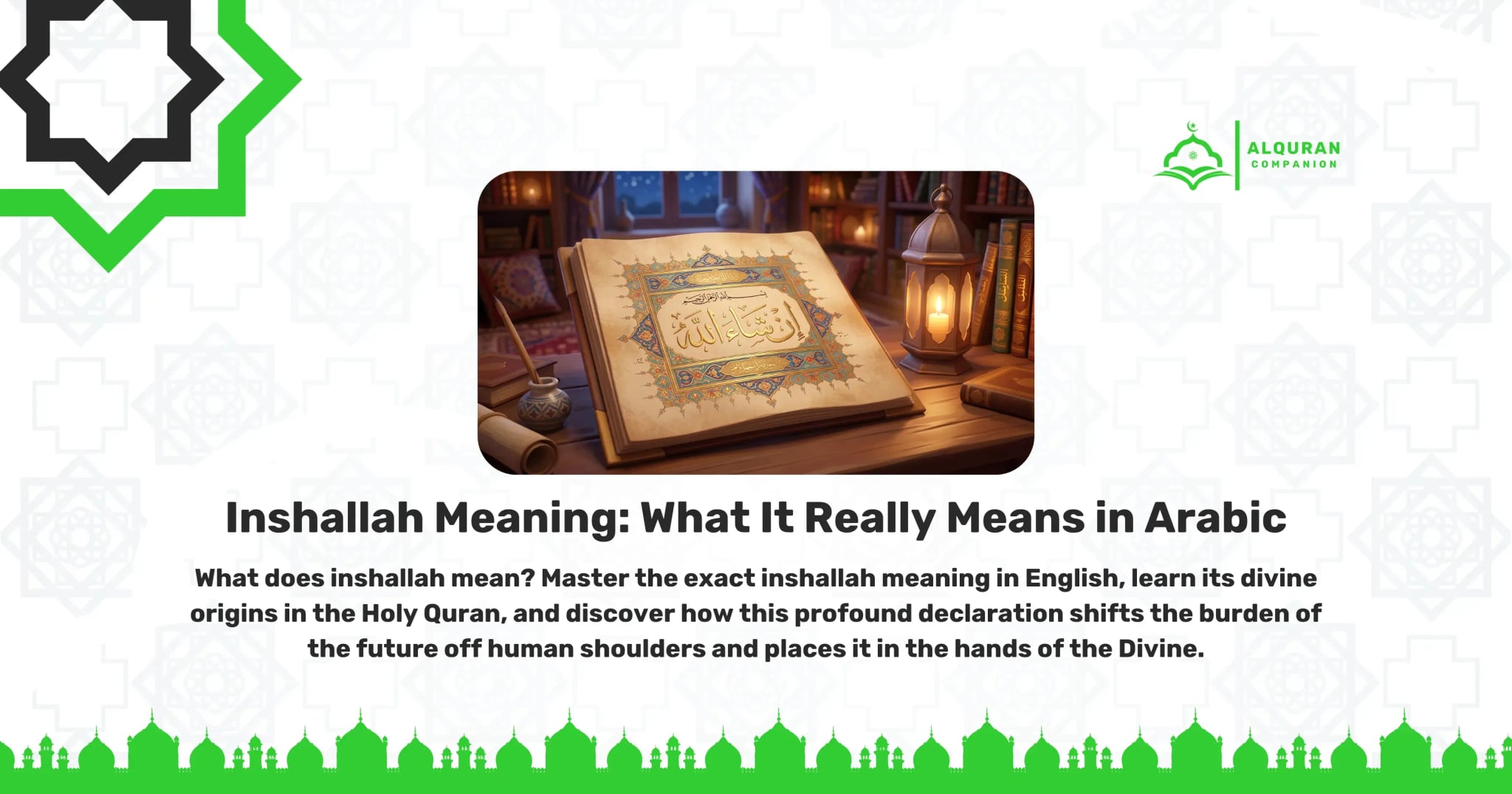
Inshallah translates precisely to 'if God wills' or 'God willing in Arabic'. This declarative phrase combines three distinct Arabic root words: 'In' (if), 'Sha' (wills), and 'Allah' (God). Muslims use this expression to acknowledge that future events only occur through divine permission and predetermined decree.
Insha Allah is a definitive Islamic statement of faith acknowledging human limitation and submitting all future outcomes strictly to the divine will of Allah. Every time a believer speaks about tomorrow, next week, or next year, they append this phrase to their statement. It is not an expression of doubt. Rather, it is an expression of supreme confidence in the Creator's ultimate plan.
Breaking Down the Word: God Willing in Arabic
To truly grasp the what does inshallah mean question, we must look at the linguistics. The Arabic language is heavily root-based. Here is how the phrase is constructed linguistically:
- In (إِنْ): This is a conditional particle meaning 'If'.
- Shaa (شَاءَ): This is a past tense verb derived from the concept of Mashi'ah, meaning 'He willed' or 'He wanted'.
- Allah (اللّٰه): The proper name of the Creator in the Islamic faith.
When you put them together, you get a powerful theological declaration. It shifts the burden of the future off human shoulders and places it in the hands of the Divine. If you want to dive deeper into how Arabic words are structured, we highly recommend exploring our Arabic Basics course.
The Origin of Inshallah: Surah Al-Kahf and the Prophet Muhammad ﷺ
The theological origin of the inshallah meaning stems directly from Surah Al-Kahf in the Holy Quran. When Jewish Rabbis from Madinah Munawwarah tested the Prophet Muhammad ﷺ with complex historical questions, he promised to answer them the next day without saying Insha Allah, causing a fifteen-day delay in divine revelation.
According to the consensus across the four established schools of Islamic jurisprudence (Hanafi, Maliki, Shafi'i, and Hanbali), this event served as a permanent educational moment for the entire Ummah. The people of Makkah Mukarramah began to doubt the Prophet ﷺ during those fifteen days of silence. Finally, the angel Jibril brought down the revelation, which included a direct commandment regarding how believers should speak about the future.
وَلَا تَقُوۡلَنَّ لِشَاىۡءٍ اِنِّىۡ فَاعِلٌ ذٰ لِكَ غَدًا ۙ﴿٢٣﴾
And never say of anything, "Indeed, I will do that tomorrow,"
اِلَّاۤ اَنۡ يَّشَآءَ اللّٰهُ وَاذۡكُرْ رَّبَّكَ اِذَا نَسِيۡتَ وَقُلۡ عَسٰٓى اَنۡ يَّهۡدِيَنِ رَبِّىۡ لِاَقۡرَبَ مِنۡ هٰذَا رَشَدًا﴿٢٤﴾
Except [when adding], "If Allāh wills." And remember your Lord when you forget [it] and say, "Perhaps my Lord will guide me to what is nearer than this to right conduct."
As noted in classical texts like Tafsir Ibn Kathir, this verse forever changed how Muslims communicate. It established a verbal safeguard against arrogance. No human being, regardless of their power or resources, can guarantee that they will wake up tomorrow, let alone complete a specific task. By uttering this phrase, we align our intentions with reality.
The Theological Weight of Qadar and Divine Decree
The insha allah meaning is deeply intertwined with the Islamic Pillar of Belief known as Qadar (Divine Decree). Muslims believe that Allah has complete knowledge and control over everything that happens in the universe. Saying the phrase is an active, daily submission to Qadar. It protects the heart from the illusion of absolute control, which in turn reduces anxiety about the future.
How Do You Respond to Inshallah?
The most appropriate way to respond to Inshallah depends entirely on the conversational context. When a Muslim says Inshallah as a genuine hope for a future event, you simply reply with 'Inshallah' to share the sentiment, or say 'Ameen' to pray for that exact outcome.
For non-Muslims wondering what does inshallah mean in a practical workplace setting, you do not need to overthink your response. You can simply nod, say 'I look forward to it', or smile. If you want to show cultural appreciation, repeating the phrase back is seen as highly respectful. However, to truly master the nuance, you need to understand the underlying intention.
The Al Quran Companion Three-Context Inshallah Framework
At Al Quran Companion, we have developed The 3-Context Inshallah Framework to help our international students navigate daily conversations easily. Here is how you identify the intention behind the phrase:
- The Genuine Commitment Context: A person says, 'I will email you the report by 5 PM, Insha Allah.' In this scenario, the person is fully committed to doing the work. They are simply acknowledging that unforeseen circumstances (a power outage, illness) might prevent it. The best response here is 'Thank you, looking forward to it.'
- The Shared Hope Context: A person says, 'I hope you have a safe flight, Insha Allah.' Here, it acts as a prayer for your well-being. The best response is 'Inshallah' or 'Ameen', meaning 'May Allah accept it.'
- The Polite Refusal Context: Sometimes, especially in certain Eastern cultures, a parent might tell a child, 'We will go to the toy store tomorrow, Insha Allah' when they actually mean 'No, but I do not want to upset you right now.' You must read the tone of voice to identify this context. In professional settings, this usage is heavily discouraged, but it exists in casual family dynamics.
Common Spelling Variations: Inshallah vs Insha Allah vs In Sha Allah
The correct English transliteration of the Arabic phrase is 'In Sha Allah' separated into three distinct words. However, spelling variations like 'inshallah', 'inshaallah', and 'insha allah' are universally accepted in everyday texting and digital communication across the UK and US without altering the fundamental theological meaning.
A few years ago, a viral message circulated claiming that spelling it as one word translates to 'create Allah'. This is a complete linguistic myth. The Arabic word for create is 'Insha'a' (إنشاء) which has a completely different root structure. When writing in English letters, the spacing does not change your actual intention. What matters most is the sincerity in your heart when making a statement about the future.
The Proper Etiquette of Intention
Pros
- Using it as a sincere commitment while actively planning for the task.
- Using it to express hope for someone's good health and success.
- Remembering human limitation even during detailed project planning.
Cons
- Using it as a polite excuse to avoid saying 'No' directly.
- Using it to justify laziness or a lack of preparation for an exam or project.
- Uttering the phrase without actually understanding the divine submission behind it.
Why You Hear Inshallah in the UK and US Workplaces Today
The phrase Inshallah has rapidly entered mainstream workplace vocabulary across the United Kingdom and the United States. Non-Muslim professionals frequently encounter this phrase during project planning, scheduling meetings, or discussing future quarterly goals with Muslim colleagues, making cross-cultural linguistic understanding highly valuable.
Consider this: When coordinating EST or PST schedules in the United States, or managing the after-school rush in London, logistics can change instantly. A Muslim colleague might say, 'I will have the quarterly presentation ready by Thursday morning, Insha Allah.' They are not doubting their own work ethic. They are acknowledging that illness, traffic, or family emergencies are realities of life. It brings a grounded humility into the corporate environment.
We see a similar trend in Australia, where evening sports schedules clash with family time. The phrase has become a natural bridge in diverse communities, representing a universally understood concept: we do our best, but we do not control the universe.
How Our Academy Teaches the True Insha Allah Meaning
At Al Quran Companion, our certified Ijazah-holding instructors utilize personalized diagnostic assessments to ensure students understand the profound theological weight behind everyday Islamic phrases. We integrate correct Arabic pronunciation and contextual understanding directly into our interactive online sessions for students across the globe.
In our live 1-on-1 classes at Al Quran Companion, we frequently observe students struggling with the proper articulation of the letter 'Sheen' in Insha Allah. Over thousands of student assessments across the UK, USA, and Australia, our academic faculty has found that simply memorizing the translation is not enough. Proper Tajweed requires physical practice. Our senior Ijazah-certified tutors recommend a daily 15-minute spaced repetition schedule to overcome these pronunciation hurdles, replacing bad habits with perfect articulation.
Safety and quality are our absolute priorities. At Al Quran Companion, we always conduct comprehensive Background Checks and detailed multi-stage reviews of every single teacher before they are certified to teach our students. We provide highly qualified female Quran tutors for daughters and adult sisters, ensuring a zero-judgment environment where adult learners and reverts receive patient, 1-on-1 guidance at their own pace.
Related Arabic Phrases Every Muslim and Non-Muslim Should Know
Mastering the inshallah meaning naturally leads to understanding other foundational Arabic expressions used daily. Phrases like Alhamdulillah for gratitude, SubhanAllah for expressing awe, and Masha'Allah for appreciating beauty form the core vocabulary of everyday Islamic communication worldwide.
If you are looking to expand your vocabulary, we highly recommend checking out our dedicated guides. Start by reading about Alhamdulillah: Meaning, Benefits & When to Say It. Understanding these terms will deeply enrich your social interactions.
Furthermore, grasping the theological roots of these words helps when studying the The 6 Kalimas of Islam: Full Arabic Text, English Translation & Why Every Muslim Should Know Them. Each phrase acts as a building block for a solid Islamic foundation, much like mastering the Wudu Steps: The Complete Guide for Beginners prepares you for Salah.
Conclusion: Embracing the Meaning of Inshallah in Daily Life
The meaning inshallah goes far beyond a casual verbal habit. It is a profound declaration of faith, a historical command from Surah Al-Kahf, and a powerful psychological tool that relieves anxiety about the unknown future. By saying 'if God wills', you align your personal ambitions with the divine decree of Allah.
Whether you are a professional navigating a multicultural workplace in London or a parent trying to instill Islamic values in your children in Texas, understanding the define inshallah concept correctly transforms your daily speech into an act of continuous worship. If you want to perfect your pronunciation and deepen your understanding of Quranic Arabic, our academy is ready to guide you step by step.
Frequently Asked Questions

Al Quran Companion Team
Verified AuthorThe official academic and editorial team at Al Quran Companion, a leading Online Quran Academy dedicated to simplifying Tajweed, Hifz, and Islamic studies for students worldwide.
Read more about author