Choosing the right quran classes for kids is one of the most important decisions Muslim parents make in Australia. With busy weekends in Sydney, Melbourne, Brisbane, and Perth, families often struggle to balance traditional weekend madrasahs with the need for personalized attention. The Australian Weekend Time-Reclamation Framework helps you compare models objectively. This guide breaks down the real differences between madrasah and online 1-on-1 tutoring. For a broader overview, see our best online Quran classes in Australia guide.
Table of Contents
- What Is the Reality of Weekend Madrasahs in Sydney and Melbourne?
- How Does the Time-Reclamation Framework Compare Active Recitation?
- How Can You Preserve Mosque Ties While Learning Quran Online?
- Book Your Free 1-on-1 Diagnostic Recitation Trial
- How Do You Transition Smoothly from Madrasah to Home Learning?
- Frequently Asked Questions About Madrasah vs Online in Australia
Key Takeaways
- Weekend madrasahs offer community bonding but often provide under 5 minutes of individual recitation per child.
- Online 1-on-1 Quran classes give 30 full minutes of active recitation and immediate Tajweed correction.
- You can preserve mosque ties for Jummah and Eid while using online classes for rigorous Hifz and Noorani Qaida.
- Al Quran Companion provides background-checked teachers, female tutors, and a zero-risk free trial.
- The 4-step transition plan helps your child move from madrasah to home learning smoothly.
What Is the Reality of Weekend Madrasahs in Sydney and Melbourne?
Weekend madrasahs in Sydney and Melbourne provide valuable social bonding and community ties. However, with class sizes often exceeding 20 students, each child receives under 5 minutes of direct teacher recitation feedback per session. This limited one-on-one time slows progress in Tajweed and Noorani Qaida.
Consider a typical Saturday morning in Lakemba or Auburn. Parents drive 30 minutes to the local masjid, wait during the 3-hour session, then drive back. The child sits in a hall with 20 other kids. The teacher rotates through the room. Your child might recite for 4 minutes total. The rest is waiting, listening, or socializing. While socializing has value, it does not build fluent Quran reading. For a detailed comparison, read our online Quran classes vs local madrasah safety analysis.
In our live 1-on-1 classes at Al Quran Companion, we frequently assess students who spent years in weekend madrasahs. They can recognize Arabic letters but cannot read a page of the Quran smoothly. The gap is not intelligence. The gap is practice time with a teacher who corrects every Makharij error immediately.
How Does the Time-Reclamation Framework Compare Active Recitation?
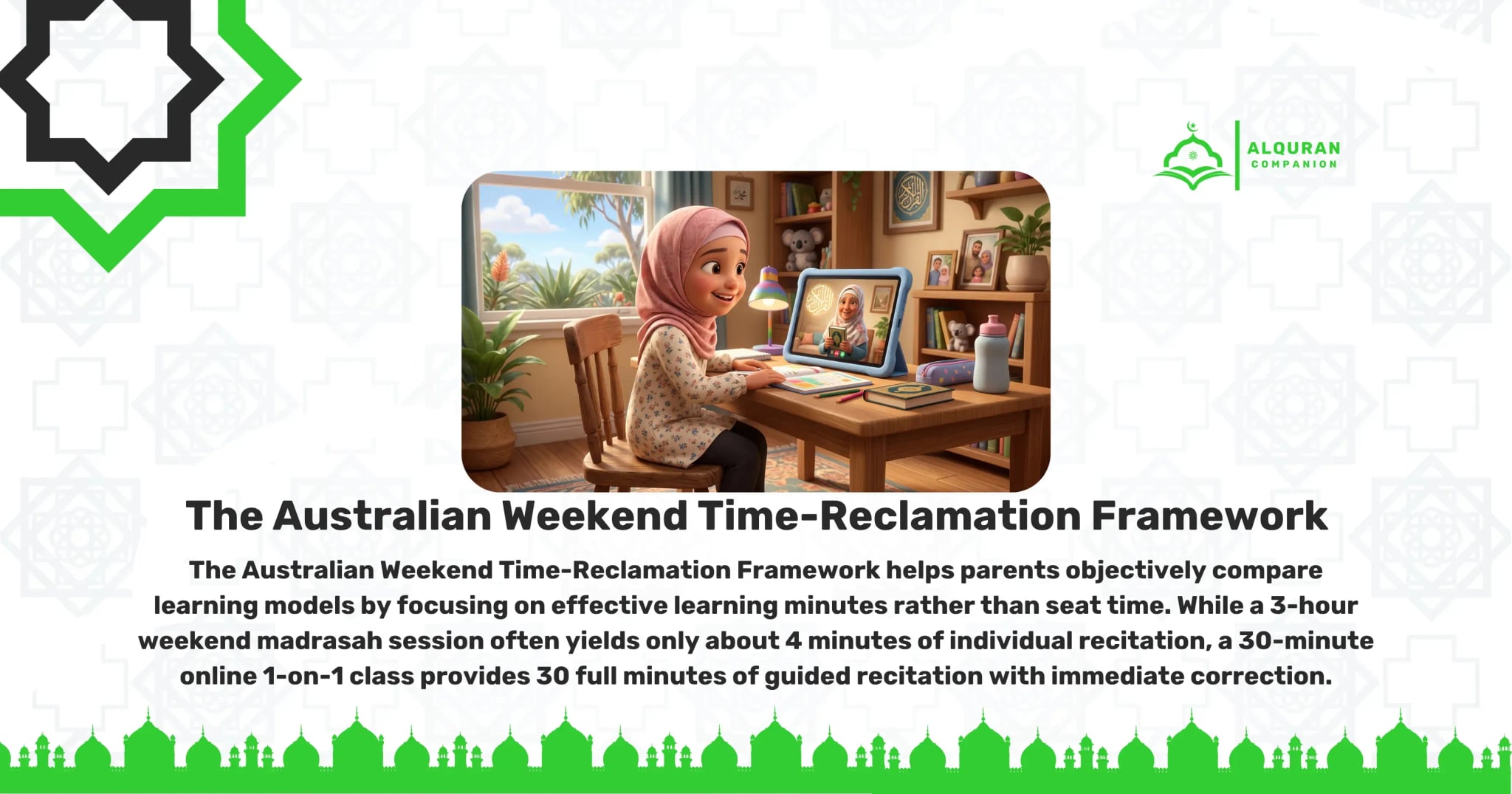
The Australian Weekend Time-Reclamation Framework compares total active recitation time, not just class duration. A 3-hour madrasah session with a 20:1 ratio yields about 4 minutes of individual recitation. A 30-minute online 1-on-1 class gives your child 30 full minutes of guided recitation with immediate correction.
Weekend Madrasah vs Al Quran Companion 1-on-1
| Feature | Weekend Madrasah | Al Quran Companion 1-on-1 |
|---|---|---|
| Session Length | 3 hours | 30 minutes |
| Student-Teacher Ratio | 20:1 | 1:1 |
| Active Recitation Time | 4 minutes | 30 minutes |
| Commute | 30-60 minutes round trip | Zero commute |
| Tajweed Correction | Occasional | Continuous |
| Schedule Flexibility | Fixed weekend slot | Weekday evenings or weekends |
Session Length
Student-Teacher Ratio
Active Recitation Time
Commute
Tajweed Correction
Schedule Flexibility
The math is clear. In one month of weekend madrasah, your child recites for about 16 minutes. In one month of online 1-on-1 classes (two 30-minute sessions per week), your child recites for 240 minutes. That is 15 times more active recitation. This is why the Time-Reclamation Framework focuses on effective learning minutes, not seat time.
اَوۡ زِدۡ عَلَيۡهِ وَرَتِّلِ الۡقُرۡاٰنَ تَرۡتِيۡلًا ؕ﴿٤﴾
aw zid ʿalayhi warattili l-qur'āna tartīlan
Or add to it, and recite the Qur’ān with measured recitation.
Allah commands us in Surah Al-Muzzammil to recite the Quran with Tarteel (slow, measured tone). This command requires a teacher who can listen and correct. Without live feedback, children develop pronunciation habits that are hard to break later. Our 3-Step Al Quran Companion Pronunciation Feedback Loop ensures every letter is articulated from its correct Makhraj before moving to the next verse.
"The one who recites the Quran beautifully, smoothly, and precisely will be in the company of the noble and obedient angels."
How Can You Preserve Mosque Ties While Learning Quran Online?
Australian families can keep strong masjid connections by attending Jummah, Eid prayers, and community events at local mosques. Online 1-on-1 classes handle rigorous Tajweed and Hifz instruction. This hybrid model gives children both community belonging and personalized academic progress.
For example, a family in Sydney can attend Auburn Gallipoli Mosque for Friday prayer and weekend community gatherings. During the week, the child logs into Al Quran Companion for 30-minute sessions focused on Noorani Qaida or Surah Al-Fatihah. The child still feels part of the Ummah. The child also gets the individual attention needed to read the Quran fluently.
Expert Insight
"Over thousands of student assessments across Australia, our academic faculty has found that children who combine mosque attendance with online 1-on-1 Tajweed classes progress three times faster than those in large group settings. The key is consistent, corrected repetition."
Book Your Free 1-on-1 Diagnostic Recitation Trial
Give your child 30 minutes of uninterrupted 1-on-1 recitation time with a certified teacher. No payment, no commitment. See the difference for yourself.
How Do You Transition Smoothly from Madrasah to Home Learning?
Transitioning from madrasah to home learning requires a clear four-step plan. First, evaluate your child's current reading level. Second, address Makharij gaps early. Third, establish a consistent weekday study rhythm. Fourth, celebrate milestone Surah completions to maintain motivation.
- Evaluate Current Reading Level: Use a diagnostic assessment to identify which letters and Harakat your child knows. Many children can read but not with Tajweed.
- Address Makharij Gaps Early: Makharij al-Huroof refers to the articulation points in the throat, tongue, lips, and nasal cavity. Fixing these early prevents permanent errors.
- Establish a Consistent Weekday Rhythm: Choose two or three evenings per week for 30-minute sessions. This fits around school homework and sports in Melbourne or Brisbane.
- Celebrate Milestone Surah Completions: When your child perfects Surah Al-Fatihah or the last ten Surahs of Juz Amma, celebrate with a family dinner or a small gift. This builds positive association.
At Al Quran Companion, we always conduct comprehensive Background Checks and detailed multi-stage reviews of every single teacher before they are certified to teach our students. We also offer qualified female Quran tutors for daughters and adult sisters. Our zero-judgment environment ensures adult learners and reverts receive patient, private guidance. The best part? You can experience a live 1-on-1 diagnostic lesson with zero commitment. If you are unsure about the right starting point, read our guide on the best age to start Noorani Qaida. Explore our online Quran classes for kids to see the curriculum. Book your free trial today.
Frequently Asked Questions About Madrasah vs Online in Australia

Al Quran Companion Team
Verified AuthorThe official academic and editorial team at Al Quran Companion, a leading Online Quran Academy dedicated to simplifying Tajweed, Hifz, and Islamic studies for students worldwide.
Read more about author