The phrase allahumma barik is one of the most powerful and frequently used supplications in the daily life of a Muslim. Whether you are scrolling through social media, attending a community gathering, or simply admiring a friend's new home, this short Arabic Dua serves as a profound spiritual shield. For Muslim families living in the West—from the busy neighborhoods of London to the sprawling suburbs of North America and Australia—maintaining these authentic Islamic expressions is a foundational part of preserving our faith identity.
But what does it actually mean? Many Muslims use the phrase purely out of habit, without understanding the deep theological weight it carries. We live in a highly visual culture where sharing our blessings—our children, our successes, our travels—is standard practice. This hyper-visibility increases the risk of 'Hasad' (jealousy) and the Evil Eye. Understanding the exact meaning, grammar, and prophetic rules surrounding this phrase is not just about expanding your vocabulary; it is about actively protecting yourself and your community.
Table of Contents
- What Does Allahumma Barik Mean? (Quick Definition & Translation)
- Arabic Linguistic Breakdown & Gender Grammar: Feek, Feeki & Feekum
- Protecting Against the Evil Eye (Ayn): Why We Say Allahumma Barik
- MashaAllah vs. TabarakAllah vs. Allahumma Barik: What Is the Difference?
- How to Reply to Allahumma Barik: Sunnah Responses and Etiquette
- Building a Household Culture of Barakah in the West
- Common Mistakes When Making Dua for Blessing
- Frequently Asked Questions
Key Takeaways
- Allahumma Barik means 'O Allah, bless it' and is the Prophetic command to protect against the Evil Eye.
- Arabic grammar requires specific gender suffixes: use 'Feeka' for men, 'Feeki' for women, and 'Feekum' for groups.
- MashaAllah acknowledges Allah's will, but Allahumma Barik is the specific Dua required when praising someone else's blessings.
- The Sunnah response is to say 'Wa Feeka BarakAllah' (And may Allah bless you too) to return the goodwill.
- Integrating these phrases daily creates a protective 'Barakah & Hasad Protection Matrix' for your household.
What Does Allahumma Barik Mean? (Quick Definition & Translation)
Allahumma Barik is a sacred Arabic supplication meaning 'O Allah, bless it' or 'O Allah, bless them'. Muslims recite this phrase upon seeing something admirable to invoke divine increase, known as Barakah, and to shield the blessing from unintentional jealousy or the harmful effects of the evil eye, known as Ayn.
To truly grasp the allahumma barik meaning, we must look at its linguistic roots. In classical Arabic, the concept of 'Barakah' originates from the root letters Ba-Ra-Ka. Historically, this root was used to describe a camel kneeling down and establishing itself firmly in a resting place. By extension, it came to mean a state of permanence, stability, and divine increase. When you ask Allah to place Barakah in something, you are asking for that blessing to remain stable, to grow, and to yield continuous good.
You will often see alternative spellings online, such as allahoema bareek, especially among European or Dutch-speaking Muslims, or 'Allah humma barik'. Regardless of the phonetic spelling, the core intention remains identical: asking the Creator to protect and multiply the good you have just witnessed. It is a beautiful way to train the heart to feel joy for others, eliminating the subtle roots of envy before they can take hold.
Arabic Linguistic Breakdown & Gender Grammar: Feek, Feeki & Feekum
To use proper Arabic grammar, you must adjust the pronoun suffix based on who you are speaking to. Use 'Allahumma Barik Feeka' when addressing a male, 'Allahumma Barik Feeki' when addressing a female, 'Allahumma Barik Feekum' for a group, and 'Allahumma Barik Lahu' for absent third parties.
Understanding how to correctly say allahumma barik in arabic is a sign of respect and linguistic precision. The word 'Feek' translates to 'in you'. When you combine the phrase, you are literally saying, 'O Allah, place blessing in you.' Because Arabic is a highly gendered and specific language, the ending of the word must match the person you are praising.
Consider this practical breakdown:
- Feeka (فيكَ): Use this when praising a single male. Example: 'Your recitation of Surah Al-Kahf is beautiful, Allahumma Barik Feeka.'
- Feeki (فيكِ): Use this when praising a single female. Example: 'Sister, your new business is thriving, Allahumma Barik Feeki.'
- Feekum (فيكم): Use this when addressing two or more people. Example: 'May Allah protect your beautiful family, Allahumma Barik Feekum.'
- Lahu / Laha (له / لها): Use these when talking about someone who is not present. Use 'Lahu' for him, and 'Laha' for her.
In our live 1-on-1 classes at Al Quran Companion, we frequently observe students struggling with the linguistic nuances of these daily Duas. Over thousands of student assessments across the UK, USA, and Australia, our academic faculty has found that integrating these phrases naturally into conversation requires structured repetition. That is why our senior Ijazah-certified tutors recommend a daily 15-minute spaced repetition schedule to overcome pronunciation hurdles and build confidence. Just as we learn the meaning and spiritual benefits of Alhamdulillah, mastering these conversational suffixes elevates our daily spiritual practice.
Protecting Against the Evil Eye (Ayn): Why We Say Allahumma Barik
We say Allahumma Barik to actively neutralize the evil eye. Prophet Muhammad ﷺ instructed in authentic Hadith traditions that whenever someone sees something pleasing in their brother, they must supplicate for blessing, an act called Tabreek, to prevent the reality of the evil eye from causing harm.
The reality of the Evil Eye, known as 'Ayn' in Arabic, is established by the consensus of the four established schools of Islamic jurisprudence (Hanafi, Maliki, Shafi'i, and Hanbali). It is a spiritual harm caused when someone looks at a blessing with admiration but fails to invoke the remembrance of Allah. The protection against this phenomenon is directly tied to the practice of Tabreek—the act of invoking Barakah.
It was narrated that Abu Umamah bin Sahl bin Hunaif said:“ ‘Amir bin Rabi’ah passed by Sahl bin Hunaif when he was having a bath, and said: ‘I have never seen such beautiful skin.’ Straightaway, he (Sahl) fell to the ground. He was brought to the Prophet (ﷺ) and it was said: ‘Sahl has had a fit.’ He said: ‘Whom do you accuse with regard to him?’ They said: “ ‘Amir bin Rabi’ah.’ They said: ‘Why would anyone of you kill his brother? If he sees something that he likes, then let him pray for blessing for him.’ Then he called for water, and he told ‘Amir to perform ablution, then he washed his face and his arms up to the elbows, his knees and inside his lower garment, then he told him to pour the water over him.”
This Hadith demonstrates that the Evil Eye does not always come from malicious jealousy. It can come from a loving parent admiring their own child, or a sincere friend admiring your success. The energy of an uncovered gaze can cause harm, and the Prophet ﷺ gave us the exact antidote. When you see a brother or sister thriving in their career in London, or a friend moving into a new home in Toronto, saying this Dua acts as a spiritual shield.
At Al Quran Companion, we prioritize spiritual and physical safety. We always conduct comprehensive Background Checks and detailed multi-stage reviews of every single teacher before they are certified to teach our students. We provide a zero-judgment environment for adults and reverts, alongside highly qualified female teachers for sisters and young daughters. This same dedication to safety in our academic structure mirrors the protective spiritual boundaries we establish by using Prophetic Duas.
MashaAllah vs. TabarakAllah vs. Allahumma Barik: What Is the Difference?
The difference lies in their specific Islamic purpose. 'MashaAllah' acknowledges Allah's sovereign will over your own blessings. 'TabarakAllah' exalts Allah's inherent blessedness and majesty. Conversely, 'Allahumma Barik' is the specific, commanded prophetic Dua used to protect another person's blessings from the harm of envy.
Many Muslims mistakenly group these three phrases together, using them interchangeably. While all three are beautiful forms of Dhikr, understanding tabarakallah vs mashaallah vs allahumma barik is critical for applying the Sunnah correctly.
Contextual Usage: When to Use Which Phrase
Pros
- Use Allahumma Barik when praising someone else's child, wealth, or health to fulfill Tabreek.
- Use Allahumma Barik to actively shield another person from Ayn (the Evil Eye).
- Use MashaAllah when looking at your own blessings, acknowledging that what Allah wills happens.
- Use TabarakAllah to praise the perfection and majesty of Allah as the ultimate Creator.
Cons
- Avoid using MashaAllah alone when admiring another person's specific blessing, as it lacks the active prayer for protection.
- Avoid assuming MashaAllah provides the exact same protective Dua as Tabreek.
- Avoid forgetting to add the proper gender suffix (Feek/Feeki) when speaking directly to someone.
When you practice saying Subhanallah 33 times in daily Dhikr, you are praising Allah's perfection. Similarly, utilizing the correct phrase of Tabreek is an essential daily habit that shows high emotional intelligence and spiritual care for your fellow believers.
How to Reply to Allahumma Barik: Sunnah Responses and Etiquette
The authentic Sunnah reply to Allahumma Barik is to return the prayer of goodwill. You should respond with 'Wa Feeka BarakAllah' to a male, 'Wa Feeki BarakAllah' to a female, or 'Wa Feekum BarakAllah' to a group, which translates to 'And may Allah bless you too'.
Knowing how to reply to allahumma barik transforms a one-sided compliment into a mutual exchange of divine grace. In Islam, whenever someone offers you a gift—even a gift of words and prayers—it is highly recommended to return it with something equal or better. The word 'Wa' means 'And'. Therefore, you are essentially reflecting their beautiful Dua back onto them.
Here's why: This simple exchange fosters a culture of deep brotherhood and sisterhood. If someone praises your new car and says, 'Allahumma Barik Lahu', your response of 'Wa Feeka BarakAllah' ensures that neither of you is deprived of Allah's mercy. This mirrors the etiquette found across all Islamic interactions. If you want to deepen your understanding of daily communicative Sunnahs, explore our complete guide to the greetings of Islam.
Building a Household Culture of Barakah in the West
The 3-Dimensional Barakah & Hasad Protection Matrix is a structured pedagogical framework we utilize at Al Quran Companion to teach families how to safeguard their homes. It consists of three active dimensions.
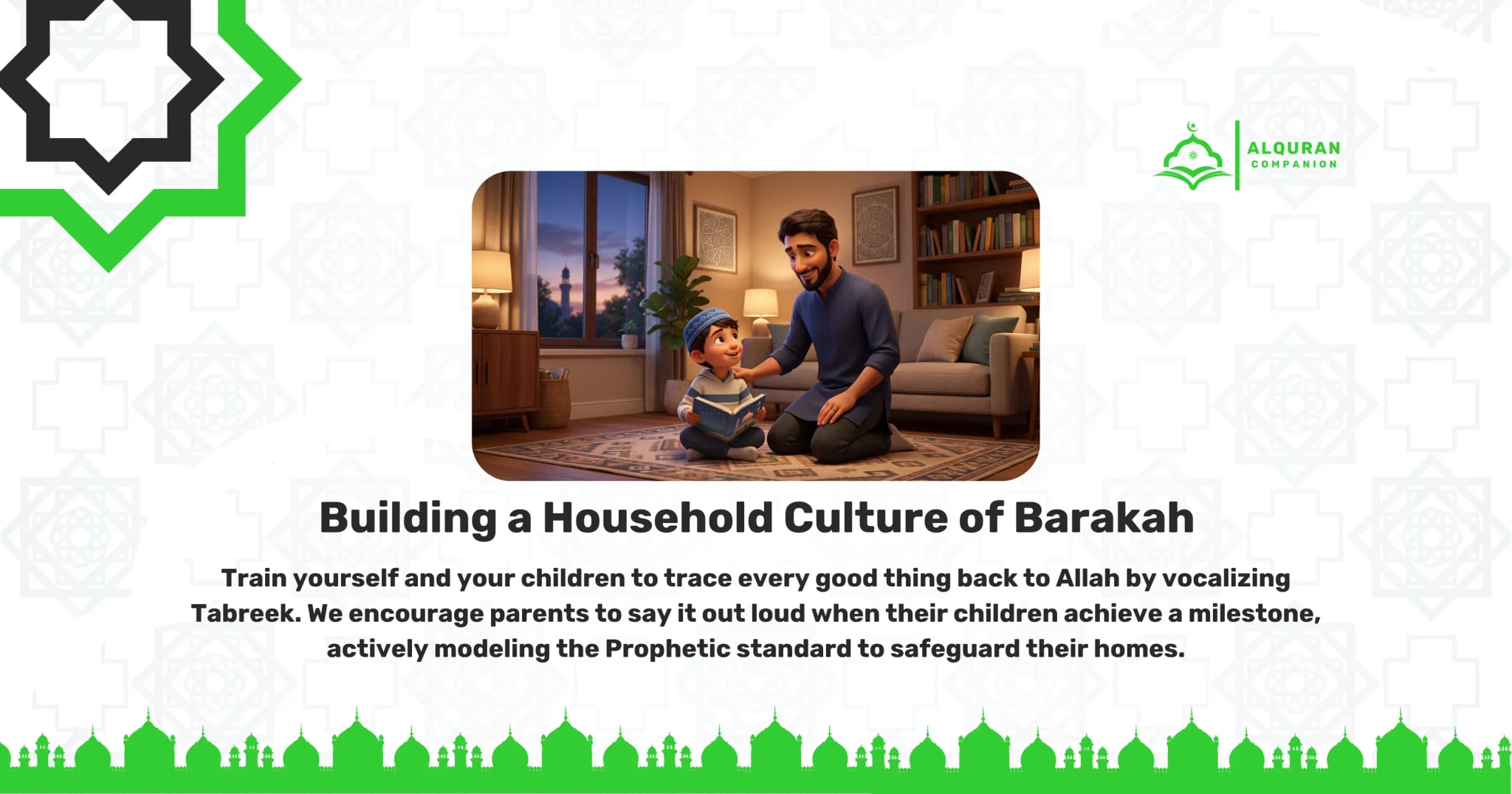
First is the Dimension of Recognition. This requires training yourself and your children to trace every good thing—a high test score, a beautiful sunset, a delicious meal—back to Allah. Second is the Dimension of Supplication. This is the vocalization of Tabreek. We encourage parents to say it out loud when their children achieve a milestone, teaching them by example. Third is the Dimension of Neutralization. This involves teaching children to return the prayer when someone compliments them, ensuring they do not develop arrogance or fall victim to hidden envy.
For parents managing evening sports schedules in Sydney or navigating the after-school rush in Birmingham, finding time to organically teach these concepts can feel overwhelming. At Al Quran Companion, our 4-Pillar Child Engagement Model integrates these practical Islamic manners directly into our Quranic curriculum. During a live 1-on-1 session, if a child recites perfectly, our teachers do not just say 'Good job.' They say, 'MashaAllah, Allahumma Barik Feek,' actively modeling the Prophetic standard.
Common Mistakes When Making Dua for Blessing
Even with the best intentions, families often make subtle linguistic or theological errors when applying these phrases. One major issue is the assumption that simply knocking on wood, burning specific incense, or wearing cultural amulets protects against the Evil Eye. According to the consensus of Islamic scholars, these practices hold no basis in the Shariah and border on superstitious innovation. True protection comes strictly from the Quranic verses and the authenticated Duas of the Prophet Muhammad ﷺ.
Consider this: Another frequent mistake is mispronunciation. The Arabic language is highly sensitive to vowel sounds and elongation (Madd). Changing a short vowel to a long vowel can alter the meaning of a word entirely. This is why investing in proper Arabic foundation courses, guided by native experts, yields lifetime benefits. At Al Quran Companion, we reassure parents and adult learners that they can experience a live 1-on-1 diagnostic lesson with zero commitment or payment upfront to evaluate their linguistic foundations.
Frequently Asked Questions

Sheikh Abdullah Al-Hanif
Verified AuthorSheikh Abdullah Al-Hanif is the Head of Education at Al Quran Companion. With over 15 years of experience in Tajweed and Hifz, he specializes in bridging the gap between classical Islamic tradition and modern digital pedagogy. He is passionate about making the Quran accessible to everyone—from energetic toddlers to busy professionals.
Read more about author