
When you set out to define Bismillah, you are not simply translating a phrase from Arabic to English. You are uncovering the fundamental formula that connects everyday human effort to divine assistance. Countless Muslims repeat this phrase dozens of times a day, yet many miss the profound linguistic depth and psychological grounding it offers.
Whether you are a busy parent managing school drop-offs in the US EST time zone, an adult in the UK seeking structured learning, or a recent revert wanting to perfect your Salah, mastering this phrase transforms routine actions into an active state of worship. Understanding what does Bismillah mean goes far beyond a surface-level translation. It requires analyzing the specific attributes of Allah and applying correct Tajweed rules to ensure proper pronunciation.
We will examine the exact Arabic morphological roots, the Fiqh rules regarding its recitation, and practical methods for instilling this powerful habit in your children. This guide provides the definitive explanation for families seeking authentic, academically grounded Islamic knowledge.
Table of Contents
- What Does Bismillah Mean? (Quick Definition And Translation)
- The Difference Between Translation And True Meaning
- Arabic Linguistic Breakdown: Ba, Ism, Allah, Ar-Rahman And Ar-Raheem
- The Depth Of Ar-Rahman Vs. Ar-Raheem
- Spiritual Secrets: Why Every Significant Action Must Begin With Bismillah?
- The 3-Pillar Basmalah Linguistic And Spiritual Framework
- Rules And Etiquette: When, Where And How To Say Bismillah
- Reciting The Basmalah In Salah: Fiqh Differences
- Tajweed Rules For Pronouncing Bismillah Correctly For Kids And Beginners
- Fixing Common Pronunciation Mistakes
- How To Teach The Power Of Bismillah To Children And Revert Muslims
- The Al Quran Companion Approach To Foundation Learning
- Securing Barakah In Your Daily Routine
- Frequently Asked Questions
Key Takeaways
- Bismillah is the shortened invocation of 'Bismillahir Rahmanir Raheem', meaning 'In the name of Allah, the Most Gracious, the Most Merciful'.
- The phrase acts as a spiritual anchor, inviting Barakah (divine increase) into mundane actions like eating, traveling, and working.
- Proper Tajweed pronunciation is essential, requiring specific attention to the heavy 'Ra' and the light 'Lam'.
- Understanding the distinct difference between Ar-Rahman (universal mercy) and Ar-Raheem (specialized mercy) deepens your daily connection to Allah.
- Al Quran Companion provides highly vetted, background-checked tutors to help families across the US, UK, and UAE master these foundational concepts.
What Does Bismillah Mean? (Quick Definition And Translation)
Define Bismillah as an Arabic invocation translating to 'In the name of Allah'. It operates as the shortened form of 'Bismillahir Rahmanir Raheem', which means 'In the name of Allah, the Most Gracious, the Most Merciful'. Muslims utter this phrase to sanctify daily actions, invite divine Barakah, and seek protection.
This definition represents the absolute core of Islamic theology. The phrase is formally known as the 'Basmalah'. When a believer speaks these words before initiating a task, they strip away their own ego and acknowledge that no success occurs without the permission and facilitation of the Creator. It is an immediate psychological reset.
Consider the reality of modern distractions. A professional sitting down to work, or a mother preparing a meal, faces endless mental noise. By pausing to pronounce Bismillah, the individual actively transitions from a state of worldly distraction into a state of focused intention. This simple vocalization aligns human action with divine will.
The Difference Between Translation And True Meaning
A standard English translation often falls short of capturing the weight of the Basmalah. In English, 'In the name of' sounds like acting as a representative, similar to 'In the name of the law'. However, the Arabic context implies seeking help, seeking Barakah, and seeking commencement. The believer is effectively stating, 'I seek the help of Allah and begin this action by His name, hoping for His mercy.' This distinction is critical when you define Bismillah and its meaning for new learners or young children.
Arabic Linguistic Breakdown: Ba, Ism, Allah, Ar-Rahman And Ar-Raheem
The phrase breaks down into five distinct Arabic components. 'Bi' acts as a preposition meaning 'with' or 'by'. 'Ism' means name. 'Allah' is the unique Creator. 'Ar-Rahman' denotes vast mercy encompassing all creation, while 'Ar-Raheem' signifies special, continuous mercy reserved specifically for believers in the Hereafter.
To truly appreciate the bismillah meaning in English, we must dissect these root words. The Arabic language relies on root letters that carry expansive meanings. When you understand the roots, the recitation transforms from a memorized sound into a profound theological statement.
First, the letter 'Ba' (ب) is a preposition of seeking help (Ba al-Isti'anah). It means you are using the name of Allah as your tool for success. The word 'Ism' originates from a root meaning elevation or greatness. Therefore, you are elevating your action by attaching it to the Divine.
The name 'Allah' is the supreme, comprehensive name of the Creator. According to classical scholars, it encompasses all other beautiful names and attributes. It specifically denotes the One who is worshipped with absolute love and reverence.
The Depth Of Ar-Rahman Vs. Ar-Raheem
Both Ar-Rahman and Ar-Raheem originate from the Arabic root R-H-M (ر ح م), which relates to the womb, symbolizing deep, unconditional care and nourishment. However, classical scholars highlight a profound distinction between the two.
Ar-Rahman is an intensive form. It refers to a mercy that is vast, immediate, and encompasses every single creation in this world—believer and non-believer, human and animal. It is the mercy that allows the sun to rise and rain to fall. Ar-Raheem refers to a continuous, specialized mercy. This mercy is reserved for the believers, manifesting most clearly in the eternal rewards of the Hereafter.
Spiritual Secrets: Why Every Significant Action Must Begin With Bismillah?
Every significant action must begin with Bismillah to invite Barakah and ensure spiritual completeness. According to authentic traditions from Madinah Munawwarah, Prophet Muhammad ﷺ stated that any important matter lacking this invocation remains 'Abtar'—spiritually cut off from divine blessings and ultimate success.
"Every important word or matter that does not being with the remembrance of Allah is maimed (Abtar)."
Barakah translates roughly to divine increase or lasting benefit. When a family sits down to eat dinner in a fast-paced environment—perhaps rushing between evening classes in Sydney or a busy London commute—the physical food provides calories. But uttering the Basmalah before eating invites Barakah, meaning the food provides spiritual nourishment, removes harm, and satisfies deeply.
The 3-Pillar Basmalah Linguistic And Spiritual Framework
At Al Quran Companion, we implement The 3-Pillar Basmalah Linguistic & Spiritual Framework to help students internalize this practice beyond rote memorization:
- Linguistic Accuracy: Ensuring the articulation points (Makharij) are precise, protecting the majestic names of Allah from distortion.
- Cognitive Recognition: Teaching the student to actively visualize the vast mercy of Ar-Rahman before undertaking a difficult task, such as an exam or a long drive.
- Barakah Activation: Forming the muscle memory to invoke the phrase instinctively, turning mundane chores into actions worthy of reward on the Day of Judgment.
Rules And Etiquette: When, Where And How To Say Bismillah
Islamic jurisprudence classifies saying Bismillah differently based on context. It remains a confirmed Sunnah before eating, drinking, or entering a home. It becomes mandatory (Wajib) during the slaughter of Halal meat, and forbidden (Haram) before committing any sinful act, according to consensus across the four established schools.
When we ask why do we say bismillah, we must look to the Sunnah of Prophet Muhammad ﷺ. He established a clear framework for daily life. Before eating or drinking, stating the name of Allah prevents Satan from sharing in the meal. Before sleeping, it acts as a fortress of protection. Before entering a vehicle or starting a journey, it secures divine safeguarding.
Reciting The Basmalah In Salah: Fiqh Differences
A common question arises regarding reciting Surah Al-Fatiha in daily Salah. Do you recite the Basmalah aloud or silently? This depends on the school of jurisprudence (Fiqh). According to the consensus across the four established schools of Islamic jurisprudence (Hanafi, Maliki, Shafi'i, and Hanbali), the approaches vary slightly but remain deeply respected.
Reciting Bismillah in Salah (Hanafi vs. Shafi'i)
Pros
- Shafi'i School: Considers Bismillah an exact, numerical Ayah of Surah Al-Fatiha. It is recited aloud in loud prayers (Fajr, Maghrib, Isha).
- Shafi'i School: Omitting it intentionally invalidates the Fatiha, thus invalidating the Salah cycle.
Cons
- Hanafi School: Considers it a verse of the Quran revealed for separating Surahs, but not an intrinsic numbered verse of Fatiha.
- Hanafi School: Recommends reciting it silently before Fatiha in all prayers, keeping the loud recitation strictly for Alhamdulillah.
Both approaches stem from authentic Ahadith and demonstrate the vast wisdom within Islamic scholarship. At Al Quran Companion, our qualified instructors guide adult learners and reverts through these nuances with zero judgment, ensuring you pray correctly according to your chosen school of thought.
Tajweed Rules For Pronouncing Bismillah Correctly For Kids And Beginners
Proper recitation of Bismillah requires strict adherence to Tajweed principles. Reciters must articulate the heavy 'Ra' (ر) in Ar-Rahman and Ar-Raheem, while lightening the 'Lam' in the word Allah due to the preceding Kasrah. Mastering these phonetic rules ensures the invocation retains its authentic linguistic purity.
Many English speakers struggle with how to pronounce Bismillah with Tajweed. English lacks the precise throat letters found in Arabic. When pronouncing 'Ar-Rahman', the letter Haa (ح) must be produced from the middle of the throat with a sharp, breathy friction. If a student uses a standard English 'H', the word changes its phonetic structure completely.
Fixing Common Pronunciation Mistakes
Here are the most critical corrections our Ijazah-holding teachers implement during our Noorani Qaida course for beginners:
- The Name of Allah: Because the word 'Bism' ends with a Kasrah (a 'ee' sound on the letter Meem), the 'Lam' in the name of Allah must be read light (Tarqeeq). Saying 'Bismillaw' with a heavy mouth is a common error. It should sound clean and light: 'Bis-mil-laah'.
- The Letter Ra (ر): In both Ar-Rahman and Ar-Raheem, the Ra carries a Fatha (an 'a' vowel). Therefore, it must be pronounced heavy and full-mouthed (Tafkheem). Do not roll the tongue excessively.
- The Madd (Elongation): The word Ar-Raheem contains a Madd Arid Lil Suqoon at the end of the phrase. You should extend the 'ee' sound for 2, 4, or 6 counts before closing the lips on the letter Meem.
How To Teach The Power Of Bismillah To Children And Revert Muslims
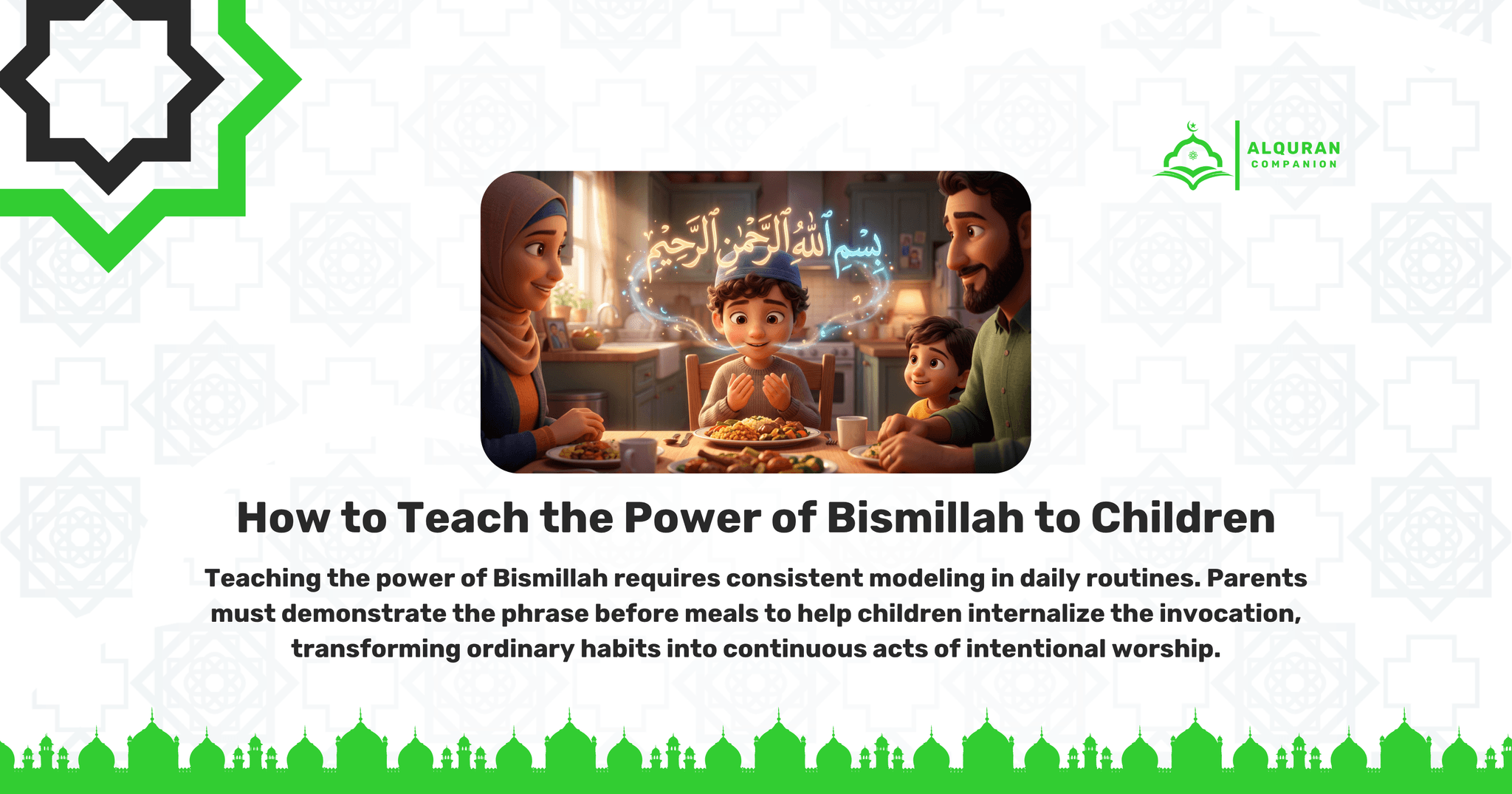
Teaching the power of Bismillah requires consistent modeling in daily routines. Parents and educators must demonstrate the phrase before meals, travel, and study sessions. Implementing structured frameworks helps both children and revert Muslims internalize the invocation, transforming ordinary habits into continuous acts of intentional worship.
For families living in Western societies, balancing secular education with Islamic identity presents a daily challenge. A child rushing to public school in Canada or attending weekend sports in Australia might easily forget their daily Duas. This is why teaching kids the meaning of Bismillah requires practical integration rather than theoretical lectures.
The Al Quran Companion Approach To Foundation Learning
At Al Quran Companion, we always conduct comprehensive Background Checks and detailed multi-stage reviews of every single teacher before they are certified to teach our students. This rigorous vetting process ensures that your child is learning the correct pronunciation and spiritual application of the Basmalah in a safe, nurturing environment.
For adult reverts or beginners feeling intimidated by Arabic, we provide qualified female Quran tutors for sisters, and highly patient male tutors for brothers. Our zero-risk free trial class allows you to experience a private, 1-on-1 diagnostic lesson without any upfront commitment. You learn at your own pace, free from the pressure of a crowded classroom.
Securing Barakah In Your Daily Routine
When you fully grasp the bismillah meaning, you realize it is the ultimate tool for spiritual productivity. By invoking the names of Allah, Ar-Rahman, and Ar-Raheem, you align your limited human capacity with limitless divine support. You transform a simple commute, a workday, or a family dinner into an act of profound faith.
Make the Basmalah the first word spoken before you open a book, turn the key in an ignition, or log into a computer. Master its pronunciation, understand its profound Arabic roots, and pass this magnificent legacy on to the next generation.
Frequently Asked Questions

Sheikh Abdullah Al-Hanif
Verified AuthorSheikh Abdullah Al-Hanif is the Head of Education at Al Quran Companion. With over 15 years of experience in Tajweed and Hifz, he specializes in bridging the gap between classical Islamic tradition and modern digital pedagogy. He is passionate about making the Quran accessible to everyone—from energetic toddlers to busy professionals.
Read more about author