
Finding accurate muslim prayer times birmingham sounds simple. Open an app, check the screen, pray. But walk into any two Birmingham mosques on the same day and you will see Fajr listed 15 minutes apart. One masjid begins Asr at 4:45 PM while another waits until 5:30 PM. For a parent rushing from Small Heath to a school pickup in Hall Green, or a professional leaving an Edgbaston office at 3 PM in December, these gaps decide whether Salah is prayed on time or missed entirely.
This guide removes the confusion. It explains exactly how Birmingham prayer times are calculated, why Green Lane Masjid and Birmingham Central Mosque sometimes differ, and how to build a daily rhythm that protects all five prayers around British work and school schedules.
What This Guide Covers
- How Muslim Prayer Times in Birmingham Are Calculated
- Birmingham Mosque Timetables: Central Mosque vs Green Lane
- The 5-Prayer Alignment Protocol for Birmingham Muslims
- 1. Fajr: The True Dawn Window
- 2. Dhuhr: The Solar Noon Decline
- 3. Asr: The Shadow-Length Marker
- 4. Maghrib: The Sunset Moment
- 5. Isha: The Twilight Disappearance
- How Birmingham Professionals Manage Salah at Work and School
- Winter vs Summer: The Two Birmingham Prayer Realities
- Anchoring Quran Recitation to Every Salah Window
- Frequently Asked Questions
Key Takeaways
- Birmingham mosques use the Muslim World League method: Fajr at 18 degrees solar depression, Isha at 17 degrees.
- The Hanafi Asr time begins when an object's shadow is twice its length; the Shafi'i and Maliki schools begin at one shadow length.
- During British summer (late May to mid-July), persistent twilight means Isha can start after 11 PM and Fajr before 3 AM.
- Birmingham's Muslim community exceeds 300,000 people, with over 200 masjids across the city.
- The last third of the night in Birmingham—the ideal window for Tahajjud—is calculated by dividing the time between Maghrib and Fajr into three equal parts.
How Muslim Prayer Times in Birmingham Are Calculated
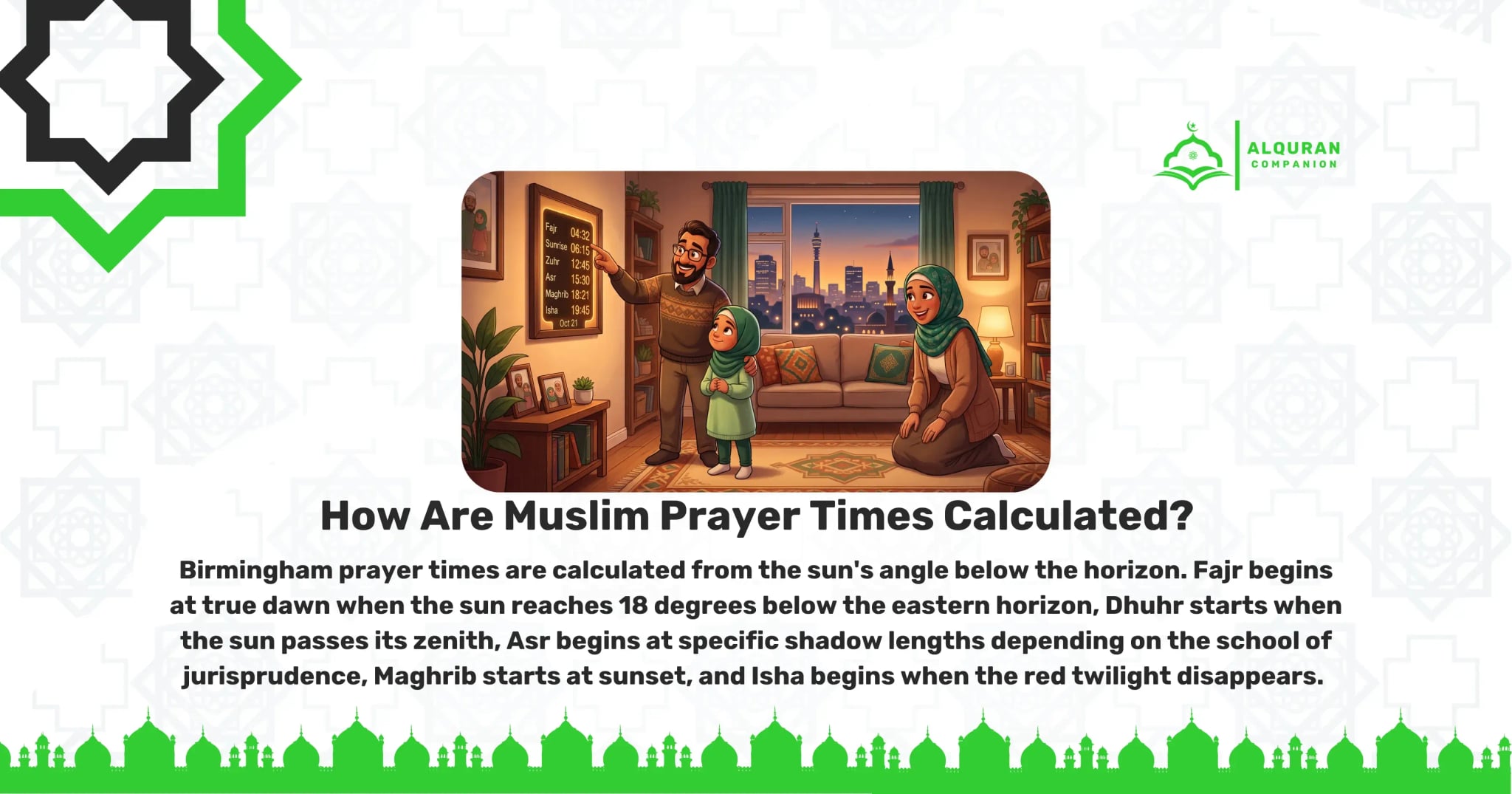
Birmingham prayer times are calculated from the sun's angle below the horizon at the city's latitude of 52.4 degrees north. Fajr begins at true dawn when the sun reaches 18 degrees below the eastern horizon. Dhuhr starts when the sun passes its zenith. Asr begins at specific shadow lengths depending on the school of jurisprudence. Maghrib starts at sunset. Isha begins when the red twilight disappears at 17 degrees below the western horizon.
Birmingham's northern latitude creates a challenge that does not exist in Makkah Mukarramah or Madinah Munawwarah. From late May to mid-July, the sun never drops far enough below the horizon for astronomical twilight to disappear completely. This phenomenon is called persistent twilight. The Muslim World League (MWL) method—used by most Birmingham mosques—applies the 18-degree rule for Fajr throughout the year and adjusts Isha during summer months using a calculated night division.
The Quran establishes this principle directly:
فَاِذَا قَضَيۡتُمُ الصَّلٰوةَ فَاذۡكُرُوا اللّٰهَ قِيَامًا وَّقُعُوۡدًا وَّعَلٰى جُنُوۡبِكُمۡ ۚؕ فَاِذَا اطۡمَاۡنَنۡتُمۡ فَاَقِيۡمُوا الصَّلٰوةَ ۚ اِنَّ الصَّلٰوةَ كَانَتۡ عَلَى الۡمُؤۡمِنِيۡنَ كِتٰبًا مَّوۡقُوۡتًا﴿١٠٣﴾
fa-idhā qaḍaytumu l-ṣalata fa-udh'kurū l-laha qiyāman waquʿūdan waʿalā junūbikum fa-idhā iṭ'manantum fa-aqīmū l-ṣalata inna l-ṣalata kānat ʿalā l-mu'minīna kitāban mawqūtan
And when you have completed the prayer, remember Allāh standing, sitting, or [lying] on your sides. But when you become secure, re-establish [regular] prayer. Indeed, prayer has been decreed upon the believers a decree of specified times.
This Ayah from Surah An-Nisa confirms that prayer carries fixed times. The Prophet Muhammad صلى الله عليه وسلم was taught the exact boundaries by the Angel Jibreel (AS). In Sahih Muslim, the Prophet صلى الله عليه وسلم said: 'The time of Fajr is from the rising of the true dawn until the rising of the sun.'
Birmingham Mosque Timetables: Central Mosque vs Green Lane
Birmingham Central Mosque, Green Lane Masjid (GLMCC), and Ghamkol Sharif all use the MWL 18-degree method for Fajr. The differences in their published timetables come from three sources: Isha twilight angle choices (17 vs 18 degrees), Asr school preference (Hanafi vs Shafi'i), and congregation Jamaat scheduling.
Birmingham Mosque Prayer Calculation Comparison
| Parameter | Birmingham Central Mosque | Green Lane Masjid (GLMCC) | Ghamkol Sharif |
|---|---|---|---|
| Fajr Angle | 18 degrees (MWL) | 18 degrees (MWL) | 18 degrees (MWL) |
| Isha Angle | 17 degrees | 18 degrees | 17 degrees |
| Asr School | Hanafi (majority) | Hanafi (majority) | Hanafi (majority) |
| Jamaat Delay | 30-45 min after start | 20-30 min after start | 30 min after start |
| Summer Isha | Adjusted via night division | Adjusted via night division | Adjusted via night division |
Fajr Angle
Isha Angle
Asr School
Jamaat Delay
Summer Isha
The most visible difference for daily planning is Asr. According to the Hanafi school, Asr begins when an object's shadow reaches twice its length plus the shadow at zenith. The Shafi'i, Maliki, and Hanbali schools begin Asr at one shadow length. In Birmingham during winter, this creates a gap of roughly 40 to 55 minutes between the two calculations.
The 5-Prayer Alignment Protocol for Birmingham Muslims
The 5-Prayer Alignment Protocol is a practical framework that anchors each daily Salah to its astronomical marker and stacks Quran recitation onto the prayer window. This approach builds consistency without relying on motivation alone.
1. Fajr: The True Dawn Window
Fajr begins at true dawn (al-fajr al-sadiq)—the horizontal whiteness spreading across the horizon. In Birmingham winter, Fajr starts around 6:00 AM. In summer, it can begin before 2:30 AM. The window closes at sunrise. The Protocol: recite 15 minutes of Quran immediately after Fajr prayer, before the day's demands begin.
2. Dhuhr: The Solar Noon Decline
Dhuhr begins when the sun passes its highest point and starts its descent. In Birmingham, this is roughly 12:15 PM in winter and 1:15 PM in summer (BST). For professionals, this window often falls during lunch breaks. The Protocol: use the Dhuhr window to read one page of Quran with translation.
3. Asr: The Shadow-Length Marker
Asr is the most debated prayer time in Birmingham because of the Hanafi-Shafi'i difference. For Hanafi followers, Asr begins when shadows double. For Shafi'i followers, it begins at one shadow length. In December, Hanafi Asr starts around 2:15 PM while Shafi'i Asr starts around 1:30 PM. The Protocol: pray Asr within its window and follow it with 10 minutes of Quran memorization review.
4. Maghrib: The Sunset Moment
Maghrib begins the moment the sun's disc fully disappears below the horizon. In Birmingham, winter Maghrib can be as early as 3:45 PM. Summer Maghrib stretches past 9:30 PM. The window is short—it closes when the red twilight disappears. The Protocol: pray Maghrib immediately after the Adhan and recite Surah Al-Mulk before Isha.
5. Isha: The Twilight Disappearance
Isha begins when the red afterglow (al-shafaq al-ahmar) leaves the sky. In Birmingham winter, Isha starts around 5:30 PM. In summer, it can start after 11:00 PM. The window extends to Islamic midnight. The Protocol: pray Isha before sleeping and recite Ayat al-Kursi as part of your bedtime routine.
How Birmingham Professionals Manage Salah at Work and School
Birmingham has one of the largest Muslim populations in the UK, with over 300,000 Muslims and more than 200 masjids across the city. Yet many workplaces in the Jewellery Quarter, Colmore Business District, and Brindleyplace still lack dedicated prayer facilities. The challenge is logistical, not spiritual.
Expert Insight
"Over thousands of student assessments across Birmingham, our faculty has observed that professionals who schedule their Quran recitation immediately after a fixed Salah—rather than at a separate time—are 3 times more likely to maintain a daily habit. The prayer becomes the anchor, not an interruption."
For UK professionals, the legal framework supports prayer rights. The Equality Act 2010 requires employers to make reasonable adjustments for religious practice. This includes allowing flexible breaks for Dhuhr and Asr, and providing a clean, private space for prayer. Birmingham City Council operates multi-faith prayer rooms in several civic buildings. NHS Trusts across the West Midlands provide prayer facilities in major hospitals.
Winter vs Summer: The Two Birmingham Prayer Realities
Birmingham prayer times swing dramatically across the year. In December, Fajr begins around 6:00 AM and Maghrib can be as early as 3:45 PM. The daylight window is compressed, making Dhuhr and Asr relatively close together. In June, Fajr begins before 2:30 AM and Isha can start after 11:00 PM. The night window is so short that some Birmingham mosques combine Maghrib and Isha prayers during the peak summer weeks to prevent undue hardship.
This seasonal shift directly affects Ramadan. When Ramadan falls in winter, fasting hours are shorter but Fajr and Isha are spaced comfortably for Taraweeh. When Ramadan falls in summer, the fast is long but the spiritual atmosphere of late-night Qiyam carries its own reward. Understanding the winter fast structure helps families plan Suhoor and Iftar more effectively.
Anchoring Quran Recitation to Every Salah Window
Salah without understanding the words recited is a body without a soul. Birmingham Muslims who pray five times daily already have five built-in Quran sessions—they just need structure. The Al Quran Companion 15-Minute Spaced-Repetition Cycle divides each prayer window into a recitation target.
In our live 1-on-1 classes at Al Quran Companion, we frequently observe students struggling with the same Makharij errors in Surah Al-Fatihah—particularly the throat letters in 'Alhamdulillah' and the emphatic 'dad' in 'walad-dallin.' These errors compound when a student rushes through Salah without feedback. Our certified tutors use personalized diagnostic assessments to isolate each student's specific articulation hurdles and correct them before they become permanent habits.
The most common Tajweed mistakes in prayer include mispronouncing the 'ha' in 'Alhamdulillah' from the wrong throat position, shortening the obligatory Madd in 'walad-dallin,' and omitting the Shadda on the 'lam' in 'Allah.' Fixing these requires guided repetition with a teacher who can hear and correct in real time. An online Quran recitation course provides exactly this feedback loop.
Frequently Asked Questions

Al Quran Companion Team
Verified AuthorThe official academic and editorial team at Al Quran Companion, a leading Online Quran Academy dedicated to simplifying Tajweed, Hifz, and Islamic studies for students worldwide.
Read more about author