Surah Quraish is the 106th chapter of the Quran. It is a short, four-verse Makkan Surah that holds a profound lesson about gratitude, divine protection, and the true source of security. For millions of Muslims balancing busy lives in the US, UK, Canada, Australia, and the UAE, this Surah offers a spiritual anchor. It reminds us that every provision and every moment of peace comes from Allah alone.
In this definitive guide, we will walk through the classical Tafsir of Surah Quraish, verse by verse. We will explore its deep connection to Surah Al-Fil, examine the Tajweed rules for perfect recitation, and uncover the practical lessons for modern Muslim families. Whether you are a parent seeking to teach your children or an adult reconnecting with the Quran, this guide is built for you.
What This Guide Covers
- Historical Revelation and Significance of Surah Quraish
- Verse 1: Li-Ilaafi Quraish (106:1) - The Familiar Unity
- Verse 2: Ilaafihim Rihlatash-Shitaaa'i Was-Saif (106:2) - The Winter and Summer Journeys
- Verses 3-4: The Call to Worship and the Twin Blessings of Food and Peace
- Start Your Recitation Diagnostic Assessment
- The Divine Security & Sustenance Framework: Lessons for Modern Diaspora Muslims
- Surah Quraish and Surah Al-Fil: A Unified Message of Divine Protection
- What Are the Tajweed Rules for Reciting Surah Quraish?
- How Does Surah Quraish Guide Our Daily Gratitude and Trust in Allah?
- The Benefits of Reciting Surah Quraish in Your Daily Life
- Frequently Asked Questions About Surah Quraish
- Start Your Journey with Surah Quraish Today
Key Takeaways
- Surah Quraish is a Makkan Surah that reminds the Quraish tribe of Allah's favors: safe trade journeys and security in Makkah.
- It is closely linked to Surah Al-Fil, as both describe Allah's protection of Makkah and the Ka'bah.
- The Surah establishes the principle that gratitude to Allah is the proper response to His blessings of food and safety.
- Correct Tajweed recitation involves mastering the Madd Badal in 'Eelafihim' and the Madd 'Aridh Lissukun at verse endings.
- Al Quran Companion offers 1-on-1 online classes with Ijazah-certified teachers to help you perfect your recitation and understanding.
Historical Revelation and Significance of Surah Quraish
Surah Quraish was revealed in Makkah, and it directly addresses the Quraish tribe. Allah reminds them of His favor in granting them safe passage during their winter and summer trade voyages. This Surah is a direct continuation of Surah Al-Fil, which recounts the destruction of the People of the Elephant. Together, these two Surahs form a powerful narrative of divine protection over the Ka'bah and its guardians.
بِسْمِ ٱللَّهِ ٱلرَّحْمَٰنِ ٱلرَّحِيمِ
According to the majority of classical scholars, including Ibn Kathir and Al-Qurtubi, Surah Quraish is Makki. The words 'Lord of this House' (Rabba hadh-al-Bait) in verse 3 are clear evidence of its Makkan origin. Imam Al-Qurtubi notes that some early scholars, such as Dahhak and Kalbi, considered it Madani. However, the overwhelming consensus supports its Makkan revelation.
The historical context is vital. The Quraish were the custodians of the Ka'bah. Because of this sacred duty, they enjoyed a unique status among the Arab tribes. When they traveled for trade, people respected them and did not harm them. This respect was a direct result of Allah's protection of the Ka'bah, as described in Surah Al-Fil. The Quraish were scattered throughout Hijaz until Qusayy bin Kilab gathered them in Makkah and established their authority over the Ka'bah.
Verse 1: Li-Ilaafi Quraish (106:1) - The Familiar Unity
لِاِيۡلٰفِ قُرَيۡشٍۙ﴿١﴾
liīlāfi qurayshin
For the accustomed security of the Quraysh -
The first verse opens with 'Li-ilaafi', which means 'for the accustomed security' or 'for the familiarity'. The Arabic root Alif-Lam-Fa (أ-ل-ف) carries the meaning of uniting, bringing together, and forming a harmonious bond. Imam Ibn Kathir explains that this 'Ilaf' refers to how Allah gathered the Quraish and made them a unified community in Makkah.
Ibn Jarir al-Tabari says the letter 'Lam' here is a prefix of amazement. Allah is saying, in effect: 'Be amazed at the taming of the Quraish and My blessings upon them.' This unity was not accidental. It was a direct result of divine protection. As you learn to recite this verse, pay close attention to the 'Madd Badal' in 'Li-ilaafi'. The teacher at Al Quran Companion can guide you through the precise Makharij for this word.
Verse 2: Ilaafihim Rihlatash-Shitaaa'i Was-Saif (106:2) - The Winter and Summer Journeys
اٖلٰفِهِمۡ رِحۡلَةَ الشِّتَآءِ وَالصَّيۡفِۚ﴿٢﴾
īlāfihim riḥ'lata l-shitāi wal-ṣayfi
Their accustomed security [in] the caravan of winter and summer -
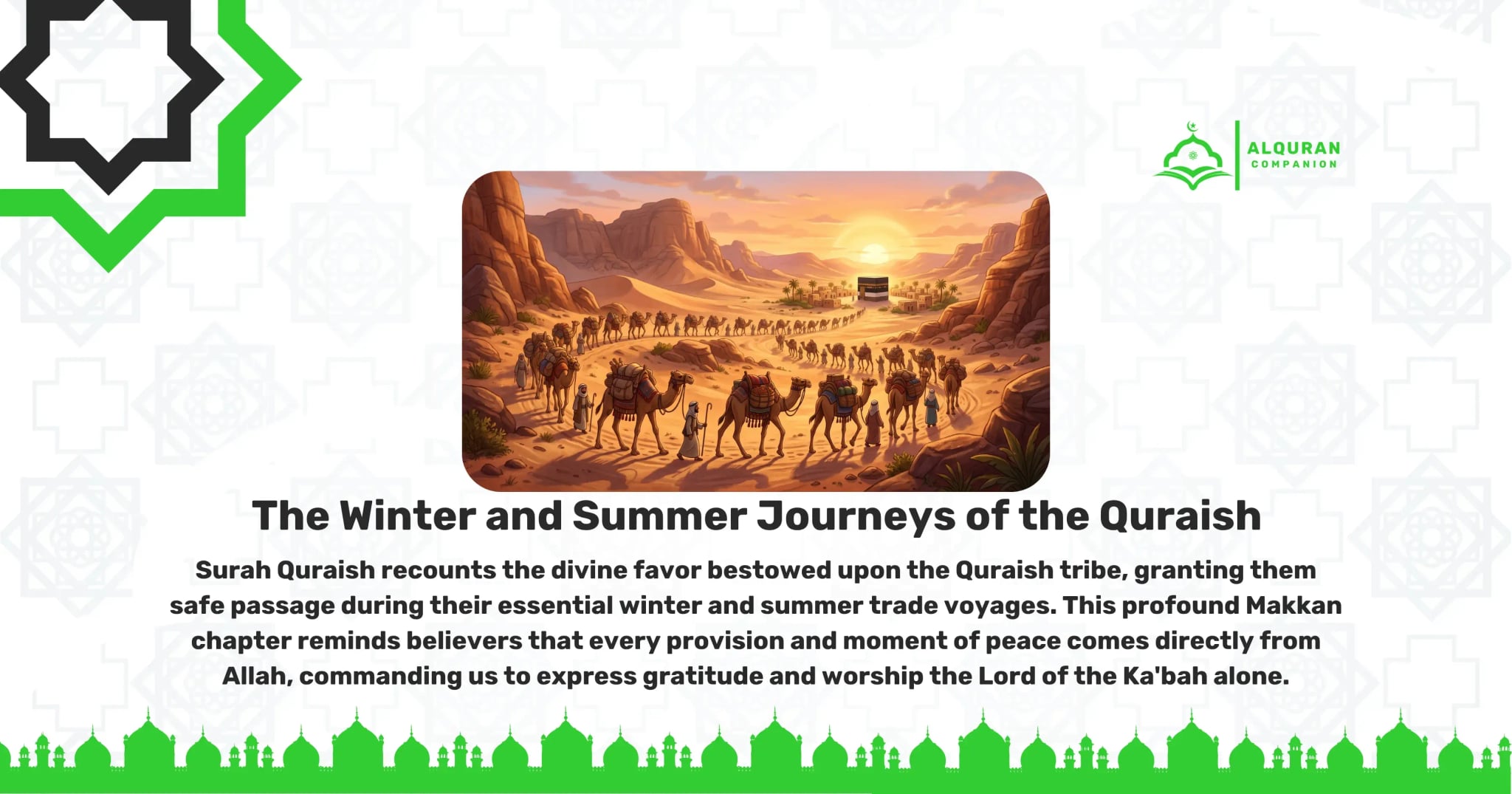
Verse 2 specifies the 'Ilaf': 'Their accustomed security in the caravan of winter and summer.' The Quraish conducted two major trade journeys each year. In winter, they traveled south to Yemen, where the climate was warmer. In summer, they traveled north to Syria (Ash-Sham), where the weather was cooler. These journeys were the economic lifeline of Makkah.
According to classical Mufassirun, the Quraish traveled with complete safety. No tribe dared to attack them because they were the guardians of the Ka'bah. This respect was a form of divine protection. For modern Muslims in London, Toronto, or Sydney, this verse teaches Tawakkul. Our provision is ultimately secured by Allah, not just by our jobs or businesses. Reciting this verse correctly requires attention to the elongated Madd in 'Rihlatash-Shitaaa'i' and the Madd 'Aridh Lissukun at the end of 'Was-Saif'. For a deeper dive, explore our guide on essential Tajweed rules.
Verses 3-4: The Call to Worship and the Twin Blessings of Food and Peace
فَلۡيَـعۡبُدُوۡا رَبَّ هٰذَا الۡبَيۡتِۙ﴿٣﴾
falyaʿbudū rabba hādhā l-bayti
Let them worship the Lord of this House,
الَّذِىۡۤ اَطۡعَمَهُمۡ مِّنۡ جُوۡعٍ ۙ وَّاٰمَنَهُمۡ مِّنۡ خَوۡفٍ﴿٤﴾
alladhī aṭʿamahum min jūʿin waāmanahum min khawfin
Who has fed them, [saving them] from hunger and made them safe, [saving them] from fear.
Verses 3 and 4 present the logical conclusion. Since Allah has granted these blessings, the Quraish are commanded: 'Let them worship the Lord of this House.' The command is specific. They should worship the One who owns the Ka'bah, not the idols they had placed around it. This is a direct call to Tawheed, the oneness of Allah.
Verse 4 describes the two blessings: 'Who has fed them against hunger and made them safe from fear.' Imam Al-Qurtubi explains that these two favors—food and security—are the foundation of all worldly well-being. Without them, no society can function. Allah reminds the Quraish that He is the ultimate source of both. This principle is timeless. When we face financial anxiety or worry about our safety, this verse directs us to the One who provides.
Start Your Recitation Diagnostic Assessment
Reciting short Surahs like Surah Quraish with perfect Tajweed transforms your Salah. It deepens your connection with every word. Our Ijazah-certified teachers provide personalized feedback on your Makharij and Madd rules.
The Divine Security & Sustenance Framework: Lessons for Modern Diaspora Muslims
Surah Quraish establishes a timeless framework. It shows us that security and sustenance are not merely economic or political outcomes. They are divine blessings. This framework has three pillars: acknowledging the blessing, expressing gratitude (Shukr), and directing worship to Allah alone.
Expert Insight
"In our work with families across the UK, USA, and Australia, we see a common struggle. Parents worry about providing for their children while keeping them safe. Surah Quraish offers a direct answer. When you recite this Surah with your family and reflect on its meaning, it builds a mindset of Tawakkul. It shifts the focus from anxiety to trust in Allah. This is not just theory. It is a daily practice that brings peace."
The principle of Shukr is central. Allah says in Surah Ibrahim (14:7): 'If you are grateful, I will surely increase you [in favor].' For a family in Toronto facing harsh winter commutes, or a professional in Dubai navigating a demanding career, gratitude realigns the heart. It protects against the anxiety of 'not having enough.' This Surah teaches that the same Allah who protected the Quraish on their dangerous trade routes is the One who protects your Rizq today. For more on this topic, see our article on The principle of Shukr is central. Allah says in Surah Ibrahim (14:7): 'If you are grateful, I will surely increase you [in favor].' For a family in Toronto facing harsh winter commutes, or a professional in Dubai navigating a demanding career, gratitude realigns the heart. It protects against the anxiety of 'not having enough.' This Surah teaches that the same Allah who protected the Quraish on their dangerous trade routes is the One who protects your Rizq today. For more on this topic, see our article on Surah Waqiah for rizq and barakah.
Surah Quraish and Surah Al-Fil: A Unified Message of Divine Protection
Surah Quraish and Surah Al-Fil are deeply connected. The majority of classical scholars view them as two parts of one divine message. Surah Al-Fil describes how Allah destroyed Abraha and his army of elephants when they tried to attack the Ka'bah. Surah Quraish describes the blessing that resulted from that protection: the Quraish's ability to travel safely and trade freely.
Imam Al-Qurtubi records that Ubayy ibn Ka'b, a senior Companion of the Prophet ﷺ, wrote these two Surahs as one in his personal Mushaf, without the Bismillah separating them. Umar ibn Al-Khattab once recited them together in prayer. This shows their tight thematic unity. Some scholars even called them 'Al-Qarinatain' (the two joined Surahs). When you recite Surah Quraish in your Salah, you are linking directly to the story of the Elephant and the protection of Makkah Mukarramah.
That while he was with a delegation from Quraish to Muawiya, the latter heard the news that `Abdullah bin `Amr bin Al-`As said that there would be a king from the tribe of Qahtan. On that Muawiya became angry, got up and then praised Allah as He deserved, and said, "Now then, I have heard that some men amongst you narrate things which are neither in the Holy Book, nor have been told by Allah's Messenger (ﷺ). Those men are the ignorant amongst you. Beware of such hopes as make the people go astray, for I heard Allah's Messenger (ﷺ) saying, 'Authority of ruling will remain with Quraish, and whoever bears hostility to them, Allah will destroy him as long as they abide by the laws of the religion
This Hadith from Sahih Bukhari, narrated by Mu'awiyah, confirms the elevated status of the Quraish. The Prophet ﷺ said: 'This matter (of leadership) is in Quraish. No one opposes them except that Allah will throw him on his face, as long as they establish the religion.' This status was tied to their role as guardians of the Ka'bah, the very role that Surah Quraish honors.
What Are the Tajweed Rules for Reciting Surah Quraish?
Surah Quraish contains several key Tajweed rules that every reciter should master. These rules ensure that the Surah is recited with the beauty and precision it deserves. In our live 1-on-1 classes, we frequently observe students struggling with the elongated Madd in 'Eelafihim' and the Madd 'Aridh Lissukun at the verse endings. Correcting these details elevates your recitation from acceptable to excellent.
- Madd Badal in 'Li-ilaafi' and 'Eelafihim': The word 'Eelafihim' begins with a Hamza followed by a Yaa with a Sukun. This creates a Madd Badal, which is elongated for two counts. Mispronouncing this can change the meaning.
- Madd 'Aridh Lissukun at Verse Endings: Every verse ends with a short vowel, such as 'Quraish' or 'Was-Saif'. When you stop at these words, the short vowel is replaced by a Sukun, creating a Madd 'Aridh Lissukun. This is stretched for two to six counts.
- Makhraj of Sheen in 'Quraish': The letter Sheen (ش) is pronounced from the middle of the tongue against the roof of the mouth. It requires a clear, focused sound without excessive hissing.
- Idgham of Fa in 'Fa-l-Ya'budu': In verse 3, the Fa (ف) is followed by a Lam (ل). Reciters must ensure a clear transition without merging the letters incorrectly.
Mastering these rules requires personalized feedback. At Al Quran Companion, our certified instructors use the '3-Step Pronunciation Feedback Loop'. This structured method isolates each rule, allows the student to practice, and then integrates it into full-verse recitation. This approach is far more effective than passive listening. If you want to understand the deeper meanings behind these words, our online Quranic Tafsir course provides a comprehensive study.
How Does Surah Quraish Guide Our Daily Gratitude and Trust in Allah?
Surah Quraish provides a practical framework for gratitude and trust. The command 'Let them worship the Lord of this House' is not just a historical instruction. It is a daily practice. For a Muslim in Germany or Ireland, where finding authentic Quran educators can be challenging, this Surah reminds you that the ultimate teacher is Allah. He provides the means, and He provides the protection.
The 'Divine Security & Sustenance Framework' applied here involves a simple daily routine. Start your morning by acknowledging one blessing of food and one blessing of safety. This shifts your mindset. For a parent in Canada dealing with a harsh winter commute, this could be a safe arrival at work. For a professional in Dubai, it could be a nourishing meal. These small acts of Shukr build a fortress against anxiety. For major life decisions, the Dua Istikhara decision guide complements this practice of seeking Allah's guidance.
Online 1-on-1 Quran Classes vs. Self-Study for Short Surahs
Pros
- Live personalized feedback on Makharij and Madd rules
- Structured curriculum with progress tracking
- Certified Ijazah-holding teachers ensure correct recitation
- Flexible scheduling for US, UK, UAE, and Australia time zones
Cons
- Requires scheduled class time
- Higher investment than free apps
The Benefits of Reciting Surah Quraish in Your Daily Life
Classical scholars mention several benefits associated with reciting Surah Quraish. It is said to bring protection from fear and anxiety. Some narrations encourage reciting it before eating to seek protection from harm in the food. While these benefits are spiritual, the core benefit is the reminder of Tawheed. When you recite this Surah consistently, it reinforces the idea that Allah alone is the Provider and the Protector.
In our work at Al Quran Companion, we see how learning the Tafsir of a Surah transforms a student's relationship with it. It is no longer just words. It becomes a living message. For children in the UK preparing for GCSEs or students in Australia balancing sports and school, understanding the meaning of Surah Quraish can bring a sense of peace and purpose to their busy schedules. To explore other short Surahs, see our guide on 4 Qul: Meaning and Benefits.
Frequently Asked Questions About Surah Quraish
Start Your Journey with Surah Quraish Today
Surah Quraish is more than a history lesson. It is a living framework for security and gratitude. When you understand its Tafsir and recite it with proper Tajweed, it transforms your daily Salah. It reminds you that the same Allah who protected the Quraish in their winter and summer journeys is protecting you today.
At Al Quran Companion, we are committed to helping you connect with the Quran. Our Ijazah-certified teachers provide personalized instruction for children and adults. We offer a Zero-Risk Free Trial Class with no payment upfront. Experience a live 1-on-1 diagnostic lesson and see the difference for yourself.

Sheikh Abdullah Al-Hanif
Verified AuthorSheikh Abdullah Al-Hanif is the Head of Education at Al Quran Companion. With over 15 years of experience in Tajweed and Hifz, he specializes in bridging the gap between classical Islamic tradition and modern digital pedagogy. He is passionate about making the Quran accessible to everyone—from energetic toddlers to busy professionals.
Read more about author